
Thea von Harbou
Thea Gabriele von Harbou (27 December 1888 – 1 July 1954) was a German screenwriter, novelist, film director, and actress. She is remembered as the screenwriter of the science fiction film classic Metropolis (1927) and for the 1925 novel on which it was based. Von Harbou collaborated as a screenwriter with film director Fritz Lang, her husband, during the period of transition from silent to sound films.
Thea von Harbou

Becker Maass / Marie Boehm · Public domain
- Name
- Thea von Harbou
- Birth Name
- Thea Gabriele von Harbou
- Born
- 27 December 1888
- Birthplace
- Tauperlitz, Bavaria, German Empire
- Died
- 1 July 1954
- Place of death
- West Berlin, West Germany
- Occupation
- * Filmmaker
- Nationality
- Kingdom of Bavaria · Weimar Republic · Nazi Germany · West Germany
- Fields
- science fiction
VALÉORINE Encyclopedia
VALÉORINE documentary reading
Documentary summary
Thea Gabriele von Harbou (27 December 1888 – 1 July 1954) was a German screenwriter, novelist, film director, and actress. She is remembered as the screenwriter of the science fiction film classic Metropolis (1927) and for the 1925 novel on which it was based. Von Harbou collaborated as a screenwriter with film director Fritz Lang, her husband, during the period of transition from silent to sound films.
Admitted source layer · organised and presented by VALÉORINE
Note VALÉORINE
No house-authored Note is published until its assertions and sources pass the VALÉORINE evidence contract. The documentary article remains available in full while that enrichment is being consolidated.
Documentary enrichment in progress · no unsupported statement published
Reference Check
Propose documentary evidence for Thea von Harbou. A contribution is never written directly as fact: identity, source, rights and evidence gates still decide.
Sign in to contribute
Documentary evidence
Evidence Panel
not yet certified
- Identity
- resolved
- Independent source families
- 0
- Admitted assertions
- 0
- Open conflicts
- 0
Authority files
wikidata · Q58866 · wikipedia · Thea von Harbou
In this article
Biography
Biography
Harbou worked between 1888 and 1954 across film director, screenwriter, writer, science fiction writer and film actor and 3 further recorded occupations. The registers place that work in science fiction. Every statement below returns to a source shown in the evidence panel; where the record is silent or divided, the article says so instead of resolving it.
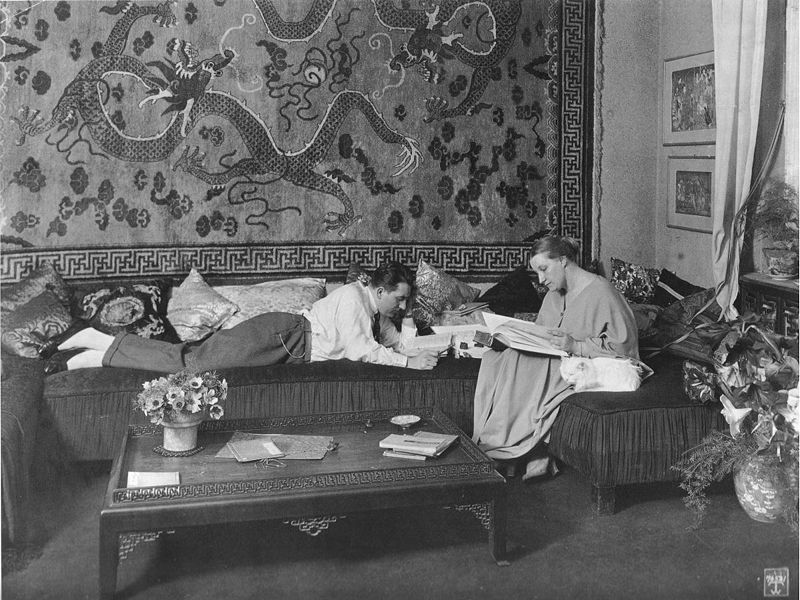
Fritz Lang und Thea von Harbou, 1923 od., 1924
Waldemar Franz Hermann Titzenthaler · scan from: Enno Kaufhold: Berliner Interieurs. Photographien von Waldemar Titzenthaler, Berlin: Nicolai 1999, S. 9. (Die Dame, 11/1924, Ullstein-Bild, Bildnummer: 00022210).
Key facts
Key facts
• Name — Thea von Harbou • Birth Name — Thea Gabriele von Harbou • Born — 27 December 1888 • Birthplace — Tauperlitz, Bavaria, German Empire • Died — 1 July 1954 • Place of death — West Berlin, West Germany • Occupation — * Filmmaker • actress • author • Years Active — 1905–1954 • Partner — Ayi Tendulkar (c. 1933–c. 1939)
Early life, family, and education
Early life, family, and education
Thea von Harbou was born in Tauperlitz (now part of Döhlau), Bavaria, in 1888, into a family of minor nobility and government officials, which gave her a level of sophisticated comfort. As a child, she was educated in a convent by private tutors who taught her several languages as well as piano and violin. She was a child prodigy. Her first works, a short story published in a magazine and a volume of poems published privately, focused on perceptions of art, subjects considered unusual for a girl of thirteen. Despite her privileged childhood, von Harbou wanted to earn a living on her own, which led her to become an actress despite her father's disapproval.
Partnership with Lang
Partnership with Lang
Thea von Harbou's first collaboration with Fritz Lang was marked by a common interest in India. As von Harbou worked on an adaptation of her novel The Indian Tomb (Das indische Grabmal, 1918), Joe May assigned Lang to help her write the screenplay and work out production details. Praising Harbou's skills, Erich Kettelhut recalled: "She was not only well-liked by her colleagues, but also as much a creative force, as highly motivated and smoothly efficient, as her husband. Her loving personality was crucial to the professional teamwork. von Harbou's ability to reach out to people and find compromise in the worst situations was a vital resource." • Illustration — Fritz Lang and Thea von Harbou in their Berlin flat, 1923 or 1924 Von Harbou and Lang began an affair during this time; she divorced Klein-Rogge in 1920. Following the success of Dr. Mabuse der Spieler (Dr. Mabuse the Gambler) and the death of Lang's first wife, the couple married in 1922. They worked on a script that would reflect their pride in their German heritage, Die Nibelungen (1924), and enhance von Harbou's reputation as a writer for the screen. She became known for her unique habit of wearing the same dress throughout filming, even as she cooked hot meals for the crew during late nights. Visitors remembered Harbou taking charge of all the domestic and social responsibilities when visiting the couple's apartment. During this time of poverty in 1920s Germany, Harbou became active in acquiring food for her film crew, as one friend recalled, "She was even able to talk the UFA into carrying the costs so the crew could get their meals for free... she stood there on the rough floor of that drafty shed for hours and didn't mind peeling potatoes or cleaning vegetables with the other women. Such was the spirit of sacrifice." Von Harbou often developed her screenplays into full-length novels, with their publication scheduled to coincide with the release of the film, though this was not the case with Metropolis (1927). von Harbou was a central player in producing Metropolis, and this epic became significant. Besides writing the novel and the screenplay, and developing the distinct moral ending of Metropolis, she discovered Gustav Fröhlich, who played the lead role of Freder Fredersen. Her next major collaboration with Lang was M (1931), a film about a child murderer. It was written with exquisite attention to accuracy. Lang and von Harbou had been enthralled with news coverage of Peter Kürten, known as the Monster of Düsseldorf, during the late 1920s. She used newspaper articles in developing the script and "maintained regular contact with the police headquarters on Alexanderplatz and was permitted access to the communications and secret publications of Berlin's force". Recalling the script, von Harbou's secretary Hilde Guttmann later said, "I saw many other film manuscripts, but never one which could compare with the manuscript for M. Two typewriter ribbons were stuck together to give us three colors: one black and red, and the other blue. The camera work and the action were typed in black, the dialogue blue, and the sound, where synchronized, was typed in red". Harbou received no credit as the script writer for M. She was also involved in politics, joining the campaign against Germany's paragraph 218, which made abortion a crime. At a mass rally in 1931, she said:
Divorce
Divorce
Shortly after von Harbou married Lang, he developed the habit of openly pursuing younger women, but they nevertheless presented themselves as a happy couple with a contented home that would have seemed like a small museum of exotic art for the common citizen. Then, during the production of Das Testament des Dr. Mabuse, Lang discovered von Harbou in bed with Ayi Tendulkar, an Indian journalist and student 17 years younger than her. After Lang and von Harbou's divorce became final on 20 April 1933, the couple slowly lost contact with each other. Shortly after the divorce, von Harbou and Ayi Tendulkar contracted a secret marriage, because the Nazi state did not permit someone of her public stature to marry a dark-skinned Indian.
Under Nazi rule
Under Nazi rule
After Adolf Hitler's Nazi Party took power in 1933, the German film industry began to be used for propaganda purposes. Von Harbou was loyal to the new regime, and joined the Party. Around 1934 on her own initiative she wrote and directed two films, Elisabeth und der Narr and Hanneles Himmelfahrt, but did not find the experience of directing satisfactory, and remained a prolific screenwriter during this time. "Under a regime where every film was a 'state film,' Thea von Harbou amassed writing credits on some twenty-six films, while giving uncredited assistance on countless others-including a handful with an indisputable National Socialist worldview". When war broke out in 1939, Tendulkar was forced to leave Germany, and their marriage ended. With von Harbou's blessing, he courted and later married an Indian woman, who visited von Harbou in 1953.
After World War II
After World War II
• Illustration — A monument in her hometown of Tauperlitz After the defeat of Nazi Germany Thea von Harbou was held from July to October 1945 in a British-run internment camp in Staumühle. Though many have asserted she had significant Nazi sympathies, von Harbou claimed she only joined the Nazi Party to continue her husband's help to Indian immigrants to Germany. Lang's biographer, Patrick McGilligan, wrote: "Her direct work on behalf of the government consisted, she claimed, entirely of volunteer welding, making hearing aids, and emergency medical care. In fact, she received a medal of merit for saving people in two air raids." In prison, she directed a performance of Faust and when released she worked as a Trümmerfrau (rubble woman) in 1945 and 1946.
Death
Death
Toward the end of von Harbou's life, pain from high blood pressure, migraines, and neuralgia weakened her, although she continued to write or dictate from her bed. After attending a showing of Der müde Tod (Destiny, 1921) as a guest of honor in June 1954, she fell and suffered serious internal injuries in her hip. On 1 July 1954, five days later, she died in hospital at the age of sixty-five. Several years after her death, Lang directed the film The Indian Tomb (1959), based upon one of von Harbou's novels.
Filmography
Filmography
Some of Harbou's most prominent films: • The Passion of Inge Krafft, directed by Robert Dinesen (1921, based on an idea by Thea von Harbou) • Das Haus des Dr. Gaudeamus, directed by Friedrich Feher (1921, based on the novel Das Haus ohne Tür und Fenster) • The Indian Tomb, directed by Joe May (1921, based on the novel The Indian Tomb) • The Stone Rider, directed by Fritz Wendhausen (1923, based on an idea by Thea von Harbou) • Metropolis, directed by Fritz Lang (1927, based on the novel Metropolis) • Spione, directed by Fritz Lang (1928, based on the novel Spione) • Woman in the Moon, directed by Fritz Lang (1929, based on the novel The Rocket to the Moon)
Identity
Identity
Thea von Harbou is recorded as Kingdom of Bavaria, Weimar Republic, Nazi Germany and West Germany. Established in Library of Congress under n50020574. Established in Discogs under 5436190. Established in FAST under 6700.
Life and career
Dated record
Life and career
Explore 1888–1954
The full dated record · 4 entries
1888
Thea von Harbou was born on 27 December 1888.
1945
1945 Erzieherin Gesucht ( Ernst Von Klipstein, Fritz Wagner, Olly Holzmann) Thea Von Harbou (1945) is digitised and catalogued by Internet Archive.
1954
Dies at West Berlin.
1954
Thea von Harbou died at West Berlin.
From novelist to screenwriter
After her debut in 1906, von Harbou met actor Rudolf Klein-Rogge and married him during World War I. By 1917, she and Klein-Rogge had moved to Berlin where von Harbou devoted herself to building her career as a writer. She was drawn to writing epic myths and legends with an overtly nationalistic tone. In one historian's estimation: "Her novels became patriotic and morale-boosting, urging women to sacrifice and duty while promoting the eternal glory of the fatherland". Her first close interaction with cinema came when German director Joe May decided to adapt a piece of her fiction, Die heilige Simplizia. From that moment forward, "Her fiction output slowed down. In short order she would become one of Germany's most celebrated film writers, not only because of her partnership with Fritz Lang, but also for writing scripts for F. W. Murnau, Carl Dreyer, E. A. Dupont, and other German luminaries". Her brother, Horst von Harbou, worked for Universum Film as a photographer and began to work closely with Thea and Fritz Lang on many of their most famous productions.
Primary material
Documents and archives
reference work
- “Thea von Harbou”, English Wikipedia, consulted as further reading
Reputable secondary · Wikipedia
institutional register
- Wikidata, structured authority record Q58866: Thea von Harbou
Unverified · Wikimedia Foundation
Citations
References
Each reference names the institution holding it, so a reader may go to the document itself.
reference work
Partially resolvedinstitutional register
Wikidata, structured authority record Q58866: Thea von HarbouWikimedia Foundation
Unverified
The Encyclopedia exists whether or not anything is for sale. Corrections are recorded rather than overwritten, and every version of this record is kept. Published 14 August 2026.
Elsewhere in Film memorabilia
37,604 published records in this field, each with its sources named.
- Thea ČervenkováPerson
- Thea GillPerson
- Thea HvistendahlPerson
- Thea SharrockPerson
- Thecla ÅhlanderPerson
- Theda BaraPerson
- Theda HammelPerson
- Theeradej WongpuapanPerson
Best supported in this field
For owners
Own a work by Thea von Harbou?
A specialist will read what you send and tell you what the house can establish, what it cannot, and whether the object is suited to sale. There is no charge and no obligation. The object stays with you throughout; nothing is shipped to us unless it is arranged in writing beforehand.