
Tharros
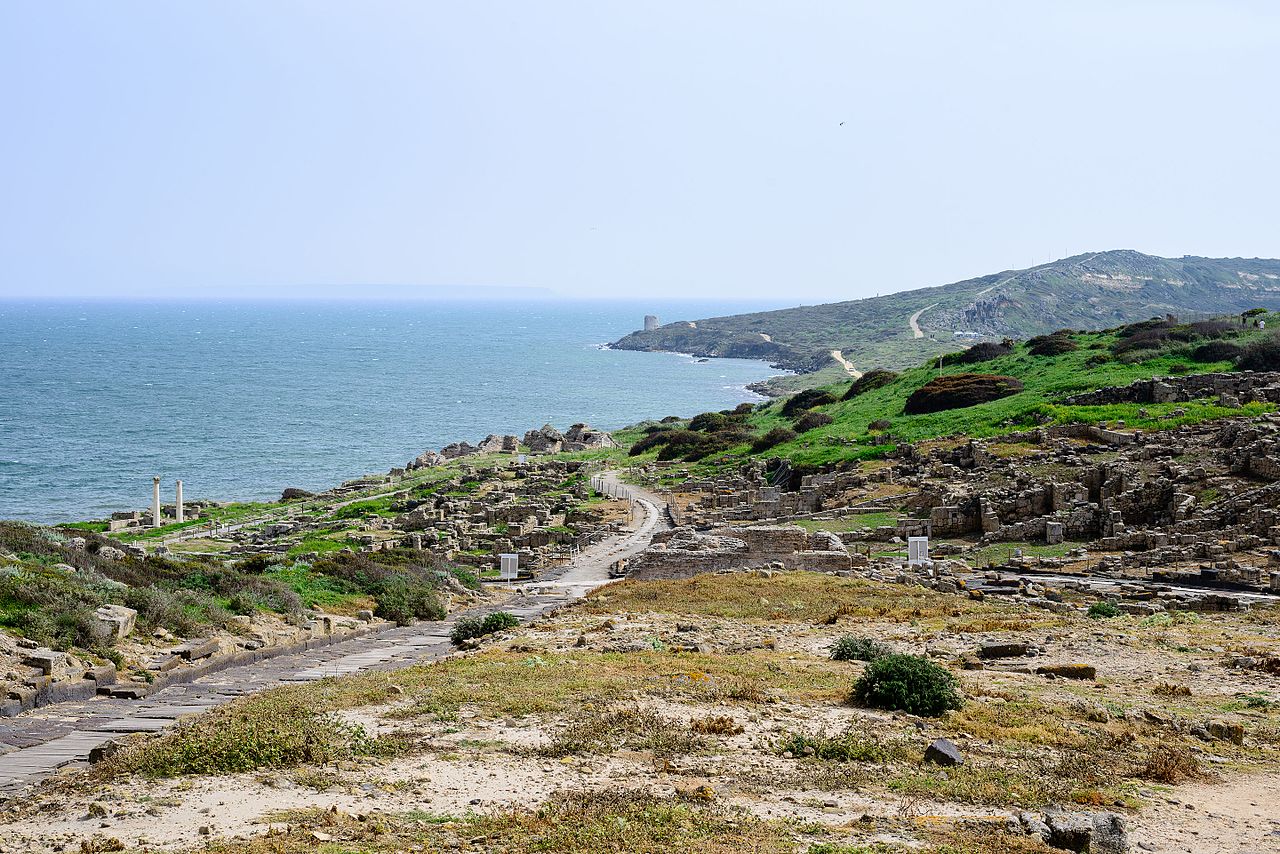
Norbert Nagel · CC BY-SA 3.0
- Name
- Tharros
Reference Check
Propose documentary evidence for Tharros. A contribution is never written directly as fact: identity, source, rights and evidence gates still decide.
Sign in to contribute
Documentary evidence
Documentary basis
Authority files
gnd · 4441371-3 · wikidata · Q736689 · wikipedia · Tharros
In this article
Key facts
Key facts
• Name — Tharros • Type — Settlement • Built — Eighth century BCE • Cultures — Nuragic civilization, Punic civilization, Roman civilization • Condition — Ruined • Management — I Beni Culturali della Sardegna • Public Access — Yes • Website — official website
Foundation
Foundation
• Illustration — The Nuragic village Until some years ago, the archaeological findings in the area of Tharros supported the theory that Phoenicians founded the town in eighth century BC. The probability of this was reduced by the finding of some parts of the old settlement in the Mistras Lagoon. A submerged 100 m wall seems to be part of a port structure much older than the Phoenician one, since in 1200 BC sea level rose, swallowing the existing buildings. A previous nuragic settlement apparently existed there in the Bronze Age, as the nuragic presence near the tophet area seems to suggest.
Thopeth
Thopeth
Archaeologists found a tophet, an open-air sacred place common for several installations of Phoenicians in the western Mediterranean, on top of a hill called Su Muru Mannu near the remains of a village built by the Nuragic peoples (1900-730 BC). This is seen as a first sign of colonization and urbanization.
Later history
Later history
• Illustration — Attic amphora depicting Heracles and Antaeus Excavations showed that from the 8th century BC until its abandonment in the 10th century Tharros was inhabited, first by Phoenicians, then by Punics and then by Romans. The town was the capital of the medieval Giudicato of Arborea, a Roman/Byzantine relict state from the 9th century until 1070 when Orzocorre I of Arborea relocated to Oristano under pressure of Saracen raiders. The town was effectively abandoned at this time or shortly thereafter. The site was then used for centuries as a quarry. An inscription records the repair of the road from Tharras to Cornus as late as the reign of Roman emperor Philip. The Antonine Itinerary correctly places it 18 miles from Cornus and 12 from Othoca (modern Santa Giusta near Oristano). However, its history during most of the period of Roman domination or early Christianity is unknown.
Residential diocese
Residential diocese
The Diocese of Tharros was established around the year 400, its only presumably historically recorded bishop being Johannes circa 500. It was renamed as the Diocese of Sinis-Tharros in 700. In 800 it gained territory from the suppressed Diocese of Cornus. From 1000 it was promoted the Metropolitan Archdiocese of Sinis-Tharros, apparently to match the prestige of the Giudice (feudal temporal governor) of Arborea, which had taken residence there, with two suffragan sees: Diocese of Santa Giusta and Diocese of Terralba and Uselli. In 1070 it lost territory to establish the Diocese of Bosa. It was formally suppressed in 1093, its territory being reassigned to establish of the Metropolitan Archdiocese of Oristano, where its seat had been established in 1070 following the depopulation of the city thereto.
Titular see
Titular see
In 1755 the diocese was nominally restored as Latin titular bishopric, bearing the name of Sinita until it was renamed Sinis in 1793. Its incumbents were/are of the fitting Episcopal (lowest) rank, with an Archiepiscopal exception (title Tharros).
Site
Site
• Illustration — Phoenician gold diadem from Tharros in the British Museum • Illustration — Gold amulet cases from Tharros in the BM The area is now an open-air museum with active excavation sites. Among the interesting structures are the tophet, the bath installations, the temple foundations and an area with houses and artisan workshops. Most of the artifacts can be found in the Archaeological Museum at Cagliari, in the Antiquarium Arborense, the Archaeological Museum of the town of Cabras and in the British Museum, London.
Paleogenetics
Paleogenetics
A 2021 Ancient DNA study by Stefania Sarno et al., found that among 14 individuals, buried in the Punic Age southern necropolis of Tharros, there were people coming from North Africa and the Iberian Peninsula. The modern inhabitants of Cabras and Belvì mainly cluster, instead, with the indigenous Pre-Phoenician inhabitants of the Island and with the other modern populations of Sardinia.
Primary material
Documents and archives
reference work
- “Tharros”, English Wikipedia, consulted as further reading
Reputable secondary · Wikipedia
- Wikidata, structured authority record Q736689: Tharros
Reputable secondary · Wikidata
authority file
- Gemeinsame Normdatei 4441371-3, Tharros.
General reference · Deutsche Nationalbibliothek
In literature
In literature
• Illustration — Finnish writer Göran Schildt at Tharros in 1949 Finnish writer Göran Schildt visited and photographed Tharros on his travels in the Mediterranean Sea with his boat Daphne (ship, 1935).
Sources and bibliography
Sources and bibliography
* * • GCatholic - former and titular bishopric
Notes from the source article
Cited by Wikipedia
Notes from the source article
These works are cited by the source article, in its own numbering. They are recorded as its citations, not as sources VALÉORINE has verified.
- 1.Antonioli, Fabrizio; Orrù, Paolo; Porqueddu, Alessandro and Solinas, Emanuela, "Variazioni del livello marino in Sardegna durante gli ultimi millenni sulla base di indicatori geo-archeologici costieri." In L'Africa romana: trasformazione dei paesaggi del potere nell'Africa settentrionale fino alla fine del mondo antico: atti del 19. Convegno di studio, 16-19 dicembre 2010, Sassari, Italia. p. 2963-2971. Carocci editore, Rome: 2012.
- 2.Zucca, Raimondo "Bronzi nuragici da Tharros" In La Sardegna nel Mediterraneo tra il secondo e il primomillennio a.C.: atti del II Convegno di Studi "Un millennio di relazioni fra la Sardegna ei Paesi del Mediterraneo", 27-30 novembre 1986, Selargius-Cagliari, Italia. p. 117-132. Cagliari: 1987.
- 3.Zucca, Raimondo. Tharros, Othoca e Neapolis. 2011.
- 4.Depalmas, A. and R. T. Melis, "The Nuragic People: their settlements, economic activities and use of the land, Sardinia, Italy." In Landscapes and Societies: Selected Cases, Eds. Martini, I. P. and W. Chesworth. Springer Science+Business Media, New York: 2010.
- 5.De la Marmora, Voy. en Sardaigne, vol. ii. pp. 359, 477.
- 6.Itin. Ant. p. 84; Ptol. iii. 3. § 2.
- 7.GCatholic.org. Titular Episcopal See of Tharros.
- 8.British Museum Collection
- 9.Sarno, Stefania. Insights into Punic genetic signatures in the southern necropolis of Tharros (Sardinia). Annals of Human Biology. 48. 3. 247–259. 2021. 10.1080/03014460.2021.1937699.
References
Citations
References
Each reference names the institution holding it, so a reader may go to the document itself.
authority file
Gemeinsame Normdatei 4441371-3, Tharros.Deutsche Nationalbibliothek
Secondary witnessreference work
Secondary witnessreference work
Secondary witness
The Encyclopedia exists whether or not anything is for sale. Corrections are recorded rather than overwritten, and every version of this record is kept. Published 14 August 2026.
Elsewhere in Institutions
3,152 published records in this field, each with its sources named.
- Termez Archaeological MuseumOrganisation
- Teshima Art MuseumOrganisation
- Teshima Yokoo HouseOrganisation
- Teylers MuseumOrganisation
- Thiel GalleryOrganisation
- Thyssen-Bornemisza MuseumOrganisation
- TierradentroOrganisation
- Tigre Art MuseumOrganisation
Best supported in this field
For owners
Own an object connected with Tharros?
A specialist will read what you send and tell you what the house can establish, what it cannot, and whether the object is suited to sale. There is no charge and no obligation. The object stays with you throughout; nothing is shipped to us unless it is arranged in writing beforehand.