
Tarō Yamamoto
Tarō Yamamoto is a Japanese politician and former actor, who is the founder and former leader of the anti-establishment political party Reiwa Shinsengumi. Yamamoto served in the House of Councillors representing Tokyo until his resignation in 2026, and previously served in the House of Representatives from 2021 to 2022. He unsuccessfully ran in the 2020 Tokyo gubernatorial election as a candidate under Reiwa.
Also recorded as Yamamoto Tarō · Taro Yamamoto · Yamamoto Taro · Tarou Yamamoto
Tarō Yamamoto

Nesnad · CC BY-SA 4.0
- Name
- Taro Yamamoto
- Born
- 24 November 1974
- Birthplace
- Takarazuka, Hyōgo, Japan
- Occupation
- Politician
- Nationality
- Japan
- Education
- Mino-Jiyu Gakuen Junior and Senior High School
- Known for
- Battle Royale · Moon Child · Go · Rain of Light · Get Up! · Kaiji: The Ultimate Gambler · Kaiji 2: The Ultimate Gambler
- Honours
- Blue Ribbon Awards for Best Supporting Actor
- Languages
- Japanese
VALÉORINE Encyclopedia
VALÉORINE documentary reading
Documentary summary
Tarō Yamamoto is a Japanese politician and former actor, who is the founder and former leader of the anti-establishment political party Reiwa Shinsengumi. Yamamoto served in the House of Councillors representing Tokyo until his resignation in 2026, and previously served in the House of Representatives from 2021 to 2022. He unsuccessfully ran in the 2020 Tokyo gubernatorial election as a candidate under Reiwa.
Admitted source layer · organised and presented by VALÉORINE
Reference Check
Propose documentary evidence for Tarō Yamamoto. A contribution is never written directly as fact: identity, source, rights and evidence gates still decide.
Sign in to contribute
World of VALÉORINE
Documentary connections
Only confirmed graph relationships appear here. Images are shown only when their identity and reuse rights both pass the documentary gate.
Documentary evidence
Documentary basis
Authority files
bnf · gnd · loc · wikidata · Q1093223 · wikipedia · Taro Yamamoto
In this article
Biography
Biography
Tarō Yamamoto studied at Mino-Jiyu Gakuen Junior and Senior High School. The recorded working language is Japanese. Positions recorded include member of the House of Councillors and party leader. Works named in the authority record are Battle Royale, Moon Child, Go, Rain of Light, Get Up! And Kaiji: The Ultimate Gambler. Distinctions recorded are Blue Ribbon Awards for Best Supporting Actor.
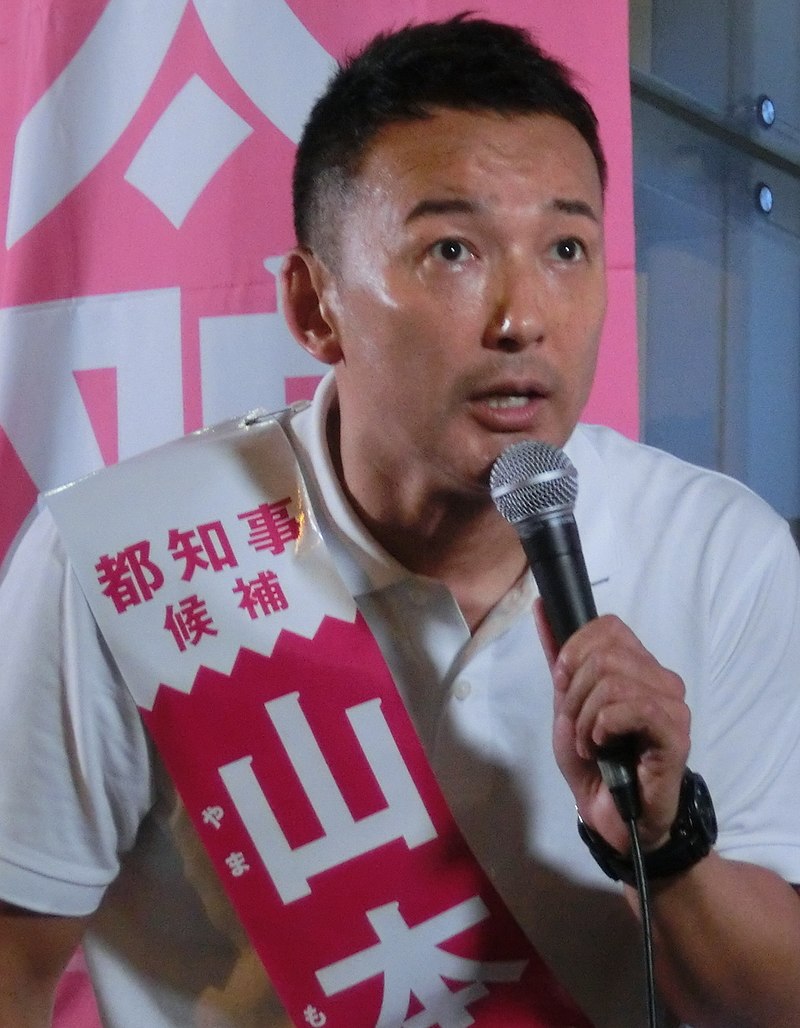
6/27(土) 北千住駅西口デッキでの街頭演説
Face to light

渋谷駅前で街頭演説する山本太郎氏
Noukei314
Key facts
Key facts
• Name — Taro Yamamoto • Office — Leader of Reiwa Shinsengumi • Term Start — 1 April 2019 • Term End — 10 July 2026 • Predecessor — Position established • Successor — Joji Yamamoto • Office1 — Member of the House of Councillors • Constituency1 — Tokyo at-large • Term Start1 — 25 July 2022 • Term End1 — 21 January 2026 • Predecessor1 — Toshio Ogawa • Successor1 — Vacant • Constituency2 — Tokyo at-large • Term Start2 — 21 July 2013 • Term End2 — 21 July 2019 • Predecessor2 — Tamayo Marukawa • Successor2 — Ayaka Shiomura • Office3 — Member of the House of Representatives • Constituency3 — Tokyo PR • Term Start3 — 31 October 2021 • Term End3 — 15 April 2022 • Predecessor3 — Multi-member district • Successor3 — Mari Kushibuchi • Born — 24 November 1974 • Birthplace — Takarazuka, Hyōgo, Japan • Occupation — Politician • Party — Reiwa Shinsengumi (since 2019) • Other Party — Independent (2011–2014) People's Life (2014–2016) Liberal (2016–2019) Tarō Yamamoto is a Japanese politician and former actor, who is the founder and former leader of the anti-establishment political party Reiwa Shinsengumi. Yamamoto served in the House of Councillors representing Tokyo until his resignation in 2026, and previously served in the House of Representatives from 2021 to 2022. He unsuccessfully ran in the 2020 Tokyo gubernatorial election as a candidate under Reiwa.
Early life and acting career
Early life and acting career
Yamamoto was born in Takarazuka, Hyogo; his father died shortly after his birth, and he and his two older sisters were raised by their mother, who sold Persian carpets. He said in his speech that when he was called to the principal's office when he was 11 years old and asked about his future dream, he answered, "Prime Minister". Yamamoto began his career as a television personality in 1990, appearing in dramas such as Futarikko (1996–97) and Shinsengumi! (2004). He appeared in dozens of films, including Battle Royale (2000) and Moon Child (2003), winning a Blue Ribbon Award for Best Supporting Actor for the latter. He continued appearing in films and television until 2013.
Independent (2011–2014)
Independent (2011–2014)
Yamamoto entered politics after the Fukushima nuclear meltdown in March 2011. He announced that he "would no longer be a silent accomplice of the terrorist nation Japan", and became a protester in the anti-nuclear movement. He resigned from his talent agency some time later in order to focus on activism. Yamamoto, a resident of Tokyo, flew to Saga Prefecture in July and attempted, along with a local citizens' group, to enter the governor's office to protest the restart of a power plant. He chanted phrases such as, "Protect our children!", "We don't need nuclear energy!" and "Come out, Governor!". He did not get an audience with the governor, but said he was glad that he came. The scene was broadcast on television, and the Saga District Public Prosecutors Office considered pressing charges against Yamamoto. Following the incident, in early 2012, Yamamoto led a petition campaign in Tokyo to hold a referendum that would bar Tokyo Electric Power Company from continuing to run nuclear facilities. He attempted to run for a seat in the House of Representatives during the 2012 general election, but placed second in the Tokyo 8th district and did not win a seat. He then ran an independent campaign (endorsed by the New Socialist Party) to be elected to the House of Councillors in the 2013 election, and was elected on 21 July. He was supported in the election by the People's Life Party, Social Democratic Party and Greens Japan. On 31 October 2013, Yamamoto handed a political letter to the Emperor Akihito at a non-political garden party. The letter was immediately passed on to the chamberlain. Whether the letter was read by the Emperor is unknown. The letter reportedly contained his complaints about the handling of the nuclear disaster. The Huffington Post reported that the action may have violated the Constitution of Japan, since the Emperor is not allowed to involve himself in political issues. The Japanese Communist Party chairman Kazuo Shii inferred that Yamamoto "didn't understand the Constitution". Various political leaders expressed their anger and disappointment in Yamamoto's alleged abuse of his legislative position, as well as Takeshi Kitano, who called the incident "somewhat of an insult". However, the manga artist Yoshinori Kobayashi supported Yamamoto's actions. On 8 November, Yamamoto received an official reprimand from the Speaker of the House of Councillors, Masaaki Yamazaki. It was also announced that he will be banned from any kind of imperial events during his entire term. In December 2013, he promised he would mobilize a million people to lay siege to the National Diet in protest of the State Secrecy Law. In the 19th Tokyo gubernatorial election held in February 2014, he didn't support any specific candidate, and called for supporting candidates that oppose nuclear power.
People's Life Party (PLP) (2014–2016)
People's Life Party (PLP) (2014–2016)
• Illustration — Yamamoto in July 2016 In the 2014 Japanese general election, the People's Life Party (PLP) lost seats and was in danger of losing its qualification as a political party. After the election, Yamamoto joined the party, and the party name was changed to "People's Life Party & Taro Yamamoto and Friends." In September 2015, in a vote of security-related bills of the House of Councillors plenary session, he voted while wearing mourning garb and a rosary, and gestured to offer incense to Prime Minister Shinzo Abe and the Liberal Democratic Party. • Illustration — Tarō Yamamoto giving a speech in Shimbashi, 2018
Liberal Party (2016–2019)
Liberal Party (2016–2019)
In October 2016, the People's Life Party & Taro Yamamoto and Friends was renamed to Liberal Party in preparation of the upcoming general election in 2017. The party went into the election as an informal bloc, and most of its members chose to either run under the Kibō no Tō banner or as independents. In April 2019, the Liberal Party officially dissolved and merged into the Democratic Party for the People. However, Yamamoto announced his intentions before the merger to form a new group, named Reiwa Shinsengumi.
Reiwa Shinsengumi (2019–present)
Reiwa Shinsengumi (2019–present)
In the first election the party contested, Yamamoto lost his seat in the House of Councillors after switching his electoral district from Tokyo to the party's National PR list, but he led his party to win 4.55% of the vote and two seats in the House of Councillors. Both of the candidates who won — Yasuhiko Funago and Eiko Kimura — were elected from the nationwide proportional bloc, and both were the first people with severe disabilities to be elected to the parliament. In June 2020, Yamamoto announced his candidacy for the 2020 Tokyo gubernatorial election. His campaign was mainly based around a pledge to cancel the 2020 Summer Olympics, and to also establish a 100,000 yen direct cash relief handout program as a part of Tokyo's response to the COVID-19 pandemic. Yamamoto came in third place in the election, winning 657,277 votes, or 10.72% of the vote. At the 2021 general election, Yamamoto won a seat in the House of Representatives running on the Tokyo PR list. His party won three seats, up from the one it held. It won seats in Tokyo, which was won by Yamamoto himself, the South Kanto proportional block, won by Ryo Tagaya, and the Kinki proportional block, which is held by Akiko Ōishi. The party also extensively co-operated with opposition parties, forming a four group pact with the Constitutional Democratic Party, Japanese Communist Party, and Social Democratic Party. Yamamoto also withdrew from running for Tokyo's 8th district and opted to run for Tokyo's proportional block as a result, leaving the 8th to the CDP's Harumi Yoshida. Reiwa Shinsengumi also withdrew seven candidates as part of the pact, meaning over 40% of its planned slate would end up not running. Yamamoto resigned his seat in the House of Representatives in April 2022, and announced his intention to increase his party's representation in the House of Councillors. He was replaced in the lower house by Mari Kushibuchi. Yamamoto won his seat, along with Reiwa gaining three councilors from 2019, leading to a total of 5 councilors after Reiwa won 4.37% of the vote. Two other councilors were elected from the nationwide proportional block. In 2023, Liberal Democratic Party lawmakers physically held Yamamoto back as he attempted to fling himself at members desks to block an anti-refugee bill in the House of Councilors. The melee lasted several minutes, with the scene being reported on by numerous news outlets. During the campaign period for the 2025 Japanese House of Councillors election, a video was posted on 18 July with him standing outside of DiverCity Tokyo Plaza in Odaiba, Minato, Tokyo, cosplaying as Quattro Bajeena from Mobile Suit Zeta Gundam as he introduced one of the party's candidates, voice actress Maya Okamoto as she explained how she is campaigning for office to fight for the abolishment and/or reduction of the invoice system in place since 2023. However four days later, Bandai Namco Filmworks, the owners of the Sunrise studio and the Gundam series stated that they didn't give permission from the party to use their character and that they do not support any political candidate. On 21 January 2026, Yamamoto resigned from the House of Councillors after he was diagnosed with multiple myeloma, a hematologic cancer. He stated he would continue as party leader with a reduced workload. On 9 July 2026, he resigned as leader of Reiwa following a speeding violation.
Filmography
Filmography
• Year — Title — Role — Notes • 1996 — That's Cunning! Shijō Saidai no Sakusen? — Kimura Kenji • 1998 — Love Letter • 1999 — Big show! Hawaii ni utaeba • 2000 — Battle Royale — Shogo Kawada • 2001 — Hashire! Ichiro • 2001 — Rain of Light • 2001 — Go — Tawake • 2001 — Genji: A Thousand-Year Love • 2002 — Through the Night • 2003 — Moon Child — Toshi • 2003 — Get Up! — Taro • 2003 — The Boat to Heaven • 2004 — Shinsengumi! — Harada Sanosuke • 2004 — Akai tsuki — Makita Shoichi • 2004 — A Day on the Planet • 2004 — Izo • 2005 — Princess Raccoon — Ostrich Monk • 2005 — Under the Same Moon • 2009 — Kaiji — Jōji Funai • 2010 — Kamen Rider × Kamen Rider OOO & W Featuring Skull: Movie War Core (Skull: Message for Double) — Seiichiro Matsui • 2011 — My Way — Noda
Identity
Identity
Tarō Yamamoto is recorded with the occupation television actor. Recorded with the occupation politician. Recorded with the occupation activist. Recorded as politician, actor and activist.
Life and career
Dated record
Life and career
The full dated record · 1 entries
1974
Tarō Yamamoto was born on 24 November 1974.
Primary material
Documents and archives
institutional register
- Bibliothèque nationale de France authority file 144905370
General reference · Bibliothèque nationale de France
- GND (German National Library) authority file 173682847
General reference · GND (German National Library)
- IdRef (French universities) authority file 142556564
General reference · IdRef (French universities)
- ISNI authority file 000000008157070X
General reference · ISNI
- Library of Congress authority file nr2004013721
General reference · Library of Congress
- VIAF authority file 76543323
General reference · VIAF
reference work
- “Taro Yamamoto”, English Wikipedia, consulted as further reading
Reputable secondary · Wikipedia
References
Citations
References
Each reference names the institution holding it, so a reader may go to the document itself.
institutional register
Bibliothèque nationale de France authority file 144905370Bibliothèque nationale de France
Secondary witnessinstitutional register
GND (German National Library) authority file 173682847GND (German National Library)
Secondary witnessinstitutional register
IdRef (French universities) authority file 142556564IdRef (French universities)
Secondary witnessinstitutional register
Secondary witnessinstitutional register
Library of Congress authority file nr2004013721Library of Congress
Secondary witnessinstitutional register
Secondary witnessinstitutional register
Wikidata, structured authority record Q1093223: Tarō YamamotoWikimedia Foundation
Secondary witnessreference work
Secondary witness
Further particulars
Held on the record
Further particulars
Open the remaining particulars
The authorities additionally record the headings Yamamoto Tarō, Taro Yamamoto, Yamamoto Taro and Tarou Yamamoto. His recorded language was Japanese. He married Nanako Seri. Work and production. Works recorded as notable number 8: Battle Royale, Moon Child, Go, Rain of Light, Get Up!, Kaiji: The Ultimate Gambler, Kaiji 2: The Ultimate Gambler and Shinsengumi!
Identity and origins
The Encyclopedia exists whether or not anything is for sale. Corrections are recorded rather than overwritten, and every version of this record is kept. Published 17 August 2026.
Elsewhere in Film memorabilia
37,928 published records in this field, each with its sources named.
- Tarık AkanTerminology
- Tarja-Tuulikki TarsalaPerson
- Tarkan TüzmenPerson
- Tarmo ManniPerson
- Tarsem SinghPerson
- Taru ValjakkaPerson
- Taryn PowerPerson
- Taryn SouthernPerson
Best supported in this field
For owners
Own a work by Tarō Yamamoto?
A specialist will read what you send and tell you what the house can establish, what it cannot, and whether the object is suited to sale. There is no charge and no obligation. The object stays with you throughout; nothing is shipped to us unless it is arranged in writing beforehand.