
Sundarar
Sundarar, also referred to as Chuntarar, Chuntaramurtti, Nampi Aruran or Tampiran Tolan, was an eighth-century poet-saint of Tamil Shaiva Siddhanta tradition of Hinduism. He is among the Tevaram trio, and one of the most prominent Nayanars, the Shaiva bhakti (devotional) poets of Tamil Nadu. His hymns form the seventh volume of the Tirumurai called Thiruppattu, the twelve-volume compendium of Shaiva Siddhanta.
Also recorded as Chuntarar · Tampiran Tolan · Nampi Aruran · Chuntaramurtti
Sundarar

Ssriram mt · CC BY-SA 3.0
- Name
- Sundarar
- Birthplace
- Tirunavalur
- Occupation
- poet
- Languages
- Tamil
VALÉORINE Encyclopedia
VALÉORINE documentary reading
Documentary summary
Sundarar, also referred to as Chuntarar, Chuntaramurtti, Nampi Aruran or Tampiran Tolan, was an eighth-century poet-saint of Tamil Shaiva Siddhanta tradition of Hinduism. He is among the Tevaram trio, and one of the most prominent Nayanars, the Shaiva bhakti (devotional) poets of Tamil Nadu. His hymns form the seventh volume of the Tirumurai called Thiruppattu, the twelve-volume compendium of Shaiva Siddhanta.
Admitted source layer · organised and presented by VALÉORINE
Note VALÉORINE
The Wikipedia record describes Sundarar as a poet. Sundarar was born at Bhaktajaneswarar temple. The language is Tamil.
Composed from admitted, traceable facts · 01 October 2026
VALÉORINE
Reference Check
Propose documentary evidence for Sundarar. A contribution is never written directly as fact: identity, source, rights and evidence gates still decide.
Sign in to contribute
World of VALÉORINE
Documentary connections
Only confirmed graph relationships appear here. Images are shown only when their identity and reuse rights both pass the documentary gate.
Documentary evidence
Documentary basis
Authority files
wikidata · Q3494321 · wikipedia · Sundarar
In this article
Biography
Biography
His songs are considered the most musical in Tirumurai in Tamil language. His life and his hymns in the Tevaram are broadly grouped in four stages. First, his cancelled arranged marriage through the intervention of Shiva in the form of a mad petitioner and his conversion into a Shaiva devotee. Second, his double marriage to temple dancers Paravai and Cankali with their stay together in Tiruvarur. Third, his blindness and then return of his sight. Finally, his reflections on wealth and material goods.
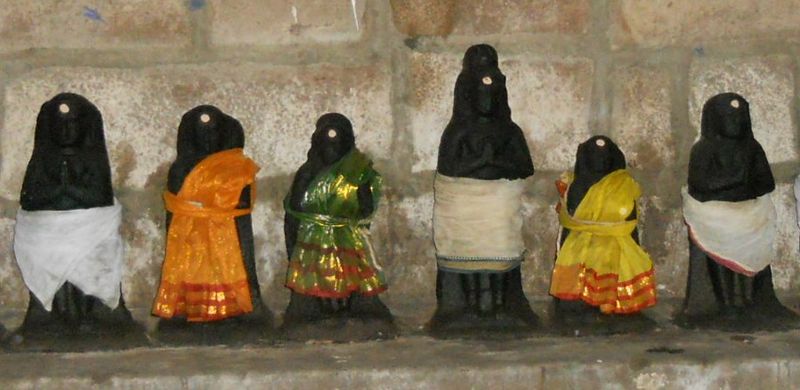
Thiruvalangadu temple Sadaya Nayanar Isai Gnaniyar Paravai Naachiyar Sundarar Sangili Naachiyar Narasingamunaiyara Nayanar
Ssriram mt

Madhuvaneswarar temple Nannilam
Ssriram mt
Key facts
Key facts
• Name — Sundarar • Religion — Hinduism • Birthplace — Tirunavalur • Philosophy — Shaivism • Honors — Nayanar • Notable Works — Tevaram
Names
Names
Sundarar is referred to by many names. Sundarar (Cuntarar) means "the lovely, handsome one". He was adopted by regional feudatory dedicated to Shiva, and that brought the name "Aruran". Peers and the generations that followed him called him "Tampiran Tolan", which means "intimate companion, dedicated friend of the lord [Shiva]".
Life
Life
• Illustration — Family of Sundarar (l->r): Sadaya Nayanar (father), Isaignaniyar (mother), Paravai Nachiyar (wife), Sundarar, Sangili Nachiyar (wife), Narasinga Muniyaraiyar (foster-father). The Tevaram hymns compositions of Sundarar are a source of biographical information about him, as are the hagiographic texts written about him few centuries after he died. Sundarar was born in Tirunavalur in a Shaiva Brahmin family to Sadaiya Nayanar and Isaignaniyar towards the end of the 7th century. He was adopted by the Narasinga Munaiaraiyar Kashatriya family, a Pallava feudatory (Thirumunaipadi-Nadu, an adoption that gave him a luxurious childhood. Sundarar is unique among the Nayanars in that both of his birth parents are also recognized as Nayanars (poet-saints of Tamil Shaivism). They were temple priests and accepted the adoption request of the local feudatory. Once he came of age, his adopted family arranged his marriage. However, as the wedding party approached the local Shiva temple, states the traditional legend, an old man mysteriously appears and produces a palm leaf document. The document stated that Sundarar was bonded to serve him, the old man, his master. A court of elders then reviews the document and finds it authentic, demands Sundarar to serve the petitioner, who then mysteriously vanishes in the Shiva shrine. Sundarar views this as a command to cancel the wedding and serve Shiva in the Tiruvarur temple. Sundarar began his first poem (Tevaram VII.1.1) by addressing Shiva as Pittaa pirai chudi.. meaning O mad man..: O madman with the moon-crowned hair, God of grace, O Lord, how can I forget you? You dwell forever in my heart, In Arutturai, shrine of grace, in Venneynallur on Pennai's southern bank, you took me for your own– how can I deny you now? – Translated by Indira Peterson • Illustration — Sundarar (left) with Paravayar (Paravai Nachiyar). In the next stage of his life, Sundarar moved around Tamil Nadu, visiting Shiva Temples of Tamil Nadu. In Tiruvarur, he fell in love with a temple dancer named Paravayar, and married her. After few years of married life, Sundarar visits the Siva temple in Thiruvottriyur, a sea-side suburb of Madras. There he meets and is enamoured by a peasant Vellala girl Cankali. With the help of Shiva, this leads to Sundarar's second marriage, but only after his wedding vows include the promise of never leaving Cankali and Thiruvottriyur. After marrying his second wife, Sundarar misses his first wife Paravai. He does not keep his word, and leaves for Tiruvarur. The broken vow causes him to go blind before he reaches Tiruvarur. His suffering thereafter are part of several Tevaram hymns. As a blind man, he visits many Shiva shrines and sings there. Slowly in stages, he becomes closer to Shiva and recovers his sight. • Illustration — Scene of boy coming back to life from crocodile after Sundarar sings hymn—Wooden sculpture. Another legends states that Cheraman Perumal Nayanar – the king of the region now known as Kerala, heard of him and came to Tiruvarur. Both embarked on a pilgrimage together. He died during this pilgrimage. Zvelebil estimates that Sundarar died about 730 CE. In his later hymns, he presents his spiritual discussions with Shiva on how to achieve both spiritual succor and material wealth in life. He seeks the latter to provide for his family and to pay for the charitable temple kitchen that fed hundreds of Shaiva pilgrims. Shiva becomes his patron king, grants him grain, gold and a flashing sword. This is embedded symbolism to inspire regional kings and wealthy patrons to support the spiritual and charitable works at Shiva temples.
Compilation
Compilation
Like the Tevaram trio, Sundarar's hymns were passed on through the oral tradition for a few centuries. Sometime around 1000 CE, Raja Raja Chola I (985-1013 CE) heard short excerpts of Shiva hymns in his court. He then embarked on a mission to recover the hymns. He sought the help of Nambiyandar Nambi, who was a priest in a Ganesha temple. Nambi, states the tradition, prayed before Ganesha for success in finding the manuscripts. Nambi found the scripts in the form of cadijam leaves half eaten by white ants in a chamber inside the second precinct in Thillai Nataraja Temple, Chidambaram. Tradition attributes this discovery to Shiva's intervention. The temple priests of Chidambaram refused to let Nampi and king to take the manuscript from the temple. They said that their temple rules demand that this can only happen if the Tevaram trio come to the temple. The king then had stone idols of the three poet-saints built and brought them to the temple in royal procession. Once the Tevaram trio images were consecrated, the temple priests allowed Nambi to take the manuscript for his studies and compilation. This, states Vasu, began the tradition of placing Nayanar statues in large Tamil Shiva temples. Nambi arranged the hymns of three saint poets Sambandar, Appar and Sundarar as the first seven books. Sundarar's composition is compiled in the seventh volume of the Tevaram. It consists of 100 hymns, consisting of 1026 stanzas. Sundarar compositions have a signature last stanza, where he links his hymns to Shiva, the Vedas or a temple location, and the benefits of reciting or listening to that hymns. For example, at the end of hymn VII.54: Those who know these ten verses that Uran, the Rude Devotee, chanter of the four Vedas and sacred texts, praised by the world, very pious young man, has sung on the dear one, who dwells at the shrine in wave-washed Orriyur, will surely reach the highest state. – Translated by Indira Peterson
Translations
Translations
Francis Kingsbury and GE Phillips selected and translated 15 out of 100 of Sundarar's hymns into English in 1921. These were published with small collection of Sambandar and Appar hymns in a book titled Hymns of the Tamil Śaivite Saints, released by the Oxford University Press. They stated that these were some of the hymns from Devaram (Tevaram) that they could hear being chanted in South Indian Shiva temples of their times. More recent English translations of many more select hymns by Sundarar have been published by Indira Peterson, and David Shulman.
Temple traditions
Temple traditions
Sundarar's pilgrimage to Shiva temples and his efforts helped expand the Shaiva sacred geography in Tamil Nadu. Like Sambandar and Appar, Sundarar's hymns have been helpful in identifying and dating many of the old Shiva temples found in Tamil Nadu. These have been helpful to art historians, and for architectural, archaeological and religious studies. List of temples associated with Sundarar • Name of the temple — Location — Number of verses — Photo • Agatheeswarar Temple — Purisai — 63 • Kripapureeswarar Temple — Thiruvennainallur — 10 — • Parangirinathar Temple — Tirupparankunram — 10 — • Turaiyurppesurar Temple — Thirunelvayil Arathurai — 10 • Mahadeva Temple — Thiruvanchikulam, Kerala — 10 — • Thiruonakathan Thali — Kanchipuram — 11 — • Swetharanyeswarar Temple — Thiruvenkadu — 10 — • Thiruethikolpadi Temple — Thiruethikolpadi — 11 • Thyagarajar Temple — Tiruvarur — 63 — • Swarnapuresar Temple — Trikaduvaikarai Putur — 11 • Thiruanegathangavatham — Kanchipuram — 11 — • Thirupoovanam — Thirupoovanam — 8 • Thirunatuthogai — Thirunatuthogai — 11 • Thiruthuraiyur — Thiruthuraiyur — 11 • Thirupachilasiramam — Thirupachilasiramam — 12 • Thirunatiyathangudi — Thirunatiyathangudi — 10 • Amirdhakalayeswarar Temple — Saakkottai — 11 — • Tirunaavaleswarar Temple — Thirunavalur — 11 — • Thiruvelvikudi Temple — Thiruvelvikudi — 10 • Thirunindriyur Temple — Thirunindriyur — 18 • Kolilinathar Temple — Thirukkuvalai — 10 • Metraleeswar Temple — Kanchipuram — 10 — • Thirumazhamannipadikarai — Thirumazhamannipadikarai — 10 • Thirukazhipalai — Thirukazhipalai — 10 • Vajranadeswara Temple — Thirumazhapadi — 10 — • Thirumuthukundram — Thirumuthukundram — 21 — • Srikalahasti Temple — Srikalahasti — 10 • Uyyakondan Thirumalai Temple — Tiruchirapalli — 10 — • Amirtagateswarar Temple — Thirukkadaiyur — 10 — • Thirukarugavoor — Thirukarugavoor — 10 — • Thirukarupariyaloor — Thirukarupariyaloor — 11 — • Thiruidaiyatruthogai — Thiruidaiyatruthogai — 10 • Thirukodikuzhagar — Kodikkarai — 10 • Agnipureeswarar Temple — Tirupugalur — 11 • Sakshinatheswarar Temple — Thiruppurambiyam — 10 • Neelivaneswarar Temple — Thirupanjeeli — 11 • Thiruvathigai Veeratanam — Thiruvatigai — 10 • Thiruthondathogai — Thiruthondathogai — 11 • Thirukanatumullur — Thirukanatumullur — 11 • Thirukachoor — Thirukachoor — 10 • VenjamakoodalThiruvenjamakoodal — Thiruvenjamakoodal — 10 • Muthupathugangai — Muthupathugangai — 10 • Thiruamathur — Thiruamathur — 11 • Kayarohanaswami Temple — Nagapattinam — 11 • Oorthogai — Oorthogai — 10 • Thirupandikodumudi — Thirupandikodumudi — 10 • Thirumuruganatheeswar Temple — Thirumuruganpoondi — 10 • Thiruppunavasal Temple — Thiruppunavasal — 10 • Thiruvalangadu — Thirvalangadu — 10 • Thirukadaiyur Mayanam — Thirukkadaiyur — 10 • Thyagaraja Temple — Tiruvottiyur — 20 • Sivalokanathar Temple — Thirupungur — 10 • Thiruneedur — Thiruneedur — 11 • Thiruvazhkolliputhur — Thiruvazhkolliputhur — 13 • Thirukazhumalam — Thirukazhumalam — 10 • Mahalingeswarar Temple — Thiruvidaimarudur — 10 • Thiruvegambam — Thiruvegambam — 11 • Thirukolakka — Thirukolakka — 10 • Thiruthinainagar — Thiruthinainagar — 10 • Masilamaiyisar Temple — Thiruvaduthurai — 15 • Thiruvalivalam — Thiruvalivalam — 11 • Tirunallar Saniswaran Temple — Tirunallar — 10 • Masilamaniswara Temple — Thirumullaivoyal — 11 • Vedaranyeswarar Temple — Vedaranyam — 10 • Thiruvalampuram — Thiruvalampuram — 11 • Thiruthuruthi — Thiruthuruthi — 5 • Thiruvelvikudi — Thiruvelvikudi — 5 • Jambukeswarar Temple — Thiruvanaikaval — 10 — • Vanchinadha Swamy Temple — Srivanchiyam — 10 • Aiyarappar temple — Tiruvaiyaru — 11 — • Kedarnath Temple — Kedarnath — 10 • Thiruparupatham — Thiruparupatham — 10 • Thiruketheeswaram — Thiruketheeswaram — 10 • Vedagiriswarar temple — Thirukazhukundram — 10 — • Thiruchuzial — 10 • Thirukanapper — 10 • Narthana Vallabeswarar temple — Thirukoodalaiyathur — 10 — • Thiruparthaanpanankattur — 10 • Soundareswararswamy Temple — Thirupanaiyur — 10 — • Veezhinathar Temple — Thiruveezhimizhalai — 10 — • Thiruvenpakkam — 11 • Thillai Nataraja Temple — Chidambaram — 10 — • Thirupukoliyur Avinasi — Avinasilingeswarar temple, Avinasi — 10 — • Sundareswarar Temple — Thirunaraiyur Chitteswaram — 10 • Odhanavaneswarar Temple — Tiruchotruturai — 10 • Thyagarajar Paravaiyundamandali Temple — Tiruvarur — 10 • Thirunanipalli — 10 • Prakasheswarar Temple — Nannilam — 11 • Naganatha Swamy Temple — Tirunageswaram — 11 • Thirunodithan Malai • Tiruvadhigai Veerataanam Temple — Tiruvadhigai — • Manikkamenivaradhar Temple — Thirumaandakuzhi • Brahmapuresar Temple — Sirkali — • Saptapreswarar Temple — Tirukolaka • Sivaloganathar Temple — Tirupungur • Mayuranathar Temple — Mayiladuthurai — • Tiruvambar Maakaalam Temple — Tiruvambar (Ambal) • Agnipuriswarar Temple — Tirupugalur • Karinateswarar Temple — Tirunatiyathankudi • Manatunainatar temple — Tiruvalivalam • Padikasu Nathar Temple — Arisirkarai Putur — • Sivagurunathaswamy Temple — Sivapuram — • Adi Kumbeswarar Temple — Kumbakonam — • Kabardeeshwarar Temple — Thiruvalanchuzhi — • Kalyanasundaresar Temple — Tirunallur — • Virataneswarar Temple — Tirukkandiyur — • Pushpavananadheswarar Temple — Tirupundhuruti • Atmanadeswarar Temple — Tiruvalamposil
Legacy
Sundarar shared the same respect as Sambandar and Appar for the Vedas. Together, they connected the Vedic ritual to the temple Agamic puja that is ever since followed in Shiva temples. According to John Cort – a scholar of Jainism and Hinduism studies, the Agamic temple rituals perpetuate the Vedic practices. The efforts of the Tevaram trio and other Nayanars helped transform this "as the central element of the Saiva Siddhanta philosophical and theological system, and thus of Tamil Saiva soteriology", states Cort, by emphasizing the instrumentality and efficacy of the temple and its rituals. According to the Nayanars, the Vedic and the Agamic overlap, are alternate roads to the same spiritual end, both evoke a transformation in the devotee, with the difference that temple-based Saiva puja alone is emphasized. The Shiva temple-centered community tradition has thrived among Tamils since the times of Sambandar, Appar and Sundarar. Odhuvars, Sthanikars, or Kattalaiyars offer musical programmes in Shiva temples of Tamil Nadu by singing Tevaram after the daily rituals. These are usually carried out as chorus programme soon after the divine offering. The singing of Tevaram was followed by musicals from the music pillars in such temples like Madurai Meenakshi Amman Temple, Nellaiappar Temple and Suchindram. The singers of these hymns were referred as Tirupadiyam Vinnapam seyvar or Pidarar, from the inscriptions of Nandivarman III in the Tiruvallam Bilavaneswara temple records. Rajaraja deputed 48 pidarars and made liberal provisions for their maintenance and successors.
Primary material
Documents and archives
reference work
- “Sundarar”, English Wikipedia, consulted as further reading
Reputable secondary · Wikipedia
institutional register
- Wikidata, structured authority record Q3494321: Sundarar
General reference · Wikimedia Foundation
Notes from the source article
Cited by Wikipedia
Notes from the source article
These works are cited by the source article, in its own numbering. They are recorded as its citations, not as sources VALÉORINE has verified.
- 1.Wendy Doniger O'Flaherty. Textual Sources for the Study of Hinduism. University of Chicago Press. 170. 1990. 978-0-226-61847-0.
- 2.Zvelebil, Kamil V. Songs of the Harsh Devotee: The Tēvāram of Chuntaramūrttināyaṉār. Journal of the American Oriental Society. JSTOR. 113. 2. 327. 1993. 0003-0279.
- 3.Sisir Kumar Das. A History of Indian Literature, 500-1399: From Courtly to the Popular. Sahitya Akademi, 2005 - India - 302 pages. 33.
- 4.Oxford University Press India, 2004 - Religion - 246 pages. Śiva in the Forest of Pines: An Essay on Sorcery and Self-knowledge. 167.
- 5.Meenakshi Khanna. Cultural History of Medieval India. Berghahn Books, 2007 - History - 248 pages. 59.
- 6.Natesan & Co. Appar : a sketch of his life and teachings. 8. 1918. saoa.crl.25894664.
- 7.Dallapiccola, A. L. Sundarar or sundaramurti nayanmar. Dictionary of Hindu lore and legend. Thames & Hudson. 2002. 0500510881.
- 8.Culter 1987, p. 50
- 9.Cort 1998, p. 178
- 10.Vasudevan 2003, pp. 109-110
- 11.Cort 1998, p. 176
- 12.Ghose 1996, p. 239
- 13.Bhargava 2006, p. 467
- 14.Kingsbury, F. Hymns of the Tamil Saivite Saints (1921). Oxford University Press. 35–68. 1921.
- 15.University of Pennsylvania. Songs of the Harsh Devotee: The Tēvāram of Chuntaramūrttināyan̲ār. 1990. 978-0-936115-07-8.
Bibliography printed in the source article · 12
- Swamigal, Sundaramurthi. tEvAram of chuntaramUrti cuvAmikaL tirumuRai 7, part 1 Poems (1-517). projectmadurai.org.
- Swamigal, Sundaramurthi. tEvAram of chuntaramUrti cuvAmikaL tirumuRai 7, part 2 Poems (518-1026). projectmadurai.org.
- Dictionary of Hindu Lore and Legend ( ) by Anna Dallapiccola
- Songs of the harsh devotee by David Dean Shulman
- The religion and philosophy of thevaram by M.A. Dorai Swamy
- Development of Religion in South India by K. A. Nilakanta Sastri
- Arupathu Moovar Kadhaigal by Durgadas S. K. Swamy (Prema Pirasuram publishers)
- Origin and early history of Śaivism in South India By Sadananda (Swami.)
- Ten saints of India By T. M. P. Mahadevan
- A short introduction to Saivism By Subodh Kapoor
- Songs of Sundararmoorthy Swamigal
- Life of Sundaramoorthy Swamigal
References
Citations
References
Each reference names the institution holding it, so a reader may go to the document itself.
reference work
Secondary witnessinstitutional register
Wikidata, structured authority record Q3494321: SundararWikimedia Foundation
General reference
Further particulars
Held on the record
Further particulars
Open the remaining particulars
The authorities additionally record the headings Chuntarar, Tampiran Tolan, Nampi Aruran and Chuntaramurtti. His recorded language was Tamil. His recorded confession was Hinduism.
Identity and origins
The Encyclopedia exists whether or not anything is for sale. Corrections are recorded rather than overwritten, and every version of this record is kept. Published 16 August 2026.
Elsewhere in Books
39,529 published records in this field, each with its sources named.
- Suna TanaltayAuthor
- Sunanda MahendraAuthor
- Sunao TokunagaAuthor
- Sunay AkınAuthor
- Sundarji BetaiAuthor
- Sung Chan-gyeongAuthor
- Sunil GangopadhyayAuthor
- Sunita DeshpandeAuthor
Best supported in this field
For owners
Own a work by Sundarar?
A specialist will read what you send and tell you what the house can establish, what it cannot, and whether the object is suited to sale. There is no charge and no obligation. The object stays with you throughout; nothing is shipped to us unless it is arranged in writing beforehand.