
suicide weapon
Illustration — Yokosuka MXY7 Ohka, a weapon especially designed for a suicide attack • Illustration — A suicide vest with ball bearings A suicide weapon is a weapon designed to be used in a suicide attack, typically based on explosives.
suicide weapon
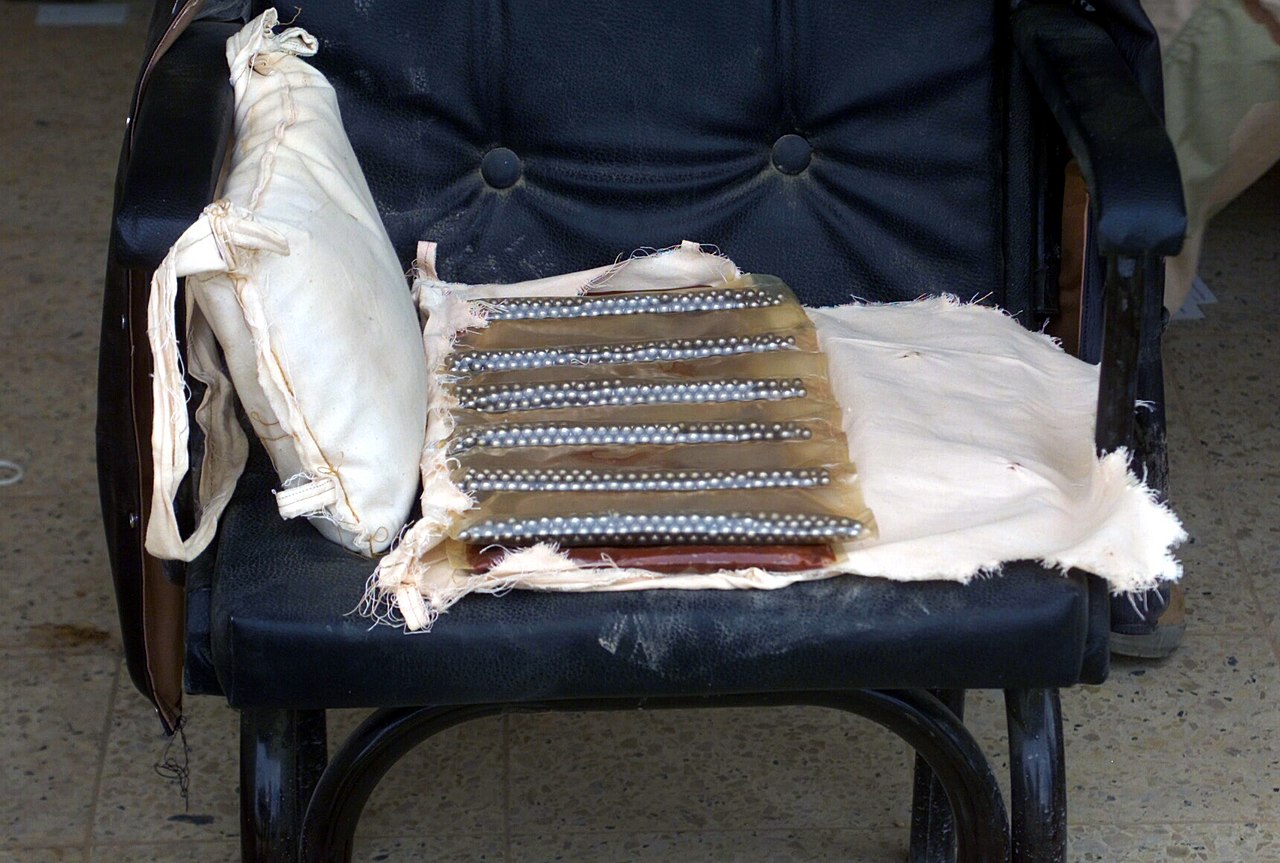
U.S. Marine Corps photo by Master Sgt. Buzz Farrell. · This image was released by the United States Marine Corps with the ID 030412-M-0049F-033 (next). This tag does not indicate the copyright status of the attached work. A normal copyright tag is still · Public domain
- Field
- weapon · suicide method
Reference Check
Propose documentary evidence for suicide weapon. A contribution is never written directly as fact: identity, source, rights and evidence gates still decide.
Sign in to contribute
World of VALÉORINE
Documentary connections
Only confirmed graph relationships appear here. Images are shown only when their identity and reuse rights both pass the documentary gate.
Broader Term · incoming
body cavity bomb
Term
Broader Term · incoming
doomsday device
Term

Broader Term · incoming
explosive belt
Term
Military Training Inventory (U.S. Army Alaska Public Affairs Office Official Series)

Broader Term · incoming
Kaiten-class human torpedo
Term
Own work

Broader Term · incoming
Yokosuka MXY-7 Ohka
Term
U.S. Navy National Museum of Naval Aviation photo No. 1996.488.161.023
Documentary evidence
Documentary basis
Authority files
wikidata · Q7635414 · wikipedia · Suicide weapon
In this article
History
History
Suicide weapons have been used both in conventional warfare, as well as in terrorism. • Illustration — Chinese suicide bomber putting on an explosive vest made out of Model 24 hand grenades to use in an attack on Japanese tanks at the Battle of Taierzhuang. In the Second Sino-Japanese War, Chinese used suicide bombing against the Japanese with explosive vests. A Chinese soldier detonated a grenade vest and killed 20 Japanese at Sihang Warehouse. Chinese troops strapped explosives like grenade packs or dynamite to their bodies and threw themselves under Japanese tanks to blow them up. This tactic was used during the Battle of Shanghai, where a Chinese suicide bomber stopped a Japanese tank column by exploding himself beneath the lead tank, and at the Battle of Taierzhuang where dynamite and grenades were strapped on by Chinese troops who rushed at Japanese tanks and blew themselves up. During one incident at Taierzhuang, Chinese suicide bombers obliterated four Japanese tanks with grenade bundles. The Pacific War of World War II bore witness to the Japanese kamikaze suicide attack pilots ("kamikaze" was not a term used by the Japanese themselves). Late in the war, as the tide turned against Japan, kamikaze pilots were deployed to attempt to crash their aircraft into American and allied ships in the Pacific. The Japanese even developed specialized aircraft for the tactic, such as the Yokosuka Ohka flying bomb. A successful kamikaze attack would both kill the plane's pilot and damage the target ship, possibly even sinking it. Related tactics included the kaiten suicide minisub, a human torpedo which a single Japanese pilot would steer into an Allied ship. North Korean tanks were attacked by South Koreans with suicide tactics during the Korean War. American tanks at Seoul were also attacked by North Korean suicide squads, who carried satchel charges on their bodies. A North Korean soldier named Li Su-Bok, who destroyed an American tank during one such attack, is hailed as a hero in North Korea. Certain aircraft built or projected for the Luftwaffe during the time of the Allied bombing before the surrender of Nazi Germany in World War II, such as the Bachem Ba 349, Fliegende Panzerfaust, Sombold So 344, Zeppelin Rammer or the Blohm & Voss BV 40 are sometimes listed as suicide weapons. However, they were not intended as such, even though the chances of survival would have been very limited for the pilots of such dangerous artifacts. In those years Nazi authorities considered the use of selbstopfer (suicide) planes such as the Messerschmitt Me 328 and the Fieseler 103. Political groups using suicide weapons in the post-Cold War era include mainly outfits affiliated to Islamic terrorism, among which even children have been used in order to escape detection when carrying out suicide attacks. However, non-Islamic groups, such as the Liberation Tigers of Tamil Eelam, also have been prone to use suicide weapons. Today, the most common suicide weapons used to carry out terrorist attacks are car bombs or truck bombs, as well as antipersonnel bombs carried by a single person. Suicide bombers strap explosives, often covered with nails, screws, or other items intended to act as fragments, to their bodies or otherwise carry them into populated areas and detonate them. The Tamil Tigers of Sri Lanka are known for having made high-profile use of this method in the assassination of Rajiv Gandhi. Similar methods have been also used by Palestinian terrorist groups in the Israeli–Palestinian conflict, among others. Kamikaze attacks were mimicked in the September 11 attacks in 2001, in which a group of mostly Saudi terrorists destroyed the World Trade Center and part of the Pentagon by flying hijacked jet airliners into them. It was the first and only time in history that hijacked jet airliners filled with fuel were used as cruise missiles against targets of such magnitude.
Examples
Examples
• Suicide bombs • Explosive belt • SVBIEDs • Car bomb • Kamikaze attacks by Japan in WWII • Kaiten - human-steered torpedo • Ohka - human-controlled missile/suicide attack parasite aircraft • Shin'yō - human-steered suicide speedboat • Fukuryu - suicide attack frogmen • Lunge mine - suicidal anti-tank mine
Primary material
Documents and archives
institutional register
- Internet Archive holdings naming suicide weapon
General reference · Internet Archive
reference work
- “Suicide weapon”, English Wikipedia, consulted as further reading
Reputable secondary · Wikipedia
authority record
- Wikidata, structured authority record Q7635414: suicide weapon
General reference · Wikidata
Text attribution
Licensing
Text attribution
Part of the biographical narrative on this page reuses licensed material. Its origin, revision and licence are recorded here.
The biographical narrative on this page is based on the Wikipedia article Suicide weapon, revision 1237280610 (EN edition), by its contributors. VALÉORINE has edited that text and built its own documentary record around it. The reused material is available under CC BY-SA 4.0, and this page's reuse of it is offered under the same licence. Everything else on this page — the chronology, the holdings, the evidence, the plates and the connections — is VALÉORINE's own record. Sources and licences.
Notes from the source article
Cited by Wikipedia
Notes from the source article
These works are cited by the source article, in its own numbering. They are recorded as its citations, not as sources VALÉORINE has verified.
- 1.Schaedler, Luc. Angry Monk: Reflections on Tibet: Literary, Historical, and Oral Sources for a Documentary Film. University of Zurich, Faculty of Arts. 518. Autumn 2007.
- 2.Harmsen, Peter. Shanghai 1937: Stalingrad on the Yangtze. Casemate. 112. 2013. 978-1612001678.
- 3.Ong, Siew Chey. China Condensed: 5,000 Years of History & Culture. Marshall Cavendish. 94. 2005. 9812610677.
- 4.Olsen, Lance. Taierzhuang 1938 – Stalingrad 1942. Numistamp. Clear Mind Publishing. 2012. 978-0-9838435-9-7.
- 5.Dr Ong Siew Chey. China Condensed: 5,000 Years of History & Culture. Marshall Cavendish International Asia Pte Ltd. 79. 2011. 978-9814312998.
- 6.Richard Neumann. International Press Correspondence, Volume 18. 447. 1938.
- 7.Epstein, Israel. The people's war. V. Gollancz. 172. 1939.
- 8.Francillon, Ph.D., René J. "Mitsubishi G4M "Betty" and Ohka Bomb" Aircraft in Profile, Vol. 9. Windsor, Berkshire, UK: Profile Publications Ltd., 1971. .
- 9.World War II in the Pacific – Japanese Suicide Attacks at Sea
- 10.Korea Society and the International Council on Korean Studies. International Journal of Korean Studies. 40. 2001.
- 11.Carter Malkasian. The Korean War. Osprey Publishing. 22–. 29 May 2014. 978-1-4728-0994-0.
- 12.T. I. Han. Lonesome Hero: Memoir of a Korea War POW. AuthorHouse. 69–. 1 May 2011. 978-1-4634-1176-3.
- 13.Charles R. Smith. U.S. Marines in the Korean War. Government Printing Office. 183–. 2007. 978-0-16-087251-8.
- 14.Sonia Ryang. North Korea: Toward a Better Understanding. Lexington Books. 78–. 16 January 2009. 978-0-7391-3207-4.
- 15.Ulrich Albrecht: Artefakte des Fanatismus; Technik und nationalsozialistische Ideologie in der Endphase des Dritten Reiches.
- 16.Explaining Suicide Terrorism: A Review Essay
- 17.Child Bombers Terror's Newest Weapon
- 18.Final Report of the National Commission on Terrorist Attacks Upon the United States
- 19.Lewis, Jeffrey William. The Human Use of Human Beings: A Brief History of Suicide Bombing. Origins. 6. 7. April 2013.
References
Citations
References
Each reference names the institution holding it, so a reader may go to the document itself.
institutional register
Internet Archive holdings naming suicide weaponInternet Archive
Secondary witnessreference work
Secondary witnessauthority record
General reference
Connections
Knowledge graph
Connections
Each connection was recorded deliberately, with the basis for it kept on the internal record.
Broader subject
3- body cavity bombTerminology
Established from a fact already recorded on a verified source.
- Kaiten-class human torpedoTerminology
Established from a fact already recorded on a verified source.
- Yokosuka MXY-7 OhkaTerminology
Established from a fact already recorded on a verified source.
Further particulars
Held on the record
Further particulars
Open the remaining particulars
Suicide weapon is connected to 4 other published records in the VALÉORINE Encyclopedia.
The Encyclopedia exists whether or not anything is for sale. Corrections are recorded rather than overwritten, and every version of this record is kept. Published 17 August 2026.
Elsewhere in Militaria
6,095 published records in this field, each with its sources named.
- submarine-launched missileTerminology
- suburitōTerminology
- Sugiura pistolTerminology
- SugobTerminology
- suitcase nukeTerminology
- SumadijaTerminology
- ŠumadijaTerminology
- Sumitomo Type 62Terminology
Best supported in this field
For owners
Own an object connected with suicide weapon?
A specialist will read what you send and tell you what the house can establish, what it cannot, and whether the object is suited to sale. There is no charge and no obligation. The object stays with you throughout; nothing is shipped to us unless it is arranged in writing beforehand.