
Sturm-Infanteriegeschütz 33B
The Sturm-Infanteriegeschütz 33B ("Assault Infantry Gun 33B"), was a German self-propelled heavy assault gun used during World War II.
Also recorded as StuIG 33B · StuIG33B · sIG 33 on Sturmgeschütz III · 150 mm sIG 33 on Sturmgeschütz III
Sturm-Infanteriegeschütz 33B
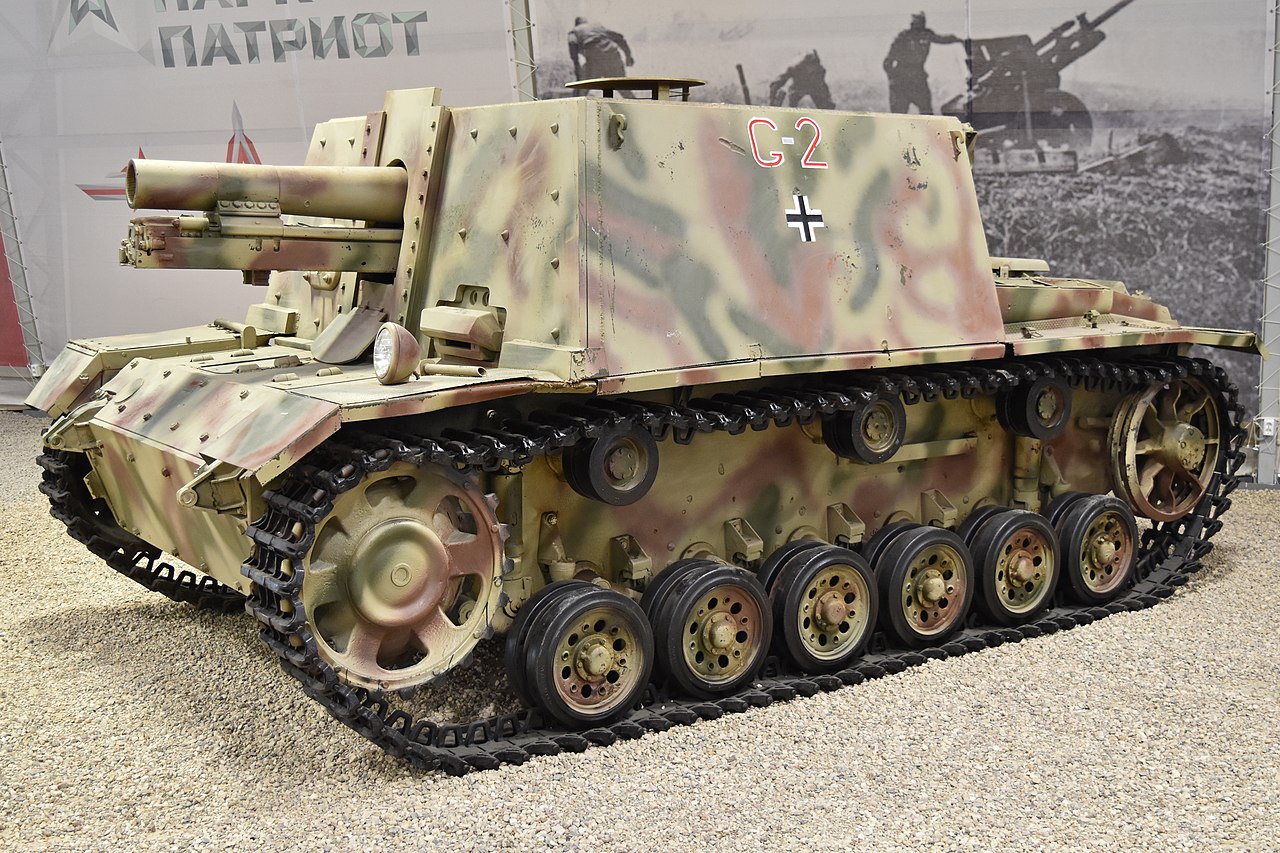
Alan Wilson from Stilton, Peterborough, Cambs, UK · Sturminfanteriegeschütz 33B ‘G-2’ - Patriot Museum, Kubinka · CC BY-SA 2.0
- Name
- Sturm-Infanteriegeschütz 33B
- Field
- Sturmgeschütz III · 15 cm sIG 33 (Sf)
- Region
- Nazi Germany
VALÉORINE Encyclopedia
VALÉORINE documentary reading
Documentary summary
The Sturm-Infanteriegeschütz 33B ("Assault Infantry Gun 33B"), was a German self-propelled heavy assault gun used during World War II.
Admitted source layer · organised and presented by VALÉORINE
Reference Check
Propose documentary evidence for Sturm-Infanteriegeschütz 33B. A contribution is never written directly as fact: identity, source, rights and evidence gates still decide.
Sign in to contribute
World of VALÉORINE
Documentary connections
Only confirmed graph relationships appear here. Images are shown only when their identity and reuse rights both pass the documentary gate.

Documentary evidence
Documentary basis
Authority files
wikidata · Q13406467 · wikipedia · Sturm-Infanteriegeschütz 33B
In this article
Key facts
Key facts
• Name — Sturm-Infanteriegeschütz 33B • Origin — Nazi Germany • Type — Heavy assault gun • Is Vehicle — yes • Service — 1942 - 1944 • Used By — Nazi Germany • Wars — World War II • Designer — Alkett • Design Date — 1941-1942 • Manufacturer — Alkett • Production Date — 1942 • Number — 24 • Weight — 21 t • Length — 5.4 m • Width — 2.9 m • Height — 2.3 m • Crew — 5 • Armour — 10 - • Primary Armament — 1× 15 cm sIG 33/1 • Secondary Armament — 1× 7.92 mm Maschinengewehr 34 • Engine — 12-cylinder Maybach HL120 TRM • Engine Power — 300 PS (296 hp, 221 kW) • Transmission — 6 forward, 1 reverse gears • Pw Ratio — 14.3 PS/tonne • Suspension — torsion-bar • Vehicle Range — 110 km • Speed — 20 km/h
Design and development
Design and development
A new, fully enclosed, and heavily armored boxy casemate superstructure was built on the chassis of the Sturmgeschütz III. It mounted the improved sIG 33/1 infantry gun, offset to the right side, for which 30 rounds were carried. It could only traverse 3° left and right, elevate 25°, and depress 6°. A MG 34 machine-gun was fitted in a ball mount to the right of the main gun with 600 rounds. Its traverse limits were 15° left and 20° right, and it could elevate 20° and depress 10°. Sources differ as to the development history. Chamberlain and Doyle say that Alkett was ordered in July 1941 to convert a dozen Sturmgeschütz III Ausf. E chassis and that these were finished in December 1941 and January 1942 - but not issued. On 20 September 1942, another dozen Sturmgeschutz IIIs were ordered to be converted, and the existing vehicles were rebuilt. Trojca and Jaugitz contend that all twenty-four were built by Alkett starting in September 1942 from repaired Sturmgeschütz III Ausf. B, C, D and E chassis.
Combat history
Combat history
The first dozen were delivered by the end of October 1942 and assigned to Sturmgeschütz-Abteilungen (Assault Gun Battalions) 177 and 244, then fighting in Stalingrad. The remaining dozen vehicles could not be delivered to Sturmgeschütz-Abteilungen 243 and 245, also fighting in Stalingrad, after the Soviets surrounded the German 6th Army on 21 November. Instead, the vehicles were formed into Sturm-Infanterie-Geschütz-Batterie/Lehr-Bataillon (Assault Infantry Gun Batterie/Demonstration Battalion) XVII. The battalion was assigned to the 22nd Panzer Division as the Germans attempted to relieve the trapped 6th Army. The division was virtually wiped out in the fighting and the battery was assigned to the 23rd Panzer Division where it became the Sturm-Infanterie-Geschütz-Batterie/Panzer-Regiment 201 (also known as 9. Kompanie/Panzer-Regiment 201) for the rest of the war. The last strength report to mention them lists five remaining in September 1944.
Surviving vehicles
Surviving vehicles
Of the five remaining in September 1944, a single vehicle survives at the Kubinka NIIBT Research Collection near Moscow.
Places
Named by the record
Places
Only places the record itself states, plotted where the house gazetteer settles their coordinates. Nothing is inferred from a name or a nationality.
Nazi Germany
Country
Sturm-Infanteriegeschütz 33B is associated with Nazi Germany.
Country
Literature
Scholarly footprint
A count of publications is evidence of attention, not of standing, and is given here only as a measure.
Notes from the source article
Cited by Wikipedia
Notes from the source article
These works are cited by the source article, in its own numbering. They are recorded as its citations, not as sources VALÉORINE has verified.
- 1.Sturminfanteriegeschütz 33B.
- 2.Sturmgeschütz III/IV.
- 3.sIG-33B Assault Howitzer.
- 4.Sturminfanteriegeschütz 33B at Stalingrad.
- 5.Sturminfanteriegeschütz 33B.
- 6.Waldemar. Sturmtiger and Sturmpanzer in Combat. Model Hobby. 2008. 978-83-60041-29-1.
- 7.Germany's 15 cm sIG 33 self propelled guns.
References
Citations
References
Each reference names the institution holding it, so a reader may go to the document itself.
reference work
Secondary witnessreference work
Secondary witness
The Encyclopedia exists whether or not anything is for sale. Corrections are recorded rather than overwritten, and every version of this record is kept. Published 16 August 2026.
Elsewhere in Militaria
6,095 published records in this field, each with its sources named.
- STRIM 40Terminology
- STRIM 65Terminology
- StugnaTerminology
- stun grenadeTerminology
- Sturmpanzer II BisonTerminology
- STV RifleTerminology
- SU-100Terminology
- SU-152 "Taran"Terminology
Best supported in this field
For owners
Own an object connected with Sturm-Infanteriegeschütz 33B?
A specialist will read what you send and tell you what the house can establish, what it cannot, and whether the object is suited to sale. There is no charge and no obligation. The object stays with you throughout; nothing is shipped to us unless it is arranged in writing beforehand.