
Stratos Dionysiou
Stratos Dionysiou (8 November 1935 – 11 May 1990), nicknamed "To Geraki tis Pistas" (The hawk of the stage), was a Greek singer, composer and lyricist.
Stratos Dionysiou
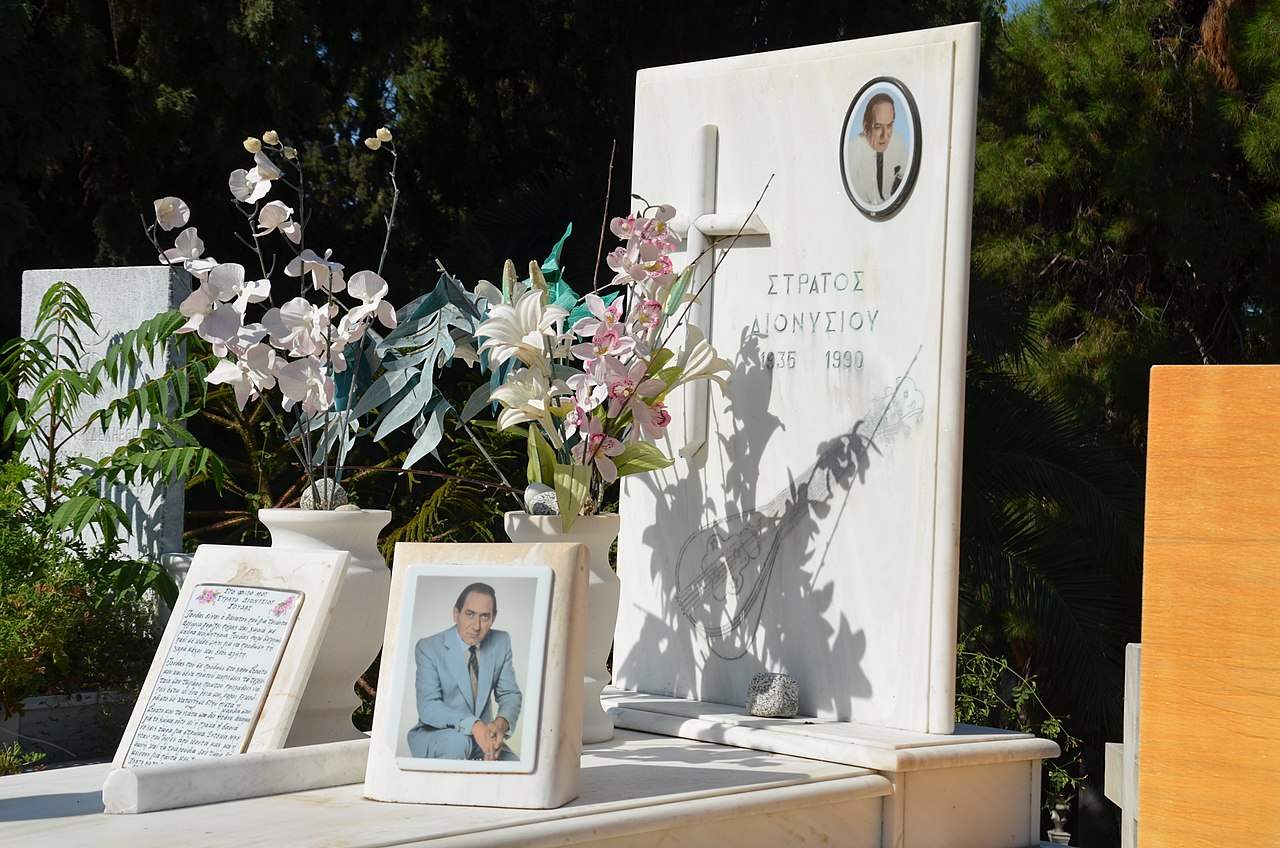
Rakoon · CC0
- Name
- Stratos Dionysiou
- Born
- 8 November 1935
- Birthplace
- Nigrita, Kingdom of Greece
- Died
- 11 May 1990
- Place of death
- Athens, Greece
- Occupation
- Singer, composer, lyricist
- Full name
- Ευστράτιος Παπαδιονυσίου.
- Nationality
- Greece.
- Fields
- laïko.
- Languages
- Modern Greek.
VALÉORINE Encyclopedia
VALÉORINE documentary reading
Documentary summary
Stratos Dionysiou (8 November 1935 – 11 May 1990), nicknamed "To Geraki tis Pistas" (The hawk of the stage), was a Greek singer, composer and lyricist.
Admitted source layer · organised and presented by VALÉORINE
Note VALÉORINE
No house-authored Note is published until its assertions and sources pass the VALÉORINE evidence contract. The documentary article remains available in full while that enrichment is being consolidated.
Documentary enrichment in progress · no unsupported statement published
Reference Check
Propose documentary evidence for Stratos Dionysiou. A contribution is never written directly as fact: identity, source, rights and evidence gates still decide.
Sign in to contribute
World of VALÉORINE
Documentary connections
Only confirmed graph relationships appear here. Images are shown only when their identity and reuse rights both pass the documentary gate.
Documentary evidence
Evidence Panel
not yet certified
- Identity
- resolved
- Independent source families
- 0
- Admitted assertions
- 0
- Open conflicts
- 0
Authority files
wikidata · Q7622239 · wikipedia · Stratos Dionysiou
In this article
Key facts
Key facts
• Name — Stratos Dionysiou • Birth Name — Stratos Dionysiou • Alias — To Geraki tis pistas • Born — 8 November 1935 • Birthplace — Nigrita, Kingdom of Greece • Died — 11 May 1990 • Place of death — Athens, Greece • Instrument — Guitar • Genre — Laïko, rebetiko • Occupation — Singer, composer, lyricist • Years Active — 1958–1990
Early life
Early life
Stratos Dionysiou was born on 8 November 1935, in Nigrita. He was the son of Angelos and Stasa Dionysiou, refugees from Aivali in Asia Minor. In 1947, he moved to Eptalofos of Ampelokipi, Thessaloniki. A year later, his father died. In 1955 he married his childhood love, Georgia Laveni, with whom they had four children: Angelos, Tasoula, Stelios and Diamantis. He was a fan of PAOK.
Early career
Early career
At first, he sang for free in nightclubs, and after working as a peddler and tailor, he debuted as a professional singer at the nightclub "Farida" in Thessaloniki. From his first appearances in the 1950s, Dionysiou attracted the interest of some artists, who urged him to come down to Athens to make more important collaborations. Dionysiou left Thessaloniki for Athens to further his singing career. He appeared in Nikaia nightclub "Asteras" with well-established singer Kaity Grey and in 1958 recorded his first song, "Paranges kai Palatia" (Shacks and Palaces). A year later, he recorded a song by Xristos Kolokotronis, "Ego den eimai enoxos" (I am not Guilty). The song was very successful, because it was released around the same time when Caryl Chessman's execution happened, and people drew connections between the song's lyrics and title and Chessman's death sentence. However, Dionysiou's voice was often mistaken for Stelios Kazantzidis' voice. Dionysiou signed a contract with the recording company Columbia and started singing songs by Xristos Kolokotronis, Babis Bakalis, Kostas Virvos, and others with some success. He also re-recorded old, pre-war and WW2-era rebetiko-gerne songs by Vassilis Tsitsanis, Yiannis Papaioannou, Giorgos Mitsakis and Manolis Chiotis. Huge success, however, did not come until the late 1960s, when he turned several Akis Panou songs into hits: "Και τι δεν κάνω" (What don't I do), "Γιατί καλέ γειτόνισσα" (Why, my good neighbour?), "Του κόσμου το περίγελο" (The laughing stock of the World), "Εγώ καλά σου τα 'λεγα" (I told you so), "Στο σταθμό του Μονάχου" (At Munich Station), "Ήταν ψεύτικα" (They were false) and many others. During his time working at Columbia, he also sang remakes of Indian songs such as "Kardia mou kaimeni" (My poor heart), remake of the Indian song Duniya mein hum aaye hain, featured in the 1957 movie Mother India. In the nightclub "SOU-MOU" where he appeared, he was the second most popular singer; he sang along with female singer Anthoula Alifragki. It's the same nightclub where Mimis Plessas heard him in 1969, and after two months, he wrote the legendary zeibekiko "Vrehi fotia stin strata mou" (Fire is raining down my path) with lyrics by Lefteris Papadopoulos. The song was featured in the 1970 movie "Oratotis Miden" (Zero Visibility) starring Nikos Kourkoulos. Then Dionysiou released the successful songs "O paliatzis", "Baglamades ki bouzoukia", "Enas aitos gremiste", "Agapi mou epikindini" and "Aphilotimi". In the early 1970s, he collaborated with Haris Alexiou, Lizeta Nikolaou and Sofi Pappa in Backing Vocals. Dionysiou also toured the United States with great success.
Arrest and imprisonment
Arrest and imprisonment
In 1973, he was arrested for illegal gun possession and hashish found in his car. He himself claimed that it was a conspiracy of competitors. He was found innocent of gun possession in 1974, but in 1975, on April 9, the trial of the notorious drug-trafficking case began at the Criminal Court of Thessaloniki. The decision that came out on May 30 sentenced him to imprisonment and exile (the latter was part of the typical sentence for drug-related offences). He was released thanks to an amnesty from prison in the spring of 1976. At this moment, his colleague and friend Tolis Voskopoulos, who in 1977 wrote and gave him the song "I fell asleep", especially supported him. While in prison, he recorded and released the album "Pali Mazi mas".
Post-release career
Post-release career
The climate in public opinion was heavy. When Dionysiou was released from prison, he was faced with rejection. No high-profile company wanted to work with him and no businessman wanted him in their nightclub. But Stratos did not give up. He persisted and finally managed to return to the music scene with the Minos company. The director of the company at the time was Makis Matsas, who viewed the collaboration with Stratos with great reservations. The prison sentence had discredited Dionysiou's career. But for Matsas, there was another big problem. Stelios Kazantzidis was also recording in Minos at the time, and the coexistence of two big names in the same space might have created problems. After the pressure that Matsas received from Dionysiou, they finally signed a contract with discouraging conditions for the singer. If the first record they would make did not exceed 30,000 sales, their collaboration would stop there. Otherwise, they would make two more records on the same terms. The sales of the first album, which had the title "Ypokrinese" (You are pretending), exceeded 100,000 within a few months. Stratos was rewarded for his persistence. The big "comeback" had taken place and the successes followed one another. "I packed up the things", "You took everything and left", "A thin booth" are just some of the songs that Stratos recorded after prison. In the 1980s, Stratos Dionysiou broke every sales record. He made very big hits, songs that are not only heard today, but come out on records, in re-runs, and in covers. They are more or less the songs that everyone once sang and are still heard on the radio today: "You took it all", "And say-say", "Listen, my friend", "The people want a song", "She killed me because I loved her", "I am the stranger", and "Remember". In 1987, he opened his own nightclub named "Stratos", in Filellinon Street.
Personal life
Personal life
Dionysiou married Georgia Laveni in 1955 and had four children, Angelos, Stelios, Diamantis and Tasoula Dionysiou. Of Stratos' four children, Angelos, Diamantis and Stelios Dionysiou are also singers. His daughter, Tasoula Dionysiou, died in April 2012 at the age of 53. From 1980-1989, while married, he had a relationship with Marina Vlaxaki, a singer who was his backing vocalist.
Political views
Political views
Although Dionysiou described himself as a "New Democrat", he believed that everybody was "The same shit", believing that all parties lead to same negative results. He disliked ELAS, due to them letting a Security Battalions commander named Papoulias escape after he bribed them. He was critical of America's influence in Greece, stating, "I believe Greece is being ordered by the big bosses, the Americans, they have separated us for years and we are like plots of land of America. We will do whatever America wants".
Death
Death
Dionysiou died of abdominal aortic aneurysm, in Athens, on 11 May 1990, at age 54. His funeral took place in the First Cemetery of Athens. His funeral was attended by hundreds of people as well as other singers and actors. A few hours before his last breath, he was singing in "Stratos", while earlier, that same afternoon, he recorded nine songs for the record "Poios allos" (Who Else) which was released a month after his death, making a sales records. According to Takis Mousafiris, the last song he recorded that day was "Don't leave me alone".
Posthumous
Posthumous
• Year — Title — Notes • 1990 — Ποιος Αλλος — 130.000 sales (platinum disc) • 1990 — 30 Χρονια Επιτυχιες — 2 Cd (200.000 sales) (platinum disc) • 1990 — Mega Souxe • 1991 — Η Ελλάδα Του Στέλιου και Του Στράτου • 1991 — Στα Ξενυχτάδικα Της Αγκαλιάς Σου (Συμμετοχή 2 Τραγούδια) • 1991 — Τα Λαϊκά • 1991 — Τραγούδια για τούς φίλους του • 1993 — Τα Ζεϊμπέκικα Του Γρηγόρη και Του Στράτου • 1994 — Από τους θησαυρούς των 45 στροφών • 1994 — Τα Ωραία του Διονυσίου • 1995 — Αξέχαστες Επιτυχίες Νο 2 • 1996 — Τραγούδια από τις 45 στροφές 1 • 1996 — Τα Σπάνια • 1997 — Αξέχαστα τραγούδια • 1997 — Τραγούδια από τις 45 στροφές 2 • 1997 — Τα τραγούδια που αγαπήσαμε • 1998 — Αγάπης βάσανα • 1998 — Τραγούδια από τις 45 στροφές 3 • 2000 — Άκου βρε φίλε • 2000 — Τραγούδια από τις 45 στροφές 4 • 2000 — Οι Μεγαλύτερες Επιτυχίες Του • 2000 — Πρώτη Εκτέλεση (Συμμετοχή 3 Τραγούδια) • 2001 — Τραγούδια από τις 45 στροφές 5 • 2002 — Οι Μεγαλύτερες Επιτυχίες Του Νο 2 • 2002 — Τα Αυθεντικά (4 Cd) • 2003 — Βρέχει φωτιά στη στράτα μου (2 Cd) • 2004 — Τ΄αγκάθια της καρδιάς • 2004 — Της Νύχτας Το Μινόρε • 2005 — Ο Στεναγμός Μου • 2005 — Τα τραγούδια του Στράτου (2 Cd) • 2006 — 14 Μεγάλα Τραγούδια • 2006 — 14 Μεγάλα Τραγούδια Νο 2 • 2006 — Για Πάντα Live Στην Αμερική (2 Cd) • 2006 — Ανθολογία - 1934-1990 (4 Cd) • 2007 — Ένας Δίσκος Η Ζωή Του (6 Cd) • 2007 — Τραγουδάει Μίμη Πλέσσα (2 Cd) • 2007 — Τραγουδάει Τάκη Σούκα (2 Cd) • 2008 — Βρέχει φωτιά στη στράτα μου (4 Cd) • 2008 — Χρυσή Δισκοθήκη • 2009 — Αφιέρωμα Στο Στράτο • 2009 — Live Ηχογραφήσεις (2 CD) • 2009 — Ντοκουμέντα • 2009 — Ο Λαός Τραγούδι Θέλει (6 CD) • 2012 — Ο Λαός Τραγούδι Θέλει Best of (4 CD)
Places
Named by the record
Places
Only places the record itself states, plotted where the house gazetteer settles their coordinates. Nothing is inferred from a name or a nationality.
Nigrita.
Birth place
Athens.
Death place
Legacy
His funeral took the form of lying in state. For some time, people were pushing to get close to the singer's body, while there were women who fainted. Many, in order to be able to see, climbed on neighboring graves, causing damage, which was later paid for by the Dionysiou family. "All roads were closed. I mean, I was speechless. I didn't expect so many simple people loved Stratos. He was, after all, the great popular singer", said Giorgos Polychroniadis, who sang together with Dionysiou. People said goodbye to their favorite singer with songs. Stratos Dionysiou's death left behind songs that are still heard today, but also a great void in Greek music. After Dionysiou's death, Notis Sfakianakis released the song "o Stratos" in his honor.
Discography
• Year — Title — Notes • 1969 — Στράτος Διονυσίου • 1970 — Μαζί με το Στράτο • 1971 — Στράτος Διονυσίου (3) • 1972 — 4.5.3 — Contributed 5 songs • 1972 — Στράτος Διονυσίου 4 • 1973 — Μπαγλαμάδες και μπουζούκια • 1974 — Νεώτερα κι ανώτερα — Contributed 6 songs • 1974 — Τα 12 του Στράτου • 1974 — Χρυσός Δίσκος — Contributed 2 songs • 1975 — Τραγουδά Άκη Πάνου • 1976 — Πάλι μαζί μας • 1976 — Πικρά κι ανθρώπινα • 1977 — 14 Χρυσές Επιτυχίες • 1977 — Αν ξαναζούσα • 1977 — Αξέχαστα τραγούδια • 1978 — 14 Χρυσές Επιτυχίες Νο 2 • 1978 — Τα Ορθόδοξα — 50.000 sales (golden disk) • 1979 — Γυναίκες γυναίκες • 1980 — Υποκρίνεσαι — 100.000 sales (platinum disc) • 1981 — Όλα είναι δανεικά — 100.000 sales (platinum disc) • 1981 — Τα ωραία του Διονυσίου • 1982 — Αξέχαστες επιτυχίες • 1982 — Θυμήσου — 50.000 sales (golden disk) • 1983 — Αξέχαστες επιτυχίες 2 • 1983 — Της γυναίκας η καρδιά — 50.000 sales (golden disk) • 1984 — Λαϊκά και πάσης Ελλάδος — Contributed 5 songs, 50.000 sales (golden disk) • 1984 — Μόνο οι ερωτευμένοι — 50.000 sales (golden disk) • 1985 — Αυτά που τραγουδήσαμε • 1985 — Ο Σαλονικιός — 100.000 sales (platinum disc) • 1986 — Για πάντα • 1986 — Ο ταξιτζής — Contributed 5 songs, 50.000 sales (golden disk) • 1987 — Δυο δυο — Contributed 7 songs • 1987 — Κράτησε με — Contributed 2 songs • 1987 — Οι Μεγαλύτερες Επιτυχίες Του • 1987 — Ο λαός τραγούδι θέλει — 50.000 sales (golden disk) • 1987 — Ζωντανή Ηχογράφηση — Contributed 2 songs • 1988 — Εγώ ο ξένος — 150.000 sales (platinum disc) • 1989 — Νομίζεις — 100.000 sales (platinum disc)
Citations
References
Each reference names the institution holding it, so a reader may go to the document itself.
reference work
Partially resolvedreference work
Partially resolved
The Encyclopedia exists whether or not anything is for sale. Corrections are recorded rather than overwritten, and every version of this record is kept. Published 19 August 2026.
Elsewhere in Music memorabilia
42,438 published records in this field, each with its sources named.
- Stranger ColePerson
- Strap OriginalsOrganisation
- Strata-East RecordsOrganisation
- Stratonice of PontusPerson
- Stratos STAN AntipariotisPerson
- Street LourdOrganisation
- Strictly RhythmOrganisation
- Strut RecordsOrganisation
Best supported in this field
For owners
Own a work by Stratos Dionysiou?
A specialist will read what you send and tell you what the house can establish, what it cannot, and whether the object is suited to sale. There is no charge and no obligation. The object stays with you throughout; nothing is shipped to us unless it is arranged in writing beforehand.