
Stokes mortar
The Stokes mortar was a British trench mortar designed by Sir Wilfred Stokes KBE that was issued to the British and U.S. armies, as well as the Portuguese Expeditionary Corps, during the latter half of the First World War. The 3-inch trench mortar was a smooth-bore, muzzle-loading weapon for high angles of fire. Although it was called a 3-inch mortar, its bore was actually 3.2 inches or 81 mm.
Also recorded as 3-inch trench mortar · 3 inch mortar Stokes · 81 mm mortar Stokes
Stokes mortar
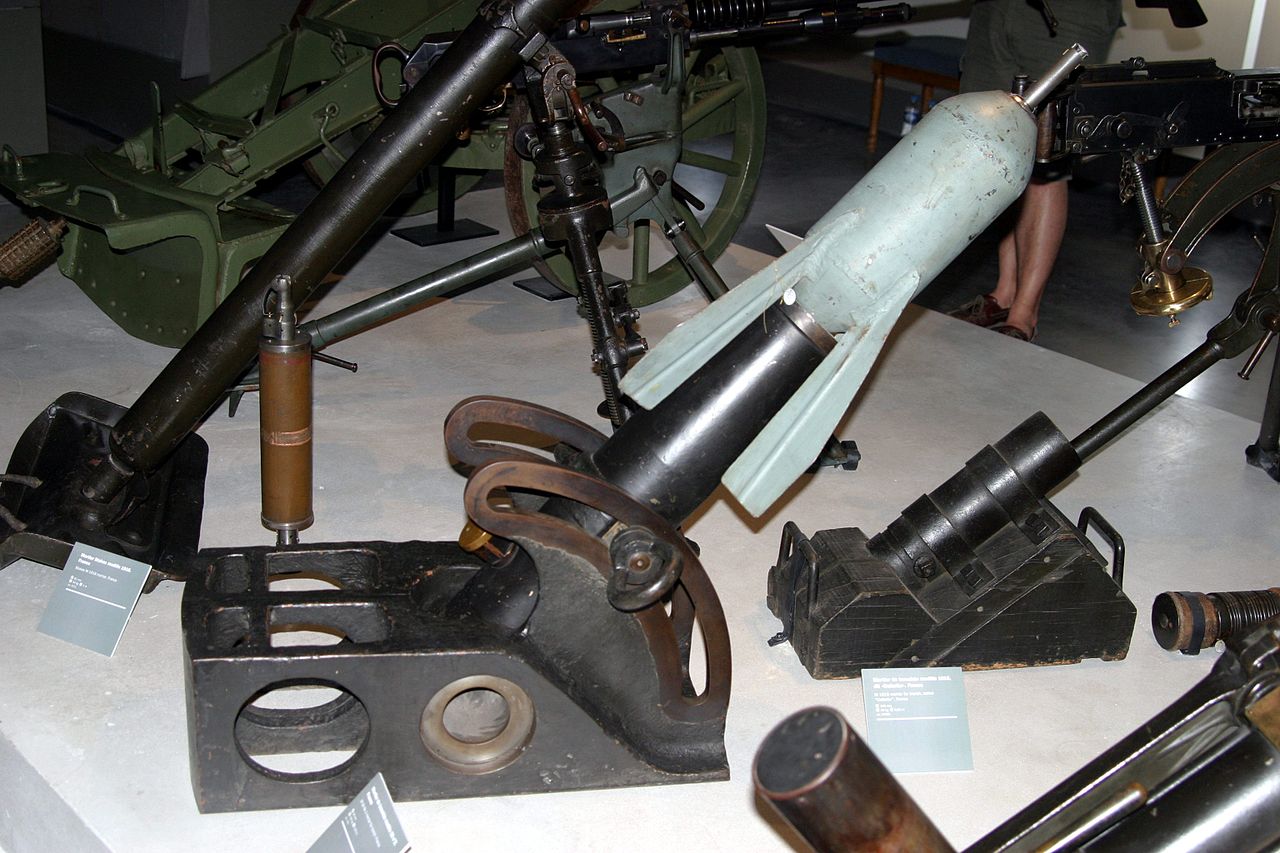
Rama. · Self-creation. · CC BY-SA 2.0 fr
- Name
- 3 inch Stokes mortar
- Field
- 81 mm mortar
- Region
- United Kingdom of Great Britain and Ireland
VALÉORINE Encyclopedia
VALÉORINE documentary reading
Documentary summary
The Stokes mortar was a British trench mortar designed by Sir Wilfred Stokes KBE that was issued to the British and U.S. armies, as well as the Portuguese Expeditionary Corps, during the latter half of the First World War. The 3-inch trench mortar was a smooth-bore, muzzle-loading weapon for high angles of fire. Although it was called a 3-inch mortar, its bore was actually 3.2 inches or 81 mm.
Admitted source layer · organised and presented by VALÉORINE
Note VALÉORINE
No house-authored Note is published until its assertions and sources pass the VALÉORINE evidence contract. The documentary article remains available in full while that enrichment is being consolidated.
Documentary enrichment in progress · no unsupported statement published
Reference Check
Propose documentary evidence for Stokes mortar. A contribution is never written directly as fact: identity, source, rights and evidence gates still decide.
Sign in to contribute
World of VALÉORINE
Documentary connections
Only confirmed graph relationships appear here. Images are shown only when their identity and reuse rights both pass the documentary gate.

Documentary evidence
Evidence Panel
not yet certified
- Identity
- resolved
- Independent source families
- 0
- Admitted assertions
- 0
- Open conflicts
- 0
Authority files
wikidata · Q1767309 · wikipedia · Stokes mortar
In this article
Key facts
Key facts
• Name — 3 inch Stokes mortar • Origin — United Kingdom • Type — Light mortar • Is Ranged — yes • Is Explosive — yes • Is Artillery — yes • Is Uk — yes • Used By — * British Empire • Belgium • French Third Republic • Kingdom of Greece • Kingdom of Italy • Paraguay • Netherlands • Second Polish Republic • Portugal • Commonwealth of the Philippines • United States • Wars — * World War I • World War II • Banana Wars • Chaco War • Designer — Sir Wilfred Stokes KBE • Design Date — 1915 • Weight — total • Crew — 2 • Cartridge — HE • Action — Trip • Rate — 25 rpm (maximum) 6–8 rpm (sustained) • Elevation — 45–75° • Filling — Amatol
Design
Design
The Stokes mortar was a simple weapon, consisting of a smoothbore metal tube fixed to a base plate (to absorb recoil) with a lightweight bipod mount. When a mortar bomb was dropped into the tube, an impact sensitive primer in the base of the bomb would make contact with a firing pin at the base of the tube, and ignite the propellant charge in the base, launching the bomb towards the target. The warhead itself was detonated by an impact fuse on reaching the target. The barrel was a seamless drawn-steel tube necked down at the breech or base end. A base cap was fitted to the breech end, within which a firing pin was secured, protruding into the barrel. The caps at each end of the bomb cylinder were 81 mm diameter. The bomb was fitted with a modified hand grenade fuse on the front, with a perforated tube containing a propellant charge and an impact-sensitive cap at the rear. Range was determined by the amount of propellant charge used and the angle of the barrel. A basic propellant cartridge was used for all firing, and covered short ranges. Up to four additional "rings" of propellant were used for incrementally greater ranges. The four rings were supplied with the cartridge and gunners discarded the rings that were not needed. One potential problem was the recoil, which was "exceptionally severe, because the barrel is only about 3 times the weight of the projectile, instead of about one hundred times the weight as in artillery. Unless the legs are properly set up they are liable to injury". A modified version of the mortar, which fired a modern fin-stabilised streamlined projectile and had a booster charge for longer range, was developed after World War I; this was in effect a new weapon.
History
History
Light mortars portable by one man had already been in use centuries earlier, but had fallen out of general usage since the Napoleonic era. With the many changes to battlefield doctrine during the First World War, the concept gained interest again. At first the British and French resorted to re-issuing these obsolete mortars; after modernised designs became available, the Stokes mortar in particular gained popularity. Frederick Wilfred Scott Stokes designed the mortar in January 1915. The British Army was at the time trying to develop a weapon that would be a match for the Imperial German Army's Minenwerfer mortar, which was in use on the Western Front. Stokes's design was initially rejected in June 1915 because it was unable to use existing stocks of British mortar ammunition. It took the intervention of David Lloyd George (at that time Minister of Munitions) and Lieutenant-Colonel J. C. Matheson of the Trench Warfare Supply Department (who reported to Lloyd George) to expedite manufacture of the Stokes mortar. In the last quarter of 1915, 304 Stokes mortars were produced. Only 104 of these reached the front, however, the remainder being sent to training schools. The subcontracting-out of manufacture of the mortar mounting was undertaken in February 1916. In March 1916, it was announced the light trench mortars would be controlled by Infantry Brigades. The handbook for the Stokes trench mortar was issued to the infantry in April 1916. In total, 11,331 3-inch Stokes mortars were manufactured in Britain. It remained in service into the Second World War, when it was superseded by the Ordnance ML 3 inch mortar, and some remained in use by New Zealand forces until after the Second World War. Stokes was knighted as a Knight of the British Empire in 1917 for inventing the mortar. He was also given several forms of monetary reward by the Ministry of Munitions. The French developed an improved version of the Stokes mortar as the Brandt Mle 27, further refined as the Brandt Mle 31; this design was widely copied with and without licence. Despite their indigenous production, out of 8,000 81 mm mortars in service with the French in 1939, 2,000 were of the original Mk. I build purchased from Great Britain.
Usage
Usage
• Illustration — Portuguese Expeditionary Corps soldiers loading a Stokes mortar, on the Western Front during World War I. In World War I, the Stokes mortar could fire as many as 25 bombs per minute and had a maximum range of 800 yd firing the original cylindrical un-stabilised projectile. British Empire units had 1,636 Stokes mortars in service on the Western Front at the Armistice.
American usage
American usage
After American entry into World War I, the Stokes mortar was standardised as the "Mortar, Trench, 3", Mk. I" and "Mortar, Trench, 3", Mk. IA2." Although production of the weapon was started in the United States before the end of the war, few American-built weapons reached France and most of those actually used in combat were of British manufacture. It was used in the Banana Wars and helped American forces defeat Sandinista rebels during the Second Battle of Las Cruces on 1 January 1928. Refinements of the British Stokes mortar were made by French weapons designer Edgar Brandt in the interwar period, resulting in the Brandt mortar. The new weapon, which was adopted by the Americans as the M1 mortar and put into limited production starting in 1935, had a heavier barrel, cross-leveling device on the bipod, and a new base plate. By 1942, the Mk. I and Mk. IA2 had been fully supplanted by the M1 and reclassified as "limited standard."
Other usage
Other usage
The Paraguayan Army made extensive use of the Stokes mortar during the Chaco War, especially as a siege weapon in the Battle of Boquerón in September 1932. The Bolivian Army also used them in the same conflict. Stokes mortars were widely used by the Republican Army during the Spanish Civil War, sold mostly by Poland. In September 1936, 44,000 Stokes rounds arrived in Spain.
South Persia Rifles usage
South Persia Rifles usage
• Qajar Iran – South Persia Rifles received four Stokes mortars and 1,000 rounds of ammunition to complete its artillery complement.
4-inch variant
4-inch variant
A 4 in calibre version of the Stokes design was used to fire smoke, poison gas, and thermite (incendiary) rounds. A quantity of just under thirty were first used at the Battle of Loos in September 1915. Up to the end of 1918, a total of 1,123 were manufactured. This weapon, used solely by the Special Brigade of the Royal Engineers, should be considered a separate weapon from the standard "3-inch" 81 mm version used by the infantry.
Image gallery
Image gallery
• Illustration — High explosive bomb • Illustration — No. 145 percussion fuze • Illustration — Men of the KOYLI fusing Stokes shells near Wieltje, 1 October 1917 • Illustration — An intact Stokes shell found during the iron harvest in 2004 near Ypres and placed on a telegraph pole for collection and disposal
Surviving examples
Surviving examples
• Australian War Memorial, Canberra • An example with bombs is displayed at l'hotel de ville d'Arras, France.

Diagram of British No. 145 Mk I Percussion Fuze. Used with the Stokes Mortar. No. 146 Fuze was similar, made by the American CA Vandervell Co for use with bombs it also manufactured.
Royal Laboratory · Royal Laboratory. "Fuze Diagrams" December 1917. Supplied by Allan Brown: British Ordnance Collectors Network

Diagram showing British No. 147 Mk I percussion fuze for trench mortar bombs.
War Office, UK. · Plate XIX in "Handbook of the M.L. Stokes 3-Inch Trench Mortar Equipments. 1919." Published by His Majesty's Stationery Office, London, 1920. This version digitised by and downloaded from
Places
Named by the record
Places
Only places the record itself states, plotted where the house gazetteer settles their coordinates. Nothing is inferred from a name or a nationality.
United Kingdom of Great Britain and Ireland
Country
Stokes mortar is associated with United Kingdom of Great Britain and Ireland.
Country
Notes from the source article
Cited by Wikipedia
Notes from the source article
These works are cited by the source article, in its own numbering. They are recorded as its citations, not as sources VALÉORINE has verified.
- 1.The Military Evolution. CLAUDIO VELAZQUEZ PLAIN. EDITORIAL GOYA. Pags 82-83.
- 2.Mortero Stokes Brandt de 81mm - El mortero del Chaco. May 2025.
- 3.Boselli Cantero, Cristina. Una guerra desconocida: la campaña del Chaco Boreal, 1932–1935. Lector. 4 & 5. 2000. 99925-51-91-7.
- 4."Appendix D. Details of Trench Mortars" in "Field Artillery Notes No. 7". Mortar=48 lb; Elevating Stand=28 lb; Base Plate=28 lb; Total Weight for Transport = 104 lbs
- 5."Appendix E. Details of Ammunition" in "Field Artillery Notes No. 7". This figure is for the unstabilised cylindrical bomb used in World War I.
- 6.War Dept. Technical Manual TM9-2005, Volume 3, Ordnance Materiel - General, p. 17, December 1942
- 7."Appendix D. Details of Trench Mortars" in "Field Artillery Notes No. 7"
- 8."Appendix E. Details of Ammunition" in "Field Artillery Notes No. 7"
- 9.Stokes's Trench Howitzer 3" Mark I, page 15
- 10.Baker, Chris. The British Trench Mortar Batteries in the First World War. 24 July 2015.
- 11.30250. 24 August 1917. 8795.
- 12.Chris Bishop. The Encyclopedia of Weapons of World War II. Sterling Publishing Company. 202. 2002. 978-1-58663-762-0.
- 13.Brandt mle 27 (Mortier Brandt de 81mm modele 27) Infantry Mortar. www.militaryfactory.com.
- 14.John Norris. Infantry Mortars of World War II. Osprey Publishing. 42–43. 2002. 978-1-84176-414-6.
- 15.The Sandino Rebellion, 1927–1934. www.sandinorebellion.com.
- 16.Howson, Gerald. Armas para España: la historia no contada de la Guerra Civil Española. Península. 2000. 9788483073049.
- 17.Percy Molesworth Sykes. Despatch on Minor Operations in Southern Persia, 7 November 1917 to 31 March 1918. Qatar Digital Library. 8. 1918.
- 18.Ministry of Munitions, Munitions Council: Historical Records Branch. Report on work of Trench Warfare Supplies Department.
- 19.Plumier, Bernard. Surviving 4-in. Stokes trench mortar at Rovereto. 20 August 2008.
- 20.Jalabert, Jean-Luc. Surviving Stokes mortar at Les Invalides. 14 August 2008.
- 21.Australian War Memorial» Blog Archive » Trench Mortar.
- 22.Bernard Plumier : his web page, photograph
Bibliography printed in the source article · 8
- United Kingdom War Office. Range Table For 3-Inch Stokes Mortar. September 1917.
- "Stokes' trench howitzer, 3", mark I". US Army War College, January 1918. via Combined Arms Research Library
- Field Artillery Notes No. 7. US Army War College August 1917. via Combined Arms Research Library
- Canfield, Bruce N. U.S. Infantry Weapons of the First World War. Andrew Mowbray Pub. 2000. 978-0917218903.
- Farndale, M. Western Front 1914–18. Royal Artillery Institution. 1986. 978-1-870114-00-4.
- Ruffell, W. L. The Mortar.
- Saunders, Anthony. A MUSE OF FIRE; British Trench Warfare Munitions, their Invention, Manufacture and Tactical Employment on the Western Front, 1914–18. University of Exeter. 2008.
- Zook, David. The conduct of the Chaco War. Bookman Associates. 1960.
References
Citations
References
Each reference names the institution holding it, so a reader may go to the document itself.
reference work
Partially resolvedreference work
Partially resolved
The Encyclopedia exists whether or not anything is for sale. Corrections are recorded rather than overwritten, and every version of this record is kept. Published 14 August 2026.
Elsewhere in Militaria
6,095 published records in this field, each with its sources named.
- STK 40 AGLTerminology
- STL-1ATerminology
- STM KarguTerminology
- Stoeger Coach GunTerminology
- stone bowTerminology
- Stoner 63Terminology
- Stoner LMGTerminology
- Storm ShadowTerminology
Best supported in this field
For owners
Own an object connected with Stokes mortar?
A specialist will read what you send and tell you what the house can establish, what it cannot, and whether the object is suited to sale. There is no charge and no obligation. The object stays with you throughout; nothing is shipped to us unless it is arranged in writing beforehand.