
standing wheelchair
Illustration — A standing wheelchair is an automated device that assists its user in moving from a seated, to standing position and oftentimes back to flat if the chair has the capabilities of doing so. Standing wheelchairs are common among individuals with: muscular dystrophy, multiple sclerosis, and other ailments that compromise mobility functions. A standing wheelchair (also known as a standing chair, a wheeled stander or a stander) is assistive technology, similar to a standing frame, that allows a wheelchair user to raise the chair from a seated to a standing position.
standing wheelchair
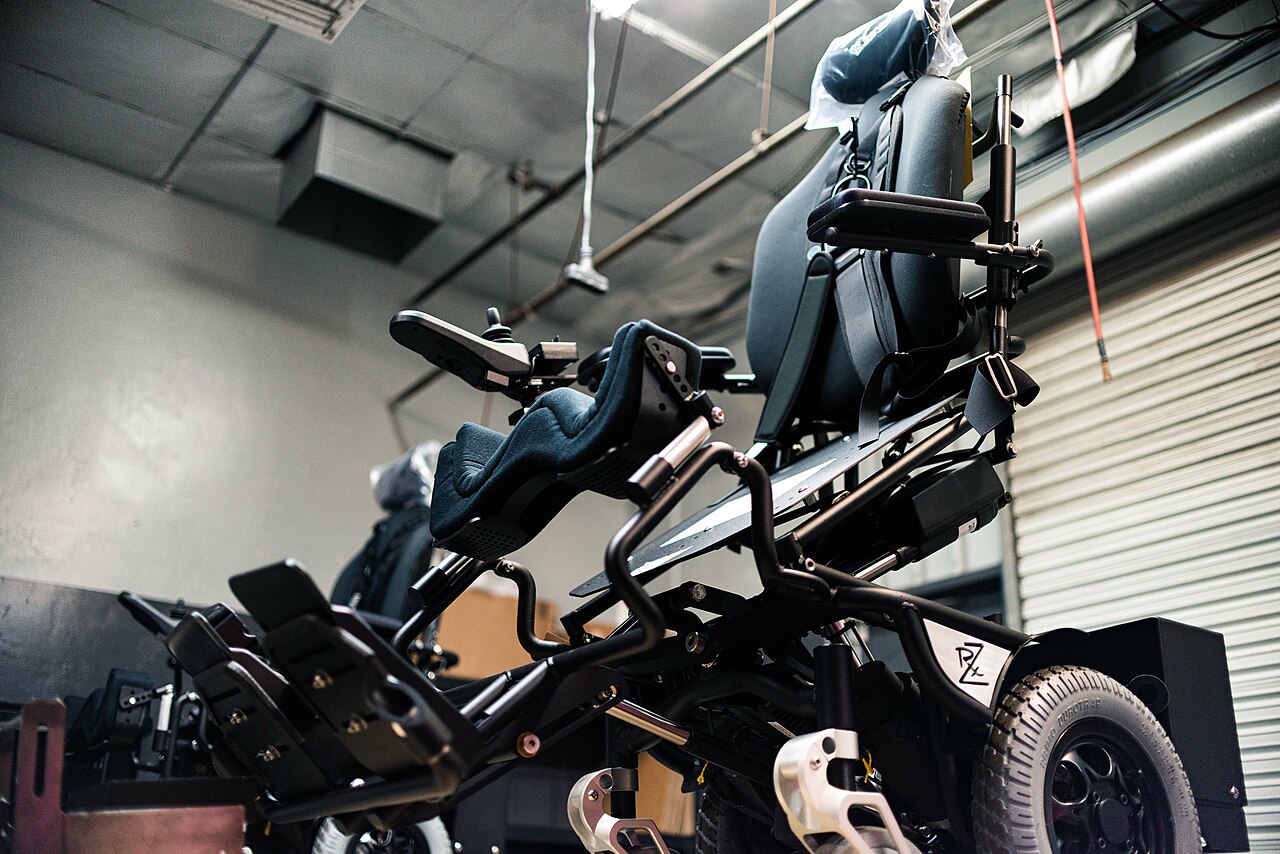
Schieler · CC BY-SA 4.0
- Field
- wheelchair
VALÉORINE Encyclopedia
VALÉORINE documentary reading
Documentary summary
Illustration — A standing wheelchair is an automated device that assists its user in moving from a seated, to standing position and oftentimes back to flat if the chair has the capabilities of doing so. Standing wheelchairs are common among individuals with: muscular dystrophy, multiple sclerosis, and other ailments that compromise mobility functions. A standing wheelchair (also known as a standing chair, a wheeled stander or a stander) is assistive technology, similar to a standing frame, that allows a wheelchair user to raise the chair from a seated to a standing position.
Admitted source layer · organised and presented by VALÉORINE
Note VALÉORINE
No house-authored Note is published until its assertions and sources pass the VALÉORINE evidence contract. The documentary article remains available in full while that enrichment is being consolidated.
Documentary enrichment in progress · no unsupported statement published
Reference Check
Propose documentary evidence for standing wheelchair. A contribution is never written directly as fact: identity, source, rights and evidence gates still decide.
Sign in to contribute
World of VALÉORINE
Documentary connections
Only confirmed graph relationships appear here. Images are shown only when their identity and reuse rights both pass the documentary gate.

Documentary evidence
Evidence Panel
original value insufficient · checked 25 September 2026
- Identity
- resolved
- Independent source families
- 0
- Admitted assertions
- 0
- Open conflicts
- 0
Authority files
wikidata · Q7598631 · wikipedia · Standing wheelchair
In this article
Design and function
Design and function
The standing wheelchair supports the person in a standing position and enables interaction with people and objects at eye level.
While they all hold the same basic function, there is much variety within standing wheelchairs. As assistive devices, standing wheelchairs are primarily designed according to their user's needs. The lifting mechanisms incorporated can be either manually operated or powered with hydraulic devices that range in strength. Wheels can also be power-operated or manual. Steel alloys are often used in production to strike a balance of durability, strength, flexibility and lightness, however there are heavier and lighter metals available. Specific models are built to be used regularly while others only assist in specific tasks. Some standing wheelchairs may even be driven from the standing position, however there is medical concern of an increased risk of bone fractures while driving due to the legs being under a heavy load.
Diagnosis and users
Diagnosis and users
Standing wheelchairs are used by people with mild to severe disabilities including: spinal cord injury, traumatic brain injury, cerebral palsy, spina bifida, muscular dystrophy, multiple sclerosis, stroke, rett syndrome, post-polio syndrome and more. Standing chairs are used by people with both paraplegia and quadriplegia, since a variety of standing options are available to accommodate for mild-to-severe disabilities.
Health benefits
Health benefits
Numerous studies show evidence of standing wheelchairs providing specific health benefits over their non-mechanized counterparts. Some of these benefits have included improved circulation, higher bone density, and lower risk for contractions and skeletal deformation. Several researchers and users alike report that benefits are not solely physical – the greater range of movement provided by mechanized standing wheelchairs allow users to lead more independent lives, resulting in improved mental health and a higher quality of life.
Documentation and funding in the United States
Documentation and funding in the United States
the United States Standing wheelchairs come at prices many consider inaccessible, with powered versions ranging from $10,000-$15,000. This inaccessibility resulted in a push for insurance companies to incorporate this technology into their existing plans. In 2020, the Independence Through Enhancement of Medicare and Medicaid (ITEM) Coalition appealed to the Centers for Medicare and Medicaid Services (CMS), requesting both standing wheelchairs and wheelchairs with power-elevated seats be covered under the Durable Medical Equipment Benefit. That request was partially granted in May 2023, as CMS incorporated wheelchairs with power-elevated seats into the benefit and claimed standing wheelchairs would be considered in the future. As of Now, Medicare may help fund some portion of a standing wheelchair, while Medicaid funding varies from state to state in the U.S. Many insurance companies, vocational rehabilitation organizations, and medical case managers are increasingly funding standing wheelchairs because of the long-term health and quality of life benefits that come from passive standing.
Effective documentation
Effective documentation
Funding (government funding or insurance) for standing equipment is achievable, but usually requires medical justification and a letter of medical necessity (a detailed prescription) written by a physical therapist or medical professional.
Funding sources
Funding sources
In the U.S. there are various funding options for purchasing durable medical equipment (DME) such as standing wheelchairs: • Public insurance/government funding (i.e. Medicaid, Waivers, etc.) • Private insurance companies (i.e. Blue Cross, health maintenance organizations (HMOs), PPOs, etc.) • Worker's compensation • Disability insurance • Liability insurance (i.e. car, home, etc.) • Out-of-pocket (cash or credit card) • Possible payment plan through supplier • Child's school purchase for use at school (i.e. standing is part of child's Individualized Education Program (IEP)) • Purchase by workplace for use while on the job • Purchase through VA Hospital • Assistance from local groups such (i.e. Rotary clubs, Lions, etc.) • Assistance from disability groups (i.e. MDA, MS Society, etc.) Most states have resources such as PAAT (Protection Advocacy for Assistive Technology) and State Technology Assistance Projects that are resources for consumers seeking funding or going through the appeals process.
Notes from the source article
Cited by Wikipedia
Notes from the source article
These works are cited by the source article, in its own numbering. They are recorded as its citations, not as sources VALÉORINE has verified.
- 1.Merai, Sushant. A study and design of standing wheelchair. Materials Today: Proceedings. 65. 3787–3792. 2022. 2214-7853.
- 2.Arva, Julianna. RESNA Position on the Application of Wheelchair Standing Devices. Assistive Technology. 21. 3. 161–168. 2009-09-18. 1040-0435.
- 3.Meade, Paul Amadeus Lane, Jim. Medicare needs to update its wheelchair coverage for the 21st century. STAT. 2022-09-12.
- 4.Gohlke, Jacob Handberg. Exploring powered wheelchair standing device use in children and adults: a longitudinal case series. Disability and Rehabilitation: Assistive Technology. 19. 3. 699–711. 2022-09-12. 1748-3107.
- 5.Young, Kerry Dooley. For many who use power wheelchairs, CMS decision just made seat elevation much less expensive. STAT. 2023-06-05.
- 6.Article – Power Mobility Devices – Policy Article (A52498). cms.gov.
References
Citations
References
Each reference names the institution holding it, so a reader may go to the document itself.
reference work
Partially resolvedreference work
Partially resolved
The Encyclopedia exists whether or not anything is for sale. Corrections are recorded rather than overwritten, and every version of this record is kept. Published 14 August 2026.
Elsewhere in Furniture
924 published records in this field, each with its sources named.
- St Catherine Altarpiece (Master of the Litoměřice Altarpiece)Terminology
- St George's AltarTerminology
- St John AltarpieceTerminology
- standing deskTerminology
- Star FlyerTerminology
- stations of the CrossTerminology
- Statue of Jan KarskiTerminology
- Statue of Jimi HendrixTerminology
Best supported in this field
For owners
Own an object connected with standing wheelchair?
A specialist will read what you send and tell you what the house can establish, what it cannot, and whether the object is suited to sale. There is no charge and no obligation. The object stays with you throughout; nothing is shipped to us unless it is arranged in writing beforehand.