
Sofia
Sofia was the name of two versions of two-passenger vehicles manufactured in Bulgaria in the 1980s and 1990s, from designer Velizar Andreev. • Illustration — A restored Sofia-B example at a retro car meetup in Ruse, Bulgaria, 2019
Sofia
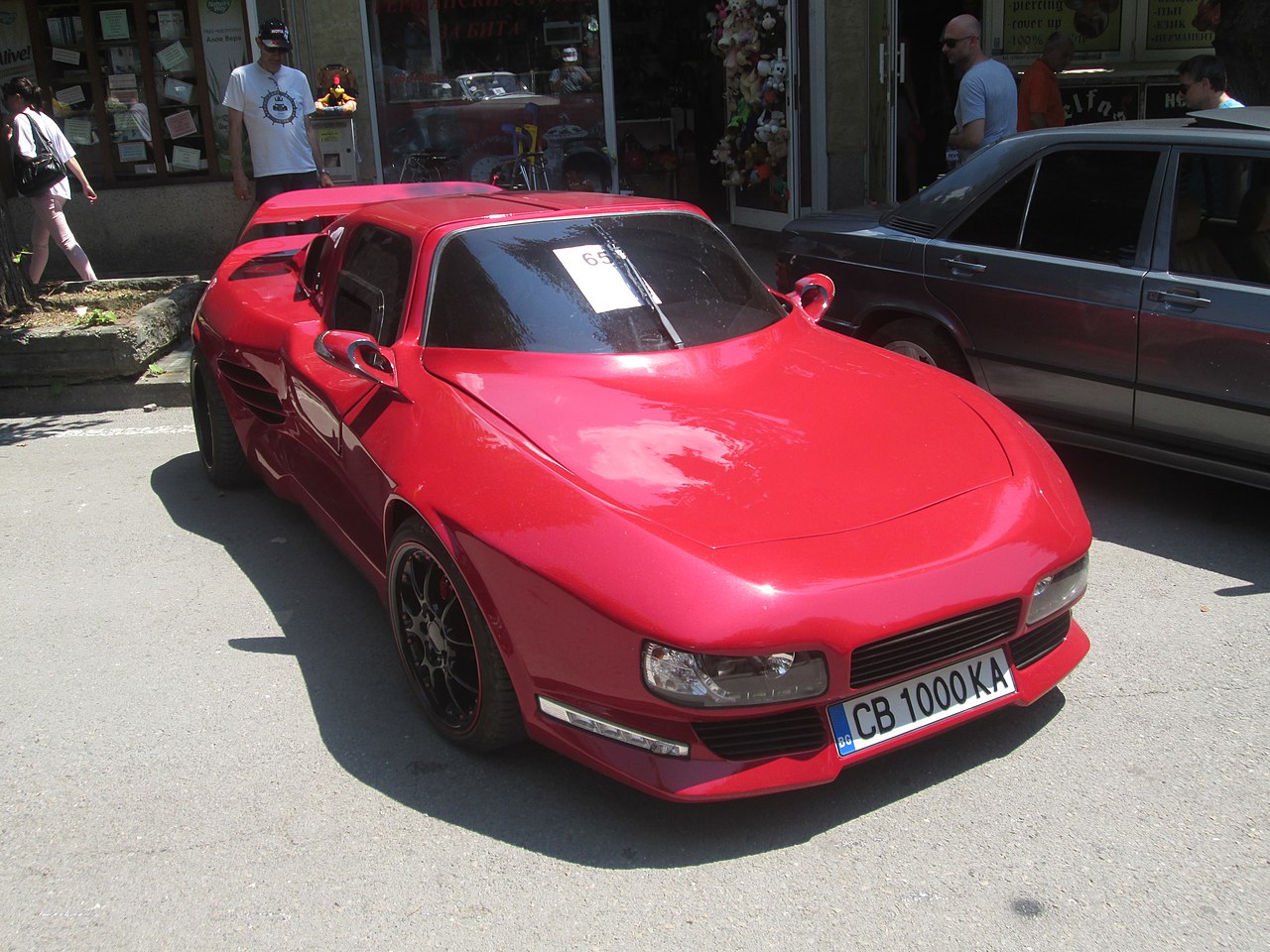
TrainSimFan · CC BY-SA 4.0
- Headquarters
- People's Republic of Bulgaria
VALÉORINE Encyclopedia
VALÉORINE documentary reading
Documentary summary
Sofia was the name of two versions of two-passenger vehicles manufactured in Bulgaria in the 1980s and 1990s, from designer Velizar Andreev. • Illustration — A restored Sofia-B example at a retro car meetup in Ruse, Bulgaria, 2019
Admitted source layer · organised and presented by VALÉORINE
Reference Check
Propose documentary evidence for Sofia. A contribution is never written directly as fact: identity, source, rights and evidence gates still decide.
Sign in to contribute
World of VALÉORINE
Documentary connections
Only confirmed graph relationships appear here. Images are shown only when their identity and reuse rights both pass the documentary gate.
Documentary evidence
Documentary basis
Authority files
gnd · 4077502-1 · wikidata · Q2297423
In this article
History
History
Velizar Andreev attended MEI (Institute for Machinery and Electrical Engineering) in Sofia, graduating in 1962 with an engineering degree in design of vehicles (automobiles, tractors and lift cars). During his studies, he built a fully functioning prototype automobile with modern lines (which has not survived); his graduate project was a mockup of a passenger car. When the graduate project was demonstrated to the grading committee, its non-conservative styling did not sit well, and they gave only a passable grade to the avant-garde design with hidden headlamps. In 1979 Andreev established the Sofia Club, which served as a meeting ground where ideas regarding the design and manufacture of a Bulgarian-made sports car could be freely discussed. About the same time, Andreev collaborated with several auto mechanics students and engineers to build his first prototype sports car. The attractive prototype was made of fiberglass and was entirely designed by Andreev, both mechanically and visually. The engine and some mechanical components were borrowed from the VAZ 2101 In fall 1985 the Plovdiv Fair showcased the prototype of the sports car Sofia B, which Andreev and several collaborators had made in 1984. Although some records mention a dark-red version, historical photographic evidence confirms that the vehicle displayed at the fair was painted white. This prototype featured gull-wing doors and represented the definitive design language of the Sofia sports car series.
Production
Production
• Illustration — The unique factory-custom rounded front end of Sofia-B Chassis #0002, preserved in original factory condition. In 1986 a small industrial cooperative called Avantgarde was formed to begin the production of the sports car Sofia B, whose annual production volume was initially planned at 200 cars.
Historical Prototype: Chassis #0002
Historical Prototype: Chassis #0002
Chassis #0002 is the most historically significant Sofia-B in existence, serving as Velizar Andreev's personal "rolling laboratory" between 1986 and 2006. While originally built to standard specifications, this unit was later personally modified by Eng. Andreev to test new design concepts. These factory-executed evolutions include: • Design & Aerodynamics: A hand-crafted, experimental rounded front-end profile and the unique horizontal integration of inverted Fiat Tipo rear light units, aimed at achieving a "wide-body" supercar aesthetic. • Bespoke Interior: The installation of an authentic prototype dashboard and steering wheel, handcrafted by Andreev himself. • Cinematic Legacy: The Sofia-B model gained national recognition after being featured in the 1990 feature film Karnavalat (The Carnival). • Preservation: Despite its role in design evolution, the vehicle remains an unregistered "time capsule" with only 1,029 km of factory-testing mileage. It has never been road-registered in its 40-year history. Its authenticity is officially recognized by FIVA (Fédération Internationale des Véhicules Anciens) under Identity Card #104356, documenting its transition from a production unit to a primary developmental prototype. In 1989 the Plovdiv Fair again showcased the final version of the Sofia B, painted in gray metallic color; the manufacture of the car was supported by the machine-building firm Balkankar and the Bulgarian Ministry of Machine-Building. The car's headlights were no longer of the flip-up type, instead becoming exposed and mounted on the front of the hood; the car's rear was also radically restyled. The gull-wing doors were abandoned as well, which did not detract from the design and made the car easier to produce and live with. The interior also received numerous improvements. In 1990, after a three-month-long effort, Andreev completed the prototype of a light SUV named Sofia C, with an engine borrowed from a Lada passenger car. That same year also saw the start of serial production of both the Sofia B and the Sofia C, made by Andreev's own private company Vilicar. During the 1990s, Andreev broadened the scope of his automotive-related activities by continuing to produce his own cars, and by tuning private passenger cars and converting passenger cars into commercial delivery vehicles. In 1997 Andreev also produced a prototype of a small passenger bus which was exhibited at the Plovdiv Fair. It was based on an Avia chassis.
End
End
Until his death in 2001, Velizar Andreev successfully defended and advanced an idea that seemed ludicrous to many others – the design and serial production of Bulgarian sports cars. His automotive workshop became the first and, until now, the only applied school for young Bulgarian car designers. After his death his son, Bozidar Andreev, became president of a company which continues providing parts and conversions for vehicles, including Sofias.
Production numbers
Production numbers
• Sofia-B (1985–2001): 12 • Sofia-C (1990–2001): 60
Catalogued output
Publications and programmes
The following works and productions are recorded by name or by count.
Collections and holdings
Where the work is held
Collections and holdings
Institutional holdings are recorded as follows.
Documents and archives
Primary material
Documents and archives
authority file
- Gemeinsame Normdatei 4077502-1, Sofia.
General reference · Deutsche Nationalbibliothek
reference work
- Wikidata, structured authority record Q2297423: Sofia
Reputable secondary · Wikidata
Notes from the source article
Cited by Wikipedia
Notes from the source article
These works are cited by the source article, in its own numbering. They are recorded as its citations, not as sources VALÉORINE has verified.
- 1.Bulgarian National Film Archive, "Karnavalat" (1990), featuring Sofia-B sports cars.
- 2.FIVA (Fédération Internationale des Véhicules Anciens) official certification database, ID #104356.
- 3.Photographs of an orange Sofia C
References
Citations
References
Each reference names the institution holding it, so a reader may go to the document itself.
authority file
Gemeinsame Normdatei 4077502-1, Sofia.Deutsche Nationalbibliothek
Secondary witnessreference work
Secondary witness
The Encyclopedia exists whether or not anything is for sale. Corrections are recorded rather than overwritten, and every version of this record is kept. Published 16 August 2026.
Elsewhere in Collectables
20,755 published records in this field, each with its sources named.
- Soda Drinker ProWork
- SODA Off-Road RacingWork
- SodinaTerminology
- SofasaOrganisation
- softballTerminology
- Softporn AdventureWork
- software synthesizerTerminology
- sofuto biniruTerminology
Best supported in this field
For owners
Own an object connected with Sofia?
A specialist will read what you send and tell you what the house can establish, what it cannot, and whether the object is suited to sale. There is no charge and no obligation. The object stays with you throughout; nothing is shipped to us unless it is arranged in writing beforehand.