
Sigmund Freudenberger
Sigmund Freudenberger (16 June 1745 – 15 November 1801) was a Swiss painter, engraver and etcher associated with the Bernese Kleinmeister tradition. After training in Switzerland and working in Paris, he returned to Bern, where rural genre scenes became central to his work.
Also recorded as Freudenberger · S. Freudenberg · Siegmund Freudenberger
Sigmund Freudenberger

Anton Hickel · Schloss Oberhofen. Berner Maler vom Barock bis zum Biedermeier, Bern 1970, S. 27. · Public domain
- Name
- Sigmund Freudenberger
- Born
- 16 June 1745
- Birthplace
- Bern, Switzerland
- Died
- 15 November 1801
- Known for
- Painting, drawing, engraving, etching
- Spouse
- Marianne Mesmer
- Nationality
- Switzerland.
- Occupation
- painter, printmaker and draftsperson.
- Fields
- portrait and erotic.
- Teachers
- Jakob Emanuel Handmann.
VALÉORINE Encyclopedia
VALÉORINE documentary reading
Documentary summary
Sigmund Freudenberger (16 June 1745 – 15 November 1801) was a Swiss painter, engraver and etcher associated with the Bernese Kleinmeister tradition. After training in Switzerland and working in Paris, he returned to Bern, where rural genre scenes became central to his work.
Admitted source layer · organised and presented by VALÉORINE
Reference Check
Propose documentary evidence for Sigmund Freudenberger. A contribution is never written directly as fact: identity, source, rights and evidence gates still decide.
Sign in to contribute
World of VALÉORINE
Documentary connections
Only confirmed graph relationships appear here. Images are shown only when their identity and reuse rights both pass the documentary gate.
Documentary evidence
Documentary basis
Authority files
wikidata · Q2284963 · wikipedia · Sigmund Freudenberger
In this article
Biography
Biography
Training under Jakob Emanuel Handmann is recorded. Gottfried Mind and Franz Niklaus König are recorded as having studied under Sigmund Freudenberger. Subjects and genres recorded for the work are portrait and erotic. Places of work recorded in the authority are Bern. Work by Sigmund Freudenberger is recorded in the collections of Städel Museum, Musée Cognacq-Jay, Print Collection and Museum Boijmans Van Beuningen.
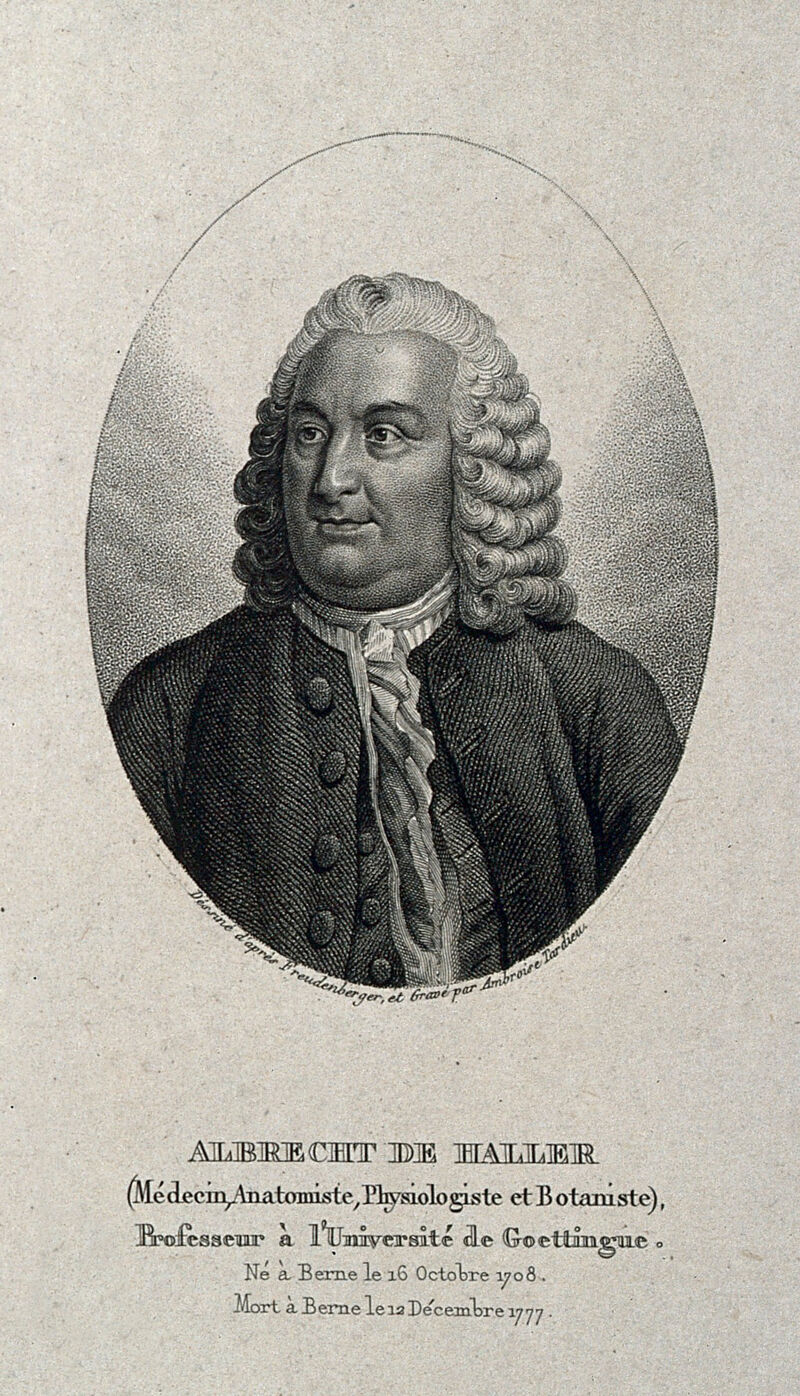
Baron Albrecht von Haller. Stipple engraving by A. Tardieu after S. Freudenberger., by Sigmund Freudenberger
Sigmund Freudenberger · Wellcome Collection, London · Wellcome Collection
![An old fortune-teller is visiting a couple and their newborn baby, whose birth she had predicted. Etching by F.A. Milius after S. Freudenberger, 1860/1890., [1860/1890], by Sigmund Freudenberger](https://iiif.wellcomecollection.org/image/V0025925/full/800,/0/default.jpg)
An old fortune-teller is visiting a couple and their newborn baby, whose birth she had predicted. Etching by F.A. Milius after S. Freudenberger, 1860/1890., [1860/1890], by Sigmund Freudenberger
Sigmund Freudenberger · Wellcome Collection, London · Wellcome Collection
Key facts
Key facts
• Name — Sigmund Freudenberger • Born — 16 June 1745 • Birthplace — Bern, Switzerland • Died — 15 November 1801 • Place of death — Bern, Switzerland • Known for — Painting, drawing, engraving, etching • Spouse — Marianne Mesmer
Biography
Biography
Sigmund Freudenberger was born in Bern on 16 June 1745.[1] He studied with Emanuel Handmann from 1761 to 1764, following him from Bern to Basel in the final year of his training.[2] After spending several months in Lausanne on portrait commissions, Freudenberger left for Paris in 1765 with the engraver Adrian Zingg. In Paris, Zingg helped introduce him to artistic circles, including that of Johann Georg Wille. While in Paris, Freudenberger attended Jakob Schmutzer's evening academy. He also joined Wille on outdoor study excursions between 1766 and 1770 and came into contact with François Boucher through Wille. He returned to Bern in 1773 and married Marianne Mesmer in 1776. Freudenberger died in Bern on 15 November 1801.
Work
Work
Freudenberger produced paintings, drawings, engravings and etchings, with a focus on Swiss genre subjects.[3] His work included pastel portraits, rural genre scenes and depictions of traditional dress, and he adapted elements of Parisian Rococo art to rural Bernese subjects. After his return to Bern in 1773, he had success with rural genre scenes, many of which were reproduced as engravings and circulated widely.[4] From the mid-1770s onward, rural genre scenes became a central part of his work. In 1778, Freudenberger received official protection against unauthorised copies of his prints. The Heptaméron Français, which he illustrated with Balthasar Anton Dunker, was published from 1778 to 1780. In 1785, he produced the costume series Premier Cahier des différents Habillements de la Ville de Berne. Freudenberger is considered one of the leading Bernese Kleinmeister of the late 18th century. Works by Freudenberger are held in collections including the Öffentliche Kunstsammlung Basel, Kunstmuseum Bern, the Swiss National Library, Kunsthaus Zürich and the Graphische Sammlung of ETH Zurich.
Gallery
Gallery
• Illustration — Return of the Swiss Soldier • Illustration — The Ribbon Seller • Illustration — Scene on a balcony
Life and career
Dated record
Life and career
The full dated record · 2 entries
1745
Sigmund Freudenberger born at Bern.
1801
Sigmund Freudenberger died at Bern.
Notes from the source article
Cited by Wikipedia
Notes from the source article
These works are cited by the source article, in its own numbering. They are recorded as its citations, not as sources VALÉORINE has verified.
- 1.Bhattacharya, Tapan. Sigmund Freudenberger. Historisches Lexikon der Schweiz (HLS). 28 August 2007.
- 2.Haldemann, Anita. Sigmund Freudenberger. SIKART Lexikon zur Kunst in der Schweiz. 2014.
- 3.Sigmund Freudenberger. British Museum.
- 4.Blösch, Emil. Freudenberger, Sigmund. Allgemeine Deutsche Biographie. 1878.
References
Citations
References
Each reference names the institution holding it, so a reader may go to the document itself.
reference work
Wikidata, structured authority record Q2284963: Sigmund FreudenbergerWikimedia Foundation
Secondary witnessreference work
Secondary witness
Further particulars
Held on the record
Further particulars
Open the remaining particulars
He trained under Jakob Emanuel Handmann. Each of those relationships is stated by the authority record rather than inferred from style.
Recognition and collections
Work by Sigmund Freudenberger is
Städel Museum, Musée Cognacq-Jay, Print Collection and Museum Boijmans Van Beuningen
The Encyclopedia exists whether or not anything is for sale. Corrections are recorded rather than overwritten, and every version of this record is kept. Published 16 August 2026.
Elsewhere in Prints
4,138 published records in this field, each with its sources named.
- Shūhō YamakawaEngraver
- Sieuwert van der MeulenEngraver
- Sigmar PolkeEngraver
- Sigmund AbelesEngraver
- Silvi LiivaEngraver
- Silvia KolbowskiEngraver
- Simeon JocelynEngraver
- Simó GómezEngraver
Best supported in this field
For owners
Own a work by Sigmund Freudenberger?
A specialist will read what you send and tell you what the house can establish, what it cannot, and whether the object is suited to sale. There is no charge and no obligation. The object stays with you throughout; nothing is shipped to us unless it is arranged in writing beforehand.