
Shiba Kōkan
Shiba and Andō
Also recorded as Rantei · Ando Katsusaboro Fugen Dojin · Harushige Suzuki · Ando Kichijiro
Shiba Kōkan
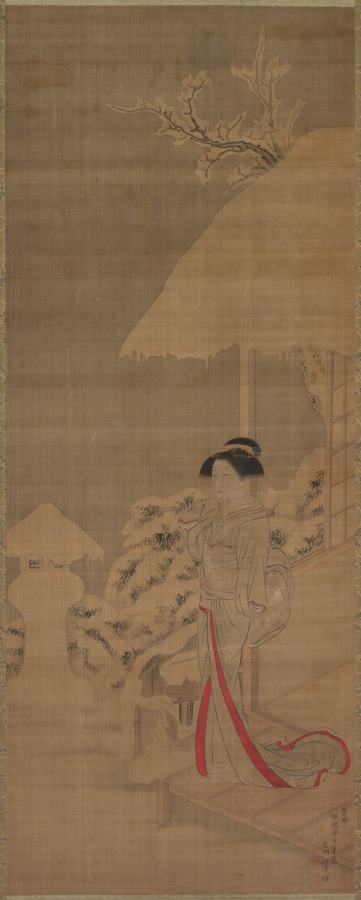
Shiba Kōkan · The Cleveland Museum of Art · Kelvin Smith Fund · CC0
- Name
- Shiba Kōkan
- Birth Name
- Andō Kichijirō
- Born
- 1747
- Birthplace
- Edo (Tokyo)
- Died
- 1818
- Known for
- Ukiyo-e, oil painting, copper engraving
- Movement
- Rangaku
- Nationality
- Japan
- Occupation
- cartographer · painter · printmaker · Rangaku scholar · ukiyo-e artist · xylographer · artist
VALÉORINE Encyclopedia
VALÉORINE documentary reading
Documentary summary
Shiba and Andō
Admitted source layer · organised and presented by VALÉORINE
Note VALÉORINE
No house-authored Note is published until its assertions and sources pass the VALÉORINE evidence contract. The documentary article remains available in full while that enrichment is being consolidated.
Documentary enrichment in progress · no unsupported statement published
Reference Check
Propose documentary evidence for Shiba Kōkan. A contribution is never written directly as fact: identity, source, rights and evidence gates still decide.
Sign in to contribute
Documentary evidence
Evidence Panel
wikipedia incomplete · checked 25 September 2026
- Identity
- resolved
- Independent source families
- 0
- Admitted assertions
- 0
- Open conflicts
- 0
Authority files
wikidata · Q652953 · wikipedia · Shiba Kōkan
In this article
Key facts
Key facts
• Name — Shiba Kōkan • Birth Name — Andō Kichijirō • Born — 1747 • Birthplace — Edo (Tokyo) • Died — 1818 • Place of death — Edo (Tokyo) • Known for — Ukiyo-e, oil painting, copper engraving • Movement — Rangaku • Illustration — A meeting of Japan, China, and the West, by Shiba Kōkan. • Illustration — Rakan, by Shiba Kōkan. Shiba Kōkan, born Andō Kichirō (安藤吉次郎) or Katsusaburō (勝三郎), was a Japanese painter and printmaker of the Edo period, famous both for his Western-style yōga paintings, in imitation of Dutch oil painting styles, methods, and themes, which he painted as Kōkan, and his ukiyo-e prints, which he created under the name Harushige, but also producing forgeries of the works of Suzuki Harunobu. He is said to have boasted of his ability to forge the great master so well. He also was engaged in Western learning (Rangaku) in the field of astronomy. Like many other Edo period artists, Kōkan used a great variety of other names at various points in his career, though "Shiba Kōkan", "Suzuki Harushige", and close variations on those appear far more often. Variations include Shiba Shun (司馬峻) and Suzuki Shun, while his other names include A Fugen-dōjin, Kungaku, Rantei, and as a writer Shumparō (春波楼).
Early life and training
Early life and training
Kōkan started his artistic career at the age of 15 at the Kanō school in Edo, but left the school six years later. He was influenced then by Suzuki Harunobu and Sō Shiseki. In 1773 he met Hiraga Gennai.
Career
Career
Kōkan mastered a number of very different styles, and was also a great innovator, exploring new methods and styles on his own. Following Harunobu's death in 1770, Kōkan placed Harunobu's signature on a number of his own prints, which were supposedly accepted as true works of Harunobu at the time. Today, art historians have noted the distinctive calligraphic style of the faked Harunobu signature, the use of Western-style perspective, and the somewhat less delicate figures in works by "Harunobe" (Kōkan). Although Utagawa Toyoharu's contribution to the introduction of Western-style perspective into ukiyo-e is undisputed, his handling of perspective still showed inaccuracies; it was in fact Kōkan, Toyoharu's contemporary, who as early as 1770 produced genuine linear-perspective prints, both in his forgeries of Harunobu's nishiki-e and in his own designs. He became the first Japanese artist, in 1783, to use copperplate engraving, a print, called View on Mimeguri. Kōkan, who had contact with the Dutch traders permitted to dock at Nagasaki, is credited with introducing Katsushika Hokusai to Western linear perspective.
Western learning and cartography
Western learning and cartography
Kōkan lived in Edo, was a student of rangaku (Dutch studies) in addition to his pursuits as an artist, and interested in astronomy in particular. He wrote and illustrated a book on Copernicus' theories, entitled Kopperu temmon zukai (刻白爾(コッペル)天文図解, Illustrated Explanation of Copernicus' Astronomy). He met Hendrik Caspar Romberg, the Dutch embassy visiting the Shōgun at Edo, but visited Nagasaki only once, in 1788. "Shiba Kokan's world map, published in 1792 in two hand-drawn sheets, shows in the surrounding diagrams the Copernicus figures of earth, sun and moon, which his accompanying book explained with more diagrams. Australia is present with an approximation of shape quite unknown to Nagakubo Sekisui; Brazil again stretches eastward in deformity; Japan is at the far east of a sheet, but this is a modern map. The ever-original Shiba Kokan describes himself in the colophon as introducing copper engraving technologies to Japan. Later impressions added considerably to the surrounding decorations, with small scenes of whaling, of hills and harbours and plant dissection; they are also more fully colored, in homage to Willem Blaeu or popular taste. However, Shiba Kokan's spare, early issue still conveys a sense of innovation."
Gallery
Gallery
• Illustration — Moon above Shinagawa, signed Harushige alt=Two figures in flowing robes on a waterfront terrace at dusk, watching boats on shimmering water • Illustration — Woman, with faked Harunobu signature alt=Figure in elegant kimono stepping from interior onto veranda overlooking river with boats • Illustration — Pair of scrolls in style of Sō Shiseki alt=Two painted panels with gnarled tree branches and delicate white blossoms against beige background • Illustration — View on Mimeguri; first, copper print by a Japanese, hand coloured alt=Riverside scene with figures strolling along curved embankment while small boats drift on water • Illustration — Seven-miles beach with Enoshima and Fuji alt=Coastal landscape with dark waves approaching sandy shore where two figures work near rocky hills and distant islands • Illustration — Two oil paintings (Kōbe City Museum) alt=Two painted panels with figure directing riverside activity and another figure seated beneath large tree with child
Life and career
Dated record
Life and career
The full dated record · 2 entries
1747
Shiba Kōkan was born in 1747.
1818
Shiba Kōkan died in 1818.
Places
Named by the record
Places
Only places the record itself states, plotted where the house gazetteer settles their coordinates. Nothing is inferred from a name or a nationality.
Shiba Kōkan was born in Edo.
Birthplace
Shiba Kōkan died in Edo.
Deathplace
Primary material
Documents and archives
scholarly publication
- "A Forgotten Aesop: Shiba Kōkan, European Emblems, and Aesopian Fable Reception in Late Edo Japan", Studies in Japanese Literature and Culture, 2020
Scholarly · Crossref registry · 2020
- Calvin L. French: Shiba Kōkan: artist, innovator, and pioneer in the Westernization of Japan. (Studies of tke East Asian Institute, Columbia University.) xxi, 200 pp. New York, Tokyo: Weatherhill, 1974. $27.50. (Distributed in G.B. by Phaidon Press. £12.50.), Bulletin of the School of Oriental and African Studies, 1976
Scholarly · Crossref registry · 1976
- Shiba Kōkan: Artist, Innovator, and Pioneer in the Westernization of Japan. By Calvin L. French. New York and Tokyo: John Weatherhill, 1975. xxi, 200 pp. Plates, Appendixes, Notes, Bibliography, Index. $27.50, The Journal of Asian Studies, 1976
Scholarly · Crossref registry · 1976
authority record
- Wikidata, structured authority record Q652953: Shiba Kōkan
Unverified · Wikidata
reference work
- “Shiba Kōkan”, English Wikipedia, consulted as further reading
Reputable secondary · Wikipedia
Citations
References
Each reference names the institution holding it, so a reader may go to the document itself.
scholarly publication
"A Forgotten Aesop: Shiba Kōkan, European Emblems, and Aesopian Fable Reception in Late Edo Japan", Studies in Japanese Literature and Culture, 2020Crossref registry
Verifiedscholarly publication
Verifiedscholarly publication
Verifiedauthority record
Partially resolvedreference work
Partially resolved
The Encyclopedia exists whether or not anything is for sale. Corrections are recorded rather than overwritten, and every version of this record is kept. Published 14 August 2026.
Elsewhere in Prints
4,138 published records in this field, each with its sources named.
- SharakuEngraver
- Sharni PootoogookEngraver
- Sheila IshamEngraver
- Shervone NecklesEngraver
- Shibata ZeshinEngraver
- Shigeo FukudaEngraver
- Shigeru IzumiEngraver
- Shirley Paes LemeEngraver
Best supported in this field
For owners
Own a work by Shiba Kōkan?
A specialist will read what you send and tell you what the house can establish, what it cannot, and whether the object is suited to sale. There is no charge and no obligation. The object stays with you throughout; nothing is shipped to us unless it is arranged in writing beforehand.