
Seán Ó Ríordáin
Seán Pádraig Ó Ríordáin (3 December 1916 – 21 February 1977), sometimes referred to as an Ríordánach, was an Irish language poet and later a newspaper columnist. He is credited with introducing European themes to Irish poetry, and is widely regarded as one of the best Irish language poets of the 20th century.
Also recorded as Sean O Riordain
Seán Ó Ríordáin
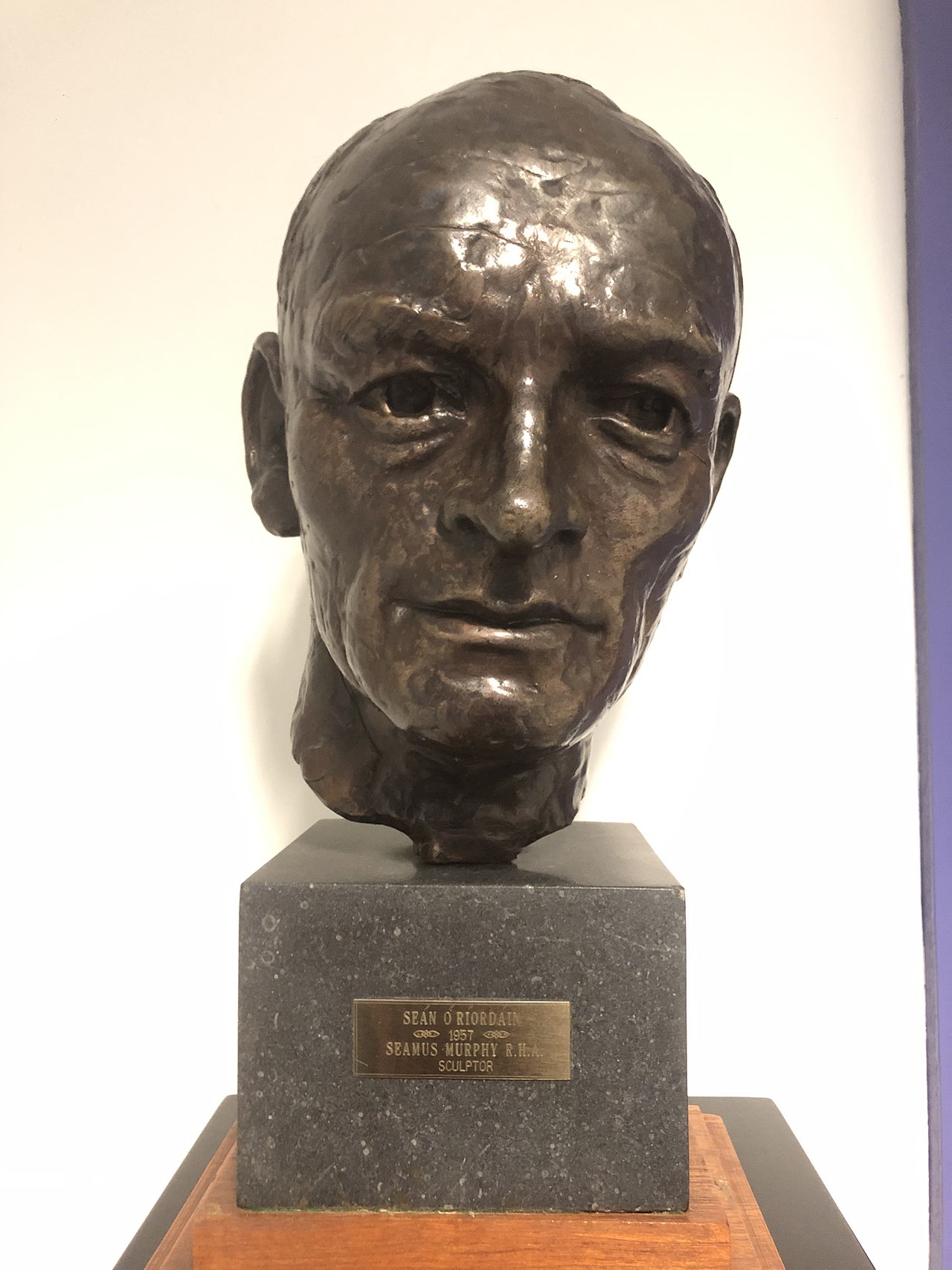
Xx78900 · CC BY-SA 4.0
- Name
- Seán Ó Ríordáin
- Born
- 3 December 1916
- Birthplace
- Baile Mhúirne, County Cork, Ireland
- Died
- 21 February 1977
- Place of death
- Glanmire, County Cork, Ireland
- Occupation
- Poet, writer
- Movement
- Modernism
- Nationality
- Ireland
- Languages
- Irish
VALÉORINE Encyclopedia
VALÉORINE documentary reading
Documentary summary
Seán Pádraig Ó Ríordáin (3 December 1916 – 21 February 1977), sometimes referred to as an Ríordánach, was an Irish language poet and later a newspaper columnist. He is credited with introducing European themes to Irish poetry, and is widely regarded as one of the best Irish language poets of the 20th century.
Admitted source layer · organised and presented by VALÉORINE
Reference Check
Propose documentary evidence for Seán Ó Ríordáin. A contribution is never written directly as fact: identity, source, rights and evidence gates still decide.
Sign in to contribute
World of VALÉORINE
Documentary connections
Only confirmed graph relationships appear here. Images are shown only when their identity and reuse rights both pass the documentary gate.
Documentary evidence
Documentary basis
Authority files
wikidata · Q3322192 · wikipedia · Seán Ó Ríordáin
In this article
Key facts
Key facts
• Name — Seán Ó Ríordáin • Native Name — Seán Pádraig Ó Ríordáin • Born — 3 December 1916 • Birthplace — Baile Mhúirne, County Cork, Ireland • Died — 21 February 1977 • Place of death — Glanmire, County Cork, Ireland • Occupation — Poet, writer • Movement — Modernism • Notable Works — Eireaball Spideoige • Language — Irish
Early life
Early life
Ó Ríordáin was the eldest of three children born in Baile Mhúirne, County Cork, to Seán Ó Ríordáin and Máiréad Ní Loineacháin. English was his first language. His mother spoke English; his father spoke Irish and English. His father's mother, a native Irish speaker, lived next door. His next-door neighbour on the other side also spoke Irish, something Ó Ríordáin attributed to contributing to his own acquisition of Irish. It wasn't long before Ó Ríordáin gained some knowledge of Irish. When Ó Ríordáin was ten, his father died of tuberculosis. Five years later, in 1932, the family moved to Inniscarra, on the outskirts of Cork city. After settling there, Seán and his brother Tadhg were sent to school in the North Monastery Christian Brothers School, on the northside of Cork city.
Professional career
Professional career
Ó Ríordáin worked as a clerk in the Cork Motor Tax Office from 1936 until his early retirement due to health issues in 1965. In 1967, Ó Ríordáin was made a part-time lecturer in University College Cork. Between 1969 and 1976. Ó Ríordáin was UCC's writer in residence. Concurrent with his time in UCC, he wrote a weekly column in The Irish Times, which he continued until 1975.
Health issues
Health issues
• Illustration — A plaque in Inniscarra, County Cork commemorating the house in which Ó Ríordáin lived the majority of his adult life. Below is a line from his poem Fill Arís, which roughly translates as "It is not natural for anyone to abandon his house or his tribe". Ó Ríordáin contracted pneumonia at the age of thirteen, and was afterwards ill for most of his life. He was diagnosed with tuberculosis in 1938, and made frequent visits to sanatoria throughout his life thereafter. Ó Ríordáin never married, and died in Sarsfield Court Hospital in 1977. He is interred in St. Gobnait's cemetery, Baile Mhúirne, alongside his father and paternal grandparents.
Eireaball Spideoige
Eireaball Spideoige
Eireaball Spideoige (A Robin's Tail) is Ó Ríordáin's first and largest collection of poetry, published in 1952. It was published by Sáirséal agus Dill who would serve as publishers for all of his later works as well. Eireaball Spideoige contains Ó Ríordáin's best known poem, Adhlacadh mo Mháthar (My Mother's Burial), from which the collection's title is derived. Adhlacadh mo Mháthair is an intimate exploration of Ó Ríordáin's grief following the death of his mother. According to scholar Louis de Paor, this poem created a new frisson in Irish language poetry when this poem was first published in 1945. In the introduction to Eireaball Spideoige Ó Ríordáin describes his poetry as an attempt to capture "the immediacy of the moment". In the preface he asks "What is poetry?", and answers "A child's mind." Though now regarded as an integral part of the Irish literary canon, Eireaball Spideoige received mixed reviews on publication in 1952, being criticized for its deviation from traditional Irish poetry in terms of subject matter and personal use of language.
Other works
Other works
Three booklets of Ó Ríordáin's poetry were subsequently published: Brosna (Kindling) in 1964, Línte Liombó (Limbo Lines) in 1971, and the posthumous Tar éis mo Bháis (After my Death) in 1978. His later works are marked by a notable dropping of the sentimentality and romanticism of his first collection. In Brosna Ó Ríordáin examines his difficult relationship with the Irish language, and in Línte Liombó he details the conquering of the individual by dispassionate destiny. His collected poems were released in 2011, under the title Na Dánta.
Interpretation
Interpretation
Ó Ríordáin delineates his personal aesthetic and theology in the preface to his first collection of poetry, Eireaball Spideoige, in which he highlights the relationship between artistic expression, poetry in particular, and being. He argues that poetry is to be under the aspect of another and without that relationship one can only ever produce a prosaic narrative. In that same preface, Ó Ríordáin considers an appropriation of an infant's mind as a prerequisite for the poetic act. The poem An Peaca (The Sin) reveals that Ó Ríordáin's ability to write poetry is at once lost if his immediate relation to nature is interrupted. According to Gearóid Denvir, Ó Ríordáin's poems "seek to answer fundamental questions about the nature of human existence and the place of the individual in a universe without meaning". Ó Ríordáin has been described as a European poet. The clash between traditional Irish and contemporary European influences was one of the most consistent conflicts in his work. As with all 'modernisers' of tradition, Ó Ríordáin received considerable opprobrium from traditionalists, most notably Máire Mhac an tSaoi. These attacks, particularly by Mhac an tSaoi on the standard of his Irish, did considerable damage to Seán's confidence and added to his already ill health. He never forgave Mhac an tSaoi. In a 1970 'Writer in Profile' television interview with Ó Ríordáin, Mhac an tSaoi phoned the station to say that she 'had never heard better Irish spoken than that by Seán Ó Ríordáin tonight'. Ó Ríordáin's response, as recorded by his biographer Seán Ó Coileáin: 'my bowels moved in disdain'. As well as writing poetry, he wrote a column in The Irish Times during the latter years of his life in which he spoke vehemently about national affairs. A number of his poems have appeared in English translation, for example, Modern Irish Poetry: An Anthology (ed. Patrick Crotty). Along with Mhac an tSaoi and Máirtín Ó Direáin, Ó Ríordáin is considered part of "an triúr mór".
Popular Poems
Popular Poems
Ó Ríordáin's poems have enjoyed constant popularity, due in part to the exposure gained by the inclusion of his work in the standard Irish curriculum. Poems such as "Fill Arís", "Cúl an Tí" and "Tost" are widely known, and "Fill Arís" was short-listed in a competition run by RTÉ in 2015 which sought to identify "Ireland's best loved poem". "Toil" is a contemplation on the limitations of human will. "Cúl an Tí" in particular is often taught in Gaelscoileanna throughout Ireland.
Identity
Identity
Seán Ó Ríordáin is recorded with the occupation writer. Recorded as a citizen of Ireland.
Life and career
Dated record
Life and career
The full dated record · 2 entries
1916
Seán Ó Ríordáin was born on 3 December 1916.
1977
Seán Ó Ríordáin died on 21 February 1977.
Places
Named by the record
Places
Only places the record itself states, plotted where the house gazetteer settles their coordinates. Nothing is inferred from a name or a nationality.
Baile Bhuirne.
Birth place
Glanmire.
Death place
Legacy
• Illustration — A bust of Ó Ríordáin in University College Cork. The writings of Ó Ríordáin were a "seminal influence" on the Innti poetry movement. Gaelscoil Uí Ríordáin, an Irish-language primary school in Ballincollig, County Cork, is named after Ó Ríordáin.
Primary material
Documents and archives
reference work
- “Seán Ó Ríordáin”, English Wikipedia, consulted as further reading
Reputable secondary · Wikipedia
authority record
- Wikidata, structured authority record Q3322192: Seán Ó Ríordáin
General reference · Wikidata
Citations
References
Each reference names the institution holding it, so a reader may go to the document itself.
reference work
Secondary witnessauthority record
General reference
The Encyclopedia exists whether or not anything is for sale. Corrections are recorded rather than overwritten, and every version of this record is kept. Published 18 August 2026.
Elsewhere in Books
38,988 published records in this field, each with its sources named.
- Sean HorlorAuthor
- Sean mac Fergail Óicc Ó hÚigínnAuthor
- Seán MacEnteeAuthor
- Seán Ó FaoláinAuthor
- Seán Ó TuamaAuthor
- Seán O'CaseyAuthor
- Sean SingerAuthor
- Sean StreetAuthor
Best supported in this field
For owners
Own a work by Seán Ó Ríordáin?
A specialist will read what you send and tell you what the house can establish, what it cannot, and whether the object is suited to sale. There is no charge and no obligation. The object stays with you throughout; nothing is shipped to us unless it is arranged in writing beforehand.