
Schwabacher
Schwabacher typefaces (pronounced) were a style of blackletter typefaces which evolved from Gothic Textualis (Textura) under the influence of Humanist type design in Italy during the 15th century. Schwabacher typesetting was the most common typeface in Germany, until it was replaced by Fraktur from the mid 16th century onwards. In the course of the 18th and 19th centuries (but in Germany not until 1941), Fraktur gave way in turn to Antiqua. • Illustration — A page from the Nuremberg Chronicle (Schedelsche Weltchronik), 1493
Schwabacher

Qasinka · Public domain
- Field
- blackletter
- Period
- 1472
VALÉORINE Encyclopedia
VALÉORINE documentary reading
Documentary summary
Schwabacher typefaces (pronounced) were a style of blackletter typefaces which evolved from Gothic Textualis (Textura) under the influence of Humanist type design in Italy during the 15th century. Schwabacher typesetting was the most common typeface in Germany, until it was replaced by Fraktur from the mid 16th century onwards. In the course of the 18th and 19th centuries (but in Germany not until 1941), Fraktur gave way in turn to Antiqua. • Illustration — A page from the Nuremberg Chronicle (Schedelsche Weltchronik), 1493
Admitted source layer · organised and presented by VALÉORINE
Reference Check
Propose documentary evidence for Schwabacher. A contribution is never written directly as fact: identity, source, rights and evidence gates still decide.
Sign in to contribute
Documentary evidence
Documentary basis
Authority files
wikidata · Q640799 · wikipedia · Schwabacher
In this article
Etymology
Etymology
The term may derive from the Franconian town of Schwabach, where, in 1529, the Articles of Schwabach, a Lutheran creed, were adopted; the Articles became the basis of the 1530 Confessio Augustana, and possibly also promoted the use of Schwabacher types.
Characteristics
Characteristics
• Illustration — Blackletter typefaces Similar to Rotunda, the rounded Schwabacher types were nearer to handwriting than the former Textualis style, though it also includes sharp edges. The lower-case g and upper-case H have particularly distinctive forms. In the context of German language texts, Schwabacher appeared vibrant and popular.
History
History
While the Latin Gutenberg Bible was still set in Textualis type, the oldest preserved Schwabacher incunable dates from 1472, and was printed in Augsburg. Schwabacher types appeared in the Free Imperial City of Nuremberg from about 1485: Anton Koberger (c. 1440–1513) used them for the publication of the Nuremberg Chronicle (in both Latin and German) in 1493, and Albrecht Dürer (1471–1528) for his Apocalypse series in 1498. Schwabacher became widely known with the spread of Luther Bibles from 1522. After Schwabacher was displaced by Fraktur as the most-used German language type style from about 1530, it remained in common use as a secondary typeface for emphasis in a similar way to italic. It was still used occasionally until the mid 20th century.
Normal type decree
Normal type decree
In January 1941, the Government of Nazi Germany officially abandoned the Fraktur type, following Martin Bormann's Normalschrifterlass ("Normal type decree"). Bormann refers to Fraktur as Schwabacher Judenlettern ("Jew-letters of Schwabach"). The statement ignores the fact that Schwabacher originated from the earlier Rotunda blackletter script and late medieval Bastarda types. Despite Bormann's assertion, there is no evidence of any connection between Jews and the Schwabacher typeface; in fact, at the time of the typeface's origin, the ownership of printing houses was reserved for Christian citizens. The decree eliminating the use of Fraktur actually makes prominent use of Fraktur, including the party name (Nationalsozialistische Deutsche Arbeiterpartei) and other letterhead elements. • Illustration — Normalschrifterlass by Martin Bormann
Samples
Samples
• Illustration — Alte Schwabacher The German sentence in this sample reads: "Beiſpiel Alte Schwabacher [Example of Old Schwabacher]: Victor jagt zwölf Boxkämpfer quer über den Sylter Deich". This is a nonsense sentence meaning "Victor chases twelve boxers across the dike of Sylt", but contains all 26 letters of the alphabet plus the German umlauts and is thus an example of a pangram. The fourth letter of Beiſpiel is a long s.
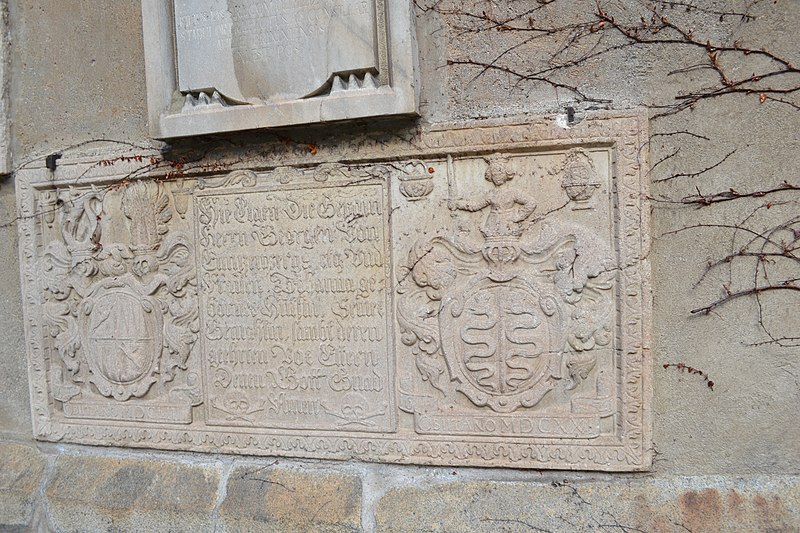
This image was uploaded as part of Wiki Loves Monuments 2014.
Ladislav Luppa

Straßenschild Attnang-Puchheim - Aignergasse
Kiwi63
Notes from the source article
Cited by Wikipedia
Notes from the source article
These works are cited by the source article, in its own numbering. They are recorded as its citations, not as sources VALÉORINE has verified.
- 1.Steinberg, S. H. (1961) Five Hundred Years of Printing; 2nd ed. Penguin Books; p. 41
- 2.Burke, Christopher. Paul Renner: the Art of Typography. Princeton Architectural Press. 165–167. 1998. 978-1-56898-158-1.
Bibliography printed in the source article · 3
- Friedrich Beck: „Schwabacher Judenlettern“ - Schriftverruf im Dritten Reich. in: Die Kunst des Vernetzens, Verlag für Berlin-Brandenburg, 2006, (pdf )
- Philipp Luidl: Die Schwabacher – Die ungewöhnlichen Wege der Schwabacher Judenletter. Maro Verlag, Augsburg 2004.
- "Vergessen und verdrängt" Schwabach 1918-1945, Ausstellungskatalog Stadtmuseum Schwabach, p. 172
References
Citations
References
Each reference names the institution holding it, so a reader may go to the document itself.
reference work
Secondary witnessreference work
Secondary witness
The Encyclopedia exists whether or not anything is for sale. Corrections are recorded rather than overwritten, and every version of this record is kept. Published 14 August 2026.
Elsewhere in Books
39,529 published records in this field, each with its sources named.
- Schack von StaffeldtAuthor
- Schalom Jakob KohenAuthor
- Schapelle CorbyAuthor
- Scholastique MukasongaAuthor
- Scipio SlataperAuthor
- ScipioneAuthor
- Scipione AgnelliAuthor
- Scipione CapeceAuthor
Best supported in this field
For owners
Own an object connected with Schwabacher?
A specialist will read what you send and tell you what the house can establish, what it cannot, and whether the object is suited to sale. There is no charge and no obligation. The object stays with you throughout; nothing is shipped to us unless it is arranged in writing beforehand.