
Salvatore Ferragamo
Salvatore Ferragamo (Italian: [salvaˈtoːre ferraˈɡaːmo]; 5 June 1898 – 7 August 1960) was an Italian shoe designer. Widely regarded as one of the most influential figures in 20th-century footwear design, he was known for combining artisanal craftsmanship with technical innovation. Ferragamo pioneered new construction methods that emphasized comfort, balance, and structural support while maintaining elegance.
Also recorded as Ferragamo
Salvatore Ferragamo
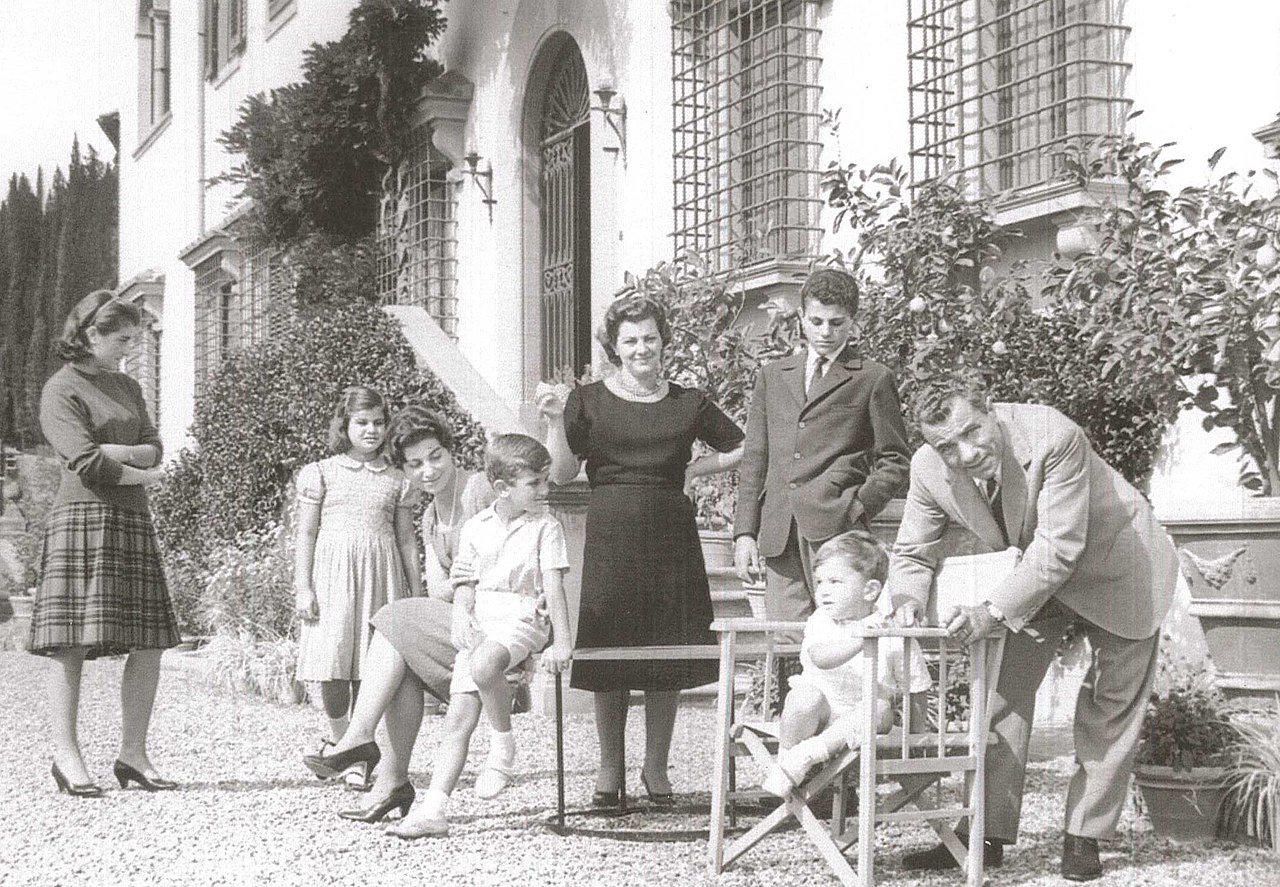
Libro. "La moda in società da archivi privati italiani" (1900-1959) pag. 182 · Public domain
- Born
- 1898.
- Nationality
- Italy and Kingdom of Italy.
- Occupation
- designer, fashion designer, businessperson and cobbler.
VALÉORINE Encyclopedia
VALÉORINE documentary reading
Documentary summary
Salvatore Ferragamo (Italian: [salvaˈtoːre ferraˈɡaːmo]; 5 June 1898 – 7 August 1960) was an Italian shoe designer. Widely regarded as one of the most influential figures in 20th-century footwear design, he was known for combining artisanal craftsmanship with technical innovation. Ferragamo pioneered new construction methods that emphasized comfort, balance, and structural support while maintaining elegance.
Admitted source layer · organised and presented by VALÉORINE
Note VALÉORINE
Salvatore Ferragamo (1898–1960) was a businessperson, cobbler and designer, among other activities, of Italian and Italian nationality. The businessperson was born in Bonito and died in Florence. Salvatore Ferragamo was educated at University of Southern California. Languages used include Italian.
Composed from admitted, traceable facts · 26 September 2026
VALÉORINE
Reference Check
Propose documentary evidence for Salvatore Ferragamo. A contribution is never written directly as fact: identity, source, rights and evidence gates still decide.
Sign in to contribute
Documentary evidence
Evidence Panel
technical hold · checked 25 September 2026
- Identity
- resolved
- Independent source families
- 0
- Admitted assertions
- 0
- Open conflicts
- 0
Authority files
gnd · 16285393-2 · wikidata · Q981342 · wikipedia · Salvatore Ferragamo
In this article
Early life
Early life
His shoes were worn by leading figures of Hollywood, earning him the nickname "Shoemaker to the Stars." After early success in the United States, Ferragamo returned to Italy in 1927, where he established a workshop in Florence that became the foundation of his international business, Salvatore Ferragamo S.p.A. Throughout the 1930s and 1940s, he developed influential designs—including the cork wedge heel and reinforced shank—often in response to material shortages, which helped redefine women's footwear. Following his death in 1960, the company was continued by his family and evolved into the luxury fashion house Ferragamo. His legacy is preserved through the Salvatore Ferragamo Museum in Florence. His life and work were the subject of the 2020 documentary film Salvatore: Shoemaker of Dreams.
Salvatore (registered as "Salvadore") Ferragamo was born in 1898 to a poor family in Bonito, Avellino, in the Campania region, the eleventh of fourteen children of Antonio Ferragamo and Mariantonia Ferragamo (both were born with the same surname, which often happened in smaller Italian towns). After making his first pair of shoes for himself, a pair of high heels, at age nine (and his sisters to wear at their confirmation), young Salvatore decided that he had found his calling.
Early career and training
Early career and training
Ferragamo showed an early interest in shoemaking after studying shoemaking in Naples for a year, 14-year-old Ferragamo opened a small store based in his parents' home. In 1914, he emigrated to Boston, Massachusetts, where one of his brothers worked in a shoe factory. After working at the factory for a week, he relocated to Santa Barbara, California to join his brothers. Ferragamo studied anatomy at the University of Southern California to learn how to make his shoes more comfortable.
Hollywood and early success
Hollywood and early success
Ferragamo established a workshop and began creating made-to-measure shoes for the fledgling film industry. His craftsmanship quickly attracted attention, leading him to design boots for Westerns at Flying A Studios and bespoke shoes for actors such as Mary Pickford and Lillian Gish, helping to solidify his reputation in Hollywood. By the early 1920s, Ferragamo had established himself as a specialist in custom footwear for film actors. In 1923, he purchased the Hollywood Boot Shop on Hollywood Boulevard, attracting clients such as Rudolph Valentino, Gloria Swanson, Joan Crawford, and Clara Bow. His work for film stars earned him the nickname "Shoemaker to the Stars."
Return to Italy, innovation, and postwar expansion
Return to Italy, innovation, and postwar expansion
In August 1927, Ferragamo returned to Italy seeking greater control over production quality. He initially sought to establish his headquarters in Naples, but he was dismissed as an "Italo-American go-getter, a hustler, and expatriate with the usual quota of high-pressure ideas from across the Atlantic. Other cities in Southern Italy proved no more receptive. After unsuccessful attempts in Rome, he traveled north to Verona, Milan, and Turin, and later to Venice and Padua, encountering the same rejection in each city. Ferragamo ultimately settled in Florence, where he established a workshop in the Via Mannelli. There, working directly with artisans under his supervision, he developed innovative designs and production methods that laid the foundation for his future success. During this period, he created shoes for many leading actors of the era, including "The Bella," a pair of black calfskin pumps with ankle straps and oversized vanilla bows worn by Gloria Swanson in the 1928 film Sadie Thompson. In 1933, he filed for bankruptcy in 1933 due to bad management and economic pressure. Despite financial difficulties caused by the Great Depression, he developed several technical innovations. including the cork wedge heel and the steel shank, which improved stability and allowed for new silhouettes. These designs helped define women's footwear during the era and reinforced Ferragamo’s reputation as both a designer and an innovator. "The Rainbow" shoe was created by Salvatore Ferragamo in 1938 and was the first instance of the platform shoe returning in modern days in the West. The platform sandal, using shaped slabs of cork covered in suede with gold kidskin straps, was designed for Judy Garland. Material shortages during World War II prompted Ferragamo to experiment with unconventional materials such as cork, raffia, and nylon, leading to some of his most distinctive designs. After the war, he resumed using luxury materials and expanded his business internationally. He was able to expand his operations in the 1950s, including a workforce of 700 artisans who made 350 pairs of shoes per day, by hand. His shoes were worn by prominent figures including Maharani of Cooch Behar, Eva Perón, Marilyn Monroe, and Audrey Hepburn further solidifying the brand’s association with glamour and craftsmanship.
Later years and death
Later years and death
In 1957, Ferragamo published his autobiography Shoemaker of Dreams. Ferragamo continued to oversee the company until his death on August 7, 1960 at the age of 62. Afterward, the business was carried on by his family, evolving into the global luxury fashion house Salvatore Ferragamo. He was survived by his wife Wanda and six children (Fiamma, Giovanna, Fulvia, Ferruccio, Massimo and Leonardo.
Family
Family
Wanda Ferragamo Miletti led the group since 1960, when her husband and founder of the company, Salvatore, died. She was honorary chairman until her death in 2018. Ferruccio Ferragamo, chairman of the company Giovanna Gentile-Ferragamo, vice president of Salvatore Ferragamo SpA Leonardo Ferragamo, since 2000, has been the Director of Salvatore Ferragamo SpA, Ferragamo Finanziaria; Executive Vice President of the Fondazione Ferragamo and owner of Finnish luxury yacht builder OY Nautor Swan. Massimo Ferragamo, Chairman of Ferragamo USA. Fulvia Visconti-Ferragamo, who died in March 2018, ran the fashion label's silk accessories division beginning in the 1970s. She was the Deputy Chairwoman of Ferragamo Finanziaria SpA. Fiamma Ferragamo di San Giuliano, who died in 1998, was involved in the creation of some of the brand's products, such as Vara shoe and the Gancino. James Ferragamo, Women's and Men's Shoes and Leather Goods Division Director for the Salvatore Ferragamo Group Angelica Visconti Ruspoli, South Europe Director Diego Paternò di San Giuliano coordinates the digital activities of the brand.
Life and career
Dated record
Life and career
The full dated record · 2 entries
1898
Salvatore Ferragamo was born in 1898.
1960
Salvatore Ferragamo died at Florence.
Legacy
The Salvatore Ferragamo company expanded its operations to include bags, eyewear, silk accessories, watches, perfumes and a ready-to-wear clothing line in addition to their luxury shoes. The company is owned by the Ferragamo family, which in November 2006 included Salvatore's widow Wanda, five children, 23 grandchildren and other relatives. There is a rule that only three members of the family can work at the company, prompting fierce competition. Ferragamo's emphasis on technical innovation, comfort, and artisanal production has had a lasting influence on footwear design, and many of his original creations are preserved in museum collections Fiamma (Salvatore's eldest daughter who died in 1998) came up with the "Vara pumps" in 1978. The Salvatore Ferragamo Museum, dedicated to Ferragamo's life and work, opened in the Palazzo Spini Feroni in 1995. The palazzo had been bought by Ferragamo in the 1930s. In March 2013, the Ferragamo fashion house established the Ferragamo Foundation in Florence. The foundation was formed to cultivate young fashion designers, based on the ideas of Salvatore Ferragamo. In 2020, the documentary film Salvatore: Shoemaker of Dreams directed by Luca Guadagnino was released about his life and career.
Primary material
Documents and archives
reference work
- “Salvatore Ferragamo”, English Wikipedia, consulted as further reading
Reputable secondary · Wikipedia
- Wikidata, structured authority record Q981342: Salvatore Ferragamo
Reputable secondary · Wikidata
authority file
- Gemeinsame Normdatei 16285393-2, Salvatore Ferragamo.
Unverified · Deutsche Nationalbibliothek
Notes from the source article
Cited by Wikipedia
Notes from the source article
These works are cited by the source article, in its own numbering. They are recorded as its citations, not as sources VALÉORINE has verified.
- 1.Portale Antenati.
- 2.Ferragamo, Salvatore. Shoemaker of Dreams; The Autobiography of Salvatore Ferragamo. Crown Publishers. 41-47, 110-112. 1972.
- 3.Breward, Christopher. The Cambridge Global History of Fashion: Volume 2: From the Nineteenth Century to the Present. Cambridge University Press. 936. 2023-08-17. 978-1-108-49555-4.
- 4.Salvatore Ferragamo. fondazione.ferragamo.com.
- 5.Moore, Booth. Fashion: Ferragamo returns to its roots in L.A. Los Angeles Times. 2013-10-13.
- 6.Woodard, Josef. Review 'Salvatore: Shoemaker of Dreams' Chronicles Famed Shoe Designer, with a Critical Stop in Santa Barbara. The Santa Barbara Independent. 2022-11-16.
- 7.Bunbury, Stephanie. The little boy who helped to build Hollywood from its most famous feet up. The Sydney Morning Herald. 2022-09-19.
- 8.Singer, Olivia. Salvatore Ferragamo Reissue Shoes From The Golden Age of Hollywood. British Vogue. 2018-05-29.
- 9.Ferragamo Leaves Tonight For Naples. Los Angeles Evening Citizen News. 2. 1927-08-18.
- 10.DeMello, M. Feet and footwear: A cultural encyclopedia. Greenwood Press/ABC-CLIO. 2009.
- 11.Syme, Rachel. Wanda Ferragamo, 96, Dies; Reigned Over Family's Luxury Goods Empire. The New York Times. 24 October 2018.
- 12.Leonardo Ferragamo: The fashion magnate behind Nautor's Swan's remarkable rise. 2020-08-13.
- 13.Ferragamo's return to Italy. 90 years later Florence Daily News. Florence Daily News. 2017-04-28.
- 14.Kilcooley-O'Halloran, Scarlett. Salvatore Ferragamo Launches Fashion Foundation. Vogue. 27 March 2013.
- 15.Winkelman, Natalia. ‘Salvatore: Shoemaker of Dreams’ Review: For the Heel of It. The New York Times. 2022-11-03. 0362-4331.
Bibliography printed in the source article · 1
- Ricci, Stefania. Walking Dreams: Salvatore Ferragamo, 1898-1960. 2006.
References
Citations
References
Each reference names the institution holding it, so a reader may go to the document itself.
authority file
Gemeinsame Normdatei 16285393-2, Salvatore Ferragamo.Deutsche Nationalbibliothek
Partially resolvedreference work
Partially resolvedreference work
Partially resolved
The Encyclopedia exists whether or not anything is for sale. Corrections are recorded rather than overwritten, and every version of this record is kept. Published 14 August 2026.
Elsewhere in Fashion
2,260 published records in this field, each with its sources named.
- Sally MilgrimDesigner
- Sally RidgeDesigner
- Sally TorpeyDesigner
- Salvacion Lim HigginsDesigner
- Salvatore J. CesaraniDesigner
- Samantha SleeperDesigner
- Sammy SheldonDesigner
- Samu-Jussi KoskiDesigner
Best supported in this field
For owners
Own a work by Salvatore Ferragamo?
A specialist will read what you send and tell you what the house can establish, what it cannot, and whether the object is suited to sale. There is no charge and no obligation. The object stays with you throughout; nothing is shipped to us unless it is arranged in writing beforehand.