
Ruzbihan Baqli
Illustration — Ruzbihan Baqli reclining before a brazier. From a manuscript made in 16th-century Safavid Iran Abu Muhammad Sheikh Ruzbehan Baqli (1128–1209) was a Persian poet, mystic, teacher and sufi master. He wrote about his own life as well as published commentaries on Sufi poets and ideas.
Also recorded as Abu Muhammad Sheikh Ruzbehan Baqli
Ruzbihan Baqli
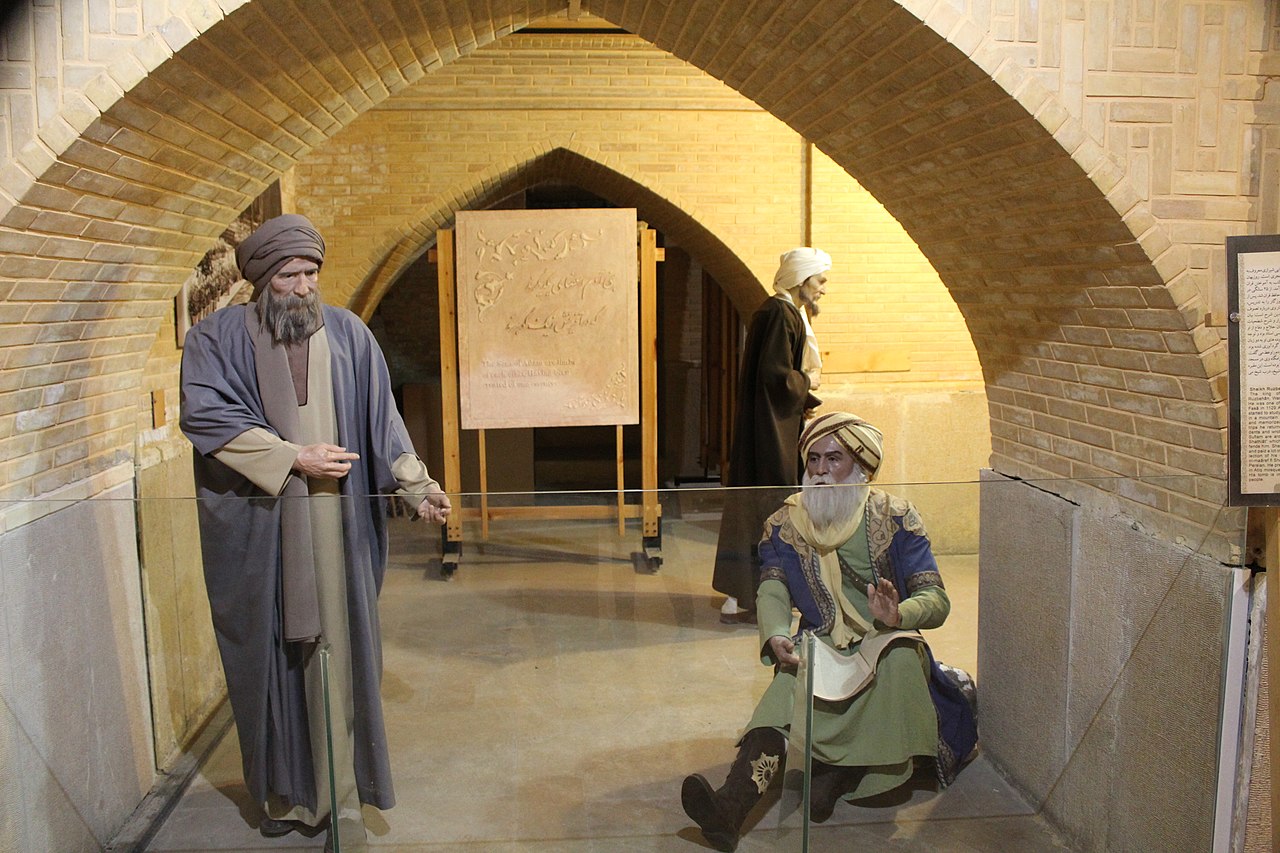
Najmeh99 · CC BY-SA 4.0
- Born
- 1128 · Fasa.
- Died
- 1209
- Occupation
- poet · mystic · philosopher · qur'anic exegete · sufi
- Known for
- 'Arā'is al-bayān fī tafsīr al-Qur'ān
- Languages
- Persian
VALÉORINE Encyclopedia
VALÉORINE documentary reading
Documentary summary
Illustration — Ruzbihan Baqli reclining before a brazier. From a manuscript made in 16th-century Safavid Iran Abu Muhammad Sheikh Ruzbehan Baqli (1128–1209) was a Persian poet, mystic, teacher and sufi master. He wrote about his own life as well as published commentaries on Sufi poets and ideas.
Admitted source layer · organised and presented by VALÉORINE
Note VALÉORINE
Ruzbihan Baqli (1128–1209) was a mystic, philosopher and poet, among other activities. The mystic was born in Fasa. Languages used include Persian.
Composed from admitted, traceable facts · 26 September 2026
VALÉORINE
Reference Check
Propose documentary evidence for Ruzbihan Baqli. A contribution is never written directly as fact: identity, source, rights and evidence gates still decide.
Sign in to contribute
Documentary evidence
Documentary basis
Authority files
wikidata · Q3458926 · wikipedia · Ruzbihan Baqli
In this article
Life
Life
Baqli's most renowned work was his autobiography Unveiling of Secrets or Kashf al-asrar.
Ruzbihan Baqli was born in 1128 to a family of Daylamite origin in Fasa in what is today Iran. As a teenager, Baqli worked as a grocer. Although Baqli claimed to have had religious visions at ages three, seven, and fifteen, he said that his family was not religious. He described these visions as dreams and powerful ecstasies in The Unveiling of Secrets. At age 15, Baqli left Fasa to spend 18 months in desert, during which time he claimed to receive more visions. After leaving the desert, he joined a Sufi sect. In The Unveiling of Secrets, Baqli says he had his first "unveiling" while training with the Sufis. He eventually returned to Fasa to seek a master and spiritual guide; there he met and became a disciple of Shaykh Jamal al-Din Abi al-Wafa’ ibn Khalil al-Fasa’I. It is speculated that Baqli spent the next years travelling to Syria, Iraq, Kerman in Iran, Arabia, making the hajj twice. He returned to Shiraz in 1165 and set up a hospice where he taught for 50 years. He married several wives and had two sons and three daughters. Baqli died in 1209 in Shiraz.
Literary works
Literary works
Baqli wrote his spiritual experiences and his poetry in a dense, rhetorical prose style. He composed mostly in Arabic and Persian. His writings are unique because, while they do not include many dates or chronology, he talks about his personal life and his family, while not mentioning other outside events. Baqli was known for his fondness and defense of many early Sufis’ ecstatic sayings (shathiyat) and therefore was dubbed "Doctor Ecstaticus." Baqli completed his book Commentary on Ecstatic Sayings or Sarh al-shathiyyat in 1174. He also wrote The Spirits’ Font in 1184. The Unveiling of Secrets or Kashf al-asrar was completed in 1189 after eight years. It is both an autobiography and a diary of visions and Sufi teachings. Many of his works emphasize the Sufi theories of love, and also defend early Sufi saints in their ecstatic utterances. The Sufi saint Hallaj was a primary example in Baqli's text. While direct literary references to Baqli in later Sufism were not common, perhaps because of the difficulty of the texts, he was known for his love of beauty: fine fragrances, a beautiful face, and sweet voices. His texts were studied, however, by Jāmi of the fifteenth century and a Mughal prince of the seventeenth century.
Licensing
Text attribution
Part of the biographical narrative on this page reuses licensed material. Its origin, revision and licence are recorded here.
The biographical narrative on this page is based on the Wikipedia article Ruzbihan Baqli, revision 1364824677 (EN edition), by its contributors. VALÉORINE has edited that text and built its own documentary record around it. The reused material is available under CC BY-SA 4.0, and this page's reuse of it is offered under the same licence. Everything else on this page — the chronology, the holdings, the evidence, the plates and the connections — is VALÉORINE's own record. Sources and licences.
Legacy
• Illustration — Tomb of Ruzbihan Baqli in Shiraz, Iran Baqli's center for Sufi training and his teachings remained popular several generations after his death. Ruzbihan Baqli died in 1209 in Shiraz and was placed in a tomb in his ribat. For several generations after his death, Ruzbihan Baqli's legacy as a Sufi master continued and Shiraz became a place of pilgrimage. However, the popularity of his order waned and eventually disappeared and his tomb fell into disrepair. In 1972, Baqli's tomb was restored by the Iranian Department of Antiquities. The two most important hagiographies about him were written by family members almost a century after his death: The Gift to the People of Gnosis, in Memory of the Chief Axis of the World, Ruzbihan (1300); and The Spirit of the Gardens, on the Life of the Master Ruzbihan (1305). Some groups in the Middle East, Central Asia, India, and Persia still study his texts today.
Primary material
Documents and archives
reference work
- “Ruzbihan Baqli”, English Wikipedia, consulted as further reading
Reputable secondary · Wikipedia
authority record
- Wikidata, structured authority record Q3458926: Ruzbihan Baqli
General reference · Wikidata
References ==== Sources
References ==== Sources
• Baqli, Ruzbihan. The Unveiling of Secrets: Diary of a Sufi Master. Trans. Carl W. Ernst. Chapel Hill, NC: Parvardigar, 1997. • Ernst, C. "Rūzbihān." Encyclopaedia of Islam, Second Edition. Edited by: P. Bearman; Th. Bianquis; C.E. Bosworth; E. van Donzel; and W.P. Heinrichs. Brill, 2011. Brill Online. Augustana. 7 April 2011. • Ernst, C. Ruzbihan Baqli: Mysticism and the Rhetoric of Sainthood in Persian Sufism. Surrey: Curzon, 1996. • Ernst, C. "Symbolism of Birds and Flight in the Writings of Ruzbihan Baqli." In The Heritage of Sufism, Volume 2. Ed. Leonard Lewisohn. Oxford: One World, 1999. 353–366. • Schimmel, Annemarie (1975). Mystical Dimensions of Islam. Chapel Hill, NC: University of North Carolina Press. • Shahbazi, A. Shapur, "Shiraz", Encyclopædia Iranica, Online Edition, 7 July 2004.
Notes from the source article
Cited by Wikipedia
Notes from the source article
These works are cited by the source article, in its own numbering. They are recorded as its citations, not as sources VALÉORINE has verified.
- 1.Cambridge University Press. The new Cambridge history of Islam, Volume 4. 72. 2010. 978-0-521-83824-5.
- 2.Shahbazi, A. Shapur. Shiraz i. History to 1940. Encyclopaedia Iranica. Columbia University Press.
- 3.Baqli, Ruzbihan. The Unveiling of Secrets: Diary of a Sufi Master. Parvardigar. 9–11. 1997.
- 4.Baqli, Ruzbihan. The Unveiling of Secrets: Diary of a Sufi Master. Parvardigar. 11–12. 1997.
- 5.Ernst, Carl W. Ruzbihan Baqli: Mysticism and the Rhetoric of Sainthood in Persian Sufism. Curzon. 2. 1996.
- 6.Ernst, Carl W. Rūzbihān. Encyclopaedia of Islam, Second Edition. Brill Online.
- 7.Ernst, Carl W. Ruzbihan Baqli: Mysticism and the Rhetoric of Sainthood in Persian Sufism. Curzon. 5–7. 1996.
- 8.Ernst, Carl W. Ruzbihan Baqli: Mysticism and the Rhetoric of Sainthood in Persian Sufism. Curzon. 7. 1996.
- 9.Ernst, Carl W. Rūzbihān. Encyclopaedia of Islam, Second Edition. Brill Online.
- 10.Ernst, Carl W. Ruzbihan Baqli: Mysticism and the Rhetoric of Sainthood in Persian Sufism. Curzon. 5. 1996.
- 11.Baqli, Ruzbihan. The Unveiling of Secrets: Diary of a Sufi Master. Parvardigar. x-xi. 1997.
- 12.Ernst, Carl W. Rūzbihān. Encyclopaedia of Islam, Second Edition. Brill Online.
- 13.Baqli, Ruzbihan. The Unveiling of Secrets: Diary of a Sufi Master. Parvardigar. xi. 1996.
- 14.Schimmel, Annemarie. Mystical Dimensions of Islam. University of North Carolina Press. 296. 1976.
- 15.Ernst, Carl W. The Heritage of Sufism. One World. 354–366. 1999.
Bibliography printed in the source article · 6
- Baqli, Ruzbihan. The Unveiling of Secrets: Diary of a Sufi Master. Trans. Carl W. Ernst. Chapel Hill, NC: Parvardigar, 1997.
- Ernst, C. "Rūzbihān." Encyclopaedia of Islam, Second Edition. Edited by: P. Bearman; Th. Bianquis; C.E. Bosworth; E. van Donzel; and W.P. Heinrichs. Brill, 2011. Brill Online. Augustana. 7 April 2011 http://www.brillonline.nl/subscriber/entry?entry=islam_SIM-6355.
- Ernst, C. Ruzbihan Baqli: Mysticism and the Rhetoric of Sainthood in Persian Sufism. Surrey: Curzon, 1996.
- Ernst, C. "Symbolism of Birds and Flight in the Writings of Ruzbihan Baqli." In The Heritage of Sufism, Volume 2. Ed. Leonard Lewisohn. Oxford: One World, 1999. 353–366.
- Schimmel, Annemarie (1975). Mystical Dimensions of Islam. Chapel Hill, NC: University of North Carolina Press.
- Shahbazi, A. Shapur, "Shiraz", Encyclopædia Iranica, Online Edition, 7 July 2004.
References
Citations
References
Each reference names the institution holding it, so a reader may go to the document itself.
reference work
Secondary witnessauthority record
General reference
The Encyclopedia exists whether or not anything is for sale. Corrections are recorded rather than overwritten, and every version of this record is kept. Published 17 August 2026.
Elsewhere in Books
39,529 published records in this field, each with its sources named.
- Ruy BeloAuthor
- Ruy González de ClavijoAuthor
- Ruy López de SeguraAuthor
- Rużar BriffaAuthor
- Růžena JesenskáAuthor
- Růžena SvobodováAuthor
- Ryan G. Van CleaveAuthor
- Ryan MurphyAuthor
Best supported in this field
For owners
Own a work by Ruzbihan Baqli?
A specialist will read what you send and tell you what the house can establish, what it cannot, and whether the object is suited to sale. There is no charge and no obligation. The object stays with you throughout; nothing is shipped to us unless it is arranged in writing beforehand.