
Russian Museum
The State Russian Museum, formerly known as the Russian Museum of His Imperial Majesty Alexander III, on Arts Square in Saint Petersburg, is the world's largest depository of Russian fine art. It is also one of the largest art museums in the world with a total area over 30 hectares. In 2022 it attracted 2,651,688 visitors, ranking twelfth on list of most-visited art museums in the world.
Also recorded as State Russian Museum · Russian Museum of His Imperial Majesty Alexander III
Russian Museum
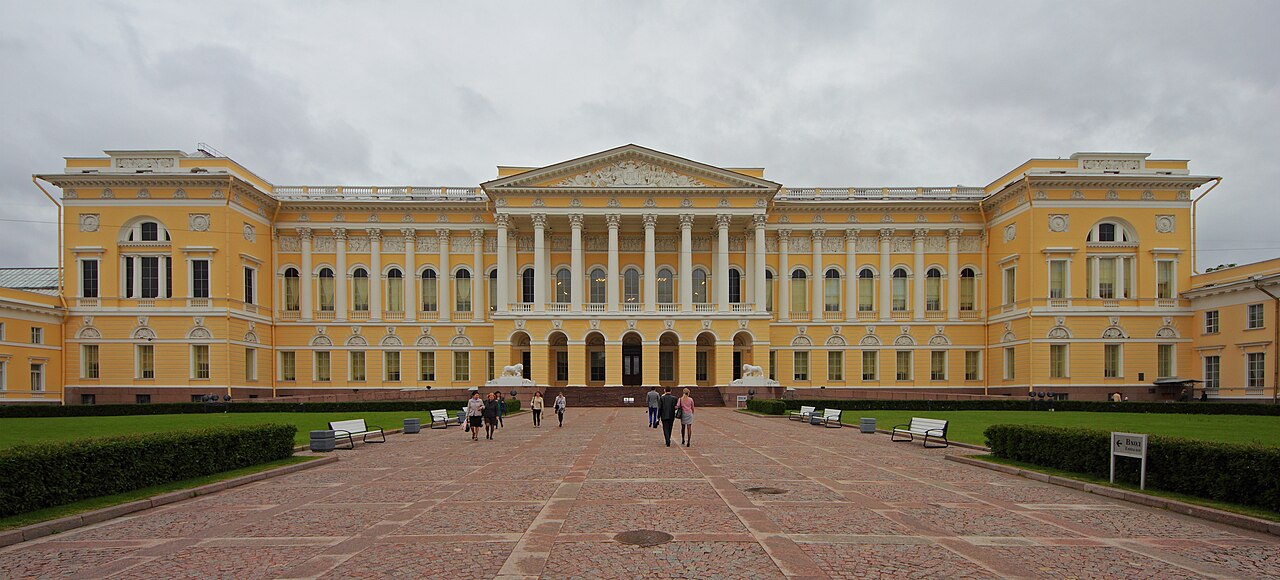
A.Savin · CC BY-SA 3.0
- Name
- Russian Museum
- Founded
- 1895
- Founder
- Nicholas II of Russia
- Headquarters
- Russia · Russian Empire
VALÉORINE Encyclopedia
VALÉORINE documentary reading
Documentary summary
The State Russian Museum, formerly known as the Russian Museum of His Imperial Majesty Alexander III, on Arts Square in Saint Petersburg, is the world's largest depository of Russian fine art. It is also one of the largest art museums in the world with a total area over 30 hectares. In 2022 it attracted 2,651,688 visitors, ranking twelfth on list of most-visited art museums in the world.
Admitted source layer · organised and presented by VALÉORINE
Reference Check
Propose documentary evidence for Russian Museum. A contribution is never written directly as fact: identity, source, rights and evidence gates still decide.
Sign in to contribute
World of VALÉORINE
Documentary connections
Only confirmed graph relationships appear here. Images are shown only when their identity and reuse rights both pass the documentary gate.
Documentary evidence
Documentary basis
Authority files
wikidata · Q211043 · wikipedia · Russian Museum
In this article
Key facts
Key facts
• Name — Russian Museum • Established — 1895 • Type — Art museum and Historic site • Visitors — 3,611,899 (2024) • Website — http: en.rusmuseum.ru
Creation
Creation
The museum was established on April 13, 1896, upon enthronement of the emperor Nicholas II to commemorate his father, Alexander III. Its original collection was composed of artworks taken from the Hermitage Museum, Alexander Palace, and the Imperial Academy of Arts. The task to restructure the interiors according to the need of future exposition was imposed on Vasily Svinyin. The grand opening took place on the 17 of March, 1898. After the Russian Revolution of 1917, many private collections were nationalized and relocated to the Russian Museum. These included Kazimir Malevich's Black Square.
Architecture
Architecture
The main building of the museum is the Mikhailovsky Palace, the Neoclassical former residence of Grand Duke Michael Pavlovich, erected in 1819–1825 to a design by Carlo Rossi on Square of Arts in St Petersburg. Upon the death of the Grand Duke the residence was named after his wife as the Palace of the Grand Duchess Elena Pavlovna, and became famous for its many theatrical presentations and balls. Some of the halls of the palace retain the Italianate opulent interiors of the former imperial residence. The project of Benois Building (or 'Corpus Benua') adjacent to the Mikhailovsky Palace was developed in 1910-1912 by the famous Russian architect Leon Benois. The construction started in 1914, but was interrupted by the First World War. After the Russian Revolution, in 1919 the Benois Building was completed. In 1930s it was assigned to the Russian museum. Other buildings and locations, assigned to the Russian museum, include the Summer Palace of Peter I (1710–1714) with the Summer Garden, the Marble Palace of Count Orlov (1768–1785), St Michael's Castle of Emperor Paul (1797–1801), the cabin of Peter the Great, and the Rastrelliesque Stroganov Palace on the Nevsky Prospekt (1752–1754).
Directors
Directors
• 1895-1917 - Grand Duke Georgy Mikhailovich Romanov • 1918-1922 - Alexander Alexandrovich Miller (1875-1934) • 1922-1926 - Nikolai Petrovich Sychev (1883-1964) • 1926-1930 - Vorobyov, Pavel Ivanovich (1892-1937) • 1930-1932 - Ostretsov, Ivan Andreevich (1890-1944) • 1932-1934 - Gurvich, Joseph Naumovich (1895-1978) • 1934-1937 - Sofronov, Alexander Grigorievich (1890-?) • 1938-1941 - Tsyganov, Nikolai Alekseevich (1898—1955) • 1941-1945 - Lebedev, Georgy Efimovich (1903-1958) • 1945-1951 - Baltun, Pyotr Kazimirovich (1904-1980) • 1951-1977 - Pushkarev, Vasily Alekseevich (1915-2002) • 1977-1985 - Novozhilova, Larisa Ivanovna (1929-2005) • 1985-1988 - Lenyashin, Vladimir Alekseevich (born 1940) • 1988—2023 — Gusev, Vladimir Alexandrovich (born 1945) • 02/10/2023 to 04/24/2023 - Anna Yuryevna Tsvetkova (acting) • From 04/25/2023 - Manilova, Alla Yuryevna (born 1957)
Restoration of the museum property
Restoration of the museum property
All process on the restoration of works of art in the Russian Museum is carried out at the Museum Valuables Restoration Service. The need to set up a special restoration workshop at the Russian Museum was first raised in 1906. At that time, the artist and restorer A. Boravskiy drew up his famous project to set up a restoration workshop at the Russian Museum. However, owing to a lack of funds, he was not destined to succeed. It was in 1922 that the restoration workshop of the Russian Museum was established. Its first director was the painter-restorer N.A. Okolovich. The restoration workshop consisted of two sections: the main one, which worked for the Museum, and the regional one, which was engaged in saving cultural monuments in Petrograd and other cities of Russia. In 1935, the Conservation and Restoration Department was divided into laboratories and sections: painting, new painting, sculpture, applied art and folk art. During the 1950s and 1960s, new workshops were set up. In 1953, a workshop for graphic arts restoration, in 1954 for Old Russian painting, in 1961 for wooden sculpture, decorative carving and furniture and a workshop for textile restoration, in 1969 for plaster and stone sculpture and 1970 for applied art. At present, the restoration department is made up of 16 workshops (sectors) for all types of materials, employing, its figures, 95 people. The department includes the following restoration workshops: easel painting, Old Russian paintings, mixed media painting, graphics, ceramics and glassware, textiles, metalwork, veneered furniture, polychrome and gilded carving, carved icons and wooden sculpture, picture frames, plaster and stone sculpture, contemporary art objects (established in 2010). The department is staffed by artists with the highest and the highest restoration category. The department includes a sector of chemical and biological research and a sector of the history and theory of museum restoration. In 2014, the Department of Restoration of Museum Properties restored 4,511 exhibits, of which 280 were restored with special complexity. 5,930 exhibits were prepared for 77 museum exhibitions (preparation of preservation reports, preventive conservation and restoration, packing and unpacking of exhibits). 150 meetings of the Restoration Commission were held, at which the most important issues on the research and methods of restoration of museum exhibits were considered. As of 1 January 2019, the Department of Restoration of Museum Estates was transformed into the Service of Restoration of Museum Estates.
Exhibits
Exhibits
• Illustration — The Russian Museum of Ethnography The Ethnographic Department was originally set up in a building specially designed by Vladimir Svinyin in 1902. The museum soon housed gifts received by Emperor's family from representatives of peoples inhabiting various regions of the Russian Empire. Further exhibits were purchased by Nicholas II and other members of his family as State financing was not enough to purchase new exhibits. In 1934, the Ethnographic Department was given the status of an independent museum: the Russian Museum of Ethnography.
Málaga branch
Málaga branch
The city of Málaga, home to thousands of Russian expats, signed an agreement to host the first overseas branch of the State Russian Museum, which opened in March 2015. Works displayed in the Malaga branch range from Byzantine-inspired icons to social realism of the Soviet era. They are on display in 2,300 m2yards) of exhibition space in La Tabacalera, a 1920s tobacco factory.
Gallery
Gallery
• Illustration — The Angel with Golden Hair (12th century) • Illustration — Dionisius, Harrowing of Hell (1495–1504) • Illustration — Simon Ushakov, The Mandylion (1658) • Illustration — Ivan Nikitin, A Malorossian Hetman (c. 1720s) • Illustration — Dmitry Levitzky, Portrait of Glafira Alymova (1776) • Illustration — Dmitry Levitzky, Portrait of Countess Anna Vorontsova (c.1790) • Illustration — Karl Brullov, The Last Day of Pompeii (1830–33) • Illustration — Fyodor Bruni, The Brazen Serpent (1841) • Illustration — Ivan Aivazovsky, The Ninth Wave (1850) • Illustration — Ilya Repin, Reply of the Zaporozhian Cossacks (1880–91) • Illustration — Victor Vasnetsov, Knight at the Crossroads (1882) • Illustration — Nikolai Yaroshenko, In a Warm Land (1890) • Illustration — Vasily Surikov, Taking a Snow Town (1891) • Illustration — Isaak Levitan, Lake (1900) • Illustration — Ilya Repin, What freedom! (1903). • Illustration — Léon Bakst, Ancient Horror (1908) • Illustration — Valentin Serov, Portrait of Ida Rubenstein (1910) • Illustration — Boris Kustodiev, Portrait of Chaliapin (1921) • Illustration — Kasimir Malevich, Black Square (1923)
Identity
Identity
Russian Museum is associated with Russia and Russian Empire.
Institutional history
Dated record
Institutional history
The full dated record · 1 entries
1895
Russian Museum established.
Collection
Today the collection shows Russian art from the 10th century up to the 21st century, covering all genres from the old Russian icon painting to contemporary art.
Literature
Literature
The Ethnographic Department of The Russian Museum in the Complex of Academic Interests of A. THE DEVELOPMENT OF RUSSIAN MUSEUM TRADITIONS IN THE PROJECT "CRIMEAN MUSEUM SCHOOL "MUSEUM STUDIO"", Гуманитарные науки в Сибири, 2020.
Transformation of cultural and educational programs on television in a pandemic context (on the example of the project “Russian Museum
Notes from the source article
Cited by Wikipedia
Notes from the source article
These works are cited by the source article, in its own numbering. They are recorded as its citations, not as sources VALÉORINE has verified.
- 1.Lee Cheshire and José da Silva. The 100 most popular art museums in the world—who has recovered and who is still struggling?. The Art Newspaper. 27 March 2023.
- 2.Culture.ru. Государственный Русский музей.
- 3.Italianate opulent interiors , Russian Museum, Russia.
- 4.Culture.ru. Корпус Бенуа.
- 5.Culture.ru. 10 фактов о Русском музее.
- 6.Макаревич, Эдуард Федорович. Политическая революционность и революция художников. Научные труды Московского гуманитарного университета. 1. 2. 2015-04-25. 2307-5937.
- 7.Терещенко, А. Случайные находки из поселка Прогресс. Archaeological News. 29. 2020. 1817-6976.
- 8.История создания и развития Службы реставрации музейных ценностей Русского музея. restoration.rusmuseum.ru.
- 9.Отчет о работе Отдела реставрации Русского музея за 2014 год. restoration.rusmuseum.ru.
- 10.История создания и развития Службы реставрации музейных ценностей Русского музея. restoration.rusmuseum.ru.
- 11.Russian Museum. Accessed 8 July 2008.
- 12.Pes, Javier. Russian art museum to open Spanish satellite. The Art Newspaper. 27 May 2014.
- 13.Russian museum to open €5m branch in Spain. The Local.
- 14.Málaga branch - Русский музей. en.rusmuseum.ru.
References
Citations
References
Each reference names the institution holding it, so a reader may go to the document itself.
reference work
Secondary witnessreference work
Secondary witness
The Encyclopedia exists whether or not anything is for sale. Corrections are recorded rather than overwritten, and every version of this record is kept. Published 16 August 2026.
Elsewhere in Institutions
3,152 published records in this field, each with its sources named.
- Ruins of San Domingos ConventOrganisation
- RusellaeOrganisation
- Russborough HouseOrganisation
- Russell-Cotes Art Gallery & MuseumOrganisation
- Ruth Chandler Williamson GalleryOrganisation
- Rwanda Art MuseumOrganisation
- Rwesero Art MuseumOrganisation
- Ryazan Oblast State Art Museum named after I.P. PojalostinOrganisation
Best supported in this field
For owners
Own an object connected with Russian Museum?
A specialist will read what you send and tell you what the house can establish, what it cannot, and whether the object is suited to sale. There is no charge and no obligation. The object stays with you throughout; nothing is shipped to us unless it is arranged in writing beforehand.