
Rudolph Ruzicka
Illustration — Brooklyn Bridge by Rudolph Ruzicka • Illustration — Georges Guynemer by Rudolph Ruzicka, 1918 Rudolph Ruzicka (29 June 1883 – 20 July 1978) was a Czech American wood engraver, etcher, illustrator, typeface designer, and book designer. He designed a number of seals and medals, including the American Institute of Graphic Arts (AIGA) and the Dartmouth Medal of the American Library Association.[1]
Also recorded as Rudolf Růžička · Rudolf Ruzicka · Rudolph Ružicka
Rudolph Ruzicka
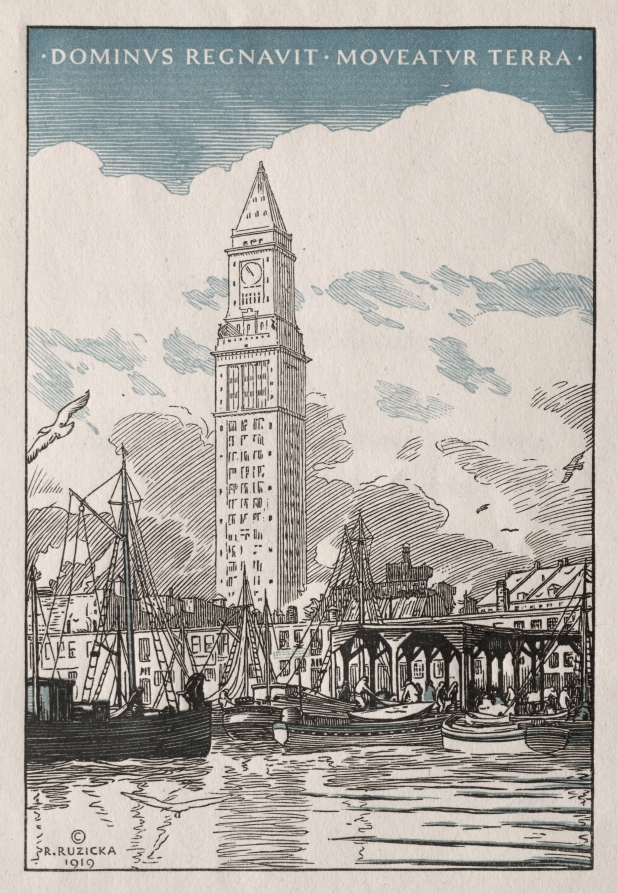
Rudolph Ruzicka · The Cleveland Museum of Art · Gift of FitzRoy Carrington · CC0
- Full name
- Rudolf Růžička.
- Born
- 1883.
- Died
- 1978.
VALÉORINE Encyclopedia
VALÉORINE documentary reading
Documentary summary
Illustration — Brooklyn Bridge by Rudolph Ruzicka • Illustration — Georges Guynemer by Rudolph Ruzicka, 1918 Rudolph Ruzicka (29 June 1883 – 20 July 1978) was a Czech American wood engraver, etcher, illustrator, typeface designer, and book designer. He designed a number of seals and medals, including the American Institute of Graphic Arts (AIGA) and the Dartmouth Medal of the American Library Association.[1]
Admitted source layer · organised and presented by VALÉORINE
Reference Check
Propose documentary evidence for Rudolph Ruzicka. A contribution is never written directly as fact: identity, source, rights and evidence gates still decide.
Sign in to contribute
World of VALÉORINE
Documentary connections
Only confirmed graph relationships appear here. Images are shown only when their identity and reuse rights both pass the documentary gate.
Documentary evidence
Documentary basis
Authority files
wikidata · Q7377450 · wikipedia · Rudolph Ruzicka
In this article
Biography
Biography
Rudolph Ruzicka was born in Bohemia in 1883.[2] He emigrated to the United States of America at age ten, living first in Chicago where he took drawing lessons at the Hull House School before becoming an apprentice wood engraver. From 1900 to 1902 he attended further classes at the Art Institute of Chicago. In 1903 he moved to New York to work as an engraver at the American Bank Note Company and at Calkins & Holden. In subsequent years he attended classes at both the Art Students League of New York and the New York School of Art. In 1910 Ruzicka set up his own shop at 954 Lexington Avenue in New York City. He received his first major art commission from System magazine. Many exhibitions followed, including such venues as the Societe de la Gravure, Paris, the Grolier Club, and the Century Association. He published New York in collaboration with the Grolier Club --a series of thirty colored wood engravings that depicted the changes in architecture.[3] In 1916 Ruzicka built a house and a workshop in Dobbs Ferry, New York.[4] Ruzicka’s mastery of technique was viewed by William Ivins as one of the foremost American wood engravers as described in The Wood-Engravings of Rudolph Ruzicka.[5] In 1935 Ruzicka was awarded the Gold Medal from the American Institute of Graphic Arts, and in that same year began work with the Typographic Development staff at Mergenthaler Linotype Company, for which he was to produce typeface families. He was in charge of finding antique and modern tools used for the printmaking processes for a display at the Department of Printing and Graphic Arts, Houghton Library at Harvard University. He often collaborated with Philip Hofer curator of the Department.[6] In 1948 he moved to Massachusetts, and eventually he settled in Vermont. Over the years, D. B. Updike and Ruzicka collaborated on a number of well-respected book designs, including Newark and the Grolier Club's Irving, as well as a fine series of Merrymount Press annual keepsakes. Ruzicka also provided substantial consulting for Updike's book Printing Types. Today Ruzicka's art is collected in the Art Institute of Chicago, the Carnegie Institute, Library of Congress, the Brooklyn Institute of Arts and Sciences, and the Metropolitan Museum of Art, New York.[7]
Typefaces
Typefaces
• Lake Informal, designed for Linotype in 1935, though matrices were evidently never cut, as there is no record of this type having ever actually been cast in metal. Design later used for so-called "digital type" in 1993. • Ruzicka Freehand, proposed designs made for Linotype in 1939 and never made into actual type. A digital knock-off of this design was made in 1993 by Ann Chaisson and Mark Altman. • Fairfield series • Fairfield + Italic (Mergenthaler Linotype Company, 1940). Perhaps twenty digital variants of this face have been designed by Alex Kaczun for Linotype. • Fairfield Medium + Italic (Mergenthaler Linotype Company, 1949). A digital knock-off of this has been issued by Bitstream as Transitional 751. • Primer + Italic (Mergenthaler Linotype Company, 1953), designed for legibility and to compete with A.T.F.'s Century Schoolbook. A digital knock-off of this has been issued by Bitstream as Century 751.
Life and career
Dated record
Life and career
The full dated record · 2 entries
1883
Rudolph Ruzicka was born in 1883.
1978
Rudolph Ruzicka died at New York City.
Context
Primary material
Context
The circumstances in which Rudolph Ruzicka stands.
Documents and archives
Primary material
Documents and archives
scholarly publication
- Ruzicka, Rudolph (1883-1978), artist, typographer, and author, American National Biography Online, 2000
Scholarly · Crossref registry · 2000
authority record
- Wikidata, structured authority record Q7377450: Rudolph Ruzicka
General reference · Wikidata
reference work
- “Rudolph Ruzicka”, English Wikipedia, consulted as further reading
Reputable secondary · Wikipedia
Notes from the source article
Cited by Wikipedia
Notes from the source article
These works are cited by the source article, in its own numbering. They are recorded as its citations, not as sources VALÉORINE has verified.
- 1.Rudolph Ruzicka's Two Dartmouth Medals. Dartmouth Alumni Magazine. (October 1983: 46-47.
- 2.Ruzicka, Rudolph. Fairfield, new linotype face. Mergenthaler Linotype Company. 17. 1940.
- 3.Walter Prichard Eaton, New York: A Series of Wood Engravings in Colour and a Note on Colour Printing by Rudolph Ruzicka, with Prose Impressions of the City by Walter Pritchard Eaton (New York: The nGrolier Club, 1915).
- 4.Ruzicka, Rudolph. Fairfield, new linotype face. Mergenthaler Linotype Company. 18. 1940.
- 5.William M. Ivins. The Wood-Engravings of Rudolph Ruzicka. Newark, N.J.: Newark Museum Association, 1917.
- 6.Duroselle-Melish, Caroline. “Containers of Ideas”: The Collection of Printmaking Artifacts of Philip Hofer." Harvard Library Bulletin 24 (Spring 2013): 45-65.
- 7.Bond, W. H. 1979. [Memorial to] Rudolph Ruzicka, 1833-1978. New York: Century Association.
References
Citations
References
Each reference names the institution holding it, so a reader may go to the document itself.
scholarly publication
Ruzicka, Rudolph (1883-1978), artist, typographer, and author, American National Biography Online, 2000Crossref registry
Institutional witnessauthority record
Secondary witnessreference work
Secondary witness
Further particulars
Held on the record
Further particulars
Open the remaining particulars
Rudolph Ruzicka was recorded at birth as Rudolf Růžička. The authorities additionally record the headings Rudolf Růžička, Rudolf Ruzicka and Rudolph Ružicka. His recorded language was English. Ruzicka received AIGA Medal. Works and catalogued output.
Identity and origins
Recognition and collections
Work by Rudolph Ruzicka is
Art Institute of Chicago, Hunterian Museum and Art Gallery, Smithsonian American Art Museum and Stedelijk Museum Amsterdam
A Summer Day
1936 and held by
The Encyclopedia exists whether or not anything is for sale. Corrections are recorded rather than overwritten, and every version of this record is kept. Published 16 August 2026.
Elsewhere in Prints
4,138 published records in this field, each with its sources named.
- Rudolf SchlichterEngraver
- Rudolf StangEngraver
- Rudolf von AltEngraver
- Rudolf WiegmannEngraver
- Rufino TamayoEngraver
- Rupert CarabinEngraver
- Russell T. GordonEngraver
- Russell YoungEngraver
Best supported in this field
For owners
Own a work by Rudolph Ruzicka?
A specialist will read what you send and tell you what the house can establish, what it cannot, and whether the object is suited to sale. There is no charge and no obligation. The object stays with you throughout; nothing is shipped to us unless it is arranged in writing beforehand.