
Rudolf Tobias
Rudolf Tobias (29 May [O.S. 17 May] 1873 – 29 October 1918) was the first Estonian professional composer, as well as a professional organist. He studied at the Saint Petersburg Conservatory. His compositions include among others piano works, string quartets and an oratorio, Des Jona Sendung (Jonah's Mission) (1908, revised and premiered 1909, later reconstructed by Vardo Rumessen).
Rudolf Tobias
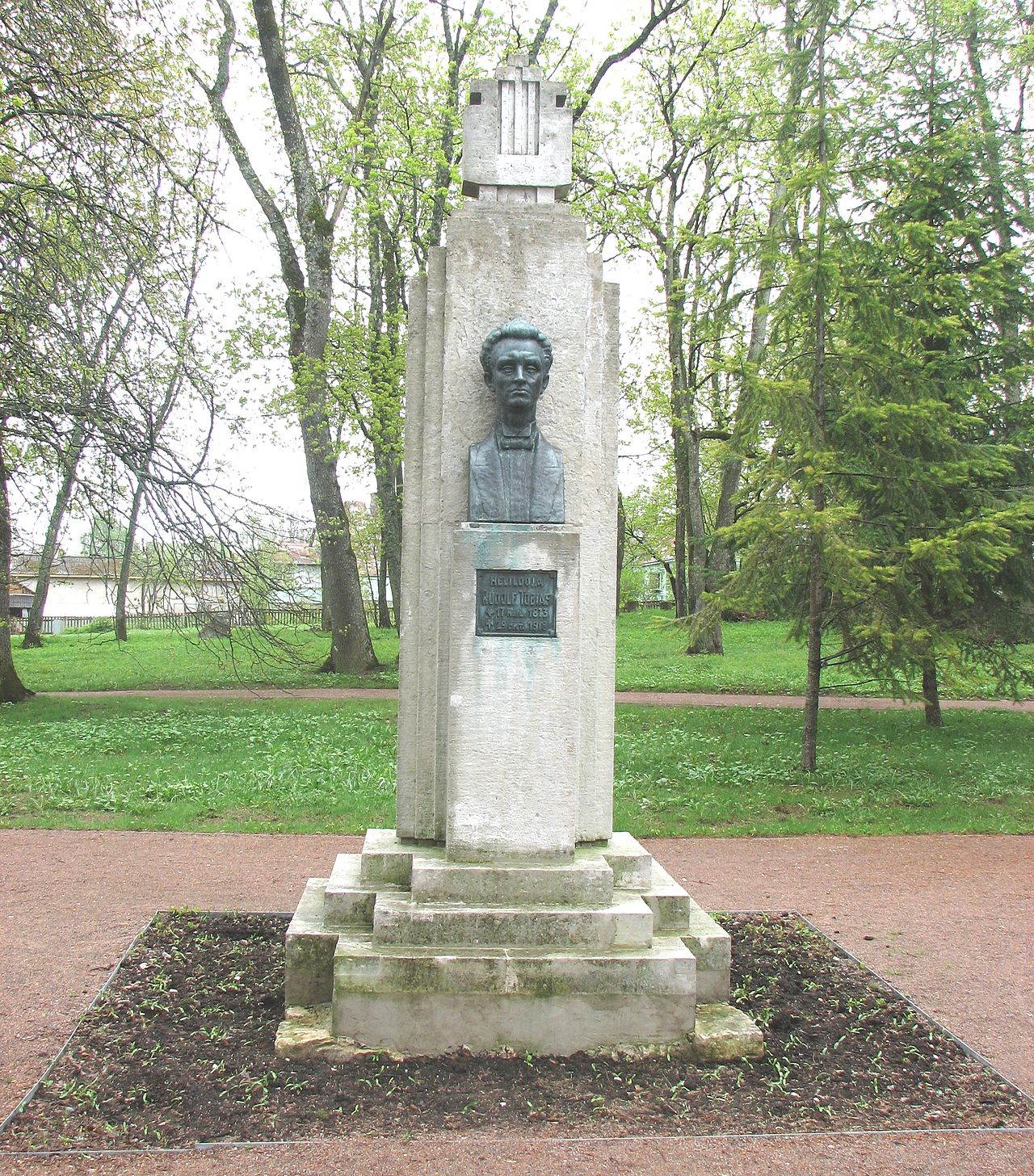
Avjoska · CC BY-SA 3.0
- Born
- 1873. · Selja.
- Died
- 1918. · Berlin.
- Nationality
- Russian Empire, German Empire and Estonia.
- Occupation
- conductor, composer, choir director, music educator, music teacher and musician.
- Fields
- classical music.
- Education
- Saint Petersburg Conservatory.
- Languages
- German and Russian.
VALÉORINE Encyclopedia
VALÉORINE documentary reading
Documentary summary
Rudolf Tobias (29 May [O.S. 17 May] 1873 – 29 October 1918) was the first Estonian professional composer, as well as a professional organist. He studied at the Saint Petersburg Conservatory. His compositions include among others piano works, string quartets and an oratorio, Des Jona Sendung (Jonah's Mission) (1908, revised and premiered 1909, later reconstructed by Vardo Rumessen).
Admitted source layer · organised and presented by VALÉORINE
Note VALÉORINE
Rudolf Tobias (1873–1918) was a choir director, composer and conductor, among other activities, of Estonian and German nationality. The choir director was born in Selja and died in Berlin.
Rudolf Tobias was educated at Saint Petersburg Conservatory. The choir director worked for Berlin University of the Arts.
The work spans classical music. Languages used include German and Russian.
Composed from admitted, traceable facts · 27 September 2026
VALÉORINE
Reference Check
Propose documentary evidence for Rudolf Tobias. A contribution is never written directly as fact: identity, source, rights and evidence gates still decide.
Sign in to contribute
Documentary evidence
Evidence Panel
not yet certified
- Identity
- resolved
- Independent source families
- 0
- Admitted assertions
- 0
- Open conflicts
- 0
Authority files
gnd · 1375553267 · wikidata · Q1346393 · wikipedia · Rudolf Tobias
In this article
Early life
Early life
Rudolf Tobias was born in Selja, Käina Parish, on the island of Hiiumaa. He was the son of local parish clerk Johannes Tobias and his wife Emilie. Tobias received his first musical training from his father. Under his father's tutelage, he began musical training at an early age and composing his first composition exercises from 1882 when he was 9 years old. In 1885 he entered the Haapsalu school and studied piano under Catharina von Gernet, a local pianist. After he graduated, Tobias moved with his parents to Kullamaa, where his father had become the parish clerk. In 1889 Tobias entered Tallinn Nicolai High School, where he passed the tutor's exam and studied both organ and music theory with Ernst Reinicke, the Tallinn Cathedral organist. In 1893 Tobias furthered his studies at the Saint Petersburg Conservatory, where he studied organ with Louis Homilius and composition with Nikolai Rimski-Korsakov. In 1897 Tobias graduated from conservatory with two special subjects, presenting as his graduate work the cantata "Johannes Damascenus". After graduation Tobias worked as organist and choir conductor of the Saint Petersburg Estonian St. John's Church from 1898 to 1904. During this time he also performed there his own compositions.
Career
Career
In 1904 Tobias moved to Tartu and worked as a music teacher in numerous schools and also worked as a tutor. During his time in Tartu he participated in organizing concerts, as well as performing as pianist, conductor and organist and preparing with his contemporary Aleksander Läte performances of oratorios. Tobias also began working as a musical journalist during this period and joined the literary group Noor Eesti. In January 1908 Tobias briefly moved to Paris, France. Shortly after that he lived briefly in Munich and Dresden in Germany and Prague and Dubí in present-day Czech Republic. At the end of 1908 he moved to Leipzig. In 1910 Tobias moved to Berlin, where he worked as both an organist and journalist. In 1911 he was an active member of the evaluation committee of the Consortium of German Composers (Genossenschaft Deutscher Tonsetzer). In 1914 he acquired German citizenship, and then full professorship at the Royal Academy of Music. In August 1913 Tobias visited his homeland to view opening ceremonies of the new Estonia Theatre, where he also conducted his own compositions. After returning to Berlin, Tobias arranged his authorship concert where passages of his oratorio "Mission of Jonah" were performed. After the outbreak of World War I Tobias was enrolled in the German army where he worked as an interpreter. Tobias was released from service for medical reasons in 1916 and he returned to work in the Royal Academy of Music.
Life and career
Dated record
Life and career
The full dated record · 1 entries
1918
Rudolf Tobias died at Berlin.
Places
Named by the record
Places
Only places the record itself states, plotted where the house gazetteer settles their coordinates. Nothing is inferred from a name or a nationality.
Selja.
Birth place
Berlin.
Death place
Death and legacy
Tobias died of pneumonia in Berlin, Germany, on 29 October 1918. His youngest daughter, Helen, born seven months after his death, also became a composer. He was buried in the Friedhof Wilmersdorf cemetery in Berlin. After the restoration of the Republic of Estonia, Tobias's remains were reburied on 7 June 1992 in Kullamaa. In commemoration of Rudolf Tobias' life and work, a monument was erected in Haapsalu in 1929 designed by architect Roman Haavamägi and a memorial erected in Kullamaa in 1973. In 1924 a street in Tallinn's Raua subdistrict was renamed after Tobias and in 1973 Tobias's name was given to the Children's Music School in Kärdla. On the occasion of the centennial of Tobias's birth in 1973, a memorial museum was opened in Selja, Käina Parish in the house where he was born. Rudolf Tobias was engraved on the front side of the Estonian 50 krooni bill used between 1994 and 2010. The Tobias String Quartet (Tobiase keelpillikvartett) is named after this composer.

Rudolf Tobiase haud Kullamaa kirikaias
Athanasius Soter

Eesti muusika pidupäevad Hiiumaal Rudolf Tobias 150
TOBALV
Primary material
Documents and archives
reference work
- Wikidata, structured authority record Q1346393: Rudolf Tobias
Reputable secondary · Wikimedia Foundation
- “Rudolf Tobias”, English Wikipedia, consulted as further reading
Reputable secondary · Wikipedia
authority file
- Gemeinsame Normdatei 1375553267, Rudolf, Tobias.
Unverified · Deutsche Nationalbibliothek
Notes from the source article
Cited by Wikipedia
Notes from the source article
These works are cited by the source article, in its own numbering. They are recorded as its citations, not as sources VALÉORINE has verified.
References
Citations
References
Each reference names the institution holding it, so a reader may go to the document itself.
authority file
Gemeinsame Normdatei 1375553267, Rudolf, Tobias.Deutsche Nationalbibliothek
Partially resolvedreference work
Wikidata, structured authority record Q1346393: Rudolf TobiasWikimedia Foundation
Partially resolvedreference work
Partially resolved
The Encyclopedia exists whether or not anything is for sale. Corrections are recorded rather than overwritten, and every version of this record is kept. Published 14 August 2026.
Elsewhere in Music memorabilia
42,307 published records in this field, each with its sources named.
- Rudolf SchwarzPerson
- Rudolf SerkinPerson
- Rudolf SieczyńskiPerson
- Rudolf TillmetzPerson
- Rudolf TomsitsPerson
- Rudolf von und zu LiechtensteinPerson
- Rudolf Wagner-RégenyPerson
- Rudolph BayPerson
Best supported in this field
For owners
Own a work by Rudolf Tobias?
A specialist will read what you send and tell you what the house can establish, what it cannot, and whether the object is suited to sale. There is no charge and no obligation. The object stays with you throughout; nothing is shipped to us unless it is arranged in writing beforehand.