
Rothko Chapel
The Rothko Chapel is a non-denominational chapel in Houston, Texas, founded by John and Dominique de Menil. The interior serves not only as a chapel, but also serves as the display framework for a major work of modern art: on its walls are fourteen paintings by Mark Rothko in varying hues of black. The shape of the building—an octagon inscribed in a Greek cross—and the design of the chapel were largely influenced by the artist.
Rothko Chapel

Mike Linksvayer from Oakland, California · dsc01183.jpg Uploaded by Trycatch · CC BY 2.0
- Name
- Rothko Chapel
- Founded
- 1971
- Headquarters
- United States
- Part of
- Menil Campus
VALÉORINE Encyclopedia
VALÉORINE documentary reading
Documentary summary
The Rothko Chapel is a non-denominational chapel in Houston, Texas, founded by John and Dominique de Menil. The interior serves not only as a chapel, but also serves as the display framework for a major work of modern art: on its walls are fourteen paintings by Mark Rothko in varying hues of black. The shape of the building—an octagon inscribed in a Greek cross—and the design of the chapel were largely influenced by the artist.
Admitted source layer · organised and presented by VALÉORINE
Note VALÉORINE
No house-authored Note is published until its assertions and sources pass the VALÉORINE evidence contract. The documentary article remains available in full while that enrichment is being consolidated.
Documentary enrichment in progress · no unsupported statement published
Reference Check
Propose documentary evidence for Rothko Chapel. A contribution is never written directly as fact: identity, source, rights and evidence gates still decide.
Sign in to contribute
World of VALÉORINE
Documentary connections
Only confirmed graph relationships appear here. Images are shown only when their identity and reuse rights both pass the documentary gate.
Documentary evidence
Evidence Panel
not yet certified
- Identity
- resolved
- Independent source families
- 0
- Admitted assertions
- 0
- Open conflicts
- 0
Authority files
gnd · 300215711 · wikidata · Q2956755 · wikipedia · Rothko Chapel
In this article
Overview
Overview
The chapel sits 2 mi southwest of downtown in the Montrose neighborhood, situated between the building housing the Menil Collection and the Chapel of Saint Basil on the campus of the University of Saint Thomas. About 110,000 people visit the chapel each year. Barnes states "The Rothko Chapel.. Became the world's first broadly ecumenical center, a holy place open to all religions and belonging to none. It became a center for international cultural, religious, and philosophical exchanges, for colloquia and performances. On September 16, 2000, the Rothko Chapel was placed on the National Register of Historic Places.

Rothko Chapel, Houston, August 2010.
David Van Horn from Boston, MA, USA · dsc01183.jpg DSC_1278 Uploaded by Trycatch
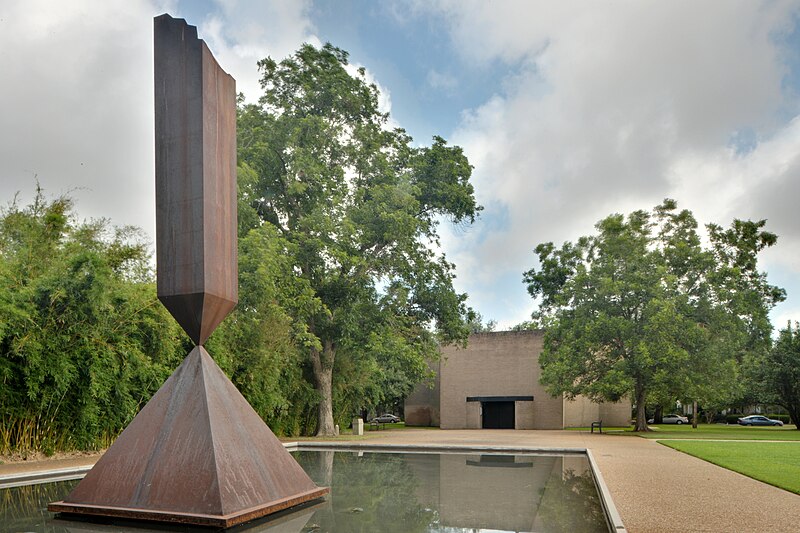
The outdoor sculpture, "Broken Obelisk" by Barnett Newman, is permanently installed in the reflecting pool on the grounds of Rothko Chapel in Houston, Texas, USA.
Ed Uthman, Houston, Texas, USA
Key facts
Key facts
• Name — Rothko Chapel • Location — 3900 Yupon Street, Houston, Texas • Built — 1971 • Architect — Rothko, Mark; Johnson, Philip, et al. Renovation (2020) by Architecture Research Office. • Architecture — Modern Movement, New Formalist • Added — August 16, 2000 • Area — less than 1 acre • Ref Num — 00000883
History
History
In 1964 Rothko was commissioned by John and Dominique de Menil (also founders of the nearby Menil Collection) to create a meditative space filled with his paintings. The works are site-specific, one of the requirements of the program. As Rothko was given creative license on the design of the structure, he clashed with the project's original architect, Philip Johnson over the plans for the chapel. The plans went through several revisions and architects. Rothko continued to work first with Howard Barnstone and then with Eugene Aubry, but ultimately he did not live to see the chapel's completion in 1971. After a long struggle with depression, Rothko died by suicide in his New York studio on February 25, 1970. From 1973 onward, the Rothko Chapel doubled as a center for colloquiums aimed at fostering mutual understanding on issues affecting justice and freedom throughout the world. The first colloquium drew scholars from Lebanon, Iran, India, Pakistan, Nigeria, Japan, Italy, the United States and Canada. In 1981, it initiated “The Rothko Chapel Awards to Commitment to Truth and Freedom." In 1986, a second award was established to honor and emulate the spirit of Óscar Romero, Archbishop of San Salvador, who was murdered on March 24, 1980. These Rothko Chapel Awards have recognized individuals and organizations who, at great risk, denounce violations of human rights. In 1991 the Rothko Chapel marked its 20th anniversary with a joint award with the Carter-Menil Human Rights Foundation, founded in 1986 with former President Jimmy Carter. Nelson Mandela was the keynote speaker and received the special Rothko Chapel award. In early 1999, the Rothko Chapel closed for a major renovation. The paintings had been exhibiting premature signs of age, and the largest could not be removed for treatment. In 2000, the chapel reopened after an 18-month, $1.8million renovation, with the artist's paintings newly restored. In May 2018, museum staff discovered the Chapel had been vandalized. White paint was spilled near the Chapel's entrance and in the reflecting pool surrounding the Broken Obelisk sculpture. Handbills had been strewn around the grounds and pool that read "It's okay to be white", an alt-right slogan. For its fiftieth anniversary in 2021, the Rothko Chapel underwent $30million in restoration to hew nearer the original plan. The 2019-2021 work removed the baffled skylight in favor of a new louvered skylight designed by George Sexton Associates; re-landscaped nearby lawns and fencing; removed glass doors; and added a new visitor center designed by Architecture Research Office. In July 2024, the Rothko Chapel suffered extensive damage from stormwater during Hurricane Beryl. Three of Rothko's murals were damaged, along with the chapel's ceiling and walls. The chapel was closed in August 2024 for renovations and restoration. The building reopened in December 2024 after reparative work was completed.
Architecture
Architecture
The chapel is an irregular octagonal brick building with gray or rose stucco walls and a skylight. It serves as a place of meditation as well as a meeting hall and is furnished with eight simple, moveable benches for meditative seating; more are provided to accommodate the audience for special events. Holy books from several religions are available. As renovated in 2020 by Architecture Research Office and George Sexton Associates, the louvered skylight diffuser consists of 280 reflective aluminum blades that are individually angled and spaced to ensure an even distribution of light onto the paintings along the perimeter walls.
Works of art
Works of art
The chapel is associated with several works of art other than the building itself, in the fields of painting, sculpture, and music.
Music
Music
One of Morton Feldman's best known pieces of music was inspired by and written to be performed in the chapel—it too is called Rothko Chapel (1971). The musician Peter Gabriel wrote a 1992 song called "Fourteen Black Paintings" which was inspired by a visit to the chapel. David Dondero composed a song entitled "Rothko Chapel" that appears on his 2007 album Simple Love. Visiting Tibetan Gyuto Tantric monks performed harmonic chanting in April 1986. Houston Grand Opera's HGOco commissioned and premiered an opera in 2017 about the chapel called Some Light Emerges, with music by Laura Kaminsky, concept by Mark Campbell and libretto by Campbell and Kimberly Reed. In 2019, Solange Knowles filmed scenes for the visual album When I Get Home in the chapel. Dessa's 2023 album Bury the Lede includes a song called "Rothko", which is set in the chapel and references the paintings.
Recognition
Recognition
As a focal point of dialogue between social justice, artistic, and spiritual leaders, the Rothko Chapel has been the recipient of several notable awards, including the Peace Award from The Houston Baha’í Community (1998), a Community Award from the Museum District Business Alliance (2000), The James L. Tucker Interfaith Award from Interfaith Ministries (2004), an Urban Greenery Award from The Park People (2005), and recognitions from the Houston Peace and Justice Center (2008). The Rothko Chapel also hosts the biannual Óscar Romero Award to recognize "courageous, grassroots, human rights advocacy." Past awardees include Bishop Proaño, Cardinal Arns, the Oslobodjenje, Sr. Dianna Ortiz, Salima Ghezali, and Berta Cáceres.
Institutional history
Dated record
Institutional history
The full dated record · 2 entries
1971
Rothko Chapel established.
1971
Rothko Chapel is recorded from 1971.
Places
Named by the record
Places
Only places the record itself states, plotted where the house gazetteer settles their coordinates. Nothing is inferred from a name or a nationality.
- United States
Paintings
Paintings
• Illustration — Rothko chapel interior Fourteen of Rothko's paintings are displayed in the chapel. Three walls display triptychs, while the other five walls display single paintings. Beginning in 1964, Rothko began painting a series of black paintings, which incorporated other dark hues and texture effects. The de Menils offered Rothko a commission for the chapel in 1964. From the fall of 1964 through the spring of 1967, he painted the fourteen large paintings and four alternates, which incorporated many of the characteristics of the earlier 1964 black paintings.
Sculpture
Sculpture
• Illustration — Broken Obelisk in front of the Rothko Chapel A distinctive sculpture by Barnett Newman, Broken Obelisk, was installed in 1970 in front of the chapel. The sculpture sits in a reflecting pool designed by Philip Johnson and it is dedicated to the memory of Martin Luther King Jr., who was assassinated in 1968. The sculpture originally stood in Washington, D.C., and was offered in 1969 by the de Menils as a memorial to King to stand in front of Houston City Hall. Houston turned down the gift and the de Menils then donated the sculpture and the Rothko paintings to start the Rothko Chapel.
Primary material
Documents and archives
reference work
- “Rothko Chapel”, English Wikipedia, consulted as further reading
Reputable secondary · Wikipedia
- Wikidata, structured authority record Q2956755: Rothko Chapel
Reputable secondary · Wikidata
authority file
- Gemeinsame Normdatei 300215711, The Rothko Chapel.
Unverified · Deutsche Nationalbibliothek
References
Citations
References
Each reference names the institution holding it, so a reader may go to the document itself.
authority file
Gemeinsame Normdatei 300215711, The Rothko Chapel.Deutsche Nationalbibliothek
Partially resolvedreference work
Partially resolvedreference work
Partially resolved
Further particulars
Held on the record
Further particulars
Open the remaining particulars
Rothko Chapel is associated with United States. Recorded from 1971.
Rothko Chapel is recorded as
Menil Park
The Encyclopedia exists whether or not anything is for sale. Corrections are recorded rather than overwritten, and every version of this record is kept. Published 14 August 2026.
Elsewhere in Institutions
3,152 published records in this field, each with its sources named.
- RooseumOrganisation
- Rose Art MuseumOrganisation
- Rosenthal Center for Contemporary ArtOrganisation
- Ross Memorial MuseumOrganisation
- Rotorua MuseumOrganisation
- Rourke Art MuseumOrganisation
- Royal Abbey of Our Lady of ChaalisOrganisation
- Royal Academy of ArtsOrganisation
Best supported in this field
For owners
Own an object connected with Rothko Chapel?
A specialist will read what you send and tell you what the house can establish, what it cannot, and whether the object is suited to sale. There is no charge and no obligation. The object stays with you throughout; nothing is shipped to us unless it is arranged in writing beforehand.