
roneat thung
The roneat thung or roneat thum is a low-pitched xylophone used in the Khmer classical music of Cambodia. It is built in the shape of a curved, rectangular boat. This instrument plays an important part in the Pinpeat ensemble.
roneat thung
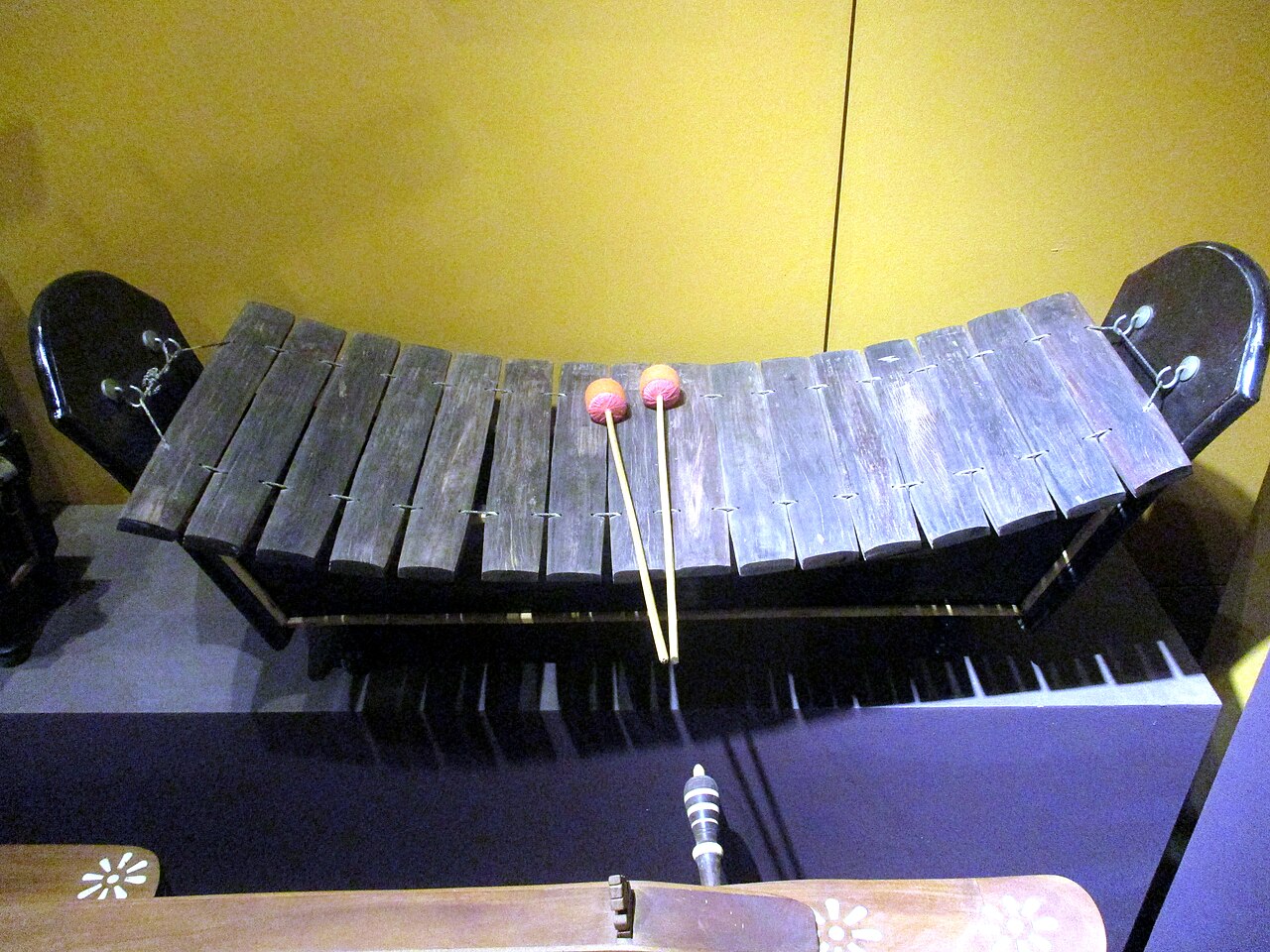
Turaids · CC BY-SA 4.0
- Name
- Roneat thung
- Field
- xylophone · traditional Cambodian musical instrument
VALÉORINE Encyclopedia
VALÉORINE documentary reading
Documentary summary
The roneat thung or roneat thum is a low-pitched xylophone used in the Khmer classical music of Cambodia. It is built in the shape of a curved, rectangular boat. This instrument plays an important part in the Pinpeat ensemble.
Admitted source layer · organised and presented by VALÉORINE
Reference Check
Propose documentary evidence for roneat thung. A contribution is never written directly as fact: identity, source, rights and evidence gates still decide.
Sign in to contribute
World of VALÉORINE
Documentary connections
Only confirmed graph relationships appear here. Images are shown only when their identity and reuse rights both pass the documentary gate.

Documentary evidence
Documentary basis
Authority files
wikidata · Q7365592 · wikipedia · Roneat thung
In this article
Overview
Overview
The roneat Thung is placed on the left of the roneat ek, a higher-pitched xylophone. The Roneat Thung is analogous to the ranat thum of Thai.
Key facts
Key facts
• Name — Roneat thung • Names — Roneat thum • Classification — Percussion (idiophone) • Related — Ranat thum, ranat thum lek, ranat ek
Etymology
Etymology
Roneat means xylophone where thung literally mean [wooden] container in Khmer. This may derived from the shape of this type of xylophone which shaped like a rectangular wooden container. Terry E. Miller and Sean Williams in their book The Garland Handbook of Southeast Asian Music, Roneat Thung is better called Roneat thomm/ thum which literally means "large xylophone". This name may designates the fact that roneat thum's resonator and note bars are larger and longer than those of roneat ek.
History
History
• Illustration — Khmer female musician with roneat thung taken by Emile Gsell in the mid-1800s. • Illustration — Man playing a roneat thung on a pre-1900 postcard by Pierre Dieulefils. Roneat Thung, the sister musical instrument of Roneat Ek, was already established itself as a member of the Pinpeat orchestra since before the Angkor period. According to another source, Cambodian Roneat genres were derived from the Javanese gamelan musical instruments which influenced the Khmer musical instrument in the early Angkorian period which spread from Kampuchea further northwest to Myanmar. Specifically, Roneat Thung is identical to the Indonesian and Malay gambang kayu. Throughout the history of Cambodian music, especially in the post-Angkorian period, Roneat thung usually appears in various mural paintings along with Roneat ek and always represent in the Pinpeat or Mahori orchestra.
Structure
Structure
The shape of Roneat Thung is thought to be modeled from a riverboat as Roneat Ek as well. Roneat thung's rectangular trough-resonator measures about 50 inches long supported by four short legs. While the end-pieces of the roneat aek and the roneat daek are flat and straight, the roneat thung end-pieces are curved slightly outward. The roneat thung has sixteen bamboo or wooden bars, measuring about 18.75 inches (low pitch) to 15.25 inches (high pitch) in length. The width of the bars (low and high) is approximately 2.5 inches and the thickness of both is about 0.75 inch. As the materials, which are used to make the bars, are the same as the roneat aek, the same tuning blobs are also utilized. Like the roneat aek, the roneat thung bars are suspended with two cords running through holes in each bar and placed on two hooks at each of the two curved end-pieces that are connected to the resonator. Only soft mallets are used to play the roneat thung, either indoor or outdoor. While the mallet handles of the roneat thung are about the same length as those of the roneat aek, their disc are larger and thicker. Each measure approximately 1.75 inches in diameter and about 1.5 inches in thickness. The range of the roneat thung overlaps that of the roneat aek, one octave lower. Due to its stylistic playing, the sixteen bars cover a range of music of over two octaves, a range that is wider than that of the roneat aek. The role assigned to the roneat thung is to counter the melody. The roneat thung plays a line almost identical to that of the korng thomm, except in a lak (vivacious, funny, comic) fashion.
Significance
Significance
Roneat Thung has significant function in Khmer traditional orchestra both Pinpeat and Mohaori. But the Roneat Thung used in Mahori has to have higher sound (one sound) than the Roneat Thung used in Pinpeat starting from the first bar note. According to Cambodian traditional musicians, roneat thung has the same representation as Roneat Ek. Roneat Ek represents female naga or dragon where roneat thung itself represents male naga in which both nagas has to be next to one another or pairing as accompanied in Khmer traditional orchestras.
Primary material
Documents and archives
reference work
- “Roneat thung”, English Wikipedia, consulted as further reading
Reputable secondary · Wikipedia
authority record
- Wikidata, structured authority record Q7365592: roneat thung
General reference · Wikidata
Literature
Scholarly footprint
A count of publications is evidence of attention, not of standing, and is given here only as a measure.
Notes from the source article
Cited by Wikipedia
Notes from the source article
These works are cited by the source article, in its own numbering. They are recorded as its citations, not as sources VALÉORINE has verified.
- 1.Chhounnath' dictionary. "roneat, thung"
- 2.Miller, Terry. The Garland Handbook of Southeast Asian Music. Routledge. 2011-03-17. 9781135901554.
- 3.United Nations Educational, Scientific and Cultural Organization. Traditional Musical Instruments of Cambodia. unesdoc.unesco.org. 2003.
- 4.Geography of gamelan. www.perso.ch.
- 5.The kantoam ming funeral orchestra. Site de soundsofangkor !.
- 6.Masis, Julie. Popular Archeology - The Hidden Art of Angkor Wat. Popular Archeology.
- 7.POV. Conduct a Cambodian Ensemble The Flute Player POV PBS. POV American Documentary Inc. 2003-01-17.
- 8.ឧបករណ៍ភ្លេង រនាដធុង. Koh Santepheap Daily. 2010-08-30.
References
Citations
References
Each reference names the institution holding it, so a reader may go to the document itself.
reference work
Secondary witnessauthority record
General reference
Connections
Knowledge graph
Connections
Each connection was recorded deliberately, with the basis for it kept on the internal record.
Broader subject
1- xylophoneTerminology
Established from a fact already recorded on a verified source.
The Encyclopedia exists whether or not anything is for sale. Corrections are recorded rather than overwritten, and every version of this record is kept. Published 16 August 2026.
Elsewhere in Collectables
20,755 published records in this field, each with its sources named.
- rondadorTerminology
- Rondo of SwordsWork
- roneat dekTerminology
- Roneat ekTerminology
- Ronn Motor CompanyOrganisation
- ronrocoTerminology
- roof knockingTerminology
- RoogooWork
Best supported in this field
For owners
Own an object connected with roneat thung?
A specialist will read what you send and tell you what the house can establish, what it cannot, and whether the object is suited to sale. There is no charge and no obligation. The object stays with you throughout; nothing is shipped to us unless it is arranged in writing beforehand.