
Robert Howlett
Robert Howlett (3 July 1831 – 2 December 1858) was a British pioneering photographer whose pictures are widely exhibited in major galleries. Howlett produced portraits of Crimean War heroes, genre scenes and landscapes. His photographs include the iconic picture of Isambard Kingdom Brunel which was part of a commission by the London-based weekly newspaper Illustrated Times to document the construction of the world's largest steamship, the SS Great Eastern.
Robert Howlett

Robert Howlett · en.wikipedia · Public domain
- Name
- Robert Howlett
- Born
- 3 July 1831
- Birthplace
- Theberton, Suffolk, England
- Died
- 2 December 1858
- Place of death
- London, England
- Occupation
- Photographer
- Nationality
- United Kingdom of Great Britain and Ireland · United Kingdom
- Languages
- English
Reference Check
Propose documentary evidence for Robert Howlett. A contribution is never written directly as fact: identity, source, rights and evidence gates still decide.
Sign in to contribute
World of VALÉORINE
Documentary connections
Only confirmed graph relationships appear here. Images are shown only when their identity and reuse rights both pass the documentary gate.

Documentary evidence
Documentary basis
Authority files
wikidata · Q7345653 · wikipedia · Robert Howlett
In this article
Biography
Biography
He exhibited at the London Photographic Society and published On the Various Methods of Printing Photographic Pictures upon Paper, with Suggestions for Their Preservation. He worked in partnership with Joseph Cundall at "The Photographic Institution" at New Bond Street, London. Howlett made photographic studies for the artist William Powell Frith to assist him on his vast modern panorama painting The Derby Day (1856–58; Tate, London) which was exhibited at the Royal Academy of Arts in 1858. Howlett was commissioned by Queen Victoria and Prince Albert to photograph the frescoes in the new drawing-room at Buckingham Palace, make copies of the paintings by Raphael and make a series of portraits called 'Crimean Heroes' which was exhibited in 1857 the Photographic Society of London's annual exhibition. His death was apparently due to typhoid (rather than as a result of over-exposure to dangerous chemicals, as was suggested by some at the time, a myth that has continued to this day). The Illustrated Times praised him as "one of the most skillful photographers of the day." Prints from Howlett's photographs were published posthumously by his late partners Cundall & Downes under their own name, and by the London Stereoscopic and Photographic Company.
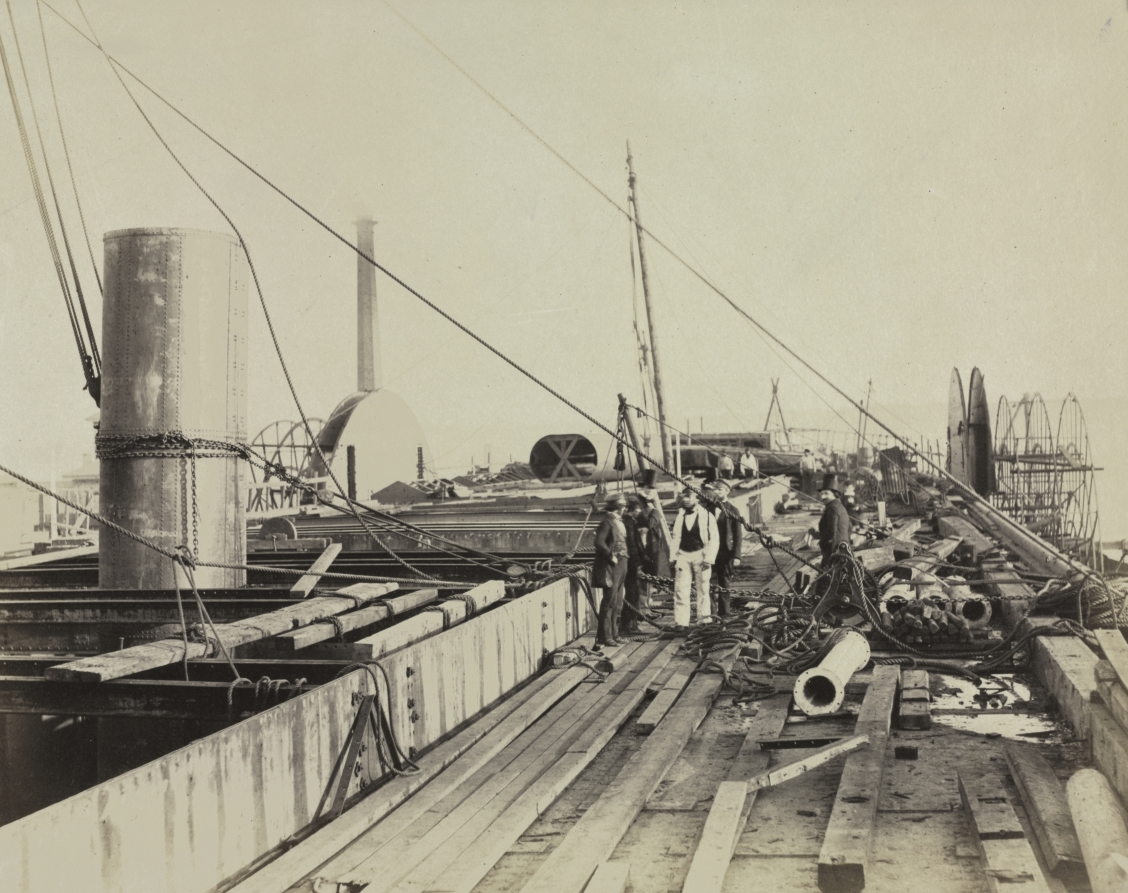
Deck Scene of the Great Eastern, 1857, by Robert Howlett
Robert Howlett · The Cleveland Museum of Art · John L. Severance Fund
Key facts
Key facts
• Name — Robert Howlett • Born — 3 July 1831 • Birthplace — Theberton, Suffolk, England • Died — 2 December 1858 • Place of death — London, England • Occupation — Photographer
Early life and education
Early life and education
• Illustration — Isambard Kingdom Brunel Standing Before the Launching Chains of the Great Eastern by Robert Howlett (1857) Howlett was the second of four sons of Reverend Robert Howlett and Harriet Harsant. Two brothers died in infancy and his younger brother Thomas became a farmer. He was born in Theberton, Suffolk and the family had moved to Longham, Norfolk by the time he was 9 years old. His maternal grandfather, Thomas Harsant, a surgeon, constructed telescopes, microscopes, electrical machines, implements and instruments. Robert built his own microscope when a child. Thomas Harsant died in 1852 and left him £1000 plus his "turning lathe and all the apparatus and tools belonging thereto". Thus he was able to move to London.
Career
Career
In London Howlett rose to prominence while working for the Photographic Institution at 168 New Bond Street, London, which was a leading establishment for the commercial promotion of photography through exhibitions, publications, and commissions. Although the Photographic Institution was established in 1853 by Joseph Cundall and Philip Henry Delamotte, it is believed that Howlett replaced Delamotte, who became professor of drawing at King's College London. He was elected to membership of the Photographic Society of London, later the Royal Photographic Society, in December 1855 and remained a member until his death. By 1856 Howlett was mentioned in the photographic press. He sent prints to the annual exhibitions of photographic societies in London, Manchester, and Norwich. These included landscape studies, In the Valley of the River Mole, Mickleham, and Box Hill, Surrey, which are presumed to have been taken in 1855. He exhibited at the London Photographic Society and in 1856 published a booklet "On the Various Methods of Printing Photographic Pictures upon Paper, with Suggestions for Their Preservation". He also designed and sold 'dark room tents' and worked in partnership with Joseph Cundall at "The Photographic Institution" at 168 New Bond Street, London. Howlett undertook the first of a number of commissions for Queen Victoria and Prince Albert in 1856, working for the Photographic Institution. These included copying the works of Raphael for Prince Albert, and making a series of portraits of heroic soldiers from the Crimean War. These were first exhibited in 1857 as 'Crimean Heroes' at the Photographic Society of London's annual exhibition. In 2004 Cundall and Howlett's portraits of Crimean war veterans, were used by the Royal Mail for a set of six postage stamps to mark the 150th anniversary of the conflict. Howlett's studio portraits at 'The Photographic Institute' included eminent 'fine artists' such as William Powell Frith, Frederick Richard Pickersgill, John Callcott Horsley, and Thomas Webster which were among a larger group exhibited at the Art Treasures Exhibition in Manchester in 1857. Howlett was commissioned to make photographic studies of the crowd at the 1856 Epsom Derby for the painter William Powell Frith, who used them in 1858 for his painting of The Derby Day which was exhibited at the Royal Academy of Art in 1859. The photographs were taken from the roof of a cab. • Illustration — Great Eastern steamship under construction (1857), photograph by Robert Howlett
The Great Eastern
The Great Eastern
Howlett's major work was the commission by The Illustrated Times Weekly Newspaper to document the construction of the world's largest steamship, the SS Great Eastern. His images were translated into wood-engravings by Henry Vizetelly for the Illustrated Times. They reflected and stimulated the widespread interest in this feat of engineering. This project included the well-known portrait of the Great Easterns creator and engineer, Isambard Kingdom Brunel, standing in front of the giant launching chains on the 'checking drum' braking mechanism at John Scott Russell's Millwall shipyard. It was taken to celebrate the launch of the world's largest steamship, in November 1857. This image, which depicts Brunel in an industrial setting instead of a more traditional background for a portrait, has been described as "one of the first examples of environmental portraiture".
Death
Death
Howlett died in 1858, aged 27, at his home and studio at 10 Bedford Place, Campden Hill, shortly after returning from a trip to France to try out a new 'wide angle lens'. The cause of death was apparently due to typhoid, rather than (as suggested by some at the time) to over-exposure to the chemicals used in the Collodion photographic process invented by Frederick Scott Archer in about 1850. The Illustrated Times praised him as "one of the most skillful photographers of the day". The death certificate simply states febris (fever), 20 days. Howlett had originally told his friend Thomas Frederick Hardwich that he had a cold.
Grave
Grave
Howlett is buried at the church of St Peter and St Paul, Wendling, Norfolk, where his father was perpetual curate. His gravestone is to the east of the chancel. In 2017 a campaign led by his biographer, Rose Teanby, succeeded in having his grave restored, followed by a re-dedication service on 14 October 2017.
Galleries showing Robert Howlett
Galleries showing Robert Howlett
• London, National Portrait Gallery • London, Victoria and Albert Museum • New York, Hans P. Kraus, Jr., Fine Photographs • San Francisco Museum of Modern Art • Cleveland Museum of Art
Identity
Identity
Robert Howlett is recorded as photographer and journalist.
Life and career
Dated record
Life and career
The full dated record · 2 entries
1831
Robert Howlett born at Theberton.
1858
Robert Howlett died at London.
Places
Named by the record
Places
Only places the record itself states, plotted where the house gazetteer settles their coordinates. Nothing is inferred from a name or a nationality.
Theberton.
Birth place
London.
Death place
Modern tribute
In 2008, photojournalist David White recreated both Howlett's camera and the Brunel commission, travelling across south and west England. In 2009, the article The Light Shone and Was Spent: Robert Howlett and the Power of Photography by David White was published.
Primary material
Documents and archives
Institutional database
- Wikidata, structured authority record Q7345653: Robert Howlett
Scholarly · Wikimedia Foundation
reference work
- “Robert Howlett”, English Wikipedia, consulted as further reading
Reputable secondary · Wikipedia
Text attribution
Licensing
Text attribution
Part of the biographical narrative on this page reuses licensed material. Its origin, revision and licence are recorded here.
The biographical narrative on this page is based on the Wikipedia article Robert Howlett, revision 1372549789 (EN edition), by its contributors. VALÉORINE has edited that text and built its own documentary record around it. The reused material is available under CC BY-SA 4.0, and this page's reuse of it is offered under the same licence. Everything else on this page — the chronology, the holdings, the evidence, the plates and the connections — is VALÉORINE's own record. Sources and licences.
References
Citations
References
Each reference names the institution holding it, so a reader may go to the document itself.
Institutional database
Wikidata, structured authority record Q7345653: Robert HowlettWikimedia Foundation
Institutional witnessreference work
Secondary witness
The Encyclopedia exists whether or not anything is for sale. Corrections are recorded rather than overwritten, and every version of this record is kept. Published 18 August 2026.
Elsewhere in Photography
11,392 published records in this field, each with its sources named.
- Robert Henry BowPhotographer
- Robert Hobart DavisPhotographer
- Robert HoldenPhotographer
- Robert HolmesPhotographer
- Robert Hutchison of CarlowriePhotographer
- Robert J HirschPhotographer
- Robert James WallerPhotographer
- Robert JanásPhotographer
Best supported in this field
For owners
Own a work by Robert Howlett?
A specialist will read what you send and tell you what the house can establish, what it cannot, and whether the object is suited to sale. There is no charge and no obligation. The object stays with you throughout; nothing is shipped to us unless it is arranged in writing beforehand.