
Richard Steele
Sir Richard Steele (c. 1671 – 1 September 1729) was an Anglo-Irish writer, playwright and politician best known as the co-founder of the magazine The Spectator alongside his close friend Joseph Addison. • Illustration — c. 1712 kit-cat portrait of Steele by Sir Godfrey Kneller
Also recorded as Sir Richard Steele
Richard Steele
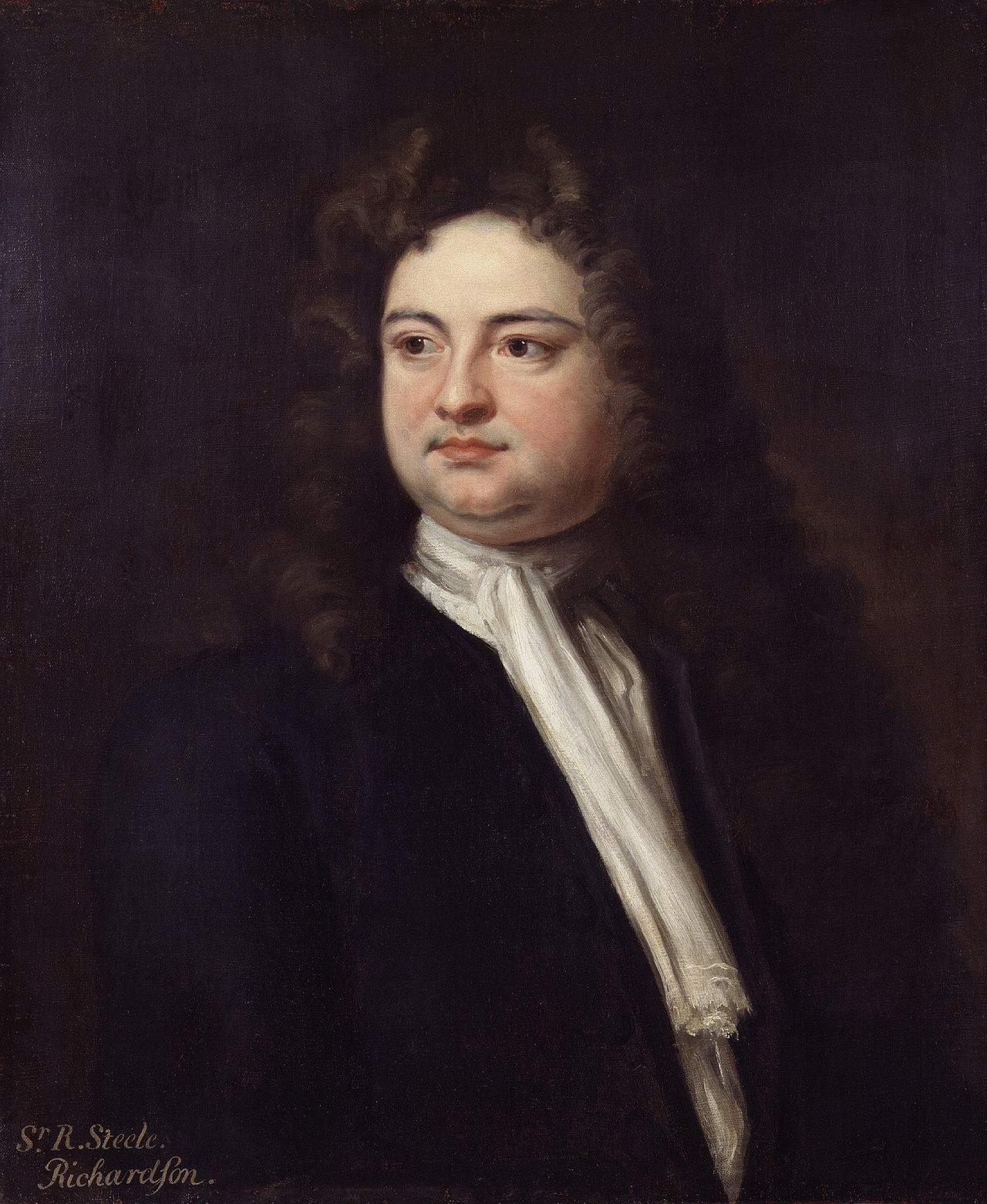
Jonathan Richardson (died 1745) · Public domain
- Name
- Richard Steele
- Born
- 1671
- Birthplace
- Dublin, Ireland
- Died
- 1 September 1729
- Place of death
- Carmarthen, Wales
- Education
- Christ Church, Oxford Merton College, Oxford
- Occupation
- Writer, playwright, politician
- Known for
- Founder of The Spectator
- Nationality
- Ireland
- Languages
- English
VALÉORINE Encyclopedia
VALÉORINE documentary reading
Documentary summary
Sir Richard Steele (c. 1671 – 1 September 1729) was an Anglo-Irish writer, playwright and politician best known as the co-founder of the magazine The Spectator alongside his close friend Joseph Addison. • Illustration — c. 1712 kit-cat portrait of Steele by Sir Godfrey Kneller
Admitted source layer · organised and presented by VALÉORINE
Note VALÉORINE
No house-authored Note is published until its assertions and sources pass the VALÉORINE evidence contract. The documentary article remains available in full while that enrichment is being consolidated.
Documentary enrichment in progress · no unsupported statement published
Reference Check
Propose documentary evidence for Richard Steele. A contribution is never written directly as fact: identity, source, rights and evidence gates still decide.
Sign in to contribute
Documentary evidence
Evidence Panel
not yet certified
- Identity
- resolved
- Independent source families
- 0
- Admitted assertions
- 0
- Open conflicts
- 0
Authority files
gnd · 1236177312 · wikidata · Q333148 · wikipedia · Richard Steele
In this article
Key facts
Key facts
• Honorific Prefix — Sir • Name — Richard Steele • Born — 1671 • Birthplace — Dublin, Ireland • Died — 1 September 1729 • Place of death — Carmarthen, Wales • Education — Christ Church, Oxford Merton College, Oxford • Occupation — Writer, playwright, politician • Known for — Founder of The Spectator
Early life
Early life
Steele was born in Dublin, Ireland, in 1671 to Richard Steele, a wealthy attorney, and Elinor Symes (née Sheyles); his sister Katherine was born the previous year. He was the grandson of Sir William Steele, Lord Chancellor of Ireland and his first wife Elizabeth Godfrey. His father lived at Mountown House, Monkstown, Dublin. His mother, of whose family background little is known, was described as "a very beautiful woman, of a noble spirit". His father died when he was four, and his mother a year later. Steele was largely raised by his uncle and aunt, Henry Gascoigne (secretary to James Butler, 1st Duke of Ormonde), and Lady Katherine Mildmay. A member of the Protestant gentry, he was educated at Charterhouse School, where he first met Addison. After starting at Christ Church, Oxford, he went on to Merton College, Oxford, then joined the Life Guards of the Household Cavalry in order to support King William's wars against France. He was commissioned in 1697, and rose to the rank of captain within two years.
Literary life
Literary life
Steele's first published work, The Christian Hero (1701), attempted to point out the differences between perceived and actual masculinity. Written while Steele served in the army, it expressed his idea of a pamphlet of moral instruction. The Christian Hero was ultimately ridiculed for what some thought was hypocrisy because Steele did not necessarily follow his own preaching. He was criticized for publishing a booklet about morals when he himself enjoyed drinking, occasional duelling, and debauchery around town. Steele wrote a comedy that same year titled The Funeral. This play met with wide success and was performed at Drury Lane, bringing him to the attention of the King and the Whig party. Next, Steele wrote The Lying Lover (1703), one of the first sentimental comedies, but a failure on stage. Steele was a member of the Whig Kit-Kat Club. Both Steele and Addison became closely associated with Child's Coffee-house in St Paul's Churchyard. Steele left the army in 1705, perhaps due to the death of the 34th Foot's commanding officer, Lord Lucas, which limited his opportunities of promotion. Also in 1705, Steele married a widow, Margaret Stretch, who died in the following year. After Margaret's death, a slave plantation she owned in Barbados came into Steele's ownership. At her funeral he met his second wife, Mary Scurlock, whom he nicknamed "Prue" and married in 1707. In the course of their courtship and marriage, he wrote more than 400 letters to her. Steele wrote The Tender Husband (1705) with contributions from Addison, and later that year wrote the prologue to The Mistake, by John Vanbrugh, also an important member of the Kit-Kat Club. In 1706 Steele was appointed to a position in the household of Prince George of Denmark, consort of Anne, Queen of Great Britain. He also gained the favour of Robert Harley, Earl of Oxford. The Tatler, Steele's first public journal, first came out on 12 April 1709, and appeared three times a week: on Tuesdays, Thursdays, and Saturdays. Steele edited this periodical under the pseudonym Isaac Bickerstaff and gave the Bickerstaff character an entire, fully developed personality. "Bickerstaff's" best Tatler columns were published by Steele as the book Isaac Bickerstaff, Physician and Astrologer later that year. Steele described his motive in writing The Tatler as "to expose the false arts of life, to pull off the disguises of cunning, vanity, and affectation, and to recommend a general simplicity in our dress, our discourse, and our behaviour". Steele founded the magazine, and although he and Addison collaborated, Steele wrote the majority of the essays; Steele wrote roughly 188 of the 271 total and Addison 42, with 36 representing the pair's collaborative works. While Addison contributed to The Tatler, it is widely regarded as Steele's work. The Tatler was closed down in early 1711 to avoid the complications of running a Whig publication that had come under Tory attack. Addison and Steele then founded The Spectator in 1711 and also The Guardian in 1713.
Parliamentary and late literary life
Parliamentary and late literary life
Steele became a Whig Member of Parliament in 1713, for Stockbridge. He was soon expelled for issuing a pamphlet in favour of the Hanoverian succession. When the Hanoverian George I of Great Britain came to the throne in the following year, Steele was knighted and given responsibility for the Theatre Royal, Drury Lane, London. He returned to parliament in 1715, for Boroughbridge. He wrote a preface to Addison's 1716 comedy play The Drummer. His wife Mary died in 1718, at a time when she was considering separation. Their daughter, Elizabeth (Steele's only surviving legitimate child), married John Trevor, 3rd Baron Trevor. Steele ended his parliamentary career in March 1722. While at Drury Lane, Steele wrote and directed the sentimental comedy The Conscious Lovers, which was an immediate hit on stage in November 1722.
Retirement
Retirement
Steele fell out with Addison and with the government administration over the Peerage Bill (1719), and in 1724 he retired to his second wife's homeland of Wales, where he spent the remainder of his life. • Illustration — Steele's house at Llangunnor, near Carmarthen, 1797 Steele died in 1729. He was buried in Carmarthen at St Peter's Church. During the restoration of the church in 2000, his skull was discovered in a lead casket, having previously been accidentally disinterred during the 1870s. • Illustration — Of the 271 essays published in The Tatler journal, Joseph Addison (left) wrote 42, Steele (right) wrote roughly 188, and the rest were collaborations between the two writers.
Identity and origins
Identity and origins
The authorities additionally record the heading Sir Richard Steele. His recorded language was English. He was the child of Richard Steele and Elinor Sheyles.
Life and career
Dated record
Life and career
The full dated record · 2 entries
1671
Richard Steele born at Dublin.
1729
Richard Steele died at Carmarthen.
Places
Named by the record
Places
Only places the record itself states, plotted where the house gazetteer settles their coordinates. Nothing is inferred from a name or a nationality.
Dublin.
Birth place
Carmarthen.
Death place
Primary material
Documents and archives
reference work
- Wikidata, structured authority record Q333148: Richard Steele
Reputable secondary · Wikimedia Foundation
- “Richard Steele”, English Wikipedia, consulted as further reading
Reputable secondary · Wikipedia
authority file
- Gemeinsame Normdatei 1236177312, Richard Steele and Son (London).
Unverified · Deutsche Nationalbibliothek
In literature
Steele plays a minor role in the novel The History of Henry Esmond by William Makepeace Thackeray. It is during his time with the Life Guards, where he is mostly referred to as Dick the Scholar and makes mention of his friend "Joe Addison". Thackeray depicts Steele in glowing terms as a warm, generous, talented mentor who befriends the title character in his youth and remains loyal to him for years despite their political differences.
Citations
References
Each reference names the institution holding it, so a reader may go to the document itself.
authority file
Gemeinsame Normdatei 1236177312, Richard Steele and Son (London).Deutsche Nationalbibliothek
Partially resolvedreference work
Wikidata, structured authority record Q333148: Richard SteeleWikimedia Foundation
Partially resolvedreference work
Partially resolved
The Encyclopedia exists whether or not anything is for sale. Corrections are recorded rather than overwritten, and every version of this record is kept. Published 14 August 2026.
Elsewhere in Books
38,960 published records in this field, each with its sources named.
- Richard ShepardAuthor
- Richard ShepherdAuthor
- Richard SimmonsAuthor
- Richard StanihurstAuthor
- Richard StevensonAuthor
- Richard T. ElyAuthor
- Richard TelekyAuthor
- Richard V. ReevesAuthor
Best supported in this field
For owners
Own a work by Richard Steele?
A specialist will read what you send and tell you what the house can establish, what it cannot, and whether the object is suited to sale. There is no charge and no obligation. The object stays with you throughout; nothing is shipped to us unless it is arranged in writing beforehand.