
Richard Fariña
Richard George Fariña (March 8, 1937 – April 30, 1966) was an American folksinger, songwriter, poet and novelist.
Also recorded as Richard George Fariña
Richard Fariña
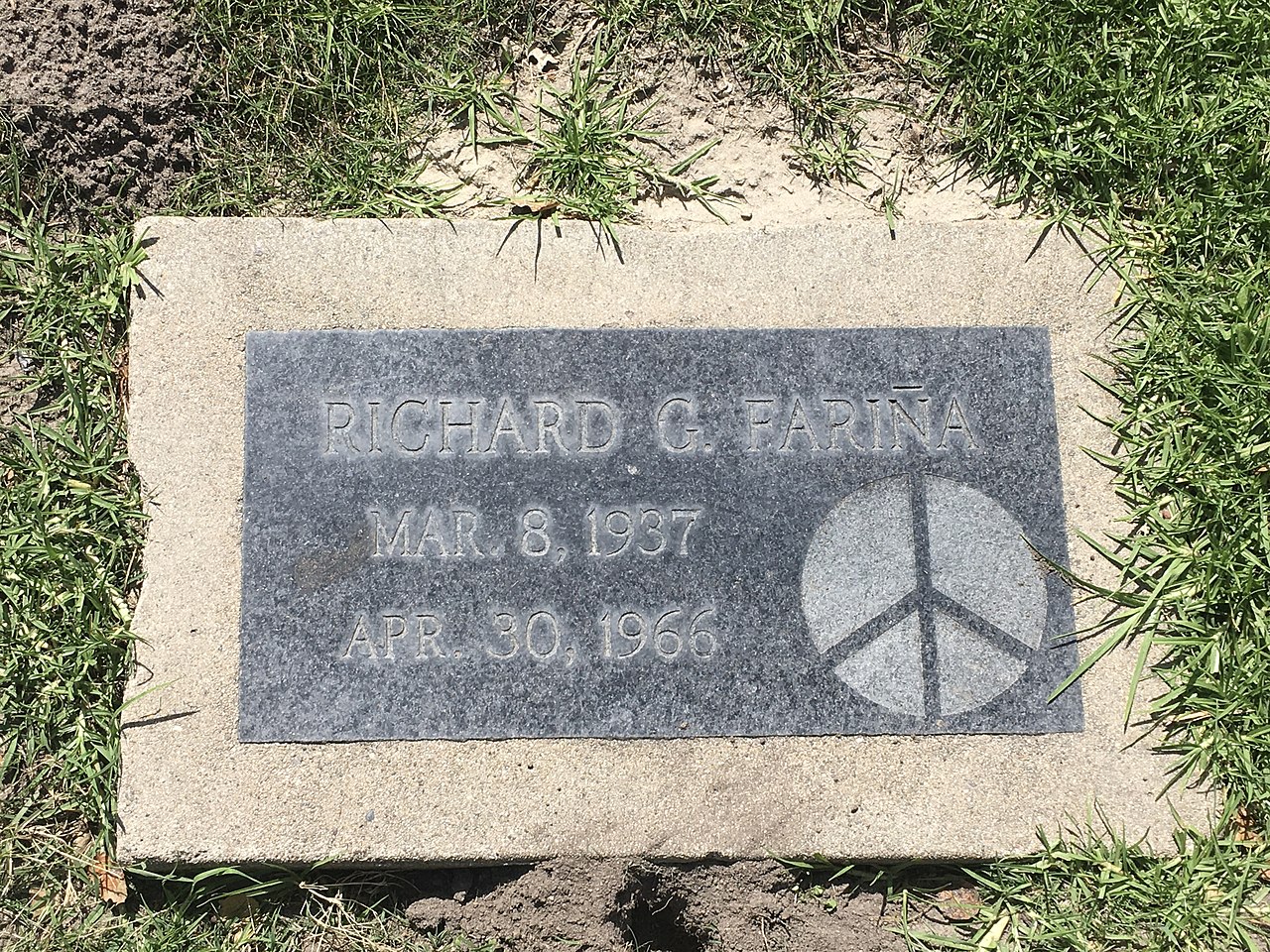
Lyncherson · CC BY-SA 4.0
- Born
- 1937. · Brooklyn.
- Died
- 1966. · Carmel-by-the-Sea.
- Nationality
- United States.
- Occupation
- singer, novelist, singer-songwriter, writer and composer.
- Education
- Cornell University and Brooklyn Technical High School.
- Known for
- Been Down So Long It Looks Like Up to Me.
- Languages
- English.
VALÉORINE Encyclopedia
VALÉORINE documentary reading
Documentary summary
Richard George Fariña (March 8, 1937 – April 30, 1966) was an American folksinger, songwriter, poet and novelist.
Admitted source layer · organised and presented by VALÉORINE
Note VALÉORINE
Richard Fariña (1937–1966) was an American composer, novelist and singer, among other activities. Born in Brooklyn, the composer died in Carmel-by-the-Sea. Richard Fariña studied at Brooklyn Technical High School and Cornell University. Languages used include English.
Composed from admitted, traceable facts · 26 September 2026
VALÉORINE
Reference Check
Propose documentary evidence for Richard Fariña. A contribution is never written directly as fact: identity, source, rights and evidence gates still decide.
Sign in to contribute
World of VALÉORINE
Documentary connections
Only confirmed graph relationships appear here. Images are shown only when their identity and reuse rights both pass the documentary gate.
Documentary evidence
Documentary basis
Authority files
wikidata · Q1931654 · wikipedia · Richard Fariña
In this article
Early years and education
Early years and education
Fariña was born in Brooklyn, New York, United States, the son of an Irish mother, Theresa Crozier, and a Cuban father of Galician origin, also named Richard Fariña. He grew up in the Flatbush neighborhood of Brooklyn and attended Brooklyn Technical High School. He earned an academic scholarship to Cornell University, starting out as an engineering major, but later switching to English. While at Cornell he published short stories for local literary magazines and for national periodicals, including Transatlantic Review and Mademoiselle. Fariña became good friends with Thomas Pynchon, David Shetzline, and Peter Yarrow while at Cornell. He was suspended for alleged participation in a student demonstration against campus regulations, and although he later resumed his status as a student, he dropped out in 1959, just before graduation.
Ascent on Greenwich Village folk scene
Ascent on Greenwich Village folk scene
On returning to Manhattan, Fariña became a regular patron of the White Horse Tavern, the well-known Greenwich Village tavern frequented by poets, artists, and folksingers, where he befriended Tommy Makem. It was there that he met Carolyn Hester, a successful folk singer. They married 18 days later. Fariña appointed himself Hester's agent; they toured worldwide while Fariña worked on his novel and Carolyn performed gigs. Fariña was present when Hester recorded her third album at Columbia studios during September 1961, where a then-little-known Bob Dylan played the harmonica on several tracks. Fariña became a good friend of Dylan; their friendship is a major topic of David Hajdu's book, Positively 4th Street: The Lives and Times of Joan Baez, Bob Dylan, Mimi Baez Fariña, and Richard Fariña. Fariña and Hester recorded an EP with Rory and Alex McEwen, (later Fariña and Eric Von Schmidt recorded a 1963 album as a duo, with Dylan as a guest). Fariña then travelled to Europe, where he met Mimi Baez, the teenage sister of Joan Baez, in the spring of 1962. Hester divorced Fariña soon thereafter, and Fariña married 17-year-old Mimi in April 1963. Thomas Pynchon was the best man. They moved to a small cabin in Carmel, California, where they composed songs with a guitar and Appalachian dulcimer. They debuted their act as "Richard & Mimi Fariña" at the Big Sur Folk Festival in 1964 and signed a contract with Vanguard Records. They recorded their first album, Celebrations for a Grey Day (released under the name Mimi & Richard Fariña), in 1965, with the help of Bruce Langhorne, who had previously played for Dylan. During Richard's life, the couple released only one other album, Reflections in a Crystal Wind, also in 1965. A third album, Memories, was issued in 1968, after his death. In early 1966, Richard and Mimi Fariña appeared as the sole guests on Episode 16 of Pete Seeger's short-lived UHF television program Rainbow Quest. Fariña, like Dylan and others of this time, was considered a protest singer, and several of his songs are overtly political. Several critics have considered Fariña to be a major folk music talent of the 1960s. ("If Richard had survived that motorcycle accident, he would have easily given Dylan a run for his money," according to Ed Ward.) His best-known songs are "Pack Up Your Sorrows" and "Birmingham Sunday", the latter of which was recorded by Joan Baez and became better known after it became the theme song for Spike Lee's film 4 Little Girls, a documentary about the 16th Street Baptist Church bombing in Birmingham, Alabama in 1963. "Birmingham Sunday" was also recorded by Rhiannon Giddens in 2017, on her album Freedom Highway. He also wrote "The Quiet Joys of Brotherhood", which was recorded by Sandy Denny. At the time of his death, Fariña was producing an album for his sister-in-law Joan Baez. She ultimately decided not to release the album. Two of the songs were included on Fariña's posthumous album, and another, a cover version of Fariña's "Pack Up Your Sorrows", co-written by Fariña with the third Baez sister, Pauline Marden, was released as a single in 1966; it has been included in a number of Baez's compilation albums.
Been Down So Long It Looks Like Up to Me
Been Down So Long It Looks Like Up to Me
Fariña is known for his novel Been Down So Long It Looks Like Up to Me, originally published by Random House in 1966. The title comes from the Furry Lewis song "I Will Turn Your Money Green" ("I been down so long/It seem like up to me"). The novel, based largely on his college experiences and travels, is a picaresque novel, set in 1958 in the American West, in Cuba during the Cuban Revolution, and mostly at Cornell University (called Mentor University in the novel). The protagonist is Gnossos Pappadopoulis, who enjoys dope, paregoric, feta cheese, Red Cap ale and retsina; attacks authority figures with anarchic glee; and lusts after the girl in the green knee-socks while searching for the right karma. The book became a cult classic among fans of the 1960s and counterculture literature. Thomas Pynchon, who later dedicated his book Gravity's Rainbow (1973) to Fariña, described Fariña's novel as "coming on like the Hallelujah Chorus done by 200 kazoo players with perfect pitch... hilarious, chilling, sexy, profound, maniacal, beautiful, and outrageous all at the same time."
Death
Death
• Illustration — Fariña's tombstone. On April 30, 1966, two days after the publication of his novel, Fariña attended a book-signing ceremony at a Carmel Valley Village bookstore, the Thunderbird. Later that day, while at a party to celebrate his wife Mimi's twenty-first birthday, Fariña saw a guest with a motorcycle, who later gave Fariña a ride up Carmel Valley Road, heading east toward the rural Cachagua area of Carmel Valley. At an S-turn the driver lost control. The motorcycle tipped over on the right side of the road, came back to the other side, and tore through a barbed wire fence into a field where a small vineyard now exists. The driver survived, but Fariña was killed instantly. According to Pynchon's preface to Been Down..., the police said the motorcycle must have been traveling at 90 mi/h, even though "a prudent speed" would have been 30 mi/h. Fariña was buried in a simple grave, its marker emblazoned with a peace sign, at Monterey City Cemetery in Monterey, California.
Life and career
Dated record
Life and career
The full dated record · 1 entries
1966
Richard Fariña died at Carmel-by-the-Sea.
Places
Named by the record
Places
Only places the record itself states, plotted where the house gazetteer settles their coordinates. Nothing is inferred from a name or a nationality.
Brooklyn.
Birth place
Carmel-by-the-Sea.
Death place
Legacy
• On April 27, 1968, Fairport Convention recorded a live version of "Reno Nevada" for French TV programme Bouton Rouge, featuring vocals by Judy Dyble and Iain Matthews. They recorded the song for a BBC session later in the same year, this time with Dyble's replacement in the band Sandy Denny, subsequently included on the album Heyday. Denny also recorded "The Quiet Joys of Brotherhood" for her 1972 album Sandy. Matthews later recorded "Reno Nevada" and "Morgan the Pirate" for his album If You Saw Thro' My Eyes as well as "House of Un-American Blues Activity Dream" for his album Tigers Will Survive, and other Fariña compositions appeared on subsequent Matthews solo albums and on recordings by Matthews' band Plainsong. • South Carolina-based rock band A Fragile Tomorrow covered a version of Mimi and Richard's song "One Way Ticket" on their 2015 release Make Me Over. Their version is a collaboration with Joan Baez and Indigo Girls. Brothers Dom Kelly, Sean Kelly, and Brendan Kelly of A Fragile Tomorrow are third cousins of Richard and had wanted to cover his music with Baez. • Joan Baez's song "Sweet Sir Galahad" commemorates Fariña's death, the grieving of his widow Mimi, and Mimi's eventual recovery and remarriage. • Thomas Pynchon's 1973 novel Gravity's Rainbow is dedicated to Richard Fariña. • Richard Barone's 2016 album Sorrows & Promises: Greenwich Village in the 1960s contains Barone's interpretation of Fariña's "Pack Up Your Sorrows" performed as a duet with Nellie McKay. • In Richard Linklater's movie Slacker, Fariña is described as a "young truth with balls," who could "think and fuck at the same time" (along with Richard Feynman, Italo Balbo, et al.), which is why "history buried him." • On Jimmy Buffett's 1973 album A White Sport Coat and A Pink Crustacean, the single "Death of an Unpopular Poet" is claimed by Buffett to have been inspired by Fariña and fellow poet Kenneth Patchen.
Discography
• Rory and Alex McEwen, Carolyne and Dick Fariña – Four For Fun, EP (Waverley, 1963) • Dick Fariña & Eric Von Schmidt – Dick Fariña & Eric Von Schmidt (Folklore, 1963) [includes Bob Dylan as guest on 6 tracks] • Mimi & Richard Fariña – Celebrations For A Grey Day (Vanguard, 1965) • Richard & Mimi Fariña – Reflections In A Crystal Wind (Vanguard, 1965) • Richard & Mimi Fariña – Memories (Vanguard, 1968)
Primary material
Documents and archives
reference work
- “Richard Fariña”, English Wikipedia, consulted as further reading
Reputable secondary · Wikipedia
authority record
- Wikidata, structured authority record Q1931654: Richard Fariña
General reference · Wikidata
References ==== Further reading
References ==== Further reading
• Positively Fourth Street by David Hajdu, North Point Press
Notes from the source article
Cited by Wikipedia
Notes from the source article
These works are cited by the source article, in its own numbering. They are recorded as its citations, not as sources VALÉORINE has verified.
- 1.Richard Fariña | Biography & History. AllMusic.
- 2.Barnett, David. Richard Fariña: lost genius who bridged the gap between beats and hippies. The Guardian. March 25, 2016.
- 3.Scribner Encyclopedia of American Lives, Thematic Series: The 1960s: Fariña, Richard George. Encyclopedia.com.
- 4.Folk hero: Richard Fariña's wild ride from Tyrone to Greenwich. The Irish Times.
- 5.Hajdu, David. Positively Fourth Street. p. 39.
- 6.Hajdu, David. Positively Fourth Street. p. 41.
- 7.Hajdu, David. Positively Fourth Street. p. 308.
- 8.Pynchon, Thomas. Richard Farina. Pynchon.pomona.edu.
- 9.Altschuler, Glenn. Campus Confrontation, 1958. Cornellalumnimagazine.com. August 25, 2014.
- 10.Bread and Roses Founder Singer-Activist Mimi Farina Dead at 56. Commondreams.org.
- 11.Celebrations for a Grey Day. RichardandMimi.com.
- 12.Google LLC. Rainbow Quest: Episode 16. YouTube. February 26, 1966.
- 13.Hemmer, K. Encyclopedia of Beat Literature. Facts On File, Incorporated. 94. 2010. 978-1-4381-0908-4.
- 14.Richard Farina. RichardandMimi.com.
- 15.A Fragile Tomorrow cover Mimi and Richard Fariña's "One Way Ticket" with Joan Baez and Indigo Girls – watch. Consequence of Sound. August 26, 2015.
- 16.Jaeger, Markus. Popular Is Not Enough: The Political Voice Of Joan Baez: A Case Study in the Biographical Method. Columbia University Press. April 1, 2010. 9783838201061.
- 17.Moore, Thomas. The Style of Connectedness: Gravity's Rainbow and Thomas Pynchon. University of Missouri Press. 19. January 1, 1987. 9780826206251.
- 18.Sorrows and Promises: Greenwich Village in the 1960s - Richard Barone | Songs, Reviews, Credits. AllMusic.
- 19.Linklater, Richard. Slacker. St. Martin's Press. 109. 1992. 978-0-312-07797-6.
- 20.High Times Magazine. Jimmy Buffett. 52 subscription required. 1976.
Bibliography printed in the source article · 3
- Been Down So Long It Looks Like Up to Me (1966)
- Long Time Coming and a Long Time Gone (1969)
- Positively Fourth Street by David Hajdu, North Point Press
References
Citations
References
Each reference names the institution holding it, so a reader may go to the document itself.
reference work
Secondary witnessauthority record
General reference
The Encyclopedia exists whether or not anything is for sale. Corrections are recorded rather than overwritten, and every version of this record is kept. Published 14 August 2026.
Elsewhere in Music memorabilia
42,307 published records in this field, each with its sources named.
- Richard ElliotPerson
- Richard EybnerPerson
- Richard FallPerson
- Richard FarberPerson
- Richard FinchPerson
- Richard FluryPerson
- Richard FortusPerson
- Richard FranckPerson
Best supported in this field
For owners
Own a work by Richard Fariña?
A specialist will read what you send and tell you what the house can establish, what it cannot, and whether the object is suited to sale. There is no charge and no obligation. The object stays with you throughout; nothing is shipped to us unless it is arranged in writing beforehand.