
Richard Cockle Lucas
Richard Cockle Lucas (24 October 1800 – 18 May 1883) was a British sculptor and photographer.
Richard Cockle Lucas

Richard Cockle Lucas (self-portrait) · http: sText=Richard+Cockle+Lucas page=1 rNo=11 · Public domain
- Name
- Richard Cockle Lucas
- Born
- 24 October 1800
- Birthplace
- Salisbury, Wiltshire
- Died
- 18 May 1883
- Place of death
- Chilworth, Hampshire
- Known for
- Sculptor, photographer
- Spouse
- Eliza
- Nationality
- United Kingdom of Great Britain and Ireland
- Occupation
- photographer · sculptor · artist
- Languages
- English
VALÉORINE Encyclopedia
VALÉORINE documentary reading
Documentary summary
Richard Cockle Lucas (24 October 1800 – 18 May 1883) was a British sculptor and photographer.
Admitted source layer · organised and presented by VALÉORINE
Note VALÉORINE
Richard Cockle Lucas (1800–1883) was a British artist, photographer and sculptor. Born in Salisbury, the artist died in Chilworth.
Languages used include English. Works by Richard Cockle Lucas are held at Skulpturensammlung und Museum für Byzantinische Kunst.
Composed from admitted, traceable facts · 26 September 2026
VALÉORINE
Reference Check
Propose documentary evidence for Richard Cockle Lucas. A contribution is never written directly as fact: identity, source, rights and evidence gates still decide.
Sign in to contribute
Documentary evidence
Documentary basis
Authority files
wikidata · Q7324812 · wikipedia · Richard Cockle Lucas
In this article
Key facts
Key facts
• Name — Richard Cockle Lucas • Born — 24 October 1800 • Birthplace — Salisbury, Wiltshire • Died — 18 May 1883 • Place of death — Chilworth, Hampshire • Known for — Sculptor, photographer • Spouse — Eliza • Children — Albert Dürer Lucas
Career
Career
Lucas was born in Salisbury, Wiltshire, the son of Richard Lucas and his wife, Martha Sutton (who died shortly after childbirth). At the age of twelve, he was apprenticed to an uncle who was a cutler at Winchester, where his ability at carving knife handles revealed his skill as a sculptor. He moved to London, aged 21, and studied at the Royal Academy Schools. From 1828, he was a regular contributor to the Royal Academy, receiving silver medals for architectural drawing in 1828 and 1829. His son, Albert Dürer, was born in 1828 in Bayswater and by 1846 the family was living at Nottingham Place in central London. In 1849, the family moved out of London, probably for health reasons, to Otterbourne, near Winchester, where Lucas may have become a friend of the Victorian children's author, Charlotte Mary Yonge. Lucas then moved to Chilworth near Romsey in about 1854 where he had the "Tower of the Winds" built to his own design. This house stood opposite the former "Clump Inn". In 1865, he built a second home, "Chilworth Tower", about half a mile from the first. By this time, Lucas had become very eccentric, believing in fairies, and rode around Southampton in a Roman chariot. • Illustration — Lucas posing as a "Roman" in a self-portrait c. 1858 Lucas exhibited over a hundred works at the Royal Academy, the British Institution and at the Suffolk Street Gallery of the Society of British Artists; these included busts, medallions and classical subjects. Amongst his statuary are those of Samuel Johnson at Lichfield, Isaac Watts at Southampton and Richard Colt Hoare at Salisbury Cathedral. According to the Oxford Dictionary of National Biography, "such large works were ill suited to his powers". His marble, wax, and ivory medallion portraits were more successful, however; many were displayed at the Great Exhibition and several were subsequently purchased by the National Portrait Gallery. Amongst his works on display at Bodelwyddan Castle are wax medallions of Sir Frederic Madden, Thomas Garnier, Anthony Panizzi and Henry Hallam. Two self-portraits, an etching dated on the plate 1858, and a plaster cast of a bust, incised and dated 1868, are also in the National Portrait Gallery collection. Lucas's popular wax relief Leda and the Swan was acquired by the Victoria and Albert Museum. Another copy is held in the National Gallery, Berlin. The Victoria & Albert also has a bust of the London society hostess, Catherine, Lady Stepney, posing as Cleopatra. Lucas was an enthusiastic student of the Elgin Marbles, of which he made two large wax models, the first showing the Parthenon as it appeared after bombardment by the Venetians in 1687; the other representing it restored in accordance with his own theories as to the original arrangement of the sculptures. The latter was exhibited in the Elgin room at the British Museum, where it became the subject of much public interest. In 1845 he published his Remarks on the Parthenon, illustrated with fifteen etchings. Lucas produced many etchings depicting his own sculptural works, biblical stories, and scenes from eighteenth-century poetry. A nearly complete series of these, mounted in an album bound by Lucas himself, and including a frontispiece portrait of the artist, was held the British Museum. These albumen "cartes de visite" (now in the National Portrait Gallery) show Lucas in a variety of theatrical and expressive poses that further reveal his eccentricity. Towards the end of his life, Lucas's conversational prowess ensured that he was a frequent guest at Broadlands, the seat of Lord Palmerston, who obtained for him a civil-list pension in June 1865. Lucas made three wax portraits of Palmerston, and a statuette which formed his last exhibit at the Royal Academy in 1859. In 1870 he published An Essay on Art.
Death
Death
Lucas died of paralysis at his home in Chilworth, on 18 May 1883, leaving a widow, Eliza (c.1805–1893), and a son, Albert Dürer Lucas (1828–1918). Albert was a painter of still-life and flowers who had exhibited at the British Institution and with the Society of Artists between 1859 and 1874. His paintings are still regularly reproduced and sold at auction.
The Flora bust
The Flora bust
• Illustration — The Flora bust Among the objects in the Bode's collection is a bust of Flora, which had been purchased by the Kaiser Friedrich Museum, Berlin, under the belief that it was by Leonardo da Vinci. Wilhelm von Bode, the general manager of the Prussian Art Collections for the Berlin Museum, had spotted the bust in a London gallery and purchased it for 160.000 Goldmark. Bode was convinced that the bust was by Leonardo, and the Berlin Museum authorities, and the German public, were delighted to have "snatched a great art treasure from under the very noses" of the British art world. However, in 1910, Albert Dürer Lucas – the son of Richard Cockle Lucas – claimed that the sculpture had been created by his father. Shortly thereafter, The Times ran an article claiming that the bust was the work of Lucas, who had been commissioned to produce it from a painting. Lucas's son Albert then came forward and swore under oath that the story was correct and that he had helped his father to make the sculpture. Albert was able to explain how the layers of wax had been built up from old candle ends; he also described how his father would stuff various debris, including newspapers, inside the bust. When the Berlin museum staff removed the base they found the debris, just as Albert had described it, including a letter dating from the 1840s. Despite this evidence, Bode continued to claim that his original attribution was correct. To support this, he displayed the Flora bust among a selection of Lucas's other works but this exhibition backfired, as it showed that Lucas had been regularly making wax sculptures inspired by the great works of previous times. Hungarian-born London art critic and historian Paul George Konody, in particular, "waged war on Dr. Bode's claims through the columns of the London Daily Mail". Various claims and counter-claims have been put forward about the bust, from its being an outright forgery to being a genuine 16th-century piece (albeit not by Leonardo). In April 2021, the bust was dated using carbon-14, which confirmed that it was sculpted in the 19th century. The bust remains on display in what is now the Bode Museum labelled "England", "19th Century" with a question mark.
Works
Works
As well as items in museums and the large statuary, there are many works by Lucas in churches and other public places. These include: • The Robert Pearce family grave in Southampton Old Cemetery. The sculpture depicts the figures of Faith, Hope and Charity, surmounted by a draped urn. The memorial is English Heritage Listed, Grade II. • Wax relief of Thomas Burgess (1756–1837), Bishop of Salisbury. This is on display at the University of Wales, Lampeter. • Portrait tablet to John Willis Fleming (1781–1844) in St. Nicolas' Church, North Stoneham, near Southampton. • A recumbent effigy to Count Jerome de Salis-Soglio (1771–1836) in St. Mary's church, Harlington, West London. • Statue of Richard Colt Hoare in Salisbury Cathedral (1841) • Statue of Isaac Watts at Southampton (1858)
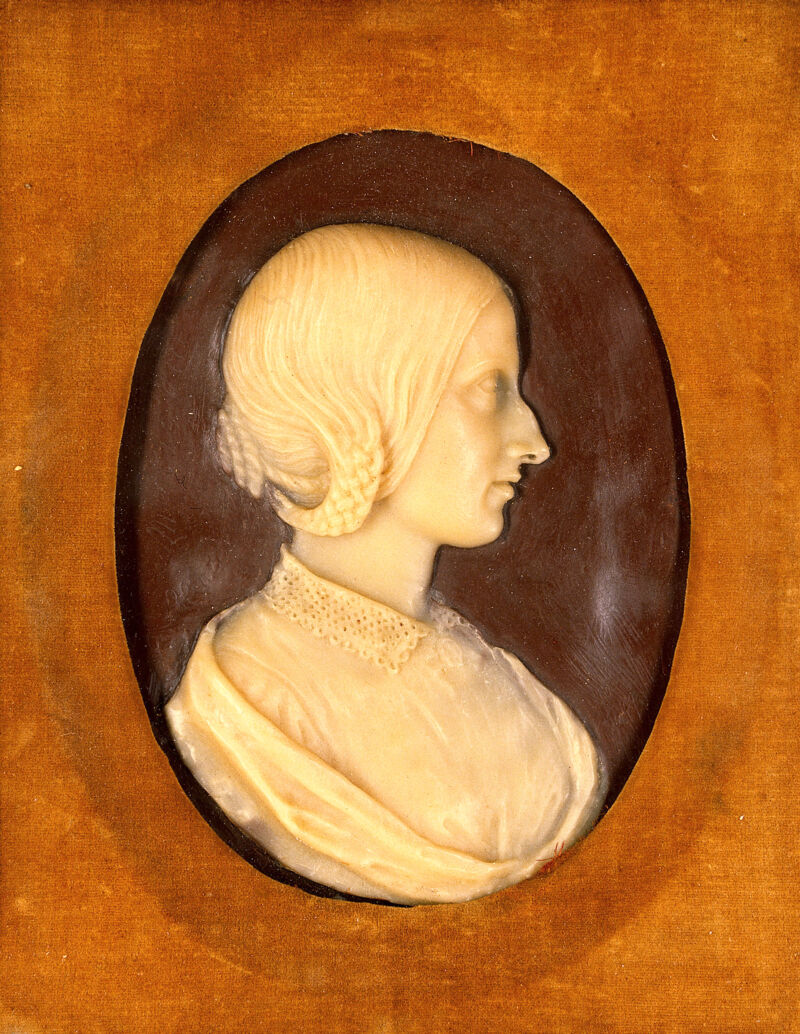
Mrs Charles Wood. Wax relief by R.C. Lucas., by Richard Cockle Lucas
Richard Cockle Lucas · Wellcome Collection, London · Wellcome Collection
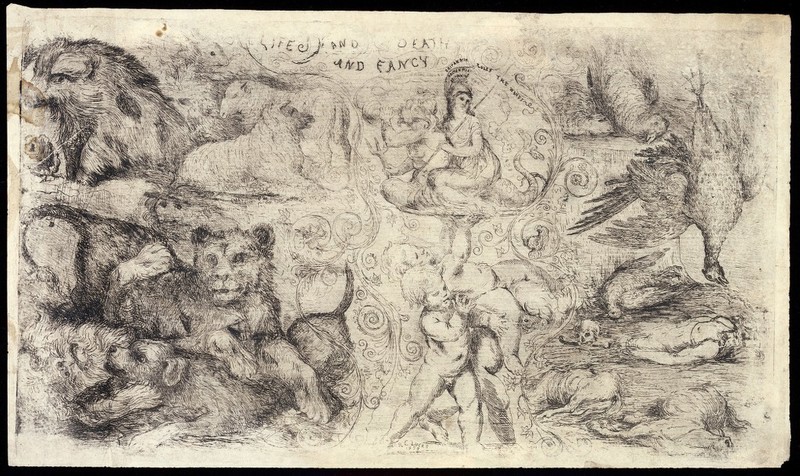
Animals and human figures manifesting life, death and fancy. Etching by R.C. Lucas, 1838., 1838, by Richard Cockle Lucas
Richard Cockle Lucas · Wellcome Collection, London · Wellcome Collection
Places
Named by the record
Places
Only places the record itself states, plotted where the house gazetteer settles their coordinates. Nothing is inferred from a name or a nationality.
Salisbury.
Birth place
Chilworth.
Death place
Notes from the source article
Cited by Wikipedia
Notes from the source article
These works are cited by the source article, in its own numbering. They are recorded as its citations, not as sources VALÉORINE has verified.
- 1.O'Donoghue, F. M. Lucas, Richard Cockle (1800–1883), sculptor. Oxford Dictionary of National Biography. January 2008.
- 2.Millington, Peter. The Lucas Family and Chilworth. A Painting of Mummers at Chilworth. mastermummers.org. 10 December 2008.
- 3.Willis Fleming Historical Trust. The Tower of the Winds. The Muniment Room. 22 May 2010.
- 4.Test Valley Borough Council. Chilworth Old Village - Conservation Policy. 5. 1 November 1989.
- 5.Willis Fleming Historical Trust. Chilworth Tower (with photographs). The Muniment Room. 22 May 2010.
- 6.National Portrait Gallery. Sir Frederic Madden. Richard Cockle Lucas.
- 7.National Portrait Gallery. Thomas Garnier. Richard Cockle Lucas.
- 8.National Portrait Gallery. Sir Anthony Panizzi. Richard Cockle Lucas.
- 9.National Portrait Gallery. Henry Hallam. Richard Cockle Lucas.
- 10.National Portrait Gallery. Richard Cockle Lucas. etching, pen and wash, 1858.
- 11.National Portrait Gallery. Richard Cockle Lucas. plaster cast of bust, 1868.
- 12.Victoria & Albert Museum. Leda and the Swan. Relief (1865).
- 13.Bloch, Peter. Leda and the Swan. The Victorian Web. 5 November 2006.
- 14.Landow, George P. Lady Catherine Stepney as Cleopatra. The Victorian Web. 4 June 2008.
- 15.National Portrait Gallery. Richard Cockle Lucas albumen carte-de-visite.
- 16.artnet. Albert Durer Lucas.
- 17.Brown, Phillip. Albert Durer Lucas. Victorian / Edwardian Paintings. 9 June 2009.
- 18.Craddock, Paul. Scientific investigation of copies, fakes and forgeries. Butterworth-Heinemann. 432–434. 2009. 978-0-7506-4205-7.
- 19.Burlington Paintings. Albert Dürer Lucas.
- 20."Showing Swindlers in the World of Art Never Lack Victims", New York Herald (22 June 1919), p. 72.
- 21.Not a Leonardo! Clue to wax bust's attribution lies inside a sperm whale.
- 22.Léonard de Vinci n'a définitivement pas sculpté le buste de la Flora | CNRS.
- 23.Härig, Beatrice. Flora's duel for waxy smile. Monumente. February 2010.
- 24.Blake, Gillian. Southampton Old Cemetery, Pearce family grave. Parks and Gardens UK. 2008.
- 25.Gathering the Jewels. Wax relief of Thomas Burgess.
- 26.North Stoneham Church: St Nicolas. North Stoneham Park. 2008–2009.
- 27.Council for the Care of Churches. Harlington St Mary. CCC Response to Government Air Transport Consultation. June 2003.
References
Citations
References
Each reference names the institution holding it, so a reader may go to the document itself.
reference work
Secondary witnessreference work
Secondary witness
The Encyclopedia exists whether or not anything is for sale. Corrections are recorded rather than overwritten, and every version of this record is kept. Published 16 August 2026.
Elsewhere in Sculpture
6,174 published records in this field, each with its sources named.
- Ricardo Romero DelgadilloArtist
- Ricardo VelosaArtist
- Richard Arthur LedwardArtist
- Richard BockArtist
- Richard E. BrooksArtist
- Richard GuhrArtist
- Richard GuinoArtist
- Richard HudsonArtist
Best supported in this field
For owners
Own a work by Richard Cockle Lucas?
A specialist will read what you send and tell you what the house can establish, what it cannot, and whether the object is suited to sale. There is no charge and no obligation. The object stays with you throughout; nothing is shipped to us unless it is arranged in writing beforehand.