
Rayman
Rayman is a 1995 platform game developed by Ubi Pictures and published by Ubi Soft. The player controls Rayman, who must pursue Mr. Dark to recover the Great Protoon that used to keep the balance between nature and the people of Rayman's valley.
Also recorded as Rayman Advance · Rayman Classic · Rayman Ultimate
Rayman

MikeAtari at German Wikipedia · Public domain
- Model
- Rayman
- Date
- 1995
- Genre
- 2D platform game
VALÉORINE Encyclopedia
VALÉORINE documentary reading
Documentary summary
Rayman is a 1995 platform game developed by Ubi Pictures and published by Ubi Soft. The player controls Rayman, who must pursue Mr. Dark to recover the Great Protoon that used to keep the balance between nature and the people of Rayman's valley.
Admitted source layer · organised and presented by VALÉORINE
Reference Check
Propose documentary evidence for Rayman. A contribution is never written directly as fact: identity, source, rights and evidence gates still decide.
Sign in to contribute
World of VALÉORINE
Documentary connections
Only confirmed graph relationships appear here. Images are shown only when their identity and reuse rights both pass the documentary gate.
Documentary evidence
Documentary basis
Authority files
wikidata · Q13219473
In this article
The object
The object
The player must navigate the valley, defeat enemies with abilities gained throughout the game, and free captured Electoons, while also encountering a boss at the end of each thematic world. Michel Ancel originally conceived Rayman as a teenager, and was later able to realise the concept after being hired by Ubi Soft in 1989. The game initially targeted the Atari ST, and then the Super NES CD-ROM, but development was moved to the Atari Jaguar after the peripheral's cancellation. Ancel incorporated several childhood memories into the design and was soon joined by a larger development team. Ubi Soft made Rayman a launch title for the PlayStation in North America and Europe to compete with Japanese platform games on the console. First released for the PlayStation on 7 September 1995, and shortly thereafter for the Atari Jaguar, Sega Saturn, and MS-DOS. The game received positive reviews, with praise going towards its atmosphere, visuals, and soundtrack, though some criticized its high difficulty and lack of originality. Rayman became one of the best-selling PlayStation games and would become the first entry in the Rayman series. A 30th Anniversary Edition for modern platforms featuring bonus content and a compilation of ports, including a prototype of the cancelled Super NES version, was released in February 2026 in partnership between Ubisoft and Digital Eclipse.
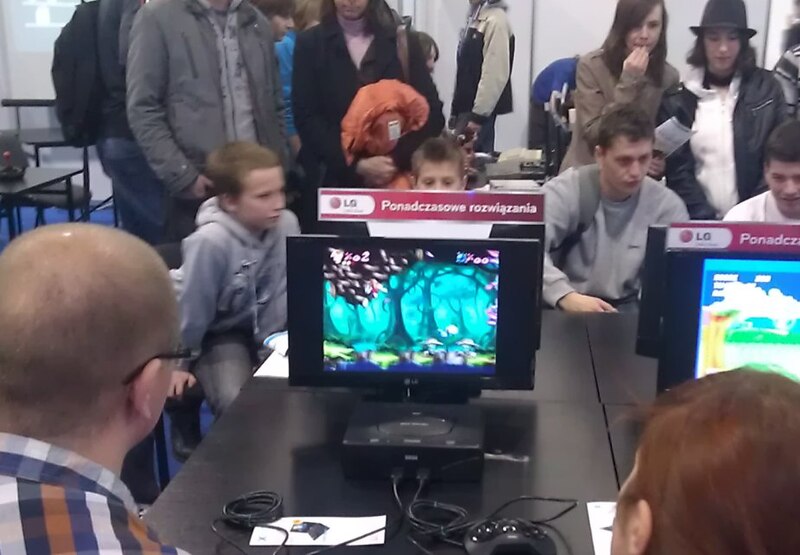
Poznań Game Arena, 2012
Klapi

Gamescom expo, Cologne, Germany
Sergey Galyonkin from Raleigh, USA · Rayman Legends on Xbox 360 at Gamescom 2013
Key facts
Key facts
• Title — Rayman • Developer — Ubi Pictures • Publisher — Ubi Soft • Series — Rayman • Genre — Platform • Modes — Single-player • Director — Agnès Haegel • Producer — Gérard Guillemot • Designer — * Michel Ancel • Serge Hascoët • Alexandra Steible • Programmer — * Daniel Palix • Frédéric Houde • Fred Markus • Artist — * Alexandra Steible • Éric Pelatan • Sylvaine Jenny • Composer — * Rémi Gazel • Didier Lord • Stéphane Bellanger • Christophe Héral
Gameplay
Gameplay
• Illustration — Rayman prepares to attack using his "telescopic fist". Rayman is a side-scrolling platformer. The player controls Rayman, who must navigate six thematic worlds. Each level hides six cages of captured Electoons that Rayman can free. Additionally, he can collect blue crystals, "Tings", and gain an extra life whenever he has obtained 100 of them. If the player loses their five lives, they would need to load their save file or restart the game. Rayman occasionally gains new powers, including the ability to fly, run, and hang from platforms. Modifications to his detached hands include grabbing and punching distant entities, the latter known as the "telescopic fist". A boss must be defeated at the end of each world, requiring the use of the previously gained abilities. Rescuing all Electoons in the first five worlds grants Rayman access to the final world, the Candy Château, the hideout of the final boss, Mr Dark. When Rayman interacts with the Magician, who is hidden in various levels, he can access hidden rooms that grant him Tings or extra lives if beaten in a given time.
Plot
Plot
Rayman lives in a valley that, thanks to a magical orb known as the Great Protoon, has the people and nature living in harmony. One day, Mr Dark steals the Great Protoon and defeats its guardian, Betilla the Fairy. As a result, the Electoons that used to orbit the Great Protoon scatter and many are imprisoned by villains that appear in the Great Protoon's absence. Upon Betilla's request, Rayman sets out to recover the Great Protoon and free the captured Electoons. Mr Dark observes as Betilla guides Rayman though his quest and eventually kidnaps her. Rayman, having retrieved all Electoons, confronts Mr Dark in the Candy Château. However, Mr Dark takes away Rayman's telescopic fist and traps between walls of fire that close in on him. Electoons return Rayman's fist at the last moment, such that he can defeat Mr Dark and retrieve the Great Protoon. In the epilogue, Rayman takes a vacation with his friends and former enemies.
Early concepts and design
Early concepts and design
• Illustration — Michel Ancel (pictured in 2007), the creator and lead designer of Rayman Rayman was created by French video game designer Michel Ancel. He conceived the character as a teenager in the 1980s, when he was learning to draw, compose music, and program to pursue his dream of making video games. In 1988, his animation skills led him to be one of the early hires for the nascent publisher Ubi Soft, which at the time was operating with from Montreuil with six developers. One of Ubi Soft's founders, Yves Guillemot, encouraged Ancel to pitch game ideas to the company leadership. He worked one his own developing a game prototype based on his concept of Rayman for the Atari ST, including six months spent on building an animation system. He teamed up with Frédéric Houde and, during a meeting with Serge Hascoët, Gérard Guillemot, Michel Guillemot, and Yves Guillemot, the duo pitched their idea using "a picture of a big, giant trombone and you had to imagine the player inside". Although the presented technology was in its research-and-development stage, Hascoët pushed for the game to enter into production, which Michel Guillemot agreed to take on. Rayman was greenlit in 1992, and Michel Guillemot gave Ancel and his team artistic freedom. The game's style was inspired by Celtic, Chinese, and Russian fairy tales, as well as Ancel's childhood, having spent a lot of time by rivers, chasing insects, and climbing trees. When Ancel started work on the game, he began with trees and creature designs. Having become interested in rendering tools such as Autodesk 3ds Max, he chose to incorporate 60 Hz animations. Houde considered this impressive for a time where most games used sprites animated at five frames per second. Before embarking on the creation of the settings, characters and animations, Ancel and Houde recruited the illustrator Eric Pelatan and the artist Alexandra Steible. The latter came from an animation studio and was tasked with drawing rough templates of animations and later study the results for them to be digitised. Olivier Soleil, an architecture student, was hired as a graphic designer in 1994 to work on the characters. Ancel initially envisioned a game revolving around the human boy Jimmy, who creates the online world Hereitscool. After it becomes infected with a virus, Jimmy travels into the world and inhabits the body of his in-game avatar, Rayman, to defeat it. This idea was later scrapped. Ancel defined his intent as seeking "a colourful platform game with breathtaking graphics, concrete animations, fantasy, humour and, above all, great playability". During development, four people worked on each world and the synchronisation of Rayman's attitudes.
Production and release
Production and release
• Illustration — Rayman was developed for the Super NES CD-ROM until the peripheral was cancelled in 1993. This version was rediscovered in 2016 and released officially in 2026. When Ancel noticed the waning public interest in the Atari ST, he pivoted the development towards the Super NES CD-ROM, a peripheral for the Super Nintendo Entertainment System. When Nintendo cancelled the peripheral in 1993, that version of Rayman was also scrapped. It was presumed lost until Houde rediscovered a copy dated 1992 in October 2016. With his permission, the programmer Omar Cornut released it online in July 2017. Michel Guillemot eventually assigned additional developers to the project and allocated 15 million francs for its development. The production became split between two locations: While Ubi Soft's Montreuil headquarters continued to work on technical tasks, the creative team around Ancel and Houde worked from Ancel's hometown, Montpellier. The project's headcount grew to 100 people. The team moved the production over to the Atari Jaguar, a console they felt could handle the graphics they aimed for. Later, they decided to also bring the game to the PlayStation and the Sega Saturn due to their more capable hardware. Ubi Soft made Rayman a launch title for the North American and European releases of the PlayStation, seeking to outclass competing platformers from Japan by releasing it simultaneously with a new powerful system. Rayman on the Jaguar was first displayed at the 1994 Summer Consumer Electronics Show. In late 1994, magazine advertisements announced Rayman as a title for the Atari Jaguar with a release in the fall or by December 1994. Pre-release promos of the PlayStation had advertised a release date of Rayman on 13 January 1995 in Japan. Later, Japanese magazines stated a release date for the PlayStation version as being June 1995. Similarly, American magazines reported a Jaguar release by June 1995, as well as versions for the 32X and 3DO, both of which were cancelled. Rayman was released on 7 September 1995 for the PlayStation in North America. During September, it was published for the Atari Jaguar, and in November for the Sega Saturn. A version for MS-DOS was released in December 1995 in Europe and in North American in April 1996. Also in April 1996, a preview demo with the first of six worlds was released for the PlayStation and Sega Saturn. The MS-DOS version of the game in particular later received several expansion packs. 1997's Rayman Designer (also known as Rayman's World in Europe) included a level editor alongside 24 new levels by the design team. 1998's Rayman by His Fans amassed 40 fan-made levels created through the level editor. 1999's Rayman 60 Levels contained 60 levels by designers at Ubisoft.
Sales
Sales
By the end of 1995, 400,000 copies of Rayman had been sold in Europe. The game sold 900,000 copies globally by 1997. It was the all-time best-selling PlayStation game in the United Kingdom, while in France it had sold 670,000 copies by 2000, becoming the second-best-selling game on the platform in the country. Total sales in the United States numbered 357,000. The game sold over 3 million copies. According to Gamasutra, Rayman Advances sales neared 600,000 units during the first half of the 2001–2002 fiscal year alone and then reached 770,000 copies by the end of March 2002.
Fan remake
Fan remake
Rayman Redemption, a fan remake by the Finnish developer Ryemanni, features additional worlds, levels, and minigames. It was released for free via Game Jolt for Raymans 25th anniversary. It received praise from reviewers, with PC Gamer and Kotaku highlighting that the game has an option for casual and masocore players, something they considered a fortune for players traumatised by the original game's difficulty. Kotaku also commended the added content. The Retronauts writer Stuart Gipp considered the game impressive when compared to Alex Kidd in Miracle World DX and Sonic Mania. He highlighted the project's extensive attempts at revising the original game's flaws before criticising the reduction of some characteristics that had given the original game its identity.
30th Anniversary Edition
30th Anniversary Edition
On 12 February 2026, Ubisoft announced Rayman: 30th Anniversary Edition, a compilation developed by Digital Eclipse that is composed of the PlayStation, Atari Jaguar, MS-DOS, Game Boy Color, and Game Boy Advance versions of the original game, alongside the 124 extra levels from Rayman Designer, Rayman 60 Levels, and Rayman By His Fans. New features include rewind, infinite lives and invincibility toggles, a reimagined soundtrack by Rayman Origins and Rayman Legends composer Christophe Héral, newly-recorded interviews with the original staff, and a playable prototype of the cancelled Super Nintendo version. The original soundtrack by Rémi Gazel is not available in the compilation, with Nintendo Life attributing its absence to Ubisoft potentially losing the rights to the original audio. The collection was released for Nintendo Switch, PlayStation 5, Windows, and Xbox Series X/S on 13 February 2026, with physical editions planned on 26 June of that year.
Places
Named by the record
Places
Only places the record itself states, plotted where the house gazetteer settles their coordinates. Nothing is inferred from a name or a nationality.
- France
Named but not plotted · 1
Rayman is associated with France.
Country
Reception
Reception
Rayman received a generally positive reception upon release, with critics praising its animations, atmosphere, and soundtrack. Eurogamer felt there was "no shame in admitting" that it was reviewed favourably. Tommy Glide of GamePro described the game as one of the best for the Atari Jaguar and commended it as a showcase of the console's capabilities, although he considered it inferior to the PlayStation version. Electronic Gaming Monthly similarly wrote that the Atari Jaguar version was an outstanding platformer but paled against the PlayStation version due to the lower audio quality and slow responsiveness of the controls. Glide appreciated the precise controls on account of the constant jumping, ducking, and dodging involved in the gameplay. Captain Squideo, also of GamePro, commented that the PlayStation version was a "dazzling delight" and proclaimed it to be one of the most visually appealing games at the time. Next Generation, while noting a lack of original gameplay elements, believed the game set itself apart from many other platform games and had a true sense of depth and playability. The Entertainment Weekly writer Bob Strauss felt that the game may be the one that "ennobles the adolescent world of video games" and the likes of Disney animated films like Snow White and the Seven Dwarfs. Strauss exclaimed that the game was a must-have for those with a fifth-generation video game console. Many reviewers commented on the contrast of the game's difficult gameplay to its innocent visual presentation. Sam Hickman of Sega Saturn Magazine criticised the Sega Saturn version because of what he considered an overabundance of levels that played similarly with only varied attacks or an increased difficulty used as differentiation. Hence, he regarded the game "a bit too dull a bit too often", while also being "plain irritating and damned difficult" on occasion. Game Informer, while praising its visuals, believed the game was "the height of platforming challenge", with its high difficulty making it less memorable. Reviewers raised differing opinions on the game's graphics. The GameSpot writer Jeff Sengstack compared the game to Donkey Kong Country or Pitfall! and considered it to feature "wonderfully clever gaming elements, engaging and humorous characters, terrific music, and heaps of whimsy", although he faulted the lack of frequent save points. Lawrence Neves of GamePro felt it was what players wanted for the Sega Saturn and compared it favourably to previous platformers, such as Bug! and Astal. He noted that, while the graphics and music seemed childish at times, the challenge targeted experienced players. Neves regarded the lush visuals as impeccable and made particular note of the version's level transition effects. Next Generation praised the game's graphics, optimisation, challenge variety, and charming player character, and said the game made a good change of pace from other PC releases. The magazine considered the Atari Jaguar version impeccable, saying that "with its vast color palette, detailed sound effects, and overall playability, there is nothing about Rayman for the Jaguar that falls below the mark of excellent".
Legacy
Legacy
The commercial success of Rayman established a successful franchise with several sequels, including Rayman 2: The Great Escape (1999), and some of the game's elements influenced Rayman Origins. Rayman was Ubisoft's first game to achieve considerable success, and it empowered the company to go public in 1996. Ancel was honoured by the French government for his work in 2006. The character Rayman became a recognisable character after the game's release, especially his popularity surviving the transition to next-generation consoles, and was once considered to become the mascot character for the Atari Jaguar. Rayman was brought to the Game Boy Color in early 2000, to Palm OS in September 2001, to the Nintendo DSi in December 2009, and to iOS in February 2016. The Game Boy Color version was one of a number of Ubisoft games for the platform that utilised the "Ubi Key" feature, allowing players to share data between games via the system's infrared port and unlock extra content. Rayman Advance, a variant for the Game Boy Advance developed by Digital Eclipse, was released in June 2001. Next Generation noted that the game remained largely the same as the original and lauded its graphics, music, and controls. Eurogamer writer Martin Taylor considered it "a stunning looker, and possibly one of the best looking GBA games available at the moment". The game is one of twenty titles included with the PlayStation Classic, a miniature PlayStation replica released in December 2018. Rémi Gazel, the composer for Rayman, sought to turn the soundtrack into a live performance titled Rayman by Rémi prior to his death from cancer in May 2019.
Reception
Reception
Rayman: 30th Anniversary Edition received "mixed or average" reviews, according to the review aggregator website Metacritic. Push Square rated the game 6/10, praising the gameplay "[holding] up well after all these years" and the inclusion of additional levels, but criticizing the soundtrack "[cutting] out entirely, leaving large silences" and stating that the different ports "feel almost identical", opining that the anniversary package should have included other Rayman games. Similar remarks were issued by Nintendo Life, who gave the game a score of 7/10, outlining the game's value to a "super fan of the original game", noting the absence of the original soundtrack and stating that it "would have been nice to at least have had Rayman 2 included". Upon launch, the 30th Anniversary Edition received mixed reviews on Steam, with more than half of the reviews being negative. Users complained about the new soundtrack not being faithful to the game, with no option to switch to the original soundtrack, as well as the forced DRM via Ubisoft Connect. A Ubisoft employee later stated on the official Ubisoft Discord server that the team will "look into" the ability to swap to the original soundtrack. After a saved game bug was discovered, one Ubisoft Support representative falsely reported the end of the game's support after less than two days of its release; this was later debunked by another employee.
Notes from the source article
Cited by Wikipedia
Notes from the source article
These works are cited by the source article, in its own numbering. They are recorded as its citations, not as sources VALÉORINE has verified.
- 1.Rayman Classic.
- 2.Hilliard, Kyle. Rayman 30th Anniversary Edition Releases Tomorrow, Collects Five Versions Of The Original Game. Game Informer. February 12, 2026.
- 3.Voici l'interview que j'ai réalisé avec Fred Markus, ancien d'Ubi Soft, impliqué dans le projet Rayman. Jaguar 64.
- 4.Sunnyvale, Calif. Rayman saves the day; Ubi Soft launches new 'super hero' title for Jaguar 64. The Free Library. 19 September 1995.
- 5.Hill, Stephen. Rayman – The most punishing game on the PSone. VentureBeat. 11 November 2013.
- 6.Sengstack, Jeff. Rayman Review. GameSpot. 11 June 1996.
- 7.O'Neill, Jamie. Review: Rayman – An 'Armless PSone Platforming Treat. Push Square. 1 December 2018.
- 8.PlayStation Plus. Rayman. 1. 88–89. October 1995.
- 9.The Making of Rayman. Retro Gamer. 4 November 2014.
- 10.Bertz, Matt. Ubi Uncensored: The History of Ubisoft By the People Who Wrote It. Game Informer. 6 December 2011.
- 11.Playman. Playman Magazín - Léto 2013. 11. August 29, 2013.
- 12.Frederic Houde (Ubisoft) – Interview. Arcade Attack. 12 April 2018.
- 13.Ubisoft, passion montpelliéraine. Ubisoft Stories.
- 14.Console Plus. Rayman. 45. 141–142.
- 15.Kerr, Chris. Michel Ancel unearths Rayman s long-lost SNES debut after 25 years. Game Developer. 24 October 2016.
- 16.A SNES Rayman prototype has been dumped onto the Internet. Retronauts. 4 July 2017.
- 17.Rayman s Creator Michel Ancel Reveals Original Super Nintendo Prototype Cartridge & Gameplay. Retro Collect. 23 October 2016.
- 18.Gach, Ethan. A Prototype Build Of The Never Completed SNES Rayman Game Is Now On The Internet. Kotaku. 3 July 2017.
- 19.Phillips, Tom. The happiness of Michel Ancel, the Rayman legend. Eurogamer. 28 August 2013.
- 20.Rayman Preview. GameSpot.
- 21.STR Electronic Publishing Inc. Silicon Times Report. 54. 1994.
- 22.IDG. Rayman. GamePro. 74. 185. November 1994.
- 23.Short Proshots: Rayman. GamePro. 63. 174. October 1994.
- 24.Sony Computer Entertainment Inc. [VHS] Top Secret Video PlayStation. 1994.
- 25.The PlayStation Magazine #5 May 1995. May 1995.
- 26.IDG. Rayman. GamePro. 78. 142. March 1995.
- 27.PlayStation WWW – News from 1995. PlayStation Galleria.
- 28.Hickman, Sam. Review: Rayman. Sega Saturn Magazine. 1. 74–75. November 1995.
- 29.Pinky. Rayman. Joystick. 66. 80–86. December 1995.
- 30.Rayman. Computer Gaming World. 141. 50. April 1996.
- 31.Rayman Preview Disc. Game Informer. 6. 4. 14. April 1996.
- 32.https://web.archive.org/web/19971010193909/http://www.ubisoft.fr/jeux/sorties/releasesorties.html
- 33.CBS Interactive. Rayman Advance for Game Boy Advance. GameRankings.
- 34.CBS Interactive. Rayman for Game Boy Color. GameRankings.
- 35.CBS Interactive. Rayman Advance for Game Boy Advance Reviews. Metacritic.
- 36.Carpenter, Danyon. Review Crew. Electronic Gaming Monthly. Sendai Publishing. 74. 34. September 1995.
- 37.Carpenter, Danyon. Review Crew. Electronic Gaming Monthly. Sendai Publishing. 74. 40. September 1995.
- 38.Tsūshin, Hamamura. New Game Cross Review. Weekly Famitsu. ASCII Corporation. 362. 31. November 24, 1995.
- 39.Noda, Sawadhi. New Game Cross Review. Famicom Tsūshin. ASCII Corporation. 350. September 1, 1995.
- 40.レイマン ミスター・ダークの罠(わな) [ゲームボーイ]. Famitsu.
- 41.Rayman. Next Generation. 10. 110. October 1995.
- 42.Rayman. Next Generation. 11. 177. November 1995.
- 43.Rayman. Next Generation. 18. 125. June 1996.
- 44.GBA Games. Next Generation. 4. 79. 67. July 2001.
- 45.Williamson, Colin. Rayman (Atari Jaguar) Review. Allgame.
- 46.Thompson, Jon. Rayman (Game Boy Color) Review. Allgame.
- 47.Broesder, Chris. Rayman (Sega Saturn) Review. Allgame.
- 48.Dotson, Carter. Rayman Classic Review – Let Sleeping Raymen Lie. TouchArcade. 18 February 2016.
- 49.Reed, Kristan. PlayStation's last hurrah. Eurogamer. 3 May 2006.
- 50.Glide, Tommy. ProReview: Rayman. GamePro. IDG. 84. 64. September 1995.
- 51.Captain Squideo. ProReview: Rayman. GamePro. IDG. 85. 42. October 1995.
- 52.Strauss, Bob. Rayman. Entertainment Weekly. 17 November 1995.
- 53.RAYMAN. Game Informer. 166. 118. February 2007.
- 54.Neves, Lawrence. Rayman. GamePro. IDG. 87. 76. December 1995.
- 55.Ubisoft France. Ubisoft.
- 56.L'avenir de la PSone. 01Net. 5 January 2001.
- 57.Game Pilgrimage.
- 58.https://www.guinnessworldrecords.com/world-records/546976-best-selling-rayman-title
- 59.Acquisitions Propel Ubi Soft Sales Up 72%. Game Developer. 5 November 2001.
- 60.Ubi Soft. Consolidated Sales for the 2001/2002 Financial Year: 369 million euros (+42%); Consolidated Sales for the 4th Quarter of 2001/2002 are up by 14%. 2 May 2002.
- 61.Boissiere, Francois Bliss de la. Ancel and Amano talk character design in Paris. GamesIndustry.biz. 22 March 2006.
- 62.Marvin, Seebum. The Videogames Interview: Rayman. Video Games. 81. 20. October 1995.
- 63.Nix, Marc. Rayman. IGN. 5 April 2000.
- 64.Harris, Craig. First Look: Rayman Game Boy Advance. IGN. 15 February 2001.
- 65.Rayman Pocket.
- 66.Nintendo Download: 12/07/09. IGN. 7 December 2009.
- 67.Unlock Your Ubi. IGN. April 3, 2000.
- 68.Rayman Advance. IGN. 11 April 2001.
- 69.UK Release Dates. Eurogamer.
- 70.Taylor, Martin. Rayman Advance. Eurogamer. 24 August 2001.
- 71.Announcing PlayStation Classic's Full Lineup of 20 Games. PlayStation.Blog. 29 October 2018.
- 72.Clementoss. Rémi Gazel, composer of the first Rayman, has died. Jeuxvideo.com. 27 May 2019.
- 73.Plunkett, Luke. The Entire First Rayman Game Has Been Remade (And Then Some). Kotaku. 25 June 2020.
- 74.Macgregor, Jody. Rayman Redemption is a slick fangame remake. PC Gamer. 22 June 2020.
- 75.Gipp, Stuart. Rayman Redemption and the problem with remakes. Retronauts. 25 June 2020.
- 76.Romano, Sal. Rayman: 30th Anniversary Edition announced for PS5, Xbox Series, Switch, and PC. Gematsu. February 12, 2026.
- 77.Massey, Tom. Review: Rayman: 30th Anniversary Edition (Switch) - Nicely Orchestrated But Misses A Key Note. Nintendo Life. 2026-02-24.
- 78.Kerry, Ben. Ubisoft Says Rayman 30th Anniversary Edition Support Is Planned, Physical Version Skips Xbox. Pure Xbox. 2026-02-16.
- 79.https://www.nintendolife.com/reviews/nintendo-switch/rayman-30th-anniversary-edition
- 80.https://www.metacritic.com/game/rayman-30th-anniversary-edition/
- 81.Rayman: 30th Anniversary Edition. OpenCritic.
- 82.Drury, Paul. Retro Roundup. Retro Gamer. Future PLC. 283. 2026.
- 83.Fitzgerald, Simon. Review: Rayman: 30th Anniversary Edition (PS5) - A Limbless But Not Quite Soulless Retro Collection. Push Square. 2026-02-20.
- 84.Tailby, Stephen. Rayman: 30th Anniversary Edition Is Missing the Original Soundtrack, and Fans Aren't Happy. Push Square. February 16, 2026.
- 85.Iscitürk, Ahmet. Rayman 30th Anniversary Edition im Test: Diese Jubiläums-Sammlung spaltet die Fans. Eurogamer. February 16, 2026.
- 86.Serin, Kaan. Ubisoft knows Rayman: 30th Anniversary Edition's new soundtrack might not "recapture the vibe for you," so it's looking into the suggestion of adding "the old music again". GamesRadar+. 2026-02-16.
Bibliography printed in the source article · 3
- Ubisoft. Rayman. 5–20. 1995.
- Dale, Laura Kate. Things I Learned from Mario's Butt. Unbound. 2021. 978-1-783-52891-2.
- Blanchet, Alexis. Video Games Around the World. MIT Press. 2015. 978-0-262-52716-3.
References
Citations
References
Each reference names the institution holding it, so a reader may go to the document itself.
authority record
Secondary witness
The Encyclopedia exists whether or not anything is for sale. Corrections are recorded rather than overwritten, and every version of this record is kept. Published 14 August 2026.
Elsewhere in Collectables
20,755 published records in this field, each with its sources named.
- Ray's MazeWork
- RayCrisisWork
- RayfieldOrganisation
- RayForceWork
- Rayman Activity CentreWork
- Rayman Brain GamesWork
- Rayman GardenWork
- Rayman GolfWork
Best supported in this field
For owners
Own a copy of Rayman?
A specialist will read what you send and tell you what the house can establish, what it cannot, and whether the object is suited to sale. There is no charge and no obligation. The object stays with you throughout; nothing is shipped to us unless it is arranged in writing beforehand.