
QF 15-pounder Mark I gun
The Ordnance QF 15-pounder gun, commonly referred to as the Ehrhardt, was a modern German field gun purchased by Britain in 1900 as a stopgap measure to upgrade its field artillery to modern QF standards, while it developed its own alternative. This was precipitated by the experience of the British Army in South Africa during the Second Boer War, where its standard field gun, the BL 15-pounder, was out-performed by modern French and German field guns deployed by the Boers. It bore no relation to the BL 15-pounder or BLC 15-pounder, two other guns in British service at the time, other than a common shell.
Also recorded as QF 15pdr Gun Mk 1
QF 15-pounder Mark I gun

War Office, UK. · Plate XXIII and Pages 175-176, 187 in "Treatise on Ammunition", 10th Edition, 1915. · Public domain
- Name
- Ordnance QF 15-pounder Mk I
- Field
- field gun · quick-firing gun
- Region
- German Empire · United Kingdom of Great Britain and Ireland
VALÉORINE Encyclopedia
VALÉORINE documentary reading
Documentary summary
The Ordnance QF 15-pounder gun, commonly referred to as the Ehrhardt, was a modern German field gun purchased by Britain in 1900 as a stopgap measure to upgrade its field artillery to modern QF standards, while it developed its own alternative. This was precipitated by the experience of the British Army in South Africa during the Second Boer War, where its standard field gun, the BL 15-pounder, was out-performed by modern French and German field guns deployed by the Boers. It bore no relation to the BL 15-pounder or BLC 15-pounder, two other guns in British service at the time, other than a common shell.
Admitted source layer · organised and presented by VALÉORINE
Reference Check
Propose documentary evidence for QF 15-pounder Mark I gun. A contribution is never written directly as fact: identity, source, rights and evidence gates still decide.
Sign in to contribute
World of VALÉORINE
Documentary connections
Only confirmed graph relationships appear here. Images are shown only when their identity and reuse rights both pass the documentary gate.

Documentary evidence
Documentary basis
Authority files
wikidata · Q3655444
In this article
Key facts
Key facts
• Name — Ordnance QF 15-pounder Mk I • Origin — German Empire • Type — Light field gun • Is Artillery — yes • Is Ranged — yes • Is Explosive — yes • Is Uk — yes • Service — 1901–1916 • Used By — United Kingdom • Wars — World War I • Designer — Heinrich Ehrhardt • Manufacturer — Rheinische Metallwaren und Maschinenfabrik • Number — 108 • Weight — Barrel & breech 737 lb; Total 2272 lb • Part Length — Bore 7 ft; Total 7 ft • Crew — 10 • Cartridge — 76.2 x 169mm.R Separate loading QF. Shrapnel, 14 lb • Caliber — 3 in • Rate — 20 rds/min • Velocity — 1674 ft/s • Max Range — 7000 yd? (percussion fuze) 6600 yd (time fuze) • Breech — single motion, tapered block with interrupted collars • Recoil — Hydro-spring, constant, 48 in • Carriage — wheeled, pole trail • Elevation — -5° – 16° • Traverse — 3° L & R
History
History
The gun's original design and supply to Britain included no shield, all-steel wheels, axle-tree seats, and a sprung telescoping trail to help with recoil control. The British found the trail unsatisfactory in service, so they permanently pinned it in the closed position. The British also immediately replaced the original all-steel wheels with standard British wooden spoked wheels. It replaced the obsolete BL 12-pounder 6 cwt gun in Royal Horse Artillery service until the QF 13-pounder became available from 1904. When the Territorial Force was formed in 1908, the guns were assigned to its cavalry units, known as Yeomanry. The axle-tree seats were removed as unnecessary because the gunners rode horses, and gun shields were added. The modified carriage was designated Mk I+. This gun is the "15-pounder" to which writers are referring in World War I if they are referring to Royal Horse Artillery (RHA) batteries of the Territorial Force, or Yeomanry. The other "15-pounder", the BLC 15-pounder, was an unrelated gun used by Royal Field Artillery (RFA) batteries of the Territorial Force, although it was also issued to some second line RHA batteries raised in 1914.
Combat service
Combat service
• Illustration — A QF 15-pounder of B Battery, Honourable Artillery Company, at Sheik Othman, Aden. The gun was used by Royal Horse Artillery batteries of Territorial Force cavalry (Yeomanry) formations early in World War I, most notably in the campaign in Egypt against the Senussi by 1/A Battery, Honourable Artillery Company and the 1/1st Nottinghamshire Royal Horse Artillery. B Battery, Honourable Artillery Company and Berkshire RHA were in action with these guns in the recapture of Sheikh Othman from the Turks on 20 July 1915, part of the Aden campaign. From 1916, the QF 15-pounder was replaced by the modern 13-pounders and 18-pounders.
Ammunition
Ammunition
54,000 complete rounds (i.e. shell, fuze, cartridge) of German design and manufacture were originally supplied with the guns. These were replaced by British manufactures when used up. The following diagrams show British-made ammunition available in World War I. • — — — — • Mk III Cartridge — Mk VI Shrapnel shell (1 inch G.S. fuze) — No. 65A Fuze (1 inch G.S. gauge) — Mk V Case shot — Mk I high-explosive shell with No. 101 fuze.

Diagram of British 3 inch Case Shot, Mk V. 1914. For use with the following guns:- BL 15 pounder BLC 15 pounder QF 15 pounder BL 12 pounder 6 cwt QF 12 pounder 8 cwt The copper band around the base is to seal the bore on firing, but does not impart spin, which would cause too great a lateral dispersion of the balls. On firing, gas issues through the hole in the base causing the body to break awa
War Office, UK. · Plate XLI Page 226-227 in "Treatise on Ammunition" 10th Edition, 1915.
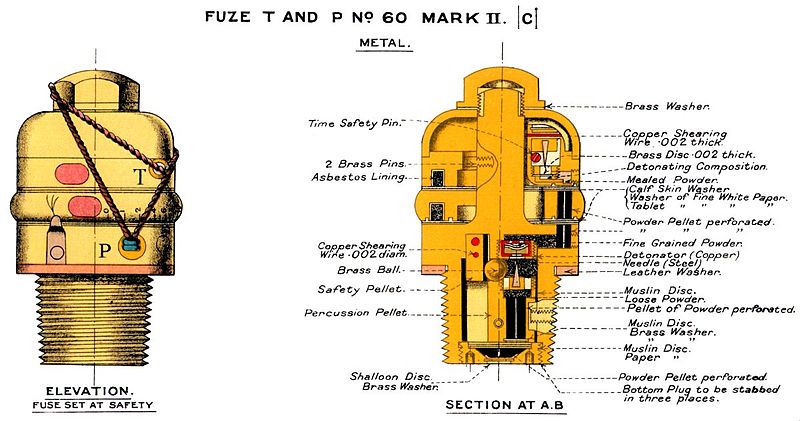
Diagram of British No. 60 Mk II Time and Percussion Fuze. Classed as Small type Time Percussion fuze, with G.S. gauge thread (1 inch tapering). 2 time rings, burning time 20.1 seconds at rest. Lower time ring is graduated. Composition channels are lined with asbestos paper.Time detonator in upper time ring contains.2 grains composition. Replaced Fuze No. 56. Listed in 1915 for use with shrapnel s
War Office, UK. · Plate LVI, Pages 313, 317, 335 in "Treatise on Ammunition" 10th Edition 1915. Facsimile reprint by Imperial War Museum and Naval Military Press 2003.
Notes from the source article
Cited by Wikipedia
Notes from the source article
These works are cited by the source article, in its own numbering. They are recorded as its citations, not as sources VALÉORINE has verified.
- 1.Hogg & Thurston 1972, p. 73
- 2.Hall 1973
- 3.Hall quotes 7000 yds maximum with percussion fuze and 6600 yds with time fuze, apparently referring to Boer War use. Hogg & Thurston quote for World War I. As the British initially used German ammunition and later their own, performance may have differed with ammunition
- 4.Hogg & Thurston 1972, p. 72
- 5.Becke, A.F. (1945). History of the Great War: Order of Battle of Divisions: Territorial Force & Mounted Divisions Pt. 2A. London HMSO.
- 6.Farndale 1988, pp. 61–67
- 7.Farndale 1988, p. 357
- 8.Clarke 2004, p. 23
Bibliography printed in the source article · 5
- Clarke, Dale. British Artillery 1914–1919. Field Army Artillery. Osprey Publishing. 2004. 1-84176-688-7.
- Mark Connelly, The British Campaign in Aden, 1914–1918
- General Sir Martin Farndale, History of the Royal Regiment of Artillery. The Forgotten Fronts and the Home Base, 1914–1918. London: Royal Artillery Institution, 1988.
- Hall, Major D. Field Artillery of the British Army 1860–1960 Part II, 1900–1914. Military History Journal. The South African Military History Society. 2. 5. June 1973.
- I.V. Hogg & L.F. Thurston. British Artillery Weapons & Ammunition 1914–1918. London: Ian Allan, 1972
References
Citations
References
Each reference names the institution holding it, so a reader may go to the document itself.
reference work
Secondary witness
Connections
Knowledge graph
Connections
Each connection was recorded deliberately, with the basis for it kept on the internal record.
Broader subject
1- field gunTerminology
Established from a fact already recorded on a verified source.
Place
1- German EmpirePlace
Established from a fact already recorded on a verified source.
The Encyclopedia exists whether or not anything is for sale. Corrections are recorded rather than overwritten, and every version of this record is kept. Published 16 August 2026.
Elsewhere in Militaria
6,095 published records in this field, each with its sources named.
- QF 13-pounder 9-cwt gunTerminology
- QF 13-pounder gunTerminology
- QF 14 pounder Maxim-NordenfeltTerminology
- QF 14 pounder Mk I & II gunTerminology
- QF 17-pounder gunTerminology
- QF 18-pounder gunTerminology
- QF 2 pounder gunTerminology
- QF 2.95 inch Mountain GunTerminology
Best supported in this field
For owners
Own an object connected with QF 15-pounder Mark I gun?
A specialist will read what you send and tell you what the house can establish, what it cannot, and whether the object is suited to sale. There is no charge and no obligation. The object stays with you throughout; nothing is shipped to us unless it is arranged in writing beforehand.