
Polyphon
A Polyphon is a disc-playing music box. The machine was invented in 1870; it was first manufactured by the Polyphon Musikwerke, in Leipzig, Germany, full-scale production having started about 1896 and continuing into the early 20th century. Polyphons were exported all over the world; music was supplied for the English, French, German markets, as well as further afield, with pieces cataloged for the Russian, Polish, and Balkan regions.
Polyphon

Katja Rehfeld · Bundesarchiv, Bild 183-S0303-015 / Katja Rehfeld / CC-BY-SA 3.0 · This image was provided to Wikimedia Commons by the German Federal Archive (Deutsches Bundesarchiv) as part of a cooperation project. The German Federal Archive guarantees an authentic representation · CC BY-SA 3.0 de
- Field
- disc musical box and music box.
- Period
- 1908.
- Region
- Germany.
VALÉORINE Encyclopedia
VALÉORINE documentary reading
Documentary summary
A Polyphon is a disc-playing music box. The machine was invented in 1870; it was first manufactured by the Polyphon Musikwerke, in Leipzig, Germany, full-scale production having started about 1896 and continuing into the early 20th century. Polyphons were exported all over the world; music was supplied for the English, French, German markets, as well as further afield, with pieces cataloged for the Russian, Polish, and Balkan regions.
Admitted source layer · organised and presented by VALÉORINE
Note VALÉORINE
No house-authored Note is published until its assertions and sources pass the VALÉORINE evidence contract. The documentary article remains available in full while that enrichment is being consolidated.
Documentary enrichment in progress · no unsupported statement published
Reference Check
Propose documentary evidence for Polyphon. A contribution is never written directly as fact: identity, source, rights and evidence gates still decide.
Sign in to contribute
World of VALÉORINE
Documentary connections
Only confirmed graph relationships appear here. Images are shown only when their identity and reuse rights both pass the documentary gate.

Documentary evidence
Evidence Panel
not yet certified
- Identity
- resolved
- Independent source families
- 0
- Admitted assertions
- 0
- Open conflicts
- 0
Authority files
gnd · 10283711-9 · wikidata · Q7226749 · wikipedia · Polyphon
In this article
Polyphon Musikwerke
Polyphon Musikwerke
Also a record label as registered by German Polyphon Musikwerke AG in 1908. Polyphon traded under the Polydor label since 1913 with their trademarks Polyphon Musik and Polyphon Record.
The German company was founded in 1887 in Wahren, Leipzig, as Firma Brachhausen & Riesener, by Gustav Adolf Brachhausen and Ernst Paul Riessner, for manufacturing their 1870 invention mechanical disc-playing music box Polyphon. The company was renamed to Polyphon-Musikwerke AG in 1895. In 1908 Hugo Wünsch was appointed director, but became head of the new subsidiary Deutsche Grammophon AG in 1918. On April 24, 1917, Polyphon-Musikwerke AG acquired the Deutsche Grammophon-Aktiengesellschaft record plant from the German government. The German state had taken over DG and British holdings during World War I on the grounds that they were enemy property. The factories Deutsche Grammophon and Polyphon-Musikwerke were handled by Polyphonwerke AG, and headquarters were relocated to Berlin, with the new corporate entity taking the name Polyphon-Grammophon-Konzern. In 1918, Polyphon AG established its head offices in Markgrafenstraße 76 in Berlin. Bruno Borchard became director general. The early owner Joseph Berliner remained as member of the boards until his retirement in 1921. In 1919 the Austrian subsidiary Polyphon-Sprechmaschinen und Schallplatten GmbH was founded in Vienna. It was as renamed Polyphon Schallplatten Ges. mbH. The Danish Nordisk Polyphon A. S. was founded in Kopenhagen. In Stockholm the Swedish subsidiary was called Nordisk Polyphon A. B. The ownership of foreign activities were concentrated in March 1929 into a Swiss holding company the Polyphon-Holding AG. In 1932 this holding was renamed to Polydor Holding AG. The owner Polyphon Werke AG was merged with Deutsche Grammophon AG in 1932, and the total shutdown of the production in Leipzig followed soon thereafter. In 1933 DG sold its shares of Polydor Holding. In 1937 the company renamed itself to Deutsche Grammophon GmbH. A capital merger operation took place by a consortium of Deutsche Bank and Telefunken Gesellschaft. In 1932 founded Telefunken Platte GmbH got a production plant as it was needed. DGG was sold to the German Siemens & Halske AG electronics company in 1941. In 1954, DGG established a subsidiary in London, Polydor Records Ltd. In 2000, the French media company Vivendi SA acquired the current owner Universal Music Group from Seagram.
Polyphon music box
Polyphon music box
Original examples still exist of 1870-invented Polyphon and contemporary manufacturers produce small quantities of both the devices and discs.
Motor
Motor
Almost without exception, all Polyphons are powered by a hand-wound clockwork motor. Polyphon may have devised an electric motor variant of a large coin-operated model in the latter days of production, but to date, no known original examples exist. The motor has an output drive dog, which is a circular component with round-topped dowels arrange to fit the holes in the discs. Discs of small diameter have two centrally located holes (centre drive), while larger discs had a series of holes around the periphery (peripheral drive). During operation, a disc is placed on the centre post, or centre boss, a pressure bar goes over the disc to hold it in place and the drive dog revolves the disc. The playing time for each disc varies, dependent upon the diameter. For example, the running time of a 19.5/8 inch-diameter disc (50 cm) is about 1 minute and 50 seconds.
Modern availability
Modern availability
Numerous sizes of Polyphons and associated discs were produced, with the diameters ranging from 6 inches to 24.5 inches. It is possible to purchase new discs, currently manufactured in the UK by Renaissance Discs, for every size of Polyphon originally produced. Originals have survived in relatively large numbers, and are often available on internet sales sites.
Polyphon Musik
Polyphon Musik
Polyphon disc records and machines followed in Germany 1905 and in England in June 1908. The trade mark was registered in Britain in 1900. Earlier Polyphon overstamped their place of origin. Polyphon as a label was founded in Leipzig on 8 September 1908 (registered Nr. 110347). In England their Klingsor Records label were repressed under Polyphon around 1910. In June 1913 the label was changed to Pilot. Polydor label was founded 2 April 1913 in Leipzig and registered on 25 July 1914 (Nr. 316613). For example, Polyphon Musikwerke entered into Persian market in 1927. In 1927 Polyphon Musikwerke recorded 200 matrices in Iraq followed by making 600 recordings in Tehran. Their agent the Hakkak company opened shops in Baghdad, Tehran and Kermanshah. Polyphon Musik and Polyphon Record had unique issue series in 36 countries or areas within decades. In 1931 agreement with Polyphon gave for Decca exclusive British licence to records on this label. Since 1946 Polydor has been the popular music arm, while the new Deutsche Grammophon Gesellschaft label was going to be a classical music label in 1949. The previous used label Grammophon was disbanded.

The sign says "please do not touch" - at £2000 a box, no fear of that!
Tim Walker from United Kingdom · Antique 'polyphons' in Northleach, England
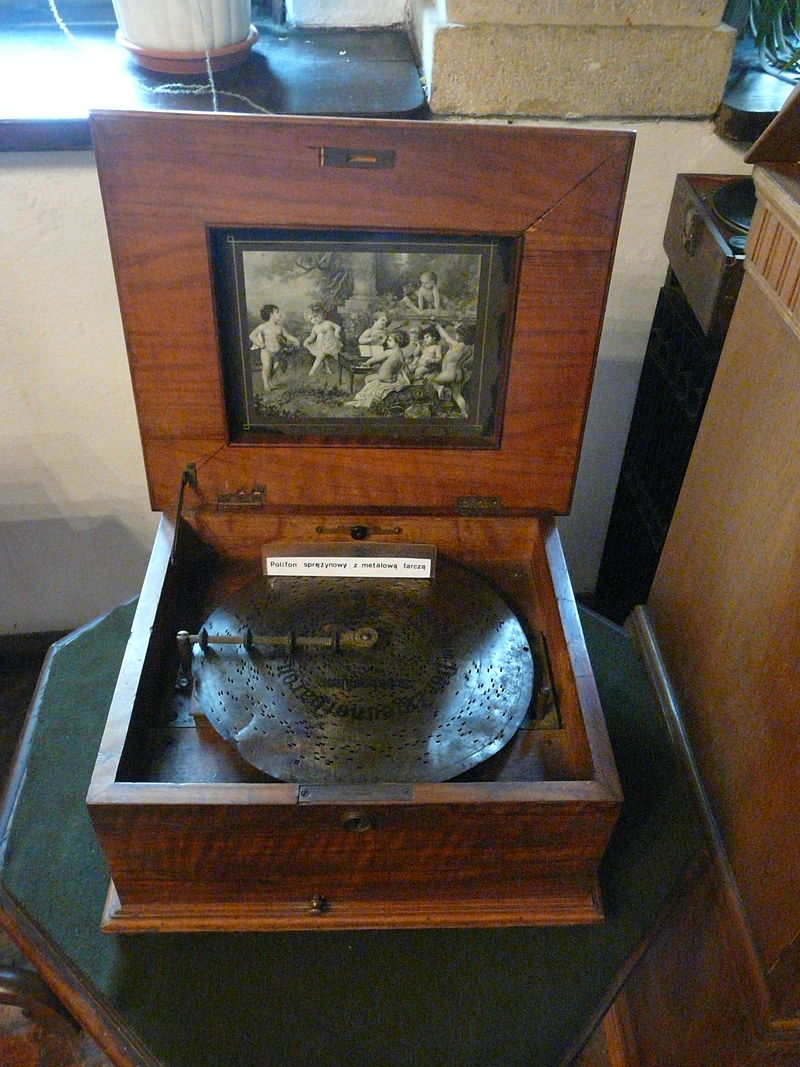
Muzeum Ziemi Bieckiej - Oddział w Domu z Basztą
myself (User:Piotrus) · Self-photographed
Chronology
Dated record
Chronology
The full dated record · 2 entries
1908
Polyphon first recorded.
1908
Polyphon is recorded from 1908.
Making music
The tune is punched out on the disc with pitch determined by the position of the punching. In the manufacturing process, the punched metal was curled back onto the underside of the disc, creating a raised projection that resembles a letter A when viewed obliquely. When the Polyphon operates, the resulting disc projections, called plectra, engage with a series of ratchet-like star wheels, each with 9 projections, that sit in a gantry. Each star wheel, when moved through 40 degrees on its axis, plucks a tooth on the instrument's comb. The tooth resonates, sounding a predetermined note. Upon the musical comb, the fast treble notes are sounded furthest from the centre and the slower bass notes nearest the centre. Many comb variants were manufactured, including a single comb on smaller instruments, and duplex combs (simultaneous strike) on mid-sized examples of 11-inch-diameter and 15.5-inch-diameter instruments. Most larger twin-combed examples had alternate strike although other manufacturers, notably Symphonion, produced large size instruments with duplex combs.
Primary material
Documents and archives
reference work
- Wikidata, structured authority record Q7226749: Polyphon
Reputable secondary · Wikidata
- “Polyphon”, English Wikipedia, consulted as further reading
Reputable secondary · Wikipedia
authority file
- Gemeinsame Normdatei 10283711-9, Polyphon.
Unverified · Deutsche Nationalbibliothek
Notes from the source article
Cited by Wikipedia
Notes from the source article
These works are cited by the source article, in its own numbering. They are recorded as its citations, not as sources VALÉORINE has verified.
- 1.Schellackplatten Label - Polyphon - Grammophon und Schellackplatten Portal 78rpm. grammophon-platten.de.
- 2.Grammophon Portal_2
- 3.Leipzig University - Polyphon Musikwerke
- 4.Play box polyphone sheet metal 39.5 cm antique music box disc 15 1/2. eBay.
- 5.Picture Postcard, Salcombe, Polyphon At Overbecks. eBay.
- 6.Emil berliner Studios - The History Of The Record 1926-1950
Bibliography printed in the source article · 1
References
Citations
References
Each reference names the institution holding it, so a reader may go to the document itself.
authority file
Gemeinsame Normdatei 10283711-9, Polyphon.Deutsche Nationalbibliothek
Partially resolvedreference work
Partially resolvedreference work
Partially resolved
The Encyclopedia exists whether or not anything is for sale. Corrections are recorded rather than overwritten, and every version of this record is kept. Published 14 August 2026.
Elsewhere in Collectables
20,755 published records in this field, each with its sources named.
- Poly Bridge 3Work
- Poly PlayWork
- PolymegaTerminology
- PolymoogTerminology
- PolyStationTerminology
- pommerTerminology
- PonchoWork
- pong langTerminology
Best supported in this field
For owners
Own an object connected with Polyphon?
A specialist will read what you send and tell you what the house can establish, what it cannot, and whether the object is suited to sale. There is no charge and no obligation. The object stays with you throughout; nothing is shipped to us unless it is arranged in writing beforehand.