
polybolos
Illustration — Arsenal of ancient mechanical artillery in the Saalburg, Germany; left: polybolos reconstruction by the German engineer Erwin Schramm (1856–1935) • Illustration — A modern reconstruction of the repeating "polybolos" catapult of Dionysius of Alexandria, in Kotsanas Museum of Ancient Greek Technology, Athens, Greece. The polybolos (the name means "multi-thrower" in Greek) was an ancient Greek repeating ballista, reputedly invented by Dionysius of Alexandria (a 3rd-century BC Greek engineer at the Rhodes arsenal) and used in antiquity. The polybolos was not a crossbow since it used a torsion mechanism, drawing its power from twisted sinew-bundles.
polybolos

SBA73 · originally posted to Flickr as Artilleria experimental romana a Saalburg / Roman experimental artillery in Saalburg · CC BY-SA 2.0
- Field
- torsion siege engine
VALÉORINE Encyclopedia
VALÉORINE documentary reading
Documentary summary
Illustration — Arsenal of ancient mechanical artillery in the Saalburg, Germany; left: polybolos reconstruction by the German engineer Erwin Schramm (1856–1935) • Illustration — A modern reconstruction of the repeating "polybolos" catapult of Dionysius of Alexandria, in Kotsanas Museum of Ancient Greek Technology, Athens, Greece. The polybolos (the name means "multi-thrower" in Greek) was an ancient Greek repeating ballista, reputedly invented by Dionysius of Alexandria (a 3rd-century BC Greek engineer at the Rhodes arsenal) and used in antiquity. The polybolos was not a crossbow since it used a torsion mechanism, drawing its power from twisted sinew-bundles.
Admitted source layer · organised and presented by VALÉORINE
Note VALÉORINE
No house-authored Note is published until its assertions and sources pass the VALÉORINE evidence contract. The documentary article remains available in full while that enrichment is being consolidated.
Documentary enrichment in progress · no unsupported statement published
Reference Check
Propose documentary evidence for polybolos. A contribution is never written directly as fact: identity, source, rights and evidence gates still decide.
Sign in to contribute
World of VALÉORINE
Documentary connections
Only confirmed graph relationships appear here. Images are shown only when their identity and reuse rights both pass the documentary gate.
Documentary evidence
Evidence Panel
not yet certified
- Identity
- resolved
- Independent source families
- 0
- Admitted assertions
- 0
- Open conflicts
- 0
Authority files
wikidata · Q734956 · wikipedia · Polybolos
In this article
Design
Design
However the earlier and similar oxybeles employed a tension crossbow mechanism, before it was abandoned in favor of torsion. Philo of Byzantium (c. 280 BC – c. 220 BC) encountered and described a weapon similar to the polybolos, a catapult that could fire again and again without a need for manual reloading. Philo left a detailed description of the gears that powered its chain drive (the oldest known application of such a mechanism) and that placed bolt after bolt into its firing slot.
The polybolos would have differed from an ordinary ballista in that it had a wooden hopper magazine, capable of holding several dozen bolts, that was positioned over the mensa (the cradle that holds the bolt prior to firing). The mechanism is unique in that it is driven by a flat-link chain connected to a windlass. The mensa itself was a sliding plank (similar to that on the gastraphetes) containing the claw latches used to pull back the drawstring and was attached to the chain link. When loading a new bolt and spanning the drawstring, the windlass is rotated counterclockwise by an operator standing on the left side of the weapon; this drives the mensa forward towards the bow string. At the very front, a metal lug triggers the latching claws into catching the drawstring. Once the string is held firm by the trigger mechanism, the windlass is then rotated clockwise; pulling the mensa back and drawing the bow string with it. At the same time, a round wooden pole in the bottom of the magazine is rotated via a spiral groove being driven by a rivet attached to the sliding mensa; dropping a single bolt from a carved notch in the rotating pole. With the drawstring pulled back and a bolt loaded on the mensa, the polybolos is ready to be fired. As the windlass is rotated further back to the very back end, the claws on the mensa meets another lug like the one that pushed the claws into catching the string. This one causes the claws to disengage the drawstring and automatically fires the loaded bolt. Upon the bolt being fired, the process is repeated. The repetition provides the weapon's name, in Greek πολυβόλος, "throwing many missiles", from πολύς (polys), "multiple, many" and -βόλος (-bolos) "thrower", in turn from βάλλω (ballo), "to throw, to hurl", literally a multithrower. A series of marks from ancient impacts on the walls of Pompeii, similar to those made by modern machine guns have been attributed to a polybolos operated by the troops of Roman commander Lucius Cornelius Sulla, who besieged the city in 89 BCE.
Popular culture
Popular culture
In 2010, a MythBusters episode was dedicated to building and testing a replica, and concluded that its existence as a historical weapon was plausible. However, the machine MythBusters built was prone to breakdowns that had to be fixed multiple times.
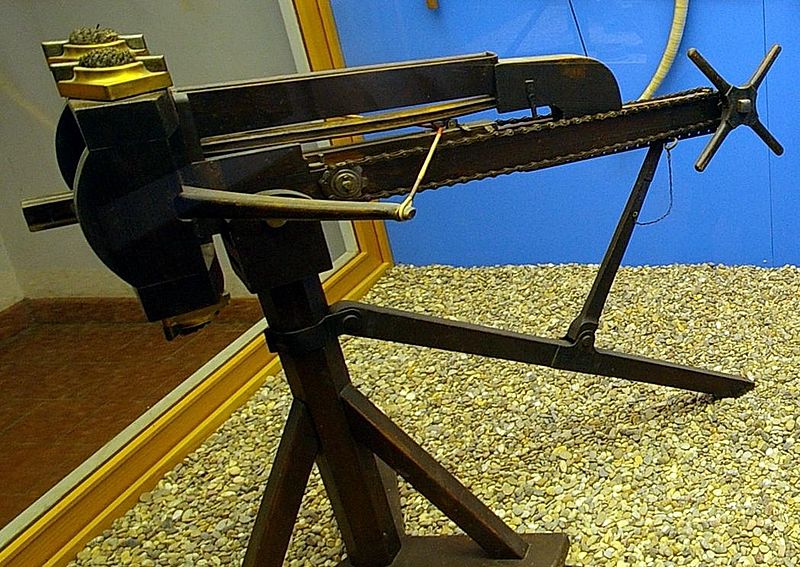
Edited version op Commons-file Ancient Mechanical Artillery. Pic 01.jpg
SBA73 · File:Ancient_Mechanical_Artillery._Pic_01.jpg originally posted to Flickr as Artilleria experimental romana a Saalburg / Roman experimental artillery in Saalburg
Notes from the source article
Cited by Wikipedia
Notes from the source article
These works are cited by the source article, in its own numbering. They are recorded as its citations, not as sources VALÉORINE has verified.
- 1.Prenderghast, Gerald. Repeating and Multi-Fire Weapons: A History from the Zhuge Crossbow Through the AK-47. McFarland. 14. March 2018. 978-1476666662.
- 2.Werner Soedel, Vernard Foley. Ancient Catapults. Scientific American. 240. 3. 124–125. March 1979. 10.1038/scientificamerican0379-150.
- 3.Alan Wilkins. Roman Artillery. Osprey Publishing. 8 Dead link. January 2024. 978-0-7478-0575-5.
- 4.Needham, Science and Civilization in China, Volume 5, Part 6 (1995), pp. 172-173.
- 5.Kinard, Jeff. Artillery: An Illustrated History of Its Impact. Bloomsbury Publishing USA. 3. 2007-03-28. 978-1-85109-561-2.
- 6.Kinard, Jeff. Artillery: An Illustrated History of Its Impact. Bloomsbury Publishing USA. 5. 2007-03-28. 978-1-85109-561-2.
- 7.Philo of Byzantium, "Belopoeica", 73.34
- 8.πολυβόλος, Henry George Liddell, Robert Scott, A Greek-English Lexicon, on Perseus Digital Library
- 9.πολύς, Henry George Liddell, Robert Scott, A Greek-English Lexicon, on Perseus Digital Library
- 10.βάλλω, Henry George Liddell, Robert Scott, A Greek-English Lexicon, on Perseus Digital Library
- 11.Brown, Taylor Mitchell. Ancient 'machine-gun' damage discovered on walls of Pompeii. Scientific American. 2026-04-20.
- 12.Episode 152: Arrow Machine Gun. mythresults.com, November 3, 2010.
Bibliography printed in the source article · 2
- Duncan B. Campbell and Brian Delf, Greek and Roman Artillery 399 BC–AD 363, New Vanguard series 89, Osprey Publishing Ltd., Oxford 2003.
- Joseph Needham, Science and Civilization in China: Volume 5, Chemistry and Chemical Technology; Part 6, Military Technology: Missiles and Sieges, Cambridge University Press, Cambridge 1995. , 052132727X
References
Citations
References
Each reference names the institution holding it, so a reader may go to the document itself.
reference work
Partially resolvedreference work
Partially resolved
Connections
Knowledge graph
Connections
Each connection was recorded deliberately, with the basis for it kept on the internal record.
Broader subject
1- torsion siege engineTerminology
Established from a fact already recorded on a verified source.
The Encyclopedia exists whether or not anything is for sale. Corrections are recorded rather than overwritten, and every version of this record is kept. Published 14 August 2026.
Elsewhere in Militaria
6,095 published records in this field, each with its sources named.
- pole weaponTerminology
- pollaxeTerminology
- PolonezTerminology
- PolstenTerminology
- PolyusTerminology
- POM-2 mineTerminology
- POMD-1 mineTerminology
- Poniard Surface-to-Ship Guided RocketTerminology
Best supported in this field
For owners
Own an object connected with polybolos?
A specialist will read what you send and tell you what the house can establish, what it cannot, and whether the object is suited to sale. There is no charge and no obligation. The object stays with you throughout; nothing is shipped to us unless it is arranged in writing beforehand.