
play money
Play money, toy money, faux paper money or formally ludic money is money that functions as a toy or a token in a game or when playing. • Illustration — Coins from the game Century: Spice Road • Illustration — Monopoly money The first such toy money was printed in 1880 by the Milton Bradley Toys company, and was actually a teaching tool, distributed to schools so that children could play at commercial transactions and learn skills for reckoning change, recognizing coins, and budgeting purchases. The rules of play money usually follow the same lines as they do for real money: counterfeiting is considered cheating at a game. A common type of game resource that can be earned, spent and lost.
Also recorded as toy money · faux paper money · ludic money
play money
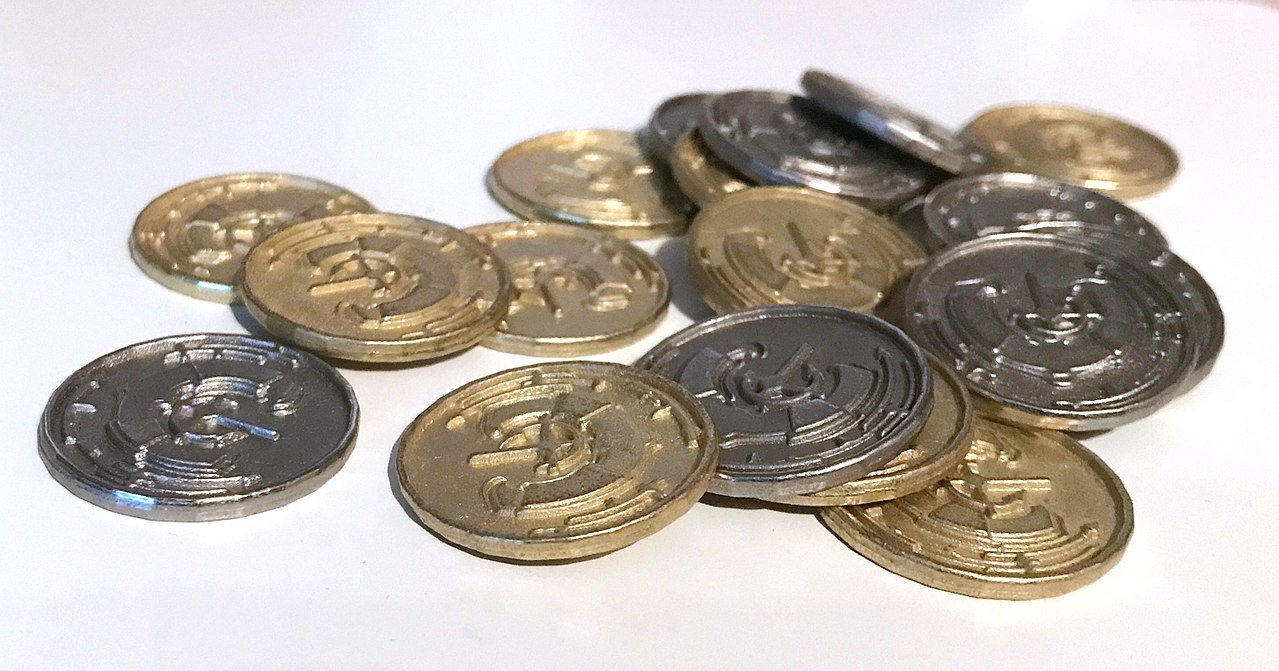
Achim Raschka · CC BY-SA 4.0
- Field
- currency · play money & banking
Reference Check
Propose documentary evidence for play money. A contribution is never written directly as fact: identity, source, rights and evidence gates still decide.
Sign in to contribute
Documentary evidence
Documentary basis
Authority files
wikidata · Q2310211 · wikipedia · Play money
In this article
Games that use play paper bills
Games that use play paper bills
Although poker chips are used in game play, the distinction between them and play money is threefold: play money is not intended to be used in gambling, play money (except for its value as a collectable item of board game paraphernalia) is not exchangeable for real currency, and play money (especially when used for teaching) tends to have some physical resemblance to actual currency. The owners of Selchow & Righter, which sold Milton Bradley branded games, had religious objections to gambling, and went so far as to object to any gaming use of play money, rejecting any game ideas that required it, to the extent that Harriet Righter passed over the chance to acquire the rights to Monopoly. A further decline in popularity has occurred because inflation has placed most coins of actual currencies within the spending abilities of children, obviating the need for play money as a cheap substitute. At its most basic level, play money refers to faux paper money, but some games can include coins, or more abstract tokens representing more generic resources (such as energy). money also encompasses virtual currencies in the complex in-game economies of MMORPGs, but again unlike older physical play money, in-game virtual currencies are exchangeable, to greater or lesser degree, with real currency. This has led to a whole economic system that has no analogue with physical game money, with virtual trading indexes, and currency exchange mechanisms for countries that do not accept real currencies like the United States dollar. Whereas Monopoly money is tangible and physical and only exists within an economic system controlled by a single game board, virtual currencies are intangible and exist within an economic system that spans multiple on-line games and extends to the currency of the real world.
• Careers • Finance • Game of Life • Monopoly • Pay Day
Games that use play coins
Games that use play coins
• Century: Spice Road • Scythe
Text attribution
Licensing
Text attribution
Part of the biographical narrative on this page reuses licensed material. Its origin, revision and licence are recorded here.
The biographical narrative on this page is based on the Wikipedia article Play money, revision 1375497863 (EN edition), by its contributors. VALÉORINE has edited that text and built its own documentary record around it. The reused material is available under CC BY-SA 4.0, and this page's reuse of it is offered under the same licence. Everything else on this page — the chronology, the holdings, the evidence, the plates and the connections — is VALÉORINE's own record. Sources and licences.
Notes from the source article
Cited by Wikipedia
Notes from the source article
These works are cited by the source article, in its own numbering. They are recorded as its citations, not as sources VALÉORINE has verified.
Bibliography printed in the source article · 4
- Chaney. The Computer Culture Reader. Cambridge Scholars Publishing. 125–136. 2009. 9781443806664.
- Random House. Word Freak: Heartbreak, Triumph, Genius, and Obsession in the World of Competitive Scrabble. 2002. 9780224060615.
- Wolf. The Routledge Companion to Video Game Studies. Routledge. 2014. 9781136290503.
- Numismatic Bibliomania Society. Milton Bradley's Educational Toy Money. The E-Sylum. 19. 6. 2016-02-07.
References
Citations
References
Each reference names the institution holding it, so a reader may go to the document itself.
reference work
Secondary witnessreference work
Secondary witness
The Encyclopedia exists whether or not anything is for sale. Corrections are recorded rather than overwritten, and every version of this record is kept. Published 14 August 2026.
Elsewhere in Collectables
20,755 published records in this field, each with its sources named.
- Plättchen Twist 'n' PaintWork
- PlatterManiaWork
- PlatypusWork
- Play MagnusWork
- Play with the TeletubbiesWork
- Playboy Automobile CompanyOrganisation
- PlayChoice-10Work
- PlaydiaTerminology
Best supported in this field
For owners
Own an object connected with play money?
A specialist will read what you send and tell you what the house can establish, what it cannot, and whether the object is suited to sale. There is no charge and no obligation. The object stays with you throughout; nothing is shipped to us unless it is arranged in writing beforehand.