
Pietro Bracci
Illustration — Oceanus (or Neptune) of the Trevi Fountain Pietro Bracci (June 16, 1700 –1773) was an Italian sculptor working in the Late Baroque manner. He is best known for carving the marble sculpture of Oceanus at the center of Rome's Trevi Fountain, based on a plaster modello by Giovanni Battista Maini.
Also recorded as Pietro, I Bracci · Petrus Bracci · Pietro Bracci I
Pietro Bracci
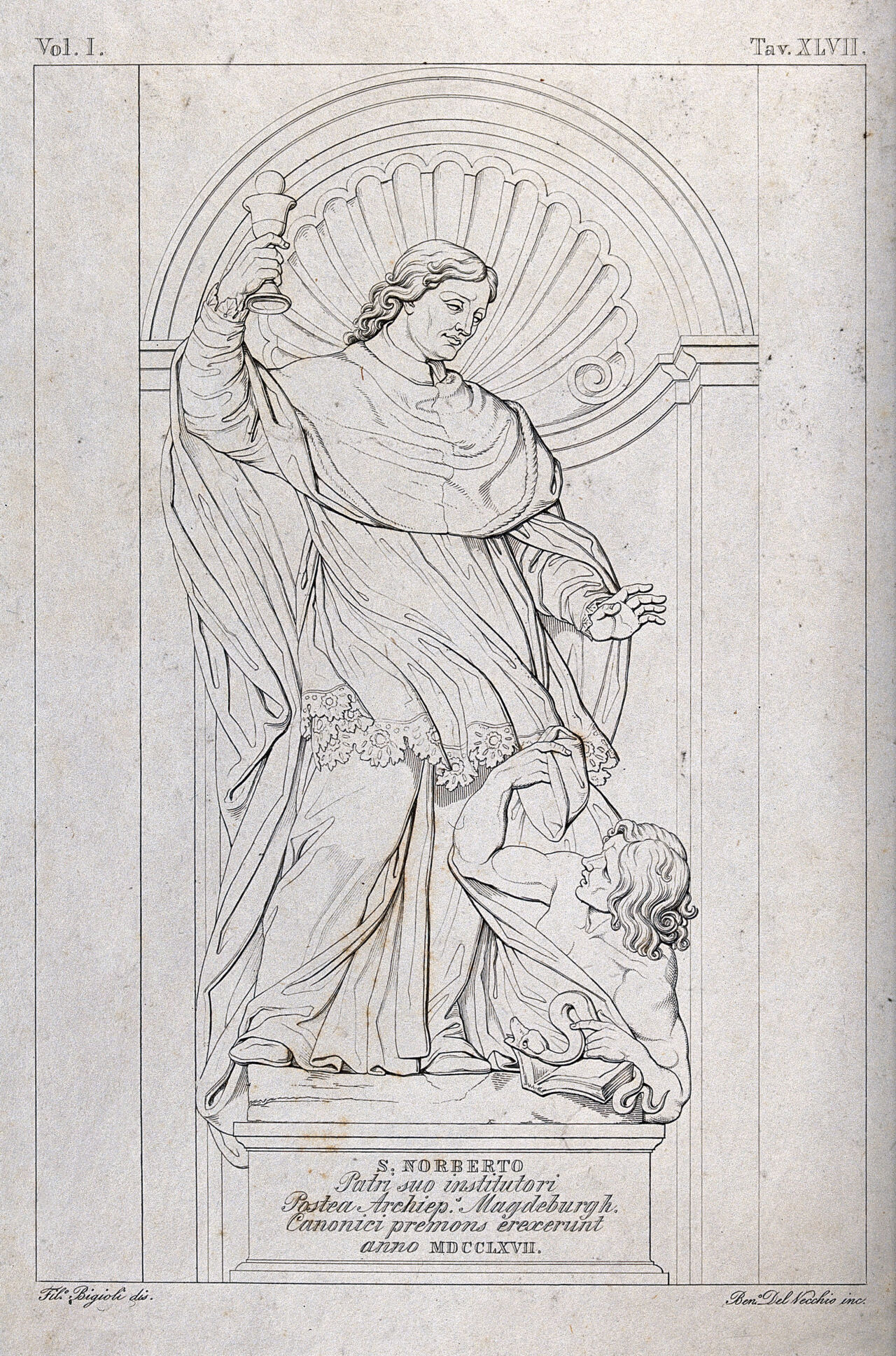
Pietro Bracci · Wellcome Collection, London · Wellcome Collection · Public Domain Mark
- Born
- 1700
- Died
- 1773
- Nationality
- Papal States
- Occupation
- sculptor
- Known for
- Pope Clement XII Corsini
VALÉORINE Encyclopedia
VALÉORINE documentary reading
Documentary summary
Illustration — Oceanus (or Neptune) of the Trevi Fountain Pietro Bracci (June 16, 1700 –1773) was an Italian sculptor working in the Late Baroque manner. He is best known for carving the marble sculpture of Oceanus at the center of Rome's Trevi Fountain, based on a plaster modello by Giovanni Battista Maini.
Admitted source layer · organised and presented by VALÉORINE
Note VALÉORINE
No house-authored Note is published until its assertions and sources pass the VALÉORINE evidence contract. The documentary article remains available in full while that enrichment is being consolidated.
Documentary enrichment in progress · no unsupported statement published
Reference Check
Propose documentary evidence for Pietro Bracci. A contribution is never written directly as fact: identity, source, rights and evidence gates still decide.
Sign in to contribute
Documentary evidence
Evidence Panel
not yet certified
- Identity
- resolved
- Independent source families
- 0
- Admitted assertions
- 0
- Open conflicts
- 0
Authority files
wikidata · Q1111180 · wikipedia · Pietro Bracci
In this article
Biography
• Illustration — Pope Benedict XIV Museum of Grenoble. He was born in Rome and became a student of Giuseppe Bartolomeo Chiari and Camillo Rusconi. His most familiar works are the colossal Oceanus or Neptune of the Trevi Fountain, Rome, after a modello by Giovanni Battista Maini, and four prominent tomb monuments in Rome. He sculpted the figures for the tomb of Benedict XIII (1734) in Santa Maria sopra Minerva, Rome, which was designed by the architect Carlo Marchionni, and for the tomb of Benedict XIV (1763–1770) in the Basilica of Saint Peter, completed with the help of his pupil Gaspare Sibilia. The third tomb at St Peter's on which he worked commemorates Maria Clementina Sobieski (1742), wife of the "Old Pretender", James Stuart, one of the Catholic Stuart claimants to the thrones of England, Scotland and Ireland. It is one of three monuments in St. Peter's dedicated to the deposed royal line of Stuart. The sculpture is in polychrome with an image of Maria Clementina in mosaic held aloft by Charity. The monument was conceived by the architect Filippo Barigioni, who provided preliminary sketches. Bracci also designed and sculpted the polychromatic tomb of Cardinal Giuseppe Renato Imperiali (1741) in Sant'Agostino in Rome. • Illustration — The Sobieski tomb His best known work is the colossal Oceanus— also known as Neptune — (after 1759) of the Trevi Fountain, Rome, where he was constrained to follow a plaster modello by Giovanni Battista Maini, who died before he could execute the marble. Bracci executed the Oceanus and the tritons when he took over work on the fountain. After the death of Nicola Salvi (1751) work was halted with only the foundations built. A few years later the works were assigned to Panini who was stopped when he started to make changes to the project. Bracci took over in 1761 and finished the fountain in 1763. Nicola Salvi and Pietro Bracci were longtime friends, both being members of Arcadia and members of the confraternity of the virtuosi at the Pantheon. There are several official busts of Benedict XIII by Bracci, and a terracotta (1724), conserved in Palazzo Venezia, Rome. The aged glare of the pope in the marble portrait was an image difficult to beautify. Like all sculptors in Rome since the 16th century, Bracci was often called upon to restore or complete Roman sculptures, such as the Capitoline Antinous, to render them suitable for display. Bracci had a wide range of interests as known from his manuscripts, most of them are today lost. These interests included architecture, military engineering, sundials but also Ancient Egyptian hieroglyphs. Bracci died in Rome in 1773. His son was the architect Virginio Bracci, whose daughter was the pastellist Faustina Bracci Armellini.
Primary material
Documents and archives
scholarly publication
Institutional database
- Wikidata, structured authority record Q1111180: Pietro Bracci
Scholarly · Wikimedia Foundation
reference work
- “Pietro Bracci”, English Wikipedia, consulted as further reading
Reputable secondary · Wikipedia
Literature and further reading
• Web Gallery of Art: Pietro Bracci * * • Kieven, Elisabeth and John Pinto., Architecture and Sculpture in Eighteenth-Century Rome: Drawings by Pietro and Virginio Bracci in the CCA and Other Collections, Penn State Press, 2001 • Drawings by Pietro Bracci, Canadian Centre for Architecture.
Notes from the source article
Cited by Wikipedia
Notes from the source article
These works are cited by the source article, in its own numbering. They are recorded as its citations, not as sources VALÉORINE has verified.
References
Citations
References
Each reference names the institution holding it, so a reader may go to the document itself.
scholarly publication
VerifiedInstitutional database
Wikidata, structured authority record Q1111180: Pietro BracciWikimedia Foundation
Verifiedreference work
Partially resolved
The Encyclopedia exists whether or not anything is for sale. Corrections are recorded rather than overwritten, and every version of this record is kept. Published 14 August 2026.
Elsewhere in Sculpture
6,174 published records in this field, each with its sources named.
- Pietro BalestraArtist
- Pietro BarattaArtist
- Pietro BerniniArtist
- Pietro BorsariArtist
- Pietro ConsagraArtist
- Pietro di Giovanni TedescoArtist
- Pietro MagniArtist
- Pietro MontanaArtist
Best supported in this field
For owners
Own a work by Pietro Bracci?
A specialist will read what you send and tell you what the house can establish, what it cannot, and whether the object is suited to sale. There is no charge and no obligation. The object stays with you throughout; nothing is shipped to us unless it is arranged in writing beforehand.