
Pieter Gerritsz van Roestraten
Pieter Gerritsz van Roestraten or Pieter Gerritsz van Roestraeten (21 April 1630 – 10 July 1700) was a Dutch painter of still lifes, in particular floral and vanitas still lifes. He also painted genre scenes and portraits. After starting his career in Haarlem, he worked most of his career in London where he enjoyed the patronage of the highest circles.
Also recorded as Pieter van Roestraten · Pieter Gerritsz. van Roestraten · Pieter Gerritsz. van Rostraten · Pieter Gerritsz. van Rostraeten
Pieter Gerritsz van Roestraten
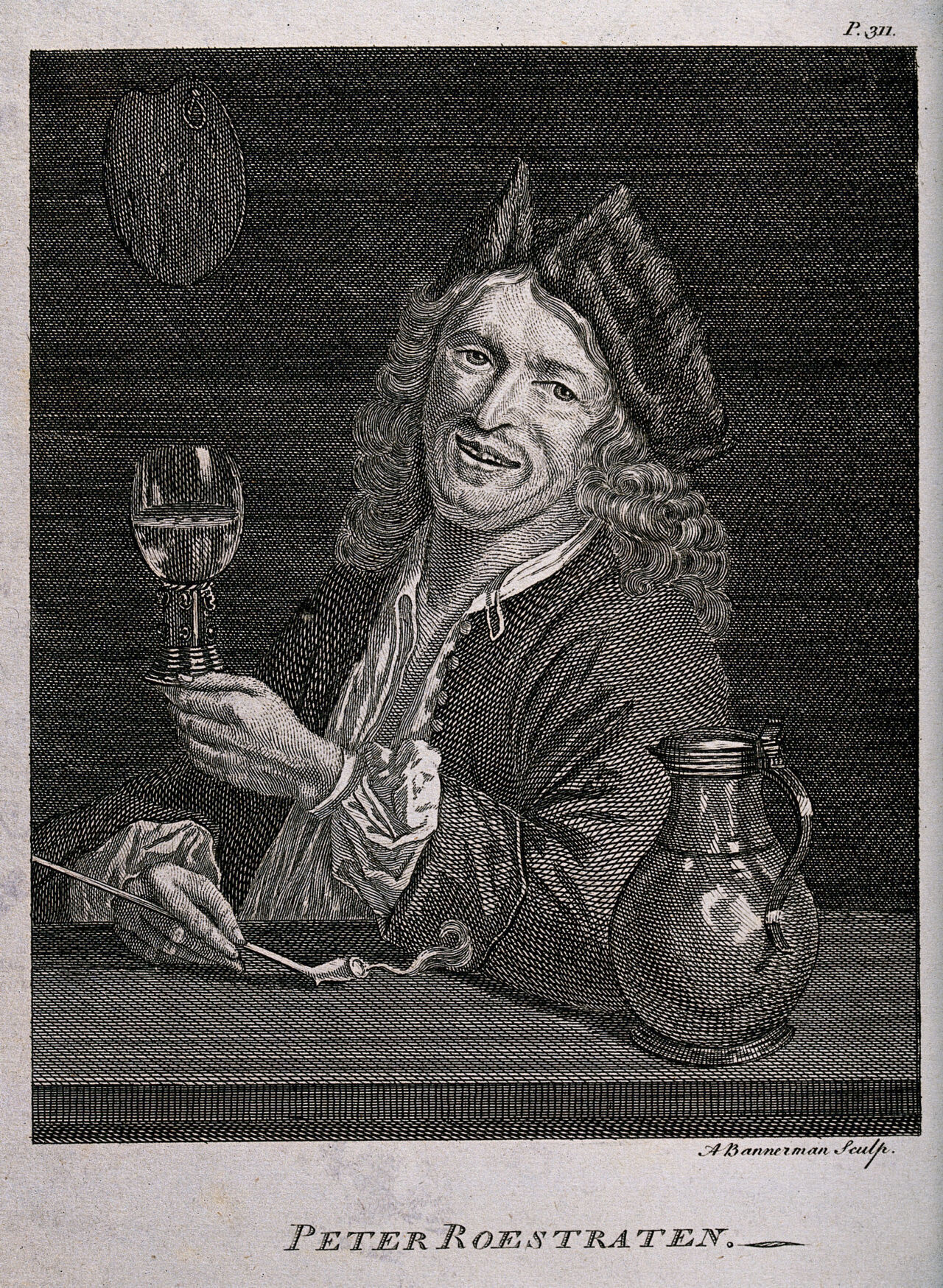
Pieter Gerritsz van Roestraten · Wellcome Collection, London · Wellcome Collection · Public Domain Mark
- Name
- Pieter Gerritsz van Roestraten
- Born
- 21 April 1630
- Birthplace
- Haarlem
- Died
- 10 July 1700
- Place of death
- London
- Field
- Still life and genre painting
- Nationality
- Dutch Republic
- Occupation
- painter · draftsperson
- Fields
- painting
- Movements
- Baroque
- Teachers
- Frans Hals
- Known for
- Vanitas
VALÉORINE Encyclopedia
VALÉORINE documentary reading
Documentary summary
Pieter Gerritsz van Roestraten or Pieter Gerritsz van Roestraeten (21 April 1630 – 10 July 1700) was a Dutch painter of still lifes, in particular floral and vanitas still lifes. He also painted genre scenes and portraits. After starting his career in Haarlem, he worked most of his career in London where he enjoyed the patronage of the highest circles.
Admitted source layer · organised and presented by VALÉORINE
Reference Check
Propose documentary evidence for Pieter Gerritsz van Roestraten. A contribution is never written directly as fact: identity, source, rights and evidence gates still decide.
Sign in to contribute
World of VALÉORINE
Documentary connections
Only confirmed graph relationships appear here. Images are shown only when their identity and reuse rights both pass the documentary gate.

Documentary evidence
Documentary basis
Authority files
wikidata · Q2100080 · wikipedia · Pieter Gerritsz van Roestraten
In this article
Biography
Biography
Training under Frans Hals is recorded. The recorded working language is Dutch. The field of work recorded is painting. Places of work recorded in the authority are Haarlem, Amsterdam and London. Works named in the authority record are Vanitas. Work by Pieter Gerritsz van Roestraten is recorded in the collections of Museum Boijmans Van Beuningen, National Museum of World Cultures, Frans Hals Museum, Art Institute of Chicago and Statens Museum for Kunst.
Key facts
Key facts
• Name — Pieter Gerritsz van Roestraten • Born — 21 April 1630 • Birthplace — Haarlem • Died — 10 July 1700 • Place of death — London • Field — Still life and genre painting
Life
Life
Pieter van Roestraten was born in Haarlem in 1630 and baptized on 21 April 1630 as the son of Gerrit Maertenszoon and Sara Meijnerts. His father Gerrit was possibly from Leiden. He was a student of Frans Hals in Haarlem for at least five years starting from 1649. He moved in 1651 to Amsterdam where he lived in the Anthonie Breestraat. On 6 June 1654 he had banns posted to marry a daughter of Frans Hals called Adriaentje who was six year his elder. • Illustration — Chinese porcelain cups and a bowl, with a mirror, a silver platter and a portrait medal and other objects on a table In the same year Reynier Hals, his brother-in-law, made in Amsterdam a disposition for van Roestraten and the Flemish genre painter Daniël Boone. The relationship between Boone and van Roestraten was likely close as van Roestraten may have been the sitter for Boone's picture of A bearded man squeezing a lemon over a roasted bird on a plate. Van Roestraten further moved to work in London around the same time as Boone moved there and like Boone, would live there for the rest of his life. He lived with his wife in Amsterdam before moving to London in 1666. The same year he suffered a hip injury during the Great Fire of London, which caused him to walk with a limp for the rest of his life. Van Roestraten was likely introduced to Charles II of England by Sir Peter Lely on the condition that he paint no portraits. He took the advice and stuck to still life painting. He was successful as he could earn forty to fifty pounds sterling for a still life. Van Roestraten lived on the south side of King's Street. This put him in close proximity to the Palace of Whitehall and to the studios of other artists, including Peter Lely and John Michael Wright. • Illustration — Still life with porcelain, silver and cockatoo When his first wife died he remarried a younger wife called Clara. He died soon afterwards. He was buried on 10 July 1700 in St. Paul's Cathedral.
Work
Work
Van Roestraten was principally a still life painter. Most of his still lifes are pronkstillevens (i.e. ostentatious still lifes) and vanitas still lifes. In his pronkstillevens he displayed his ability to depict reflective surfaces of metal objects and, in particular, silver. These paintings can to a certain extent be regarded as 'portraits' of the objects owned by his aristocratic patrons. The various objects in these compositions serve as symbols that can be read as an admonition or a life lesson. The objects usually imply a vanitas meaning as they evoke the transience and emptiness of wealth and earthly glory and point to the inevitable extinction of each human life. • Illustration — Vanitas still life An example is the Vanitas still life at the Royal Collection Trust. It includes several objects that invoke the vanitas meaning: a skull, a glass orb and a pocket watch. The book is open at a print of a laughing Democritus inscribed in Latin with lines which can be translated as: 'Everyone is sick from birth / vanity is ruining the world'. In the suspended glass sphere in the composition can be seen the reflection of a room and the figure of an artist looking towards the viewer, probably a self-portrait. Self-portraits have been identified in at least nine of van Roestraten's still lifes. Van Roestraten painted a number of self-portraits, four of which are preserved. These all show the artist holding objects that appear in his still lifes, including glassware, a clay pipe and a lemon. In one self-portrait he holds a very large wine glass, perhaps in reference to Bacchus or the sense of taste. It may be a reference to Annibale Carracci's Boy Drinking (Cleveland Museum of Art). • Illustration — The dissolute kitchen maid He also painted a number of genre scenes. An example is The Dissolute Kitchen Maid (1665, Frans Hals Museum). While it looks like a scene from daily life, it has a clear erotic meaning. The woman is acting in a shameless manner. A monkey, the symbol of wanton behaviour, leers up her dress. It is on a chain thus reminding us that man is a prisoner of his sinful desires. The picture conveys a moral message, reflected in the old man's raised finger: beware of sinful behaviour. He influenced Christian Berentz and Robert Robinson. Around 1990 Fred Meijer of the Netherlands Institute for Art History created the notname 'Pseudo-Roestraten' for an unknown artist or artists to whom he attributed a large number of still lifes with books, documents and precious objects in a style somewhat related to that of Pieter van Roestraeten. These works were mainly found in early English collections making it plausible that this artist worked in England around the same time as van Roestraten.
Identity and origins
Identity and origins
The authorities additionally record the headings Pieter van Roestraten, Pieter Gerritsz. Van Roestraten, Pieter Gerritsz. Van Rostraten, Pieter Gerritsz. Van Rostraeten and Pieter Roestraten. His recorded language was Dutch. He married Adriaentje Hals. Other recorded relations include Jan Hals and Frans Hals.
Identity
Identity
Pieter Gerritsz van Roestraten is recorded as painter and draftsperson.
Life and career
Dated record
Life and career
Explore 1630–1700
The full dated record · 7 entries
1630
Pieter Gerritsz van Roestraten born at Haarlem.
1650
Still life with objects of silver, fruits and a knife is dated 1650.
1681
Still life on a marble table with Chinese porcelain, glassware, a violin and a wax seal document is dated 1681.
1684
Flower still life in a decorative vase is dated 1684.
1700
Pieter Gerritsz van Roestraten died at London.
1700
A Yixing teapot, Chinese porcelain cups, a sugar pot and a bowl on a partly draped table is dated 1700.
1700
Still Life with King John Cup is dated 1700.
Places
Named by the record
Places
Only places the record itself states, plotted where the house gazetteer settles their coordinates. Nothing is inferred from a name or a nationality.
Haarlem.
Birth place
London.
Death place
Primary material
Documents and archives
Institutional database
- Wikidata, structured authority record Q2100080: Pieter Gerritsz van Roestraten
Scholarly · Wikimedia Foundation
reference work
- “Pieter Gerritsz van Roestraten”, English Wikipedia, consulted as further reading
Reputable secondary · Wikipedia
Notes from the source article
Cited by Wikipedia
Notes from the source article
These works are cited by the source article, in its own numbering. They are recorded as its citations, not as sources VALÉORINE has verified.
- 1.Pieter Gerritsz. van Roestraeten at the Frans Halsmuseum
- 2.Pieter Gerritsz van Roestraten at the Netherlands Institute for Art History
- 3.Daniël Boone, Man Eating from an Earthenware Pot at the Rijksmuseum
- 4.Anonymous after Daniël Boone, A grinning old man squeezing a lemon over a roasted bird at the British Museum
- 5.Pieter Gerritsz. van Roestraeten, A Vanitas c.1666-1700 at the Royal Collection Trust
- 6.Roestraten biography in Arnold Houbraken, De groote schouburgh der Nederlantsche konstschilders en schilderessen, 1718
- 7.Pieter Gerritsz. van Roestraeten, Porringer and Nautilus Cup at the Victoria and Albert Museum
- 8.Pieter Gerritsz Roestraten, The Licentious Kitchen Maid on the website of the Frans Halsmuseum
References
Citations
References
Each reference names the institution holding it, so a reader may go to the document itself.
Institutional database
Wikidata, structured authority record Q2100080: Pieter Gerritsz van RoestratenWikimedia Foundation
Institutional witnessreference work
Secondary witness
Further particulars
Held on the record
Further particulars
Open the remaining particulars
Pieter Gerritsz van Roestraten worked in painting. His work is associated with Baroque. He worked at Haarlem, Amsterdam and London.
Career and activity
Recognition and collections
Work by Pieter Gerritsz van Roestraten is
Museum Boijmans Van Beuningen, National Museum of World Cultures, Frans Hals Museum and Art Institute of Chicago
The Encyclopedia exists whether or not anything is for sale. Corrections are recorded rather than overwritten, and every version of this record is kept. Published 16 August 2026.
Elsewhere in Paintings
18,717 published records in this field, each with its sources named.
- Pieter Francis PetersArtist
- Pieter Franciscus DierckxArtist
- Pieter Frederik van OsArtist
- Pieter FrisArtist
- Pieter Godfried BertichenArtist
- Pieter HaaxmanArtist
- Pieter HardiméArtist
- Pieter Hermansz VerelstArtist
Best supported in this field
For owners
Own a work by Pieter Gerritsz van Roestraten?
A specialist will read what you send and tell you what the house can establish, what it cannot, and whether the object is suited to sale. There is no charge and no obligation. The object stays with you throughout; nothing is shipped to us unless it is arranged in writing beforehand.