
Pierre Philippe Thomire
Illustration — Baluster candle sticks and a French Empire mantel clock with a figure of Minerva, (1817). Located in the Blue Room of the White House, shown as decorated by Stéphane Boudin in 1963. The clock is now on a table of the Entrance Hall. • Illustration — Mantel clock (c.
Also recorded as Thomire-Duterme and Cie · Pierre-Philippe Thomire · Thomire
Pierre Philippe Thomire
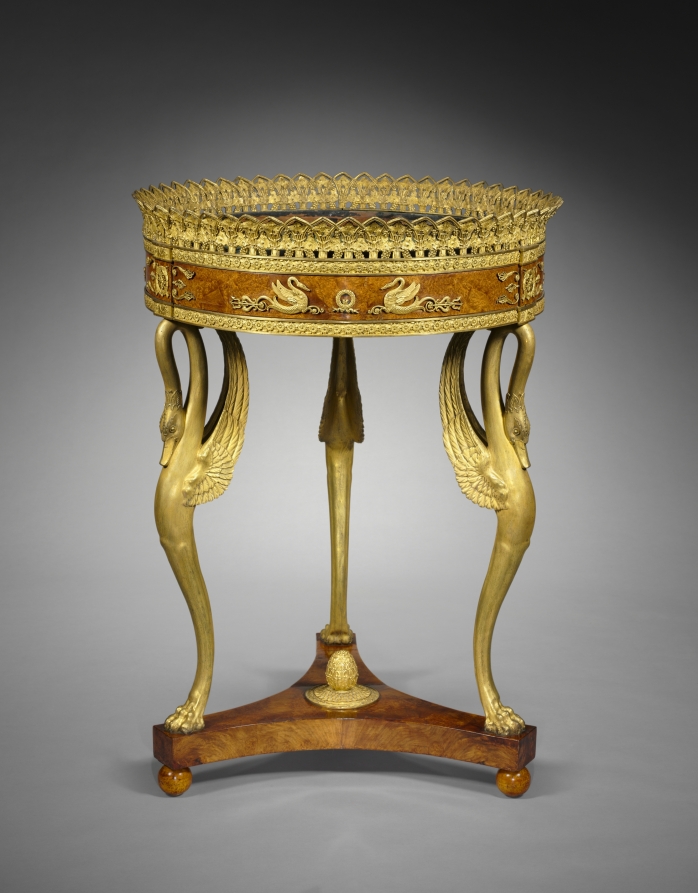
Pierre Philippe Thomire · The Cleveland Museum of Art · Gift of Carrie Moss Halle in memory of Salmon Portland Halle · CC0
- Born
- 1751 · Paris.
- Died
- 1843 · Paris.
- Nationality
- France
- Occupation
- sculptor · brazier · chaser · gilder · goldsmith
- Education
- Académie de Saint-Luc
- Teachers
- Jean-Antoine Houdon · Pierre Gouthière
- Honours
- Knight of the Legion of Honour
- Languages
- French
VALÉORINE Encyclopedia
VALÉORINE documentary reading
Documentary summary
Illustration — Baluster candle sticks and a French Empire mantel clock with a figure of Minerva, (1817). Located in the Blue Room of the White House, shown as decorated by Stéphane Boudin in 1963. The clock is now on a table of the Entrance Hall. • Illustration — Mantel clock (c.
Admitted source layer · organised and presented by VALÉORINE
Reference Check
Propose documentary evidence for Pierre Philippe Thomire. A contribution is never written directly as fact: identity, source, rights and evidence gates still decide.
Sign in to contribute
World of VALÉORINE
Documentary connections
Only confirmed graph relationships appear here. Images are shown only when their identity and reuse rights both pass the documentary gate.

Documentary evidence
Documentary basis
Authority files
wikidata · Q3383483
In this article
Biography
Biography
1810) in a gilded and patinated bronze case, symbolising the marriage of Napoleon and the Archduchess Marie-Louise, as Mars and Venus Pierre-Philippe Thomire (1751–1843) was a French sculptor and the most prominent bronzier, or producer of ornamental patinated and gilt-bronze objects and furniture mounts, of the First French Empire. His fashionable neoclassical and Empire style furnishing bronzes (bronzes d'ameublement) established the highest standard in refined finish in the craft that the French called that of the fondeur-ciseleur, "founder-finisher". In his pre-Revolutionary training, Thomire appeared first as a ciseleur, in the division of duties that went into the production, for example, of a set of gilt-bronze wall-lights delivered for Marie Antoinette's card-room, her Salon des Jeux at Compiègne: under the general supervision of Hauré, the wax and wooden model was carved by Martin, cast by Forestier, and chased by Thomire, as Pierre Verlet was able to show over fifty years ago. He had received his training in the workshop of Pierre Gouthière, the outstanding Parisian ciseleur-doreur working in the Louis XVI style, before establishing his own shop in 1776. He gradually assumed the leading position of his former master. In 1784 a pair of Sèvres vases with Raphaelesque grotesques in violet on a white ground, made in 1782 were mounted with gilt-bronze goats as handles, which Pierre Verlet recognized in a memorandum delivered by Thomire, who was responsible for modelling in wax, casting, matte gilding and mounting on the porcelain. In 1783–84 he received his first notable commission, casting and finishing the gilt-bronze handles modelled by Louis-Simon Boizot for a pair of Sèvres porcelain vases, today divided between the Musée du Louvre and Palazzo Pitti. Under the Empire, Thomire purchased the fashionable premises of the marchand-mercier Martin-Éloi Lignereux, for whom he had provided furnishing bronzes in rue Taitbout, Paris. When he exhibited in the 1806 Exposition Publique des Produits de l'Industrie, the first time a bronzier was permitted among the exhibiters, he gained a gold medal. His most prestigious commission was the execution of the cradle for the King of Rome, which was designed by Pierre Paul Prud'hon and in which Thomire collaborated with the Imperial silversmith Odiot; in a second cradle, Thomire alone was responsible. At the height of his business, Niclausse estimated Thomire employed six or seven hundred workers. A great number of the bronzes by Thomire in the Imperial residences had been commissioned, but further bronzes were supplied as collateral for a loan that was extended to Thomire in 1807 and which he was unable to repay, which consequently passed into the Imperial collection in 1811. Under the Restoration, Thomire Duterme et Cie. Retained the highest clientele, among them Monsieur, the King's brother, the duc de Berry, and as furnishers to the Garde Meuble de la Couronne, though elaborate measures were taken to rededicate Napoleonic allegories in bronze and ormolu with suitably Bourbon ones. In one, Thomire cast and finished a martial allegory sculpted by Louis-Simon Boizot, who had provided draped caryatid models for furniture mounts that were touched up by Thomire, applied to the upper corners of a secretary desk by Guillaume Beneman, delivered for the King's cabinet intérieure at Compiègne, 1787. In a notable commission for Count Nicolay Demidoff in 1819, Thomire produced finely-made figures of Fame with doubled trumpets to serve as handles for the massive malachite-veneered vase now at the Metropolitan Museum. Thomire retired from his firm in 1823.
Pierre Philippe Thomire studied at Académie de Saint-Luc. Training under Jean-Antoine Houdon and Pierre Gouthière is recorded. The recorded working language is French. Places of work recorded in the authority are Paris. Employment is recorded with Manufacture nationale de Sèvres. Work by Pierre Philippe Thomire is recorded in the collections of J. Paul Getty Museum, The Frick Collection, Kunsthistorisches Museum, Cleveland Museum of Art and National Museum Paleis het Loo. Distinctions recorded are Knight of the Legion of Honour.
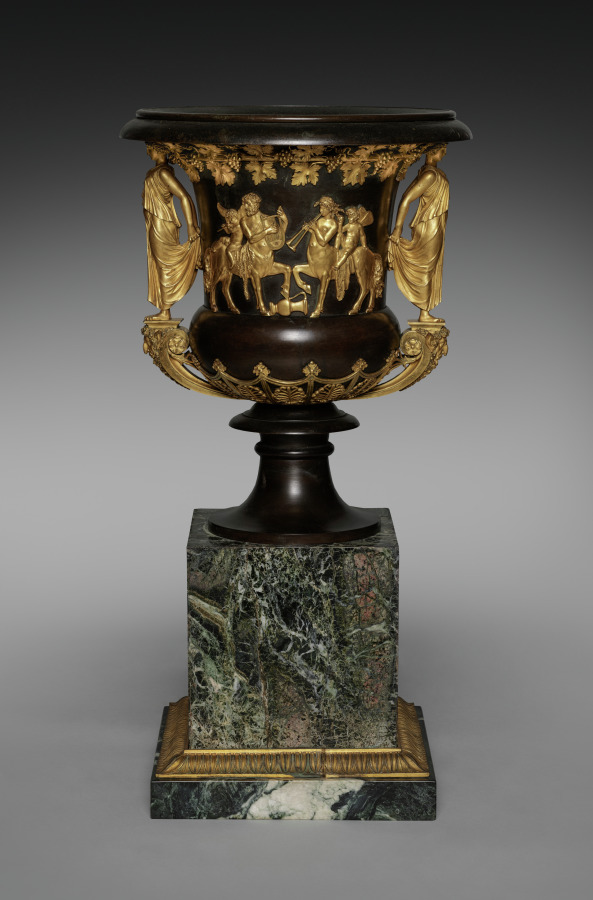
Vase, c. 1800, by Pierre Philippe Thomire
Pierre Philippe Thomire · The Cleveland Museum of Art · Gift of Mr. and Mrs. Harvey Buchanan in memory of Dorothy Tuckerman Draper
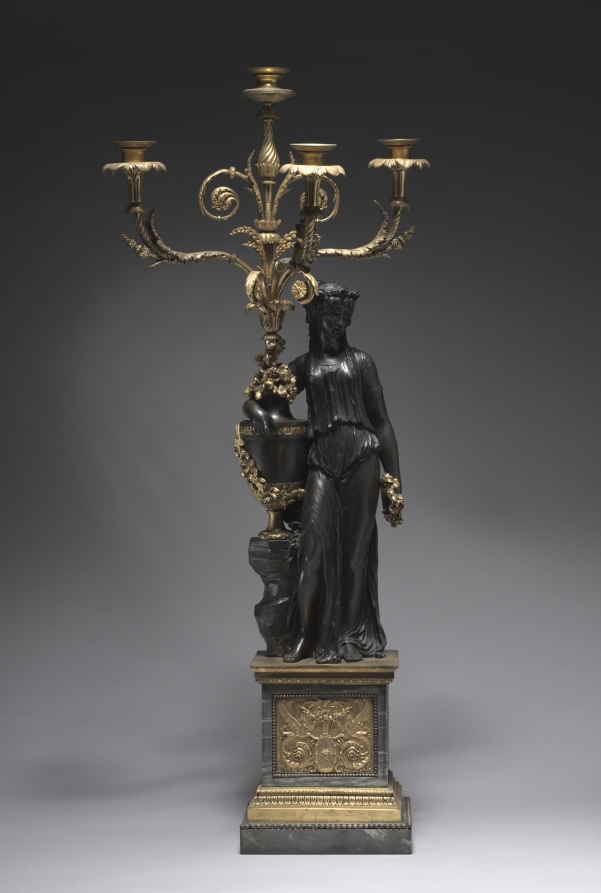
Candelabrum, c. 1780–1785, by Pierre Philippe Thomire
Pierre Philippe Thomire · The Cleveland Museum of Art · Gift of Grace Rainey Rogers in memory of her father, William J. Rainey
Life and career
Dated record
Life and career
The full dated record · 2 entries
1751
Pierre Philippe Thomire born at Paris.
1843
Pierre Philippe Thomire died at Paris.
Notes from the source article
Cited by Wikipedia
Notes from the source article
These works are cited by the source article, in its own numbering. They are recorded as its citations, not as sources VALÉORINE has verified.
- 1.Pierre Verlet, "The Wallace Collection and the Study of French Eighteenth-Century Bronzes d'ameublement" The Burlington Magazine 92 No. 567 (June 1950, pp. 154-15) p. 156. The wall-lights are identifiable in the Wallace Collection, London, by their stamped royal inventory numbers.
- 2.20 septembre 1784. Garniture de vases à bouc, fonte, modèle en cire, monture, dorure au mat noted in Pierre Verlet, "Orders for Sèvres from the French Court' The Burlington Magazine 96 No. 616 (July 1954, pp. 202–206) p. 206.
- 3.Lignereux had previously been the partner of Dominique Daguerre, who had settled in London.
- 4.David Harris Cohen, "The History of the Maréchal de Villars Group" Metropolitan Museum Journal 14 (1979, pp. 185–189), p. 185.
- 5.Now in Vienna.
- 6.Now at the Louvre.
- 7.Niclausse 1947:47.
- 8.Traced in detail in Cohen 1979.
- 9.Until 1819, thenceforth simply Thomire et Cie.
- 10.The future Charles X of France.
- 11.According to a document of 25 February 1818, noted by Cohen 1979:188.
- 12.See James David Draper, "The Fortunes of Two Napoleonic Sculptural Projects" Metropolitan Museum Journal 14 (1979), pp. 173–184.
- 13.Now in the Wrightsman collection at the Metropolitan Museum of Art.
- 14.Preston Remington, "The Story of a Malachite Vase"The Metropolitan Museum of Art Bulletin New Series, 3.6 (February 1945), pp. 142–145.
Bibliography printed in the source article · 5
- Hélène Cavalié, "Thomire", Allgemeines Künstlerlexikon, volume 109, 2020 (éléments nouveaux sur la famille notamment).
- Juliette Niclausse, Thomire, fondeur-ciseleur (1751–1843) (Paris) 1947.
- Christophe Huchet de Quénetain, Les Styles Consulat et Empire, Collection des styles, Paris, Les Éditions de l’Amateur, 2006, .
- Christophe Huchet de Quénetain, « De quelques bronzes dorés français conservés à la Maison-Blanche à Washington D.C. », dans La Revue, Pierre Bergé & associés, No. 6, mars 2005, .
- Milena Hübner, Surtout de table by Pierre-Philippe Thomire at the Wilanów Palace, Kwartalnik Historii Kultury Materialnej, 68 (3), 2020, 357–390. https://doi.org/10.23858/KHKM68.2020.3.005
References
Citations
References
Each reference names the institution holding it, so a reader may go to the document itself.
reference work
Wikidata, structured authority record Q3383483: Pierre Philippe ThomireWikimedia Foundation
Secondary witness
People, houses and institutions
Knowledge graph
People, houses and institutions
Teachers, collaborators, publishers and institutions recorded against this person, each on a stated basis.
Further particulars
Held on the record
Further particulars
Open the remaining particulars
Formation and teaching. Thomire studied at Académie de Saint-Luc. He trained under Jean-Antoine Houdon and Pierre Gouthière. Thomire received Knight of the Legion of Honour. Connected to 2 other published records in the VALÉORINE Encyclopedia.
Recognition and collections
Work by Pierre Philippe Thomire is
J. Paul Getty Museum, The Frick Collection, Kunsthistorisches Museum and Cleveland Museum of Art
Within the Encyclopedia
The Encyclopedia exists whether or not anything is for sale. Corrections are recorded rather than overwritten, and every version of this record is kept. Published 16 August 2026.
Elsewhere in Sculpture
6,174 published records in this field, each with its sources named.
- Pierre Louis RouillardArtist
- Pierre Marie François OgéArtist
- Pierre Octave VigoureuxArtist
- Pierre PetitotArtist
- Pierre SzekelyArtist
- Pierre-Charles BridanArtist
- Pierre-Charles SimartArtist
- Pierre-Claude GautherotArtist
Best supported in this field
For owners
Own a work by Pierre Philippe Thomire?
A specialist will read what you send and tell you what the house can establish, what it cannot, and whether the object is suited to sale. There is no charge and no obligation. The object stays with you throughout; nothing is shipped to us unless it is arranged in writing beforehand.