
Pierre-Luc-Charles Ciceri
Illustration — Pierre-Luc-Charles Ciceri, photograph by Nadar • Illustration — Set design for Act III of Daniel Auber's Gustave III (1833) • Illustration — Watercolor sketch for the set of the ballet, Manon Lescaut, by Jean-Louis Aumer (1830) Pierre-Luc-Charles Cicéri (17 August 1782 – 22 August 1868) was a leading French set designer of his era.
Also recorded as Pierre Luc Charles Ciceri · Pierre Luc Charles Cicéri · Pierre-Luc-Charles Cicéri · Pierre Ciceri
Pierre-Luc-Charles Ciceri
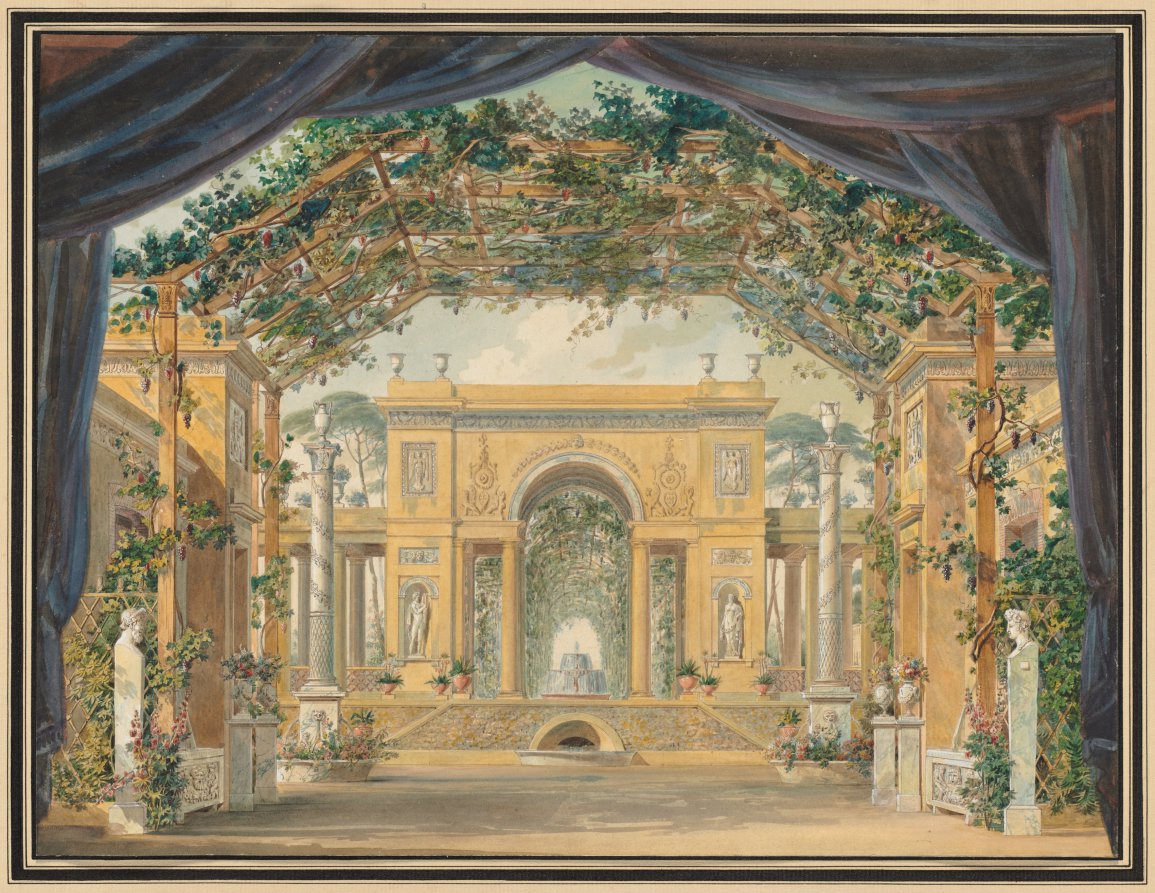
Pierre-Luc-Charles Cicéri · The Cleveland Museum of Art · Bequest of Muriel Butkin · CC0
- Born
- 1782 · Saint-Cloud.
- Died
- 1868 · Saint-Chéron.
- Nationality
- France
- Occupation
- painter · theatre designer · scenographer · watercolorist · graphic artist · musician
- Education
- Conservatoire de Paris
- Teachers
- Ignazio Degotti · Jean-Baptiste Isabey
- Honours
- Knight of the Legion of Honour · knight of the order of the Crown of Westphalia
- Languages
- French
VALÉORINE Encyclopedia
VALÉORINE documentary reading
Documentary summary
Illustration — Pierre-Luc-Charles Ciceri, photograph by Nadar • Illustration — Set design for Act III of Daniel Auber's Gustave III (1833) • Illustration — Watercolor sketch for the set of the ballet, Manon Lescaut, by Jean-Louis Aumer (1830) Pierre-Luc-Charles Cicéri (17 August 1782 – 22 August 1868) was a leading French set designer of his era.
Admitted source layer · organised and presented by VALÉORINE
Reference Check
Propose documentary evidence for Pierre-Luc-Charles Ciceri. A contribution is never written directly as fact: identity, source, rights and evidence gates still decide.
Sign in to contribute
World of VALÉORINE
Documentary connections
Only confirmed graph relationships appear here. Images are shown only when their identity and reuse rights both pass the documentary gate.
Documentary evidence
Documentary basis
Authority files
wikidata · Q3244250 · wikipedia · Pierre-Luc-Charles Cicéri
In this article
Life and works
Life and works
Pierre-Luc-Charles Ciceri studied at Conservatoire de Paris. Training under Ignazio Degotti and Jean-Baptiste Isabey is recorded. Georges William Thornley, Arnold Wallick and Troels Lund are recorded as having studied under Pierre-Luc-Charles Ciceri. The recorded working language is French. Places of work recorded in the authority are France, Italy and Naples. Residence is recorded at rue du Faubourg-Poissonnière. Work by Pierre-Luc-Charles Ciceri is recorded in the collections of Musée Carnavalet, Bibliothèque-musée de l'Opéra and Bibliothèque nationale de France. Distinctions recorded are Knight of the Legion of Honour and knight of the order of the Crown of Westphalia.
He was chief set designer for the Paris Opera from 1810 to 1847, and created the set designs for over 300 ballets and operas in his long career. In addition to his work at the Paris Opera, he designed for many of the leading theaters in Paris, including the Odéon, Palais-Royal, Comédie-Française, Théâtre des Nouveautés and the Théâtre de la Porte Saint-Martin. As Painter to the King of France, he supervised the decorations for the coronation of Charles X in 1825. Cicéri designed the set for the first performance of La belle au bois dormant ("Sleeping Beauty"), which opened on 2 March 1825 at the Théâtre de l'Académie Royale de Musique in Paris. For La belle au bois dormant Ciceri created a quasi-cinematic motion effect onstage utilizing a treadmill for the actors in front of a moving cyclorama. He also designed the sets for a ballet version of Jocko ou le Singe du Brésil ("Jocko or the Monkey of Brazil") by Frédéric-Auguste Blache, with music by Louis Alexandre Piccinni. The ballet was first performed at the Théâtre de la Porte Saint-Martin in Paris on 16 March 1825. He was awarded a Chevalier of the Légion d'honneur. His son, Eugène Cicéri, also became a painter, illustrator and set designer.
Identity and origins
Identity and origins
The authorities additionally record the headings Pierre Luc Charles Ciceri, Pierre Luc Charles Cicéri, Pierre-Luc-Charles Cicéri and Pierre Ciceri. His recorded language was French. He married Alexandrine Isabey. 2 children are recorded: Eugène Ciceri and Ernest Ciceri. Other recorded relations include Eugène Isabey, Auguste Alfred Rubé and François-Joseph Nolau.
Identity
Identity
Pierre-Luc-Charles Ciceri is recorded as having received Knight of the Legion of Honour and knight of the order of the Crown of Westphalia. Career and activity. He belonged to Royal Danish Academy of Fine Arts. He worked at France, Italy, Naples, Germany and rue du Faubourg-Poissonnière.
Life and career
Dated record
Life and career
The full dated record · 2 entries
1782
Pierre-Luc-Charles Ciceri born at Saint-Cloud.
1868
Pierre-Luc-Charles Ciceri died at Saint-Chéron.
Places
Named by the record
Places
Only places the record itself states, plotted where the house gazetteer settles their coordinates. Nothing is inferred from a name or a nationality.
rue du Faubourg-Poissonnière
Residences
Saint-Cloud.
Birth place
Saint-Chéron.
Death place
Recognition and collections
Where the work is held
Recognition and collections
Pierre-Luc-Charles Ciceri received Knight of the Legion of Honour and knight of the order of the Crown of Westphalia.
Documents and archives
Primary material
Documents and archives
scholarly publication
- Pierre-Luc-Charles Ciceri (1782–1868), Fifty Key Theatre Designers, 2023
Scholarly · Crossref registry · 2023
reference work
- “Pierre-Luc-Charles Cicéri”, English Wikipedia, consulted as further reading
Reputable secondary · Wikipedia
authority record
- Wikidata, structured authority record Q3244250: Pierre-Luc-Charles Ciceri
General reference · Wikidata
Notes from the source article
Cited by Wikipedia
Notes from the source article
These works are cited by the source article, in its own numbering. They are recorded as its citations, not as sources VALÉORINE has verified.
- 1.Selon les ouvrages, Pierre ou Charles sont utilisés.
- 2.Images et imaginaires d’architecture. Centre Georges Pompidou. 978-2-85850-241-7.
- 3.Conçu par Daguerre avec son collègue Bouton en 1822, mais cette structure est détruite dans l'incendie de la salle du Château-d'eau le et le ruine.
- 4.Composé d'une toile peinte en mouvement qui se déroule et s’enroule au fond de la scène sur des rouleaux, eux-mêmes entraînés de chaque côté par des tambours à manivelle
- 5.M. Ciceri, peintre…. Le Moniteur universel. 159. 896. 2025-6-7. 1169-2529 lire en.
- 6.Nicole Wild. Ciceri et la passion dans le décor d’opéra. L’exemple de Gustave III. @nalyses. Revue des littératures franco-canadiennes et québécoise. 8. L’opéra du XIXe siècle et le paroxysme de la passion présentation en. hiver 2013.
- 7.Histoire de l’art dramatique en France depuis vingt-cinq ans. Hetzel. 1859. 10306359.
- 8.Auguste Jal. Souvenirs d’un homme de lettres. Léon Téchener. 1877. 1449111514.
- 9.Cette épithète lui a été donnée en référence au fameux Giacomo Torelli, décorateur et ingénieux machiniste italien de théâtre, surnommé le Grand Sorcier, venu travailler à la Cour de Louis XIV, et à qui, dit-on, Corneille a dû le succès de son Andromède.
- 10.Henri Beraldi. Cent ans aux Pyrénées. L. Danel. 1899. 1254785370.
- 11.Nos théâtres de 1800 à 1880. Tresse et Stock. 1886. 764081726.
- 12.Chapitre langue=fr auteur1=Émile Bellier de La Chavignerie auteur2=Louis Auvray titre chapitre= pc Ciceri (Pierre-Luc-Charles) titre ouvrage=Dictionnaire général des artistes de l’École française depuis l’origine des arts du dessin jusqu’à nos jours sous-titre ouvrage=architectes, peintres, sculpteurs, graveurs et lithographes lieu=Paris éditeur=Renouard année=1882 tome=1 oclc=313582035 lire en ligne= Gallica id=bpt6k1133832/f261 passage=260-1 pages totales=1070 format livre=3 vol. ; 26 cm .
- 13.Hubert Lavigne. État civil d’artistes français. J. Baur. 1881. 123208868.
- 14.Cette maison est maintenant inscrite aux Monuments historiques.
Bibliography printed in the source article · 5
- Crabtree et Beudert, The History of scene art for the theatre, tools and techniques, 2004.--->
- Barry Vincent Daniels et Jacqueline Razgonnikoff, Le Décor de théâtre à l'époque romantique. Catalogue raisonné des décors de la Comédie-Française, 1799-1848 d'après les documents conservés dans les collections de la Bibliothèque nationale de France et de la Comédie-Française, Paris, Bibliothèque nationale de France, 2003, 381 p. .
- Louise Poissant, Esthétique des arts médiatiques : interfaces et sensorialité, Saint-Étienne, Publications de l'Université de Saint-Étienne / Sainte-Foy, Presses de l'Université du Québec, 2003, 324 p. .
- Jean-Michel Vinciguerra. Les Mystères d’Isis ou l’Égypte antique d’après les décorateurs de l’Opéra : sur quelques acquisitions récentes du département de la Musique. antiquitebnf.hypotheses.org. 20/12/2017.
- Nicole Wild. Décors et costumes du. Bibliothèque nationale. 1993. 978-2-71772-589-6.
References
Citations
References
Each reference names the institution holding it, so a reader may go to the document itself.
scholarly publication
Institutional witnessreference work
Secondary witnessauthority record
General reference
Further particulars
Held on the record
Further particulars
Open the remaining particulars
Pierre-Luc-Charles Ciceri studied at Conservatoire de Paris. He trained under Ignazio Degotti and Jean-Baptiste Isabey. Each of those relationships is stated by the authority record rather than inferred from style.
The Encyclopedia exists whether or not anything is for sale. Corrections are recorded rather than overwritten, and every version of this record is kept. Published 16 August 2026.
Elsewhere in Paintings
19,183 published records in this field, each with its sources named.
- Pierre-Jacques VolaireArtist
- Pierre-Justin OuvriéArtist
- Pierre-Louis BouvierArtist
- Pierre-Louis De La RiveArtist
- Pierre-Narcisse GuérinArtist
- Pierre-Nicolas BrissetArtist
- Pierre-Nolasque BergeretArtist
- Pierre-Paul Prud'honArtist
Best supported in this field
For owners
Own a work by Pierre-Luc-Charles Ciceri?
A specialist will read what you send and tell you what the house can establish, what it cannot, and whether the object is suited to sale. There is no charge and no obligation. The object stays with you throughout; nothing is shipped to us unless it is arranged in writing beforehand.