
Philippe Mercier
Philippe Mercier (also spelled Philip Mercier; 1689 – 18 July 1760) was an artist of French Huguenot descent from the German realm of Brandenburg-Prussia (later Kingdom of Prussia), usually defined to French school. Philippe Mercier was active in England for most of his working life, Mercier is considered one of the first practitioners of the Rococo style, and is credited with influencing a new generation of 18th-century English artists.
Also recorded as Philip Mercier · Phillipe Mercier · Pierre-Philippe Mercier · P. Mercier
Philippe Mercier
Philippe Mercier · Wellcome Collection, London · Wellcome Collection · Public Domain Mark
- Name
- Philippe Mercier
- Born
- 1689
- Birthplace
- Berlin, Brandenburg-Prussia
- Died
- 18 July 1760
- Place of death
- London, Kingdom of Great Britain
- Field
- Painting and etching
- Movement
- Rococo
- Education
- Antoine Pesne
- Nationality
- France
- Occupation
- painter · etcher · librarian · portraitist · artist · copper engraver
- Languages
- French
VALÉORINE Encyclopedia
VALÉORINE documentary reading
Documentary summary
Philippe Mercier (also spelled Philip Mercier; 1689 – 18 July 1760) was an artist of French Huguenot descent from the German realm of Brandenburg-Prussia (later Kingdom of Prussia), usually defined to French school. Philippe Mercier was active in England for most of his working life, Mercier is considered one of the first practitioners of the Rococo style, and is credited with influencing a new generation of 18th-century English artists.
Admitted source layer · organised and presented by VALÉORINE
Note VALÉORINE
Philippe Mercier (1689–1760) was a French artist, copper engraver and etcher, among other activities. Born in Berlin, the artist died in London. Philippe Mercier worked in London.
Languages used include French. Works by the artist are held at Art Institute of Chicago, Burrell Collection and Cincinnati Art Museum, among others.
Composed from admitted, traceable facts · 26 September 2026
VALÉORINE
Reference Check
Propose documentary evidence for Philippe Mercier. A contribution is never written directly as fact: identity, source, rights and evidence gates still decide.
Sign in to contribute
World of VALÉORINE
Documentary connections
Only confirmed graph relationships appear here. Images are shown only when their identity and reuse rights both pass the documentary gate.

Documentary evidence
Documentary basis
Authority files
wikidata · Q3380372 · wikipedia · Philippe Mercier
In this article
Key facts
Key facts
• Name — Philippe Mercier • Born — 1689 • Birthplace — Berlin, Brandenburg-Prussia • Died — 18 July 1760 • Place of death — London, Kingdom of Great Britain • Field — Painting and etching • Movement — Rococo • Education — Antoine Pesne • Patrons — Frederick, Prince of Wales
Life
Life
Mercier was born c. 1689–1691 in Berlin, the son of Pierre Mercier (died 1729, Dresden), a Huguenot tapestry-worker. He studied painting at the Akademie der Wissenschaften of Berlin and later under Antoine Pesne, who had arrived in Berlin in 1710. Later, he travelled in Italy and France before arriving in London—"recommended by the Court at Hannover"—probably in 1716. He married in London in 1719 and lived in Leicester Fields. He was appointed principal painter and librarian to the Prince and Princess of Wales at their independent establishment in Leicester Fields, and while he was in favour he painted various portraits of royalty, and no doubt many of the nobility and gentry. Of the royal portraits, those of the Prince of Wales and of his three sisters, painted in 1728, were all engraved in mezzotint by John Simon, and that of the three elder children of the Prince of Wales by John Faber the Younger in 1744. This last (entitled Playing Soldiers) was a typical piece of Mercier's composition, the children being made the subject of a spirited, if somewhat childish, allegory in their game of play. Prince George is represented with a firelock on his shoulder, teaching a dog his drill, while his little brother and sister are equally occupied in a scene that is aptly used to point a patriotic moral embodied in some verses subjoined to the plate, of which the concluding couplet is as follows: Illustrious Isle where either sex displays Such early omens of their future praise! In 1733, Mercier painted a Portrait of 'Frederick, Prince of Wales, playing a violoncello, and his Sisters'. National Portrait Gallery, London. There is an alternative version of the painting in the Royal Collection. In the painting 'The Sense of Hearing', 1744, women are playing violin, violoncello, harpsichord, and flute in the Yale Center for British Art. Mercier lost favour at Court and was replaced as principal painter to Frederick Prince of Wales by John Ellys on 7 October 1736. He 'went into the country' in 1736/7 and took rooms in Covent Garden, London. In 1739 he relocated to York, where he focused on 'fancy' pictures concerned with domestic virtue and also practised portrait painting for over ten years, before returning to London in July 1751. In 1752, Mercier went to Portugal at the request of several English merchants along with his family. He did not long remain there, however, but came back to London, where he died in 1760. John Faber the Younger also engraved six plates of "Rural Life" after Mercier, and several other subjects of his have survived him. In August 2016, Mercier's painting Portrait of a Lady (1744) was one of the subjects for episode 19 in the 5th series of the BBC Television series Fake or Fortune? Mercier's daughter Charlotte was also an artist in her early life, before turning to a life of dissolution and dying in the St James Workhouse two years after her father's death.
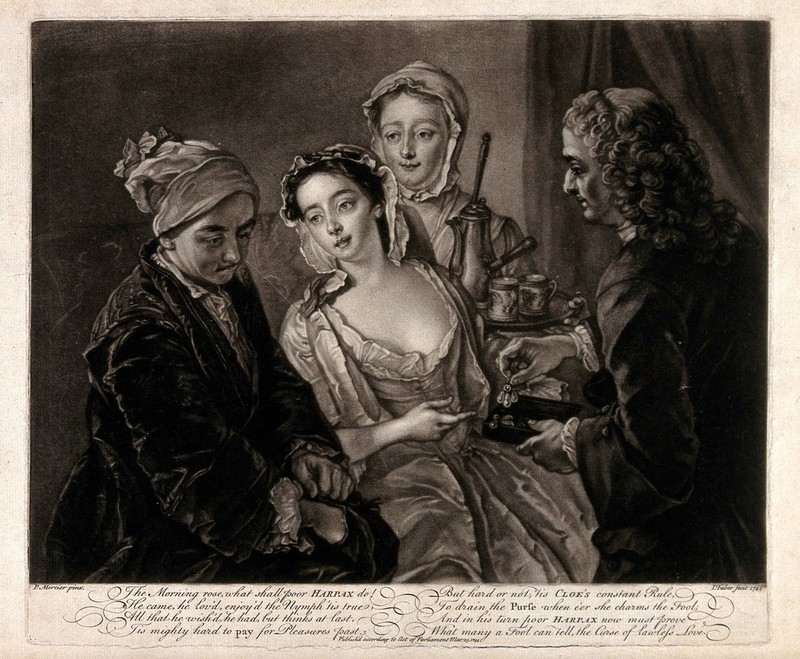
A man puts his hand into his purse to pay for the services of a young woman, as another hands her a pair of earrings. Mezzotint by J. Faber after P. Mercier., Mar.25 1794, by Philippe Mercier
Philippe Mercier · Wellcome Collection, London · Wellcome Collection
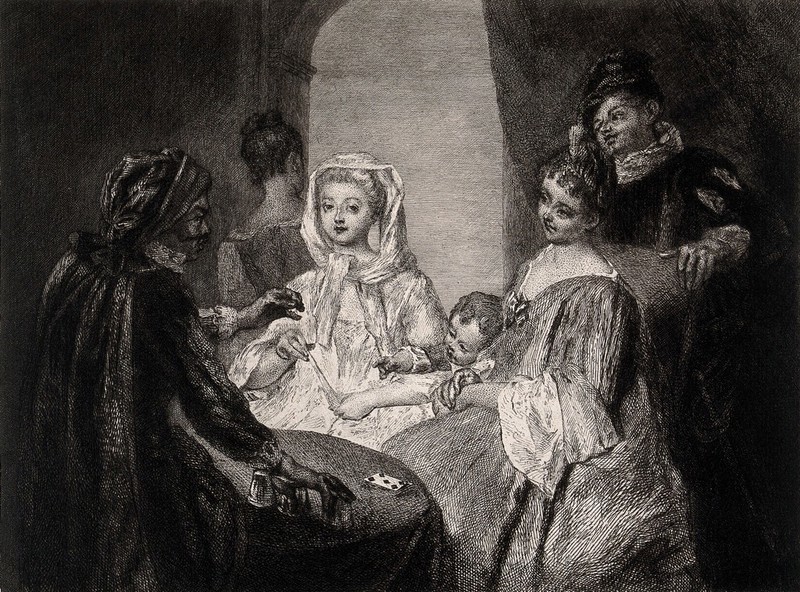
Two ladies, seated, with a child between them, being entertained by a magician who performs tricks with cups and balls. Etching by R. Rhodon after P. Mercier, 1882., 1882, by Philippe Mercier
Philippe Mercier · Wellcome Collection, London · Wellcome Collection
Life and career
Dated record
Life and career
The full dated record · 2 entries
1689
Philippe Mercier born at Berlin.
1760
Philippe Mercier died at London.
Places
Named by the record
Places
Only places the record itself states, plotted where the house gazetteer settles their coordinates. Nothing is inferred from a name or a nationality.
Berlin.
Birth place
London.
Death place
Primary material
Documents and archives
reference work
- “Philippe Mercier”, English Wikipedia, consulted as further reading
Reputable secondary · Wikipedia
authority record
- Wikidata, structured authority record Q3380372: Philippe Mercier
General reference · Wikidata
Notes from the source article
Cited by Wikipedia
Notes from the source article
These works are cited by the source article, in its own numbering. They are recorded as its citations, not as sources VALÉORINE has verified.
- 1.Bataille, 1930, p=409 , , , and , define Mercier as a painter of French school.
- 2.Waterhouse, 1952, p=127 : "Never a first-rate artist, he had a flair for novelty in the French manner, and he seems not only to have been responsible for the introduction of the French genre style into English painting, but to have played a considerable part in popularising the 'conversation piece'"; : "Philippe Mercier (c. 1689-1760) looms large in the history of English eighteenth-century art. One of the first practitioners of the new rococo style, Mercier’s genre subjects and portraits provided the foundation for William Hogarth and the next generation of English artists."
- 3.Vertue, 1934, p=37 : "Mr. P. Merciere. painter Born at Berlin, of French extraction." , give the painter's age at his death as seventy-one. From Walpole's account, , and , suggest that Mercier was the Pierre-Phillipe Mercier born in 1689 to Pierre Mercier in Berlin; however, it is noted that a Phillipe Mercier, also the son of a Huguenot tapestry-worker in Berlin, was born in 1691.
- 4.Academy Webpage
- 5.Detroit Institute of Arts. Playing Soldier. 2015.
- 6.The Sense of Hearing - YCBA Collections Search.
- 7.page 11, Philip Mercier, 1689-1760. An exhibition of paintings and engravings. City Art Gallery, York, 21 June-20 July. Iveagh Bequest, Kenwood, 29 July-28 September, 1969
- 8.York City Art Gallery catalogue, 1969
- 9.York City Art Gallery catalogue, 1969
- 10.For an example see https://collections.britishart.yale.edu/catalog/tms:52062
- 11.Fake or Fortune?, Series 5: 4. Portraits.
- 12.Profile of Claude Mercier in the Dictionary of Pastellists Before 1800.
Bibliography printed in the source article · 27
- Vertue, George. The Note-Books of George Vertue Relating to Artists and Collections in England (II). The Walpole Society. 20. whole issue. 1932. i40086519.
- Vertue, George. The Note-Books of George Vertue Relating to Artists and Collections in England (III). The Walpole Society. 22. whole issue. 1934. i40086509.
- Vertue, George. The Note-Books of George Vertue Relating to Artists and Collections in England (IV). The Walpole Society. 24. whole issue. 1936. i40086511.
- Walpole, Horace. Anecdotes Of Painting In England. Ward, Lock, and Co. 234, 346–347. 1879. 1039484687.
- Eidelberg, Martin. Watteau's 'La Boudeuse'. The Burlington Magazine. 111. 794. 275–278. May 1969. 875934.
- Eidelberg, Martin. Watteau Paintings in England in the Early Eighteenth Century. The Burlington Magazine. 117. 870. 576–583. September 1975. 878129.
- Eidelberg, Martin. Philippe Mercier as a Draftsman. Master Drawings. 44. 4. 411–449. Winter 2006. 20444473.
- Eidelberg, Martin. Philippe Mercier, Watteau's English Follower. Watteau and His Circle. October 24, 2013.
- Harrison, Brett. Philip Mercier (1691–1760) and Queen Caroline. The British Art Journal. 20. 3. 34–41. Winter 2019–2020. 1467-2006.
- Ingamells, John. A Catalogue of the Paintings, Drawings and Etchings of Philip Mercier. The Walpole Society. XLVI. 1–70. 1976–1978. 41829356.
- Raines, Robert. Philip Mercier, A Little-known Eighteenth-century Painter. Proceedings of the Huguenot Society of London. 21. 2. 124–137. 1967. 10.3828/huguenot.1966.21.02.124.
- Wescher, Paul. Philippe Mercier and the French Artists in London. Art Quarterly. 14. 179–194. Autumn 1951.
- Einberg, Elizabeth. The Age of Hogarth: British Painters Born 1675–1709. Tate Gallery Collections. II. 1988. 094659080X.
- Einberg, Elizabeth. Manners & Morals: Hogarth and British Painting 1700-1760. Tate Gallery. pp. 14, 64–65, 91–92, 113, 123, 245; cat. nos. 40, 69. 1987. 0-946590-84-2.
- Ingamells, John. Philip Mercier. York City Art Gallery, Kenwood House. 1969.
- Antal, Frederick. Hogarth and His Place in European Art. Basic Books. 1962. 1035595582.
- Davies, Randall. English society of the eighteenth century in contemporary art. Seeley. 37. 1907.
- Waterhouse, Ellis K. English Painting and France in the Eighteenth Century. Journal of the Warburg and Courtauld Institutes. 15. 3–4. 122–135. 1952. 10.2307/750471.
- Waterhouse, Ellis K. Painting in Britain, 1530 to 1790. Penguin Books. 1978. 0-14-056101-3.
- Bataille, Marie Louise. Mercier, Philippe. Allgemeines Lexikon der bildenden Künstler von der Antike bis zur Gegenwart. E. A. Seemann. 24. 409. 1930. 889110716.
- Bénézit, Emmanuel. Benezit Dictionary of Artists. Gründ. 9. 788–789. 2006. 2-7000-3079-6.
- Constans, Claire. Mercier (Philippe). Petit Larousse de la Peinture. Larousse. 2. 1181. 1979. 2-03-020149-9.
- Cust, Lionel Henry. 37. 269.
- Hopkinson, Martin. Mercier, Philippe (Philip, irrtümlich Pierre). Allgemeines Künstlerlexikon. De Gruyter. 89. 136–137. 2016. 978-3-11-023255-4.
- Ingamells, John. Mercier, Philip. The Dictionary of Art. Grove's Dictionaries. 21. 147–149. 1996. 1-884446-00-0.
- Ingamells, John. Mercier, Philip. Oxford Dictionary of National Biography. Oxford University Press. 37. 856–857. 2004. 0198613873.
- Portalis, Roger. Les graveurs du dix-huitième siècle. D. Morgand et C. Fatout. 3 (pt. 1). 82. 1882. 1050261298.
References
Citations
References
Each reference names the institution holding it, so a reader may go to the document itself.
reference work
Secondary witnessauthority record
General reference
Further particulars
Held on the record
Further particulars
Open the remaining particulars
The authorities additionally record the headings Philip Mercier, Phillipe Mercier, Pierre-Philippe Mercier, P. Mercier and Mercer. His recorded language was French. He married Dorothy Mercier. One child is recorded: Charlotte Mercier. Recorded with the occupation painter. Recorded as painter, etcher, librarian, portraitist and artist.
Identity and origins
The Encyclopedia exists whether or not anything is for sale. Corrections are recorded rather than overwritten, and every version of this record is kept. Published 16 August 2026.
Elsewhere in Paintings
18,792 published records in this field, each with its sources named.
- Philippe de MazerollesArtist
- Philippe DeromeArtist
- Philippe HadengueArtist
- Philippe HosiassonArtist
- Philippe MoraArtist
- Philippe ParrotArtist
- Philippe PasquaArtist
- Philippe PastorArtist
Best supported in this field
For owners
Own a work by Philippe Mercier?
A specialist will read what you send and tell you what the house can establish, what it cannot, and whether the object is suited to sale. There is no charge and no obligation. The object stays with you throughout; nothing is shipped to us unless it is arranged in writing beforehand.