
Philippe de Villiers
Philippe Marie Jean Joseph Le Jolis de Villiers de Saintignon (born 25 March 1949), known as Philippe de Villiers, is a French entrepreneur, politician and novelist. He is the founder of the Puy du Fou theme park in Vendée, which is centred around the history of France. Appointed Secretary of State for Culture in 1986 by President François Mitterrand, de Villiers entered the National Assembly the following year and the European Parliament in 1994.
Philippe de Villiers
Guillaume Paumier · CC BY-SA 3.0
- Name
- Philippe de Villiers
- Birth Name
- Philippe Marie Jean Joseph Le Jolis de Villiers de Saintignon
- Born
- 25 March 1949
- Birthplace
- Boulogne, France
- Spouse
- Dominique du Buor de Villeneuve
- Nationality
- France
- Occupation
- politician · official · essayist · conspiracy theorist · writer
- Fields
- politics · literary activity
- Education
- École nationale d'administration · Sciences Po · Faculté de droit de Nantes
- Honours
- Honneur et Patrie Award · Jean Ferré Prize · prix Renaissance des lettres · Prix Claude-Farrère
- Languages
- French
VALÉORINE Encyclopedia
VALÉORINE documentary reading
Documentary summary
Philippe Marie Jean Joseph Le Jolis de Villiers de Saintignon (born 25 March 1949), known as Philippe de Villiers, is a French entrepreneur, politician and novelist. He is the founder of the Puy du Fou theme park in Vendée, which is centred around the history of France. Appointed Secretary of State for Culture in 1986 by President François Mitterrand, de Villiers entered the National Assembly the following year and the European Parliament in 1994.
Admitted source layer · organised and presented by VALÉORINE
Reference Check
Propose documentary evidence for Philippe de Villiers. A contribution is never written directly as fact: identity, source, rights and evidence gates still decide.
Sign in to contribute
World of VALÉORINE
Documentary connections
Only confirmed graph relationships appear here. Images are shown only when their identity and reuse rights both pass the documentary gate.
Documentary evidence
Documentary basis
Authority files
wikidata · Q704846 · wikipedia · Philippe de Villiers
In this article
Biography
Biography
After leaving the Republican Party (PR) to found the Movement for France (MPF), he was its nominee in the 1995 and 2007 presidential elections. He received 4.74% of the vote the first time, placing seventh; he won 2.23% of the vote twelve years later, putting him in sixth place. De Villiers has been internationally notable for his criticism of mass immigration and Islam in France, as well as his ardent support of the French way of life. His brother, General Pierre de Villiers, served as Chief of the Defence Staff from 2014 to 2017.
Philippe de Villiers studied at École nationale d'administration, Sciences Po and Faculté de droit de Nantes. The recorded working language is French. The field of work recorded is politics and literary activity. Places of work recorded in the authority are Strasbourg and Brussels. Residence is recorded at Les Herbiers. Positions recorded include member of the French National Assembly and General councillor of Vendée. Distinctions recorded are Honneur et Patrie Award, Jean Ferré Prize, prix Renaissance des lettres and Prix Claude-Farrère.

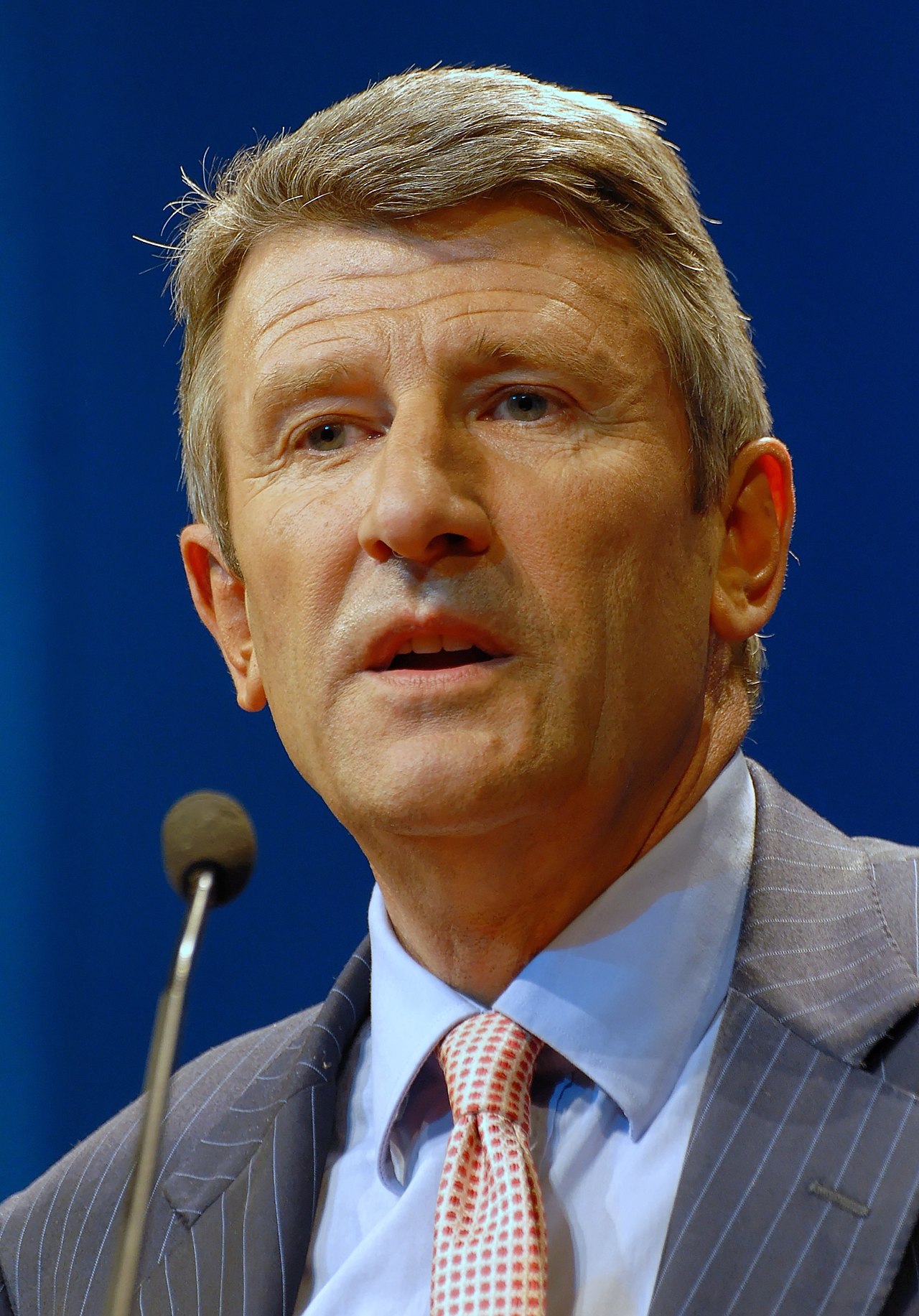
Philippe de Villiers during his meeting in Toulouse on April, 16th 2007 for the 2007 presidential election campaign.
Guillaume Paumier

TOLEDO, 16 de enero de 2019.- El presidente de Castilla-La Mancha, Emiliano García-Page, preside, en la finca Zurraquín de la capital regional, el acto de colocación de la primera piedra del futuro parque temático “Puy du Fou España”. (Fotos: José Ramón Márquez JCCM)
Emiliano García-Page Sánchez from Toledo, España · Acto de colocación de la primera piedra del futuro parque temático “Puy du Fou España”
Key facts
Key facts
• Name — Philippe de Villiers • Office — President of the Movement for France • Term Start — 20 November 1994 • Term End — 28 June 2018 • Predecessor — Position established • Successor — Position abolished • Office1 — Member of the European Parliament • Term Start1 — 20 July 2004 • Term End1 — 30 June 2014 • Constituency1 — West France • Term Start2 — 20 July 1999 • Term End2 — 16 December 1999 • Constituency2 — France • Term Start3 — 19 July 1994 • Term End3 — 15 June 1997 • Constituency3 — France • Office4 — President of the General Council of Vendée • Term Start4 — 3 October 1988 • Term End4 — 31 October 2010 • Predecessor4 — Michel Crucis • Successor4 — Bruno Retailleau • Office6 — Member of the National Assembly for Vendée • Term Start6 — 12 June 1997 • Term End6 — 19 July 2004 • Predecessor6 — Bruno Retailleau • Successor6 — Véronique Besse • Constituency6 — 4th • Term Start7 — 23 June 1988 • Term End7 — 24 October 1994 • Predecessor7 — Proportional representation • Successor7 — Bruno Retailleau • Constituency7 — 4th • Term Start8 — 2 June 1987 • Term End8 — 14 May 1988 • Predecessor8 — Vincent Ansquer • Successor8 — Constituency abolished • Constituency8 — At-large • Office9 — Secretary of State for Culture • Term Start9 — 20 March 1986 • Term End9 — 25 June 1987 • Prime Minister9 — Jacques Chirac • Predecessor9 — Position established • Successor9 — Position abolished • Birth Name — Philippe Marie Jean Joseph Le Jolis de Villiers de Saintignon • Born — 25 March 1949 • Birthplace — Boulogne, France • Party — Reconquête (2021–present) • Other Party — Republican Party (1985–1994) Movement for France (1994–2018) • Spouse — Dominique du Buor de Villeneuve • Children — 7 • Relatives — Pierre de Villiers (brother) • Alma Mater — University of Nantes Sciences Po École nationale d'administration
Personal life
Personal life
• Illustration — Le Jolis De Villiers family coat of arms De Villiers was born in Boulogne in the department of Vendée, Western France, the second of five children and eldest son of Jacques Le Jolis de Villiers de Saintignon (born in Nancy, 14 November 1913) and his wife Edwige d'Arexy (born in Nantes, 1 July 1925). His paternal grandfather, Louis Le Jolis de Villiers, born at Brucheville on 17 October 1874, was killed in action in World War I at Saint-Paul-en-Forêt on 10 September 1914. On 24 October 1904, he had married Jeanne de Saintignon (27 July 1880 – 25 August 1959), by whom he had five children, the youngest of whom was Philippe's father, Jacques. De Villiers received a master's degree in Law in 1971, graduated from the Paris Institute of Political Studies in 1973 and from the École nationale d'administration in 1978. After his studies, De Villiers became a successful entrepreneur. He created the Puy du Fou, one of the most visited theme parks in France, as a living showcase for its history. The theme park includes a replica medieval city with the 'Gallo-Roman Stadium', a colosseum designed by De Villiers to stoke patriotic feeling by recreating Gallic rebellions against Imperial Rome. The Puy du Fou park received awards from the Themed Entertainment Association in 2012, 2016, 2017 and 2019. He is married to Dominique du Buor de Villeneuve, born in Valenciennes on 4 October 1950 and has seven children.
1995 presidential bid
1995 presidential bid
From 1976 to 1978, De Villiers served as a senior civil servant in the Chirac administration. In 1981, he resigned his post as subprefect because he did not want to serve the government of the Socialist President François Mitterrand. In 1986 and 1987, he briefly served as Secretary of State for Culture (Secrétaire d'État auprès du Ministre de la Culture) in the second government of Jacques Chirac, under Minister François Léotard. His appointment was initially viewed badly by Libération and several other press agencies, which referred to his "ambiguous personality". However, Villiers supported Leotard's mixed, non-ideological policy towards French culture. In 1987, he was elected into local office as a member in Valéry Giscard d'Estaing's Republican Party. He became a rising star within the Union for French Democracy. During the public debate over the Maastricht Treaty, which established the European Union, in 1992, he achieved lasting prominence in the media as an anti-Treaty activist. This set him apart from most prominent members of the mainstream political right. The French people narrowly ratified the Treaty in September 1992. De Villiers led an anti-European integration list in 1994 receiving about 12 percent of the votes, placing it in third place behind the Gaullists and the Socialists. Villiers centered the campaign on opposition to the European Union along with a call to eliminate corruption in government. In November 1994, Villers left the Republican Party to form Movement for France. He ran for President of France in 1995 and received about 5 percent of the vote.
2007 presidential bid
2007 presidential bid
• Illustration — Philippe de Villiers, May 2005 Once a member of the Union for French Democracy, he then led the Movement for France, which enjoyed some success in elections for the European Parliament. The party's share of the vote declined in the 2004 European Parliament election. Nevertheless, Villiers and two other members of his party were elected. De Villiers ran for the French presidency in 2007, and based his campaign on his opposition to what he sees as the rampant Islamisation of France. In May 2006, polls showed that he had garnered the support of about 4% of the electorate, almost twice as high as he actually polled in the first round of the presidential election. An "Ifop-Paris-Match" poll conducted on 12 October 2006 gave him his highest ever popularity rating, with 37% saying they "have an excellent or good opinion" of Villiers, and 28% saying they could vote for him in 2007. This was not borne out in the results of the first round of voting, with him receiving less than 3% of the popular vote. Following the first round of the 2007 presidential election, he called on voters to vote for Union for a Popular Movement (UMP) candidate Nicolas Sarkozy to counter the Socialist Party's candidate Ségolène Royal and the left. Villiers and Konstantin Malofeev are planning to build two Russian history related theme parks: one in Moscow and one in Yalta (Crimea); this is in spite of Malofeev being added to the European Union list of people and organizations sanctioned during the Russo-Ukrainian War (Malofeev is suspected of funding the pro-Russian rebels in Donbas during the Russo-Ukrainian War). In August 2014 Villiers travelled to Crimea to meet Russian president Vladimir Putin; while there, he defended the 2014 Russian annexation of Crimea by saying the Crimean park will "promote the history of Crimea as part of the long history of Russia". He also stated there "I would gladly swap Hollande and Sarkozy for Putin". • Illustration — Philippe de Villiers during a meeting with Russian President Vladimir Putin, in August 2014. • Illustration — Philippe de Villiers at the podium just before the arrival of Éric Zemmour at the Trocadéro meeting, March 27, 2022 During the 2022 presidential election, he officially announced his support for Éric Zemmour. He also joined his political party Reconquête.
Political positions
Political positions
Politicians Politicians
Support base
Support base
De Villiers gathers his support from practising Roman Catholics, artisans, retired people, farmers and small business owners.
Offices held
Offices held
Governmental function Secretary of State for Communication: 1986–1987. Electoral mandates European Parliament Member of European Parliament: 1994-1997 (Resignation, reelected in the parliamentary elections in 1997) / July–December 1999 (Resignation) / 2004-2018. Elected in 1994, reelected in 1999, 2004, 2009. National Assembly of France Member of the National Assembly of France for Vendée: 1987-1994 (Became member of European Parliament in 1994) / 1997-2004 (Became member of European Parliament in 2004). Elected in 1987, reelected in 1988, 1993, 1997, 2002. General Council President of the General Council of Vendée: 1988-2010 (Resignation). Reelected in 1992, 1994, 1998, 2001, 2004, 2008. General councillor of Vendée: 1987-2010 (Resignation). Reelected in 1988, 1994, 2001, 2008. Political function President of the Movement for France: 1994-1999 / 2000-2018 (party dissolved).
Presidential
Presidential
President of the French Republic • Election — First round — Second round • Votes — % — Position — Result — Votes — % — Position — Result • 1995 — 1,443,186 — 4.74% — (#7) — Lost • 2007 — 818,407 — 2.23 — (#6) — Lost
Works
Works
* * * * * * * * * * * * * * * * * * * * * • Le Puy du Fou: un rêve d'enfance, Éditions du Rocher, 2017, 308 p. (ISBN 978-2-268-09934-7) • Le Mystère Clovis, Paris: Éditions Albin Michel, 2018. • J'ai tiré sur le fil du mensonge et tout est venu, Paris: Fayard, 2019. • Les Gaulois réfractaires demandent des comptes au Nouveau Monde, Paris: Fayard, 2020. • Le Jour d'après, Éditions Albin Michel, 2021. • La Valse de l'adieu, Paris: Plon, 2022. • Le Roman du Roi Soleil, Paris: Éditions Litos, 2024, 480 p., Poche (ISBN 978-2-38506-105-0). • Mémoricide, Paris: Fayard, 2024, 384 p. (ISBN 978-2213731087). • Populicide, Paris: Fayard, 2025, 418 p. (ISBN 978-2-213-73166-7).
Career and activity
Career and activity
Philippe de Villiers worked in politics and literary activity. Recorded positions include member of the French National Assembly, General councillor of Vendée, Sub-prefect of Vendôme and Member of the European Parliament. He worked at Strasbourg, Brussels and Les Herbiers.
Identity
Identity
Philippe de Villiers is recorded as politician, official, essayist, conspiracy theorist and writer.
Life and career
Dated record
Life and career
The full dated record · 1 entries
1949
Philippe de Villiers born at Boulogne.
Places
Named by the record
Places
Only places the record itself states, plotted where the house gazetteer settles their coordinates. Nothing is inferred from a name or a nationality.
Les Herbiers
Residences
Boulogne.
Birth place
Political philosophy
Villiers is a nationalist, a traditionalist, and a leading eurosceptic. He has self-described as a "rooted conservative". During his tenure under François Léotard, he said that he shared Léotard's American-based "libertarian liberalism". In 1995, The Economist referred to him as "an ephemeral Catholic monarchist". He advocates cutting taxes, expelling all illegal immigrants, and preventing Turkey from joining the EU. He is a vocal critic of the European Union's relationship with France, accusing it of "destroying their jobs, their security and their identity" and saying that "the Europe of Brussels is an anti-democratic dictatorship". He was a leader of the side advocating a 'No' vote in the 2005 French referendum of the European Constitution. The 'No' side won the vote, which the activists believed constituted a major victory for Euroscepticism in France. Villiers then launched a campaign to restore the franc, remarking that "Everybody notes today that the adoption of the euro was a technical success but its economic, political and human toll is incontestable." Villiers opposes immigration into France in general, but he has advocated that "individual cases be treated with the greatest humanity." He also opposes expelling current immigrants residing in France or subjecting them to discrimination in housing, employment, or other spheres. Despite their differences on these and other issues, the National Front's Jean Marie Le Pen has remarked that Villiers' ideas were "lifted" from him and that their "votes should be added together". Villiers coined the phrase "Polish Plumber" in a June 2005 political speech about the Bolkestein directive, referring to the perceived threat of cheap East European labour to French wages. The mythical figure became a central point of debate in France, and it later prompted an international controversy. He has also referred to the "Latvian mason" and the "Estonian gardener." American author Harvey Gerald Simmons has compared the "Villiers phenomenon" to Ross Perot's support in the 1992 American Presidential election. He stated that De Villiers has a populist, anti-establishment image that puts him on the edges of the mainstream political right of France rather than in the far right.
Criticism of Islam
De Villiers is known for his criticism of Islam in France. He has stated, "I am the only politician who tells the French the truth about the Islamisation of France" and, "I do not think Islam is compatible with the French Republic". He advocates ending all construction of mosques, banning all Islamist organisations suspected of links to terrorism, and expelling extremist individuals from France. De Villiers published Les mosquées de Roissy: nouvelles révélations sur l'islamisation en France (The Mosques of Roissy: New Revelations about Islamization in France) in 2006. In it he alleged, using internal documents from whistleblowers, that the Muslim Brotherhood had infiltrated security personnel at Charles de Gaulle Airport near Paris. The book led to revocation of seventy-two employees' security clearances and closure of six makeshift Muslim prayer rooms. Der Spiegel, The Wall Street Journal, The Boston Globe, and The San Francisco Chronicle have labelled De Villiers as "far right" because of his views of Islam and of Muslim immigrants.
Recognition and collections
Where the work is held
Recognition and collections
Philippe de Villiers received Honneur et Patrie Award, Jean Ferré Prize, prix Renaissance des lettres and Prix Claude-Farrère.
Documents and archives
Primary material
Documents and archives
reference work
- Wikidata, structured authority record Q704846: Philippe de Villiers
Reputable secondary · Wikimedia Foundation
- “Philippe de Villiers”, English Wikipedia, consulted as further reading
Reputable secondary · Wikipedia
scholarly publication
- Philippe de Villiers: A valued man?, Modern & Contemporary France, 1998
Scholarly · Crossref registry · 1998
Literature
Scholarly footprint
A count of publications is evidence of attention, not of standing, and is given here only as a measure.
Citations
References
Each reference names the institution holding it, so a reader may go to the document itself.
scholarly publication
Institutional witnessreference work
Wikidata, structured authority record Q704846: Philippe de VilliersWikimedia Foundation
Secondary witnessreference work
Secondary witness
The Encyclopedia exists whether or not anything is for sale. Corrections are recorded rather than overwritten, and every version of this record is kept. Published 15 August 2026.
Elsewhere in Books
38,960 published records in this field, each with its sources named.
- Philippe de MézièresAuthor
- Philippe de NanteuilAuthor
- Philippe de Rémi Sr.Author
- Philippe de ThaonAuthor
- Philippe de VitryAuthor
- Philippe DelermAuthor
- Philippe DesportesAuthor
- Philippe Di FolcoAuthor
Best supported in this field
For owners
Own a work by Philippe de Villiers?
A specialist will read what you send and tell you what the house can establish, what it cannot, and whether the object is suited to sale. There is no charge and no obligation. The object stays with you throughout; nothing is shipped to us unless it is arranged in writing beforehand.