
Philip Levine
Philip Levine (January 10, 1928 – February 14, 2015) was an American poet best known for his poems about working-class Detroit. He taught for more than thirty years in the English department of California State University, Fresno and held teaching positions at other universities as well. He served on the Board of Chancellors of the Academy of American Poets from 2000 to 2006, and was appointed Poet Laureate of the United States for 2011–2012.
Also recorded as Filip Levin · Philippus Levine
Philip Levine
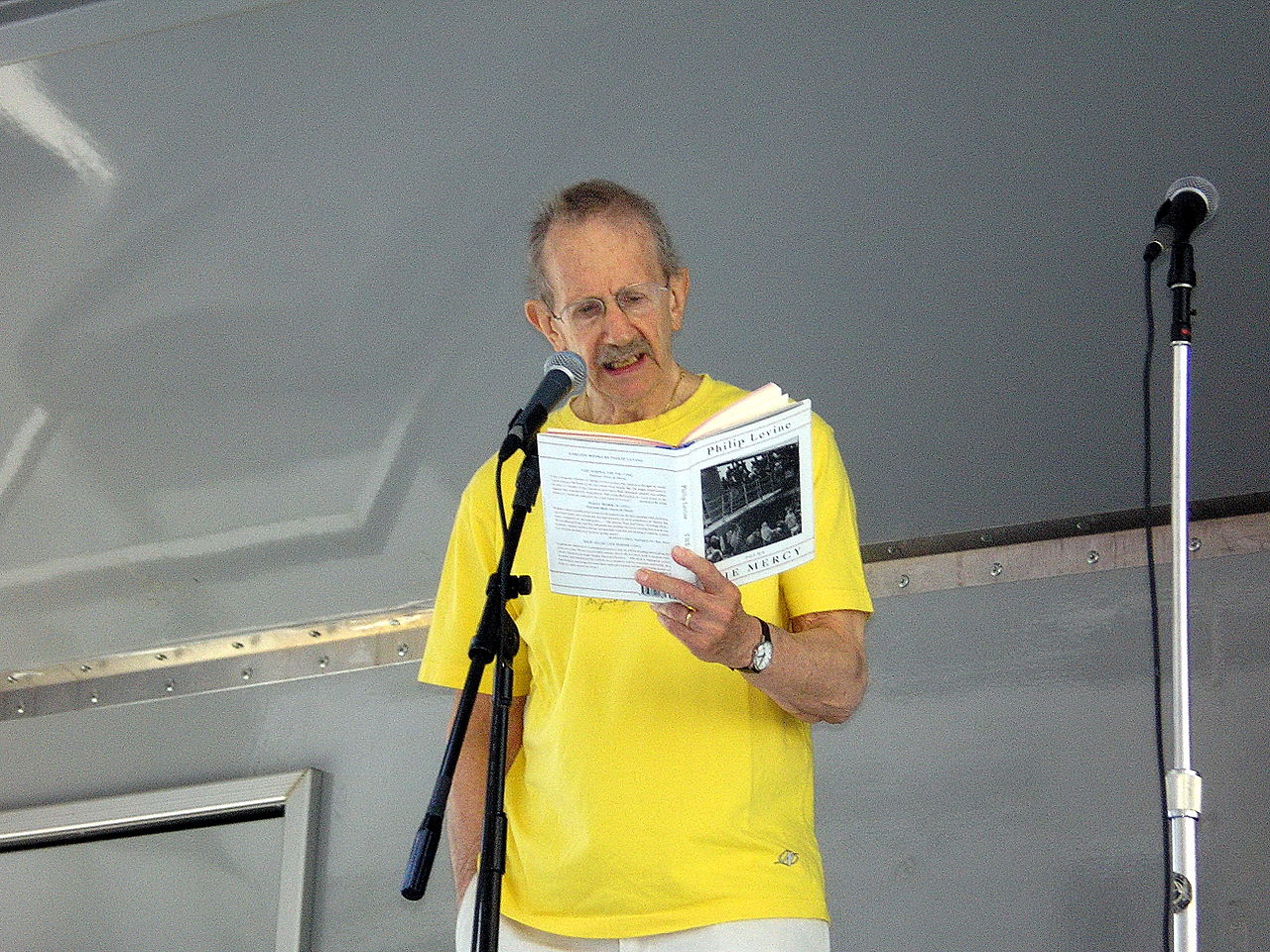
David Shankbone · David Shankbone (own work) · CC BY 2.5
- Name
- Philip Levine
- Born
- 10 January 1928
- Birthplace
- Detroit, Michigan, US
- Died
- 14 February 2015
- Place of death
- Fresno, California, US
- Occupation
- Poet
- Education
- Wayne State University (BA) University of Iowa (MFA)
- Spouse
- Patty Kanterman (1951–1953), Frances J.
- Awards
- Pulitzer Prize National Book Award National Book Critics Circle Award Philip Levine (January 10, 1928 – February 14, 2015) was an American poet best known for his poems about working-class Detroit.
- Nationality
- United States
- Honours
- Pulitzer Prize for Poetry · Guggenheim Fellowship · Ruth Lilly Poetry Prize · National Book Award · National Book Critics Circle Award for Poetry · Wallace Stevens Award
- Languages
- English
VALÉORINE Encyclopedia
VALÉORINE documentary reading
Documentary summary
Philip Levine (January 10, 1928 – February 14, 2015) was an American poet best known for his poems about working-class Detroit. He taught for more than thirty years in the English department of California State University, Fresno and held teaching positions at other universities as well. He served on the Board of Chancellors of the Academy of American Poets from 2000 to 2006, and was appointed Poet Laureate of the United States for 2011–2012.
Admitted source layer · organised and presented by VALÉORINE
Note VALÉORINE
No house-authored Note is published until its assertions and sources pass the VALÉORINE evidence contract. The documentary article remains available in full while that enrichment is being consolidated.
Documentary enrichment in progress · no unsupported statement published
Reference Check
Propose documentary evidence for Philip Levine. A contribution is never written directly as fact: identity, source, rights and evidence gates still decide.
Sign in to contribute
World of VALÉORINE
Documentary connections
Only confirmed graph relationships appear here. Images are shown only when their identity and reuse rights both pass the documentary gate.
Documentary evidence
Evidence Panel
not yet certified
- Identity
- resolved
- Independent source families
- 0
- Admitted assertions
- 0
- Open conflicts
- 0
Authority files
gnd · 5315772-2 · wikidata · Q531273
In this article
Biography
Biography
Philip Levine studied at Wayne State University, University of Iowa and Central High School (Detroit). The recorded working language is English. John Berryman and Walt Whitman are recorded as an influence. Residence is recorded at Brooklyn and Fresno. Employment is recorded with New York University, University of Houston and California State University, Fresno. Distinctions recorded are Pulitzer Prize for Poetry, Guggenheim Fellowship, Ruth Lilly Poetry Prize and National Book Award.

Phil Levine by David Shankbone, New York City
David Shankbone · David Shankbone (own work)
Key facts
Key facts
• Name — Philip Levine • Born — 10 January 1928 • Birthplace — Detroit, Michigan, US • Died — 14 February 2015 • Place of death — Fresno, California, US • Occupation — Poet • Education — Wayne State University (BA) University of Iowa (MFA) • Spouse — Patty Kanterman (1951–1953), Frances J. Artley (1954–2015) • Children — 3 • Years Active — 1963–2015 • Awards — Pulitzer Prize National Book Award National Book Critics Circle Award Philip Levine (January 10, 1928 – February 14, 2015) was an American poet best known for his poems about working-class Detroit. He taught for more than thirty years in the English department of California State University, Fresno and held teaching positions at other universities as well. He served on the Board of Chancellors of the Academy of American Poets from 2000 to 2006, and was appointed Poet Laureate of the United States for 2011–2012.
Biography
Biography
Philip Levine grew up in industrial Detroit, the second of three sons and the first of identical twins of Jewish immigrant parents. His father, Harry Levine, owned a used auto parts business, his mother, Esther Priscol (Pryszkulnik) Levine, was a bookseller. When Levine was five years old, his father died. While growing up, he faced the anti-Semitism embodied by Father Coughlin, the pro-Nazi radio priest. In high school, a teacher told him, "You write like an angel. Why don't you think about becoming a writer?" At this point, he was already working at night in auto factories, though he was just 14 years old. Detroit Central High School graduated him in 1946, and he went to college at Wayne University (now Wayne State University) in Detroit, where he began to write poetry, encouraged by his mother, to whom he dedicated the book of poems The Mercy. Levine earned his A.B. in 1950 and went to work for Chevrolet and Cadillac in what he called "stupid jobs." The work, he later wrote, was “so heavy and monotonous that after an hour or two I was sure each night that I would never last the shift.” He married his first wife, Patty Kanterman, in 1951. The marriage lasted until 1953. In 1953, he attended the University of Iowa without registering, studying with, among others, poets Robert Lowell and John Berryman, the latter of whom Levine called his "one great mentor." In 1954, he earned a mail-order master's degree with a thesis on John Keats' "Ode to Indolence," and married actress Frances J. Artley. He returned to the University of Iowa teaching technical writing and completed his Master of Fine Arts degree in 1957. The same year, he was awarded the Jones Fellowship in Poetry at Stanford University. In 1958, he joined the English department at California State University, Fresno, where he taught until his retirement in 1992. He also taught at many other universities, among them New York University as a Distinguished Writer-in-Residence, Columbia, Princeton, Brown, Tufts, Vanderbilt, and the University of California, Berkeley. Levine and his wife had made their homes in Fresno and Brooklyn Heights. He died of pancreatic cancer on February 14, 2015, at age 87.
Work
Work
The familial, social, and economic world of twentieth-century Detroit is one of the major subjects of Levine's work. His portraits of working-class Americans and his continuous examination of his Jewish immigrant inheritance (both based on real life and described through fictional characters) has left a testimony of mid-twentieth century American life. Levine's working experience lent his poetry a profound skepticism with regard to conventional American ideals. In his first two books, On the Edge (1963) and Not This Pig (1968), the poetry dwells on those who suddenly become aware that they are trapped in some murderous processes not of their own making. In 1968, Levine signed the “Writers and Editors War Tax Protest” pledge, vowing to refuse to make tax payments in protest against the Vietnam War. In his first two books, Levine was somewhat traditional in form and relatively constrained in expression. Beginning with They Feed They Lion, typically Levine's poems are free-verse monologues tending toward trimeter or tetrameter. The music of Levine's poetry depends on the tension between his line-breaks and his syntax. The title poem of Levine's book 1933 (1974) is an example of the cascade of clauses and phrases one finds in his poetry. Other collections include The Names of the Lost, A Walk with Tom Jefferson, New Selected Poems, and the National Book Award-winning What Work Is. On November 29, 2007, a tribute was held in New York City in anticipation of Levine's eightieth birthday. Among those celebrating Levine's career by reading Levine's work were Yusef Komunyakaa, Galway Kinnell, E. L. Doctorow, Charles Wright, Jean Valentine and Sharon Olds. Levine read several new poems as well. Near the end of his life, Levine, an avid jazz aficionado, collaborated with jazz saxophonist and composer Benjamin Boone on the melding of his poetry and narration with music. The resulting CD, “The Poetry of Jazz” (Origin Records 82754), was released posthumously on March 16, 2018. It contains fourteen of Levine's poems and performances by Levine and Boone as well as jazz greats Chris Potter, Greg Osby, and Tom Harrell.
Poetry
Poetry
• Collection • On the Edge (1963), The Stone Wall Press. Limited to 220 numbered hardback copies. • On the Edge (1964), The Second Press. First trade softcover edition. • Not This Pig, Wesleyan University Press, 1968; Wesleyan University Press, 1982, • Pili's Wall, Unicorn Press, 1971; Unicorn Press, 1980 • Red Dust (1971) • They Feed They Lion, Atheneum, 1972 • 1933, Atheneum, 1974, • On the Edge & Over: Poems, Old, Lost & New (1976), Cloud Marauder Press, ASIN: B0006D0JTI. Contains 16 of the 21 poems from Levine's 1963 debut volume, On the Edge, plus a second section made up of seven “lost” poems, and a third consisting of five new poems. • The Names of the Lost, Atheneum, 1976 • Ashes: Poems New and Old, Atheneum, 1979, • 7 Years From Somewhere, Atheneum, 1979, • One for the Rose, Atheneum, 1981, • Selected Poems, Atheneum, 1984,. Included by critic Harold Bloom in his list of works constituting the Western Canon. • Sweet Will, Atheneum, 1985, • A Walk With Tom Jefferson, A.A. Knopf, 1988, • New Selected Poems, Knopf, 1991, • What Work Is, Knopf, 1992, • The Simple Truth, Alfred A. Knopf, 1994; Alfred A. Knopf, 1996, • Unselected Poems, Greenhouse Review Press, 1997, • The Mercy, Random House, Inc., 1999, • Breath Knopf, 2004; reprint, Random House, Inc., 2006, • Stranger to Nothing: Selected Poems, Bloodaxe Books, UK, 2006, • News of the World, Random House, Inc., 2009, • The Last Shift (2016), Edward Hirsch (Ed.), Knopf,. • Translations • Off the Map: Selected Poems of Gloria Fuertes, edited and translated with Ada Long (1984) • Tarumba: The Selected Poems of Jaime Sabines, edited and translated with Ernesto Trejo (1979)
Essays
Essays
• The Bread of Time (1994) • So Ask: Essays, Conversations, and Interviews (2002), University of Michigan Press • My Lost Poets: A Life in Poetry (2016), Knopf,.
Interviews
Interviews
• Don't Ask, University of Michigan Press, 1981, ——————— • Notes
Albums
Albums
• The Poetry of Jazz, Origin Records, 2018, • The Poetry of Jazz Volume Two, Origin Records, 2019,
Recorded interviews
Recorded interviews
• "Interlochen Center for the Arts", Interview with Interlochen Arts Academy students on March 17, 1977. • Moyers & Company, on December 29, 2013, Philip Levine reads some of his poetry and explores how his years working on Detroit's assembly lines inspired his poetry.
Identity
Identity
Philip Levine is recorded as having studied at Wayne State University, University of Iowa and Central High School (Detroit).
Life and career
Dated record
Life and career
Explore 1928–2015
The full dated record · 3 entries
1928
Philip Levine was born in 1928 at Detroit.
2013
First Light: A Festschrift for Philip Levine on His 85th Birthday. (2013) is digitised and catalogued by Internet Archive.
2015
Philip Levine died in 2015 at Fresno.
Places
Named by the record
Places
Only places the record itself states, plotted where the house gazetteer settles their coordinates. Nothing is inferred from a name or a nationality.
Brooklyn and Fresno
Residences
Detroit.
Birth place
Fresno.
Death place
Awards
• 1973 – American Academy of Arts and Letters Award, Frank O'Hara Prize, Guggenheim Foundation fellowship • 1977 – Lenore Marshall Poetry Prize from the Academy of American Poets– The Names of the Lost (1975) • 1978 – Harriet Monroe Memorial Prize from Poetry • 1979 – National Book Critics Circle Award – Ashes: Poems New and Old – 7 Years from Somewhere • 1980 – Guggenheim Foundation Fellowship • 1980 – National Book Award for Poetry – Ashes: Poems New and Old • 1981 – Levinson Prize from Poetry magazine • 1987 – Ruth Lilly Poetry Prize from the Modern Poetry Association and the American Council for the Arts • 1991 – National Book Award for Poetry and Los Angeles Times Book Prize – What Work Is • 1995 – Pulitzer Prize for Poetry – The Simple Truth (1994) • 2011 – Appointed Poet Laureate Consultant in Poetry to the Library of Congress (United States Poet Laureate) • 2013 – Academy of American Poets Wallace Stevens Award
References
Citations
References
Each reference names the institution holding it, so a reader may go to the document itself.
Institutional database
Wikidata, structured authority record Q531273: Philip LevineWikimedia Foundation
Verified
Further particulars
Held on the record
Further particulars
Open the remaining particulars
Formation and teaching. Levine studied at Wayne State University, University of Iowa and Central High School (Detroit). His recorded influences include John Berryman and Walt Whitman. He was employed by New York University, University of Houston and California State University, Fresno. He belonged to American Academy of Arts and Letters and American Academy of Arts and Sciences. He worked at Brooklyn and Fresno. Levine received Pulitzer Prize for Poetry, Guggenheim Fellowship, Ruth Lilly Poetry Prize, National Book Award, National Book Critics Circle Award for Poetry and Wallace Stevens Award.
Career and activity
Recognition and collections
The Encyclopedia exists whether or not anything is for sale. Corrections are recorded rather than overwritten, and every version of this record is kept. Published 14 August 2026.
Elsewhere in Books
38,661 published records in this field, each with its sources named.
- Philip Kerr, 11th Marquess of LothianAuthor
- Philip KotlerAuthor
- Philip LamantiaAuthor
- Philip LarkinAuthor
- Philip M. ParkerAuthor
- Philip MassingerAuthor
- Philip Max RaskinAuthor
- Philip McDonaghAuthor
Best supported in this field
For owners
Own a work by Philip Levine?
A specialist will read what you send and tell you what the house can establish, what it cannot, and whether the object is suited to sale. There is no charge and no obligation. The object stays with you throughout; nothing is shipped to us unless it is arranged in writing beforehand.