
Philip Gilbert Hamerton
Philip Gilbert Hamerton (/ˈhæmərtən/; 10 September 1834 – 4 November 1894) was an English artist, art critic and author. He was a keen advocate of contemporary printmaking and most of his writings concern the graphic arts. He was an important theorist of the English Etching Revival.
Also recorded as Philip Hamerton · Philip Gilbert Hammerton · Philip Hammerton
Philip Gilbert Hamerton
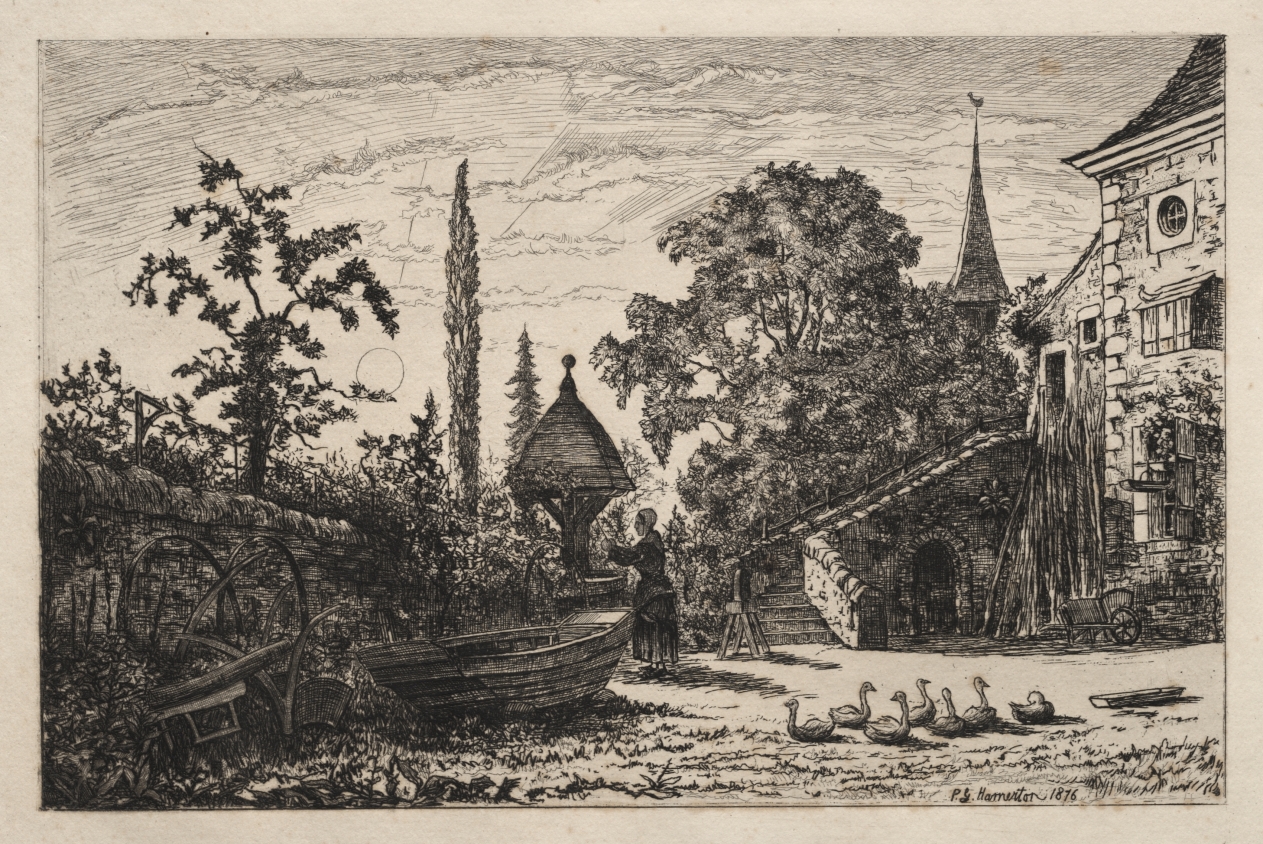
Philip Gilbert Hamerton · The Cleveland Museum of Art · Gift of Salmon P. Halle · CC0
- Name
- Philip Gilbert Hamerton
- Born
- 10 September 1834
- Birthplace
- Shaw and Crompton, Lancashire, England
- Died
- 4 November 1894
- Place of death
- Boulogne-sur-Mer, France
- Occupation
- Artist, art critic, author
- Spouse
- Eugénie Gindriez (m. 1858)
- Nationality
- United Kingdom of Great Britain and Ireland
- Education
- Burnley Grammar School
- Languages
- English
VALÉORINE Encyclopedia
VALÉORINE documentary reading
Documentary summary
Philip Gilbert Hamerton (/ˈhæmərtən/; 10 September 1834 – 4 November 1894) was an English artist, art critic and author. He was a keen advocate of contemporary printmaking and most of his writings concern the graphic arts. He was an important theorist of the English Etching Revival.
Admitted source layer · organised and presented by VALÉORINE
Reference Check
Propose documentary evidence for Philip Gilbert Hamerton. A contribution is never written directly as fact: identity, source, rights and evidence gates still decide.
Sign in to contribute
World of VALÉORINE
Documentary connections
Only confirmed graph relationships appear here. Images are shown only when their identity and reuse rights both pass the documentary gate.
Documentary evidence
Documentary basis
Authority files
wikidata · Q2086752 · wikipedia · Philip Gilbert Hamerton
In this article
Biography
Biography
Philip Gilbert Hamerton studied at Burnley Grammar School. The recorded working language is English. Work by Philip Gilbert Hamerton is recorded in the collections of Nationalmuseum, Vanderbilt Museum of Art, Yale Center for British Art, Print Collection and Towneley Hall Art Gallery And Museum.
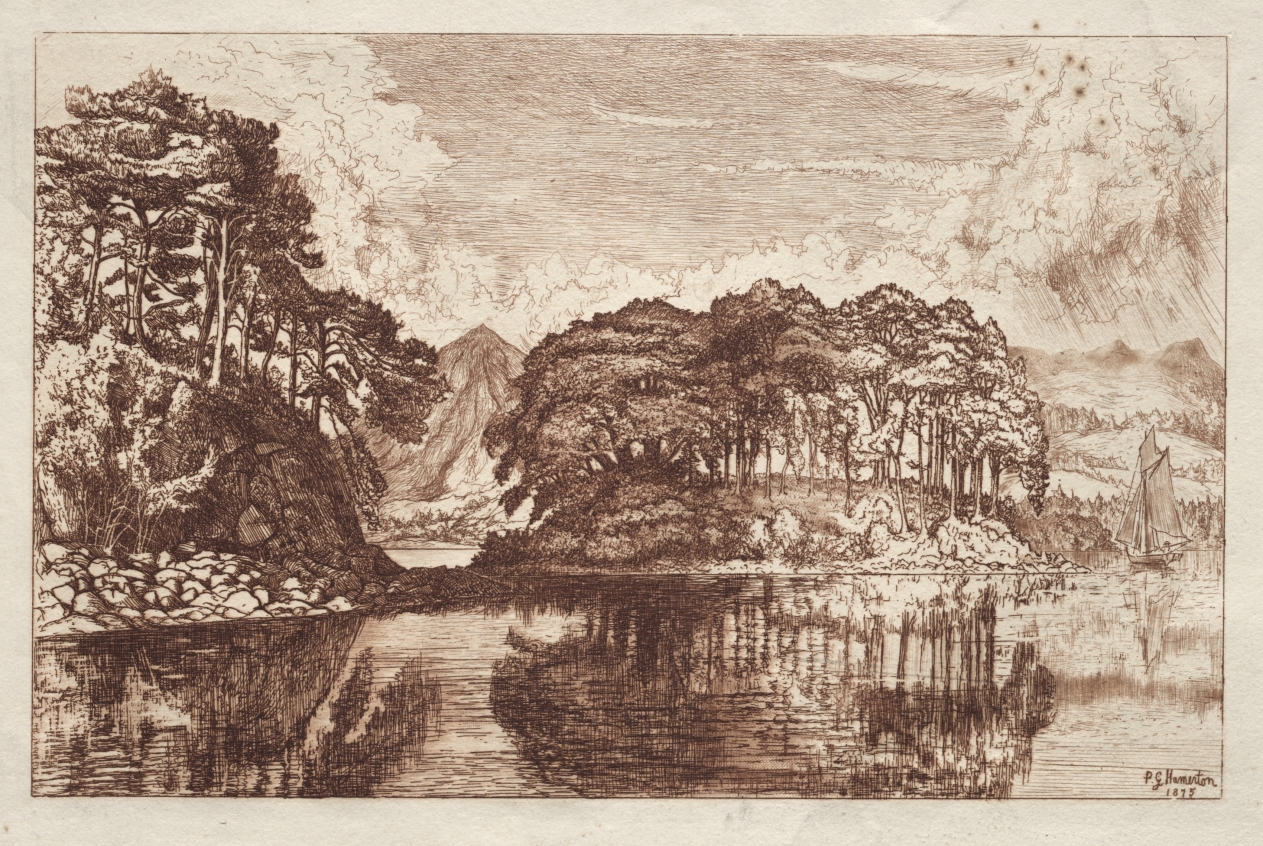
The Lake, 1875, by Philip Gilbert Hamerton
Philip Gilbert Hamerton · The Cleveland Museum of Art · Gift of Salmon P. Halle
Key facts
Key facts
• Name — Philip Gilbert Hamerton • Born — 10 September 1834 • Birthplace — Shaw and Crompton, Lancashire, England • Died — 4 November 1894 • Place of death — Boulogne-sur-Mer, France • Occupation — Artist, art critic, author • Spouse — Eugénie Gindriez (m. 1858)
Early life
Early life
Hamerton was born at Laneside, a hamlet near Shaw and Crompton, Lancashire, England. His mother died giving birth to him, and his father died ten years later. When he was about five, he was sent to live with his two aunts at an estate called the Hollins on the edge of Burnley, where he attended Burnley Grammar School.
Career
Career
• Illustration — The Lake, etching, 1875 Hamerton's first literary attempt, a volume of poems, was unsuccessful, leading him to devote himself for a time entirely to landscape painting; he camped out in the Scottish Highlands, where he eventually rented the former island of Inistrynich in Loch Awe. In 1858, Hamerton married Eugénie Gindriez, the daughter of a French republican magistrate, and they remained married until his death in 1894. Discovering after a time that he was more suited to art criticism than painting, he moved to Sens and later to Autun, where he produced his Painter's Camp in the Highlands (1863), which was very successful and prepared the way for his standard work on Etching and Etchers (1866). In the following year he published Contemporary French Painters, and in 1868 a continuation, Painting in France after the Decline of Classicism. He had by now become art critic to the Saturday Review, which necessitated frequent visits to England, forcing him to give it up. He proceeded in 1870 to establish and edit an art journal of his own, The Portfolio, a monthly periodical, each number of which included of a monograph upon some artist or group of artists, often written by him. The journal championed printmaking, especially etching. He selected and wrote the accompanying text for Etchings by French and English Artists (London: Seeley, 1874) which included work by Alphonse Legros and Léon Gaucherel. The discontinuation of his painting gave him time for writing, and he successively produced The Intellectual Life (1873), perhaps the best known and most valuable of his writings; Round my House (1876), notes on French society by a resident; and Modern Frenchmen (1879), admirable short biographies. He also wrote two novels, Wenderholme (1870) and Marmorne (1878). In 1884 Human Intercourse, another volume of essays, was published, and shortly afterwards Hamerton began his autobiography, which he brought down to 1858. In 1882 he issued a finely illustrated work on the technique of the great masters of various arts, under the title of The Graphic Arts, and three years later another illustrated volume, Landscape, which traces the influence of landscape upon the mind of man. His last books were: Portfolio Papers (1889) and French and English (1889). In 1891 he removed to Villa Clématis in the Parc des Princes district of Boulogne-Billancourt in the southwest suburbs of Paris. He died there on 4 November 1894, aged sixty. His wife later wrote that that an attack of influenza followed by a fatal pulmonary illness was likely the main cause of his death, and that he had continued working on The Portfolio and other art writings until shortly before his death, which may have contributed to his poor health even more due to stress. In 1897, Philip Gilbert Hamerton: an Autobiography, 1834–1858; and a Memoir by his Wife, 1858–1894 was published.
Identity
Identity
Philip Gilbert Hamerton is recorded as a citizen of United Kingdom of Great Britain and Ireland. Recorded with the occupation art historian.
Life and career
Dated record
Life and career
The full dated record · 2 entries
1834
Philip Gilbert Hamerton was born on 10 September 1834.
1894
Philip Gilbert Hamerton died at Boulogne-sur-Mer.
Places
Named by the record
Places
Only places the record itself states, plotted where the house gazetteer settles their coordinates. Nothing is inferred from a name or a nationality.
Shaw and Crompton.
Birth place
Boulogne-sur-Mer.
Death place
Primary material
Documents and archives
authority record
- Wikidata, structured authority record Q2086752: Philip Gilbert Hamerton
General reference · Wikidata
reference work
- “Philip Gilbert Hamerton”, English Wikipedia, consulted as further reading
Reputable secondary · Wikipedia
References
Citations
References
Each reference names the institution holding it, so a reader may go to the document itself.
authority record
Secondary witnessreference work
Secondary witness
Further particulars
Held on the record
Further particulars
Open the remaining particulars
The authorities additionally record the headings Philip Hamerton, Philip Gilbert Hammerton and Philip Hammerton. His recorded language was English. He married Eugénie Hamerton.
Identity and origins
Recognition and collections
Work by Philip Gilbert Hamerton is
Nationalmuseum, Vanderbilt Museum of Art, Yale Center for British Art and Print Collection
The Encyclopedia exists whether or not anything is for sale. Corrections are recorded rather than overwritten, and every version of this record is kept. Published 16 August 2026.
Elsewhere in Books
39,285 published records in this field, each with its sources named.
- Philip DimitrovAuthor
- Philip FrenchAuthor
- Philip FreneauAuthor
- Philip GibbsAuthor
- Philip GourevitchAuthor
- Philip Green WrightAuthor
- Philip GrossAuthor
- Philip HamiltonAuthor
Best supported in this field
For owners
Own a work by Philip Gilbert Hamerton?
A specialist will read what you send and tell you what the house can establish, what it cannot, and whether the object is suited to sale. There is no charge and no obligation. The object stays with you throughout; nothing is shipped to us unless it is arranged in writing beforehand.