
Peter Ustinov
Sir Peter Alexander Ustinov (OO-stin-ov; 16 April 1921 – 28 March 2004) was a British actor, writer and humanitarian. An internationally known raconteur, he was a fixture on television talk shows and lecture circuits for much of his career. Ustinov received numerous accolades including two Academy Awards, three Primetime Emmy Awards, a Golden Globe Award, a Silver Bear, a Laurel Award, a Photoplay Award and a Grammy Award, as well as nominations for three BAFTA Awards, two Tony Awards, two Laurence Olivier Awards and a Gemini Award.
Also recorded as Sir Peter Alexander Ustinov · Sir Peter Alexander von Ustinov · Peter Alexander Ustinov
Peter Ustinov
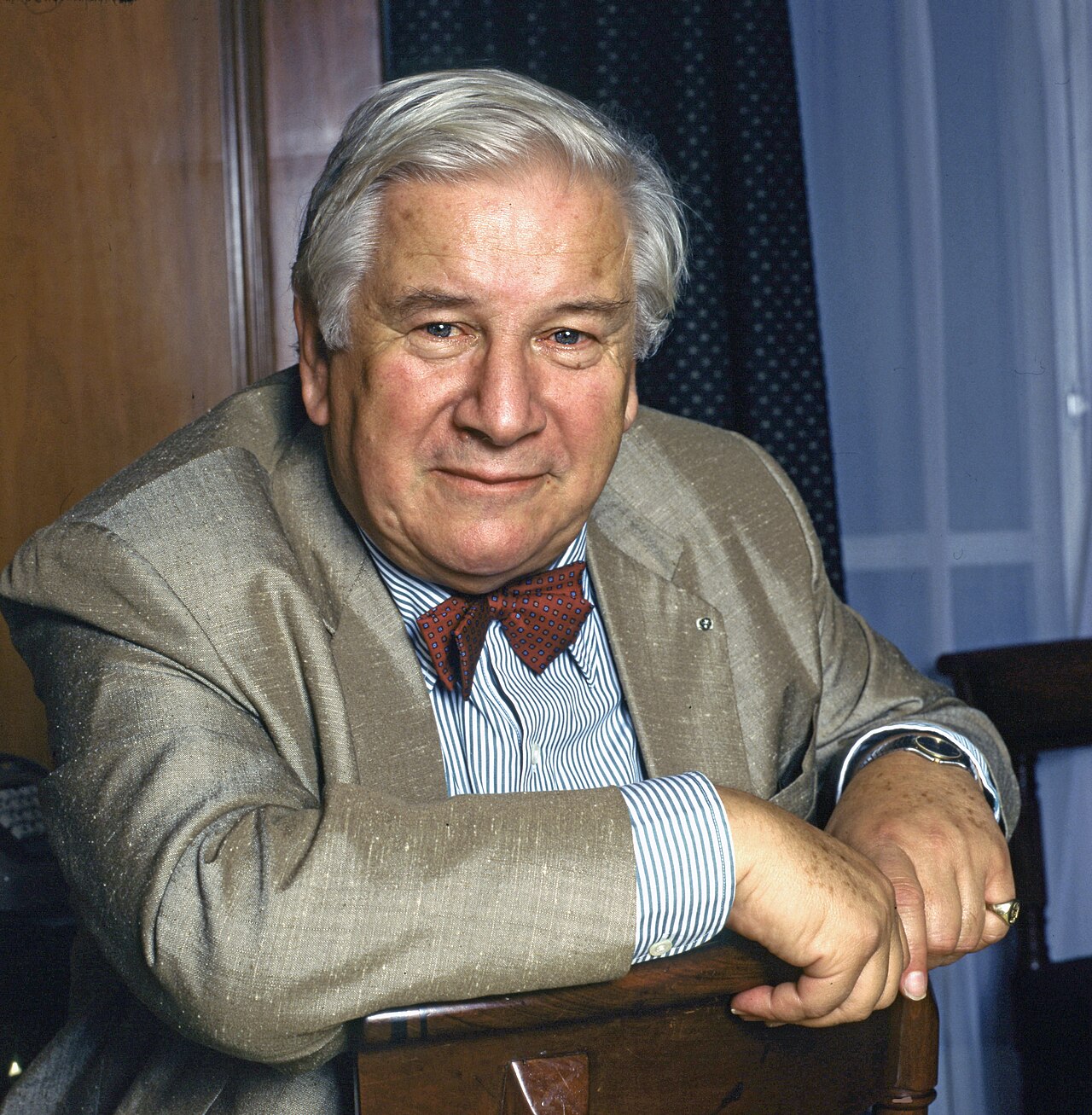
Allan Warren · Own work http: allanwarren.com · CC BY-SA 3.0
- Born
- 1921
- Died
- 2004
- Nationality
- United Kingdom
- Occupation
- actor · humanitarian · writer · television presenter · screenwriter · playwright · film producer · director · film actor · film director · film screenwriter · comedian
VALÉORINE Encyclopedia
VALÉORINE documentary reading
Documentary summary
Sir Peter Alexander Ustinov (OO-stin-ov; 16 April 1921 – 28 March 2004) was a British actor, writer and humanitarian. An internationally known raconteur, he was a fixture on television talk shows and lecture circuits for much of his career. Ustinov received numerous accolades including two Academy Awards, three Primetime Emmy Awards, a Golden Globe Award, a Silver Bear, a Laurel Award, a Photoplay Award and a Grammy Award, as well as nominations for three BAFTA Awards, two Tony Awards, two Laurence Olivier Awards and a Gemini Award.
Admitted source layer · organised and presented by VALÉORINE
Note VALÉORINE
Peter Ustinov was actor, comedian and director; nationality: United Kingdom. Peter Ustinov was born in 1921. Peter Ustinov died in 2004.
Composed from admitted, traceable facts · 27 September 2026
VALÉORINE
Reference Check
Propose documentary evidence for Peter Ustinov. A contribution is never written directly as fact: identity, source, rights and evidence gates still decide.
Sign in to contribute
Documentary evidence
Evidence Panel
not yet certified
- Identity
- resolved
- Independent source families
- 0
- Admitted assertions
- 0
- Open conflicts
- 0
Authority files
gnd · 1138202568 · wikidata · Q55796 · wikipedia · Peter Ustinov
In this article
Early life and education
Early life and education
In 1992, Ustinov was awarded with the British Academy Britannia Award. Ustinov received two Academy Awards for Best Supporting Actor for his roles in Spartacus (1960), and Topkapi (1964). He also starred in notable films such as Quo Vadis (1951), The Sundowners (1960), Billy Budd (1962), and Hot Millions (1968). He voiced Prince John and King Richard in the Walt Disney Animated film Robin Hood (1973), and portrayed Agatha Christie's fictional detective Hercule Poirot six times for both film and television. Ustinov also displayed a unique cultural versatility which frequently earned him the accolade of a Renaissance man. Miklós Rózsa, composer of the music for Quo Vadis and of numerous concert works, dedicated his String Quartet No. 22 (1950) to Ustinov. An intellectual and diplomat, Ustinov held various academic posts, and served as a goodwill ambassador for UNICEF and president of the World Federalist Movement (WFM). In 2003, Durham University changed the name of its Graduate Society to Ustinov College, in honour of the significant contributions Ustinov had made as chancellor of the university from 1992 until his death.
Peter Alexander Freiherr von Ustinov was born on 16 April 1921 at 45 Belsize Park, London. His father, Jona Freiherr von Ustinov, was of Russian, German, Polish, Ethiopian, and Jewish descent. Ustinov's paternal grandfather was Baron Plato von Ustinov, a Russian nobleman, and his grandmother was Magdalena Hall, of mixed German-Ethiopian-Jewish origin. Ustinov's great-grandfather Moritz Hall, a Jewish refugee from Kraków and later a Christian convert and colleague of Swiss and German missionaries in Ethiopia, married into a German-Ethiopian family. Ustinov's paternal great-great-grandparents (through Magdalena's mother) were the German painter Eduard Zander and the Ethiopian aristocrat Court-Lady Isette-Werq of Gondar. Ustinov's mother, Nadezhda Leontievna Benois, known as Nadia, was a painter and ballet designer of French, German, Italian, and Russian descent. Her father, Leon Benois, was an Imperial Russian architect and owner of Leonardo da Vinci's painting The Benois Madonna. Leon's brother Alexandre Benois was a stage designer who worked with Stravinsky and Diaghilev. Their paternal ancestor Jules-César Benois was a chef who had left France for Saint Petersburg during the French Revolution and became a chef to Emperor Paul I of Russia. Jona (or Iona) worked as a press officer at the German embassy in London in the 1930s and was a reporter for a German news agency. In 1935, two years after Adolf Hitler came to power in Germany, Jona von Ustinov began working for the British intelligence service MI5 and became a British subject, thus avoiding internment during the war. Ustinov claimed that the statutory notice of his application for citizenship was published in a Welsh newspaper so as not to alert the Germans; notice of "Iona von Ustinow"'s intention to apply for naturalisation was published in a London newspaper in July 1935 and his naturalisation gazetted in December. He was the controller of Wolfgang Gans zu Putlitz, an MI5 spy in the German embassy in London, who furnished information on Hitler's intentions before the Second World War. (Peter Wright mentions in his book Spycatcher that Jona was possibly the spy known as U35; Ustinov says in his autobiography that his father hosted secret meetings of senior British and German officials at their London home.) Ustinov was educated at Westminster School and had a difficult childhood because of his parents' constant fighting. While at school, Ustinov considered anglicising his name to Peter Austin, but was counselled against it by a fellow pupil who said that he should "Drop the 'von' but keep the 'Ustinov'". In his late teens he trained as an actor at the London Theatre Studio. While there, on 18 July 1938 he made his first appearance on the stage at the Barn Theatre, Shere, playing Waffles in Chekhov's The Wood Demon, and his London stage début later that year at the Players' Theatre, becoming quickly established. He later wrote, "I was not irresistibly drawn to the drama. It was an escape road from the dismal rat race of school".
Career
Career
Ustinov appeared in White Cargo at the Aylesbury Rep in 1939, where he performed in a different accent every night. He served as a private in the British Army during the Second World War, including time spent as batman to David Niven while writing the Niven film The Way Ahead. The difference in their ranks—Niven was a lieutenant-colonel and Ustinov a private—made their regular association militarily impossible; to solve the problem, Ustinov was appointed as Niven's batman. He also appeared in propaganda films, debuting in One of Our Aircraft Is Missing (1942), in which he was required to deliver lines in English, Latin and Dutch. In 1944, under the auspices of Entertainments National Service Association, he presented and performed the role of Sir Anthony Absolute, in Sheridan's The Rivals, with Dame Edith Evans, at the theatre in Larkhill Camp, Wiltshire, England. After the war, he began writing; his first major success was with the play The Love of Four Colonels (1951). He starred with Humphrey Bogart and Aldo Ray in We're No Angels (1955). His career as a dramatist continued, one of his successful plays being Romanoff and Juliet (1956). His film roles include Roman emperor Nero in Quo Vadis (1951), Lentulus Batiatus in Spartacus (1960), Captain Blackbeard in the Disney film Blackbeard's Ghost (1968), and an old man surviving a totalitarian future in Logan's Run (1976). Ustinov voiced the anthropomorphic lions Prince John and King Richard in the 1973 Disney animated film Robin Hood. He also worked on several films as writer and occasionally director, including The Way Ahead (1944), School for Secrets (1946), Hot Millions (1968), and Memed, My Hawk (1984). Ustinov portrayed Agatha Christie's detective Hercule Poirot in six films, beginning with Death on the Nile (1978) and Evil Under the Sun (1982), followed by the television films Thirteen at Dinner (1985), Dead Man's Folly (1986), and Murder in Three Acts (1986), then the theatrical release Appointment with Death (1988). Ustinov won Academy Awards for Best Supporting Actor for his roles in Spartacus (1960) and Topkapi (1964). He also won a Golden Globe award for Best Supporting Actor for the film Quo Vadis (he set the Oscar and Globe statuettes up on his desk as if playing doubles tennis; the game was a love of his life, as was ocean yachting). Ustinov was also the winner of three Emmys and one Grammy and was nominated for two Tony Awards. During the 1960s, with the encouragement of Sir Georg Solti, Ustinov directed several operas, including Puccini's Gianni Schicchi, Ravel's L'heure espagnole, Schoenberg's Erwartung, and Mozart's The Magic Flute. Further demonstrating his great talent and versatility in the theatre, Ustinov later undertook set and costume design for Don Giovanni. In 1962 he adapted Louis O. Coxe and Robert H. Chapman's critically successful Broadway play Billy Budd into a film; penning the screenplay, producing, directing, and starring as Captain Vere. In 1968, he was elected the first rector of the University of Dundee and served two consecutive three-year terms. His autobiography, Dear Me (1977), was well received and had him describe his life (ostensibly his childhood) while being interrogated by his own ego, with forays into philosophy, theatre, fame, and self-realisation. From 1969 until his death, his acting and writing took second place to his work on behalf of UNICEF, for which he was a goodwill ambassador and fundraiser. In this role, he visited some of the neediest children and made use of his ability to make people laugh, including many of the world's most disadvantaged children. "Sir Peter could make anyone laugh", UNICEF Executive Director Carol Bellamy is quoted as saying. On 31 October 1984, Ustinov was due to interview Prime Minister of India Indira Gandhi for Irish television. She was assassinated on her way to the meeting. Ustinov served as president of the World Federalist Movement (WFM) from 1991 until his death. He once said, "World government is not only possible, it is inevitable, and when it comes, it will appeal to patriotism in its truest, in its only sense, the patriotism of men who love their national heritages so deeply that they wish to preserve them in safety for the common good". He was the subject of This Is Your Life on two occasions, in November 1977 when he was surprised by Eamonn Andrews at Pinewood Studios on the set of Death on the Nile. He was surprised again in December 1994, when Michael Aspel approached him at the United Nations headquarters in Geneva. A car enthusiast since the age of four, he owned a succession of interesting machines ranging from a Fiat Topolino, several Lancias, a Hispano-Suiza, a preselector gearbox Delage, and a special-bodied Jowett Jupiter. He made records like Phoney Folklore that included the song of the Russian peasant "whose tractor had betrayed him" and his "Grand Prix of Gibraltar" was a vehicle for his creative wit and ability at car-engine sound effects and voices. He spoke English, French, Spanish, Italian, German and Russian fluently, as well as some Turkish and modern Greek. He was proficient in accents and dialects in all his languages. Ustinov provided his own German and French dubbing for some of his roles, both of them for Lorenzo's Oil. As Hercule Poirot, he provided his own voice for the French versions of Thirteen at Dinner, Dead Man's Folly, Murder in Three Acts, Appointment with Death, and Evil under the Sun, but unlike Jane Birkin, who had dubbed herself in French for this film and Death on the Nile, Ustinov did not provide his voice for the latter (his French voice being provided by Roger Carel, who had already dubbed him in Spartacus and other films). He dubbed himself in German as Poirot only in Evil under the Sun (his other Poirot roles being undertaken by three actors). However, he provided only his English and German voices for Disney's Robin Hood and NBC's Alice in Wonderland. In the 1960s, he became a Swiss resident. He was knighted in 1990 and was appointed chancellor of Durham University in 1992, having previously been elected as the first rector of the University of Dundee in 1968 (a role in which he moved from being merely a figurehead to taking on a political role, negotiating with student protesters). Ustinov was re-elected to the post for a second three-year term in 1971, narrowly beating Michael Parkinson after a disputed recount. He received an honorary doctorate from the Vrije Universiteit Brussel. Ustinov was a frequent defender of the Chinese government, stating in an address to Durham University in 2000, "People are annoyed with the Chinese for not respecting more human rights. But with a population that size it's very difficult to have the same attitude to human rights." In 2003, Durham's postgraduate college (previously known as the Graduate Society) was renamed Ustinov College. Ustinov went to Berlin on a UNICEF mission in 2002 to visit the circle of United Buddy Bears that promote a more peaceful world between nations, cultures, and religions for the first time. He was determined to ensure that Iraq would also be represented in this circle of about 140 countries. Ustinov also presented and narrated the official video review of the 1987 Formula One season and narrated the documentary series Wings of the Red Star. In 1988, he hosted a live television broadcast entitled The Secret Identity of Jack the Ripper. Ustinov gave his name to the Foundation of the International Academy of Television Arts and Sciences for their Sir Peter Ustinov Television Scriptwriting Award, given annually to a young television screenwriter.
Personal life
Personal life
Ustinov was married three times—first to Isolde Denham (1920–1987), daughter of Reginald Denham and Moyna Macgill. The marriage lasted from 1940 to their divorce in 1950, and they had one child, daughter Tamara Ustinov. Isolde was the half-sister of Angela Lansbury, who appeared with Ustinov in Death on the Nile. His second marriage was to Suzanne Cloutier, which lasted from 1954 to their divorce in 1971. They had three children: two daughters, Pavla Ustinov and Andrea Ustinov, and a son, Igor Ustinov. Both Pavla and Andrea are actresses; Pavla appeared with her father in The Thief of Baghdad. His third marriage was to Helene du Lau d'Allemans, which lasted from 1972 to his death in 2004. Ustinov was a secular humanist. He was listed as a distinguished supporter of the British Humanist Association, and had once served on its advisory council. Ustinov suffered from diabetes and a weakened heart in his last years. In 1999, Peter and his son Igor Ustinov founded the Sir Peter Ustinov Stiftung (Sir Peter Ustinov Foundation) in the city of Munich in Germany. The foundation is now based in Frankfurt am Main.
Death
Death
Ustinov died on 28 March 2004 of heart failure in a clinic in Genolier, near his home in Bursins, Switzerland, aged 82. He had suffered from diabetes and heart disease. Ustinov found his final resting place at the cemetery of Bursins. His ledger stone bears a cross, despite his self-description as a secular humanist, and the inscription:SIR PETER USTINOV 1921-2004 Writer-Actor-Humanist Musicien-Membre de l'Institut
Globalism
Globalism
Ustinov was the president of the World Federalist Movement (WFM) from 1991 to 2004, the time of his death. Until his death, Ustinov was a member of English PEN, part of the PEN International network that campaigns for freedom of expression.
Television
Television
What's My Line? (1957—1966) – gameshow, 9 episodes I've Got a Secret (1960) – gameshow, 1 episode Barefoot in Athens (1966) – TV film, as Socrates Klapzubova jedenáctka (1968) – TV serial, episode 12: "Muži z Ria", as television commentator Parkinson (1971—1972) – talk show, 3 episodes Clochemerle (1972) – 9 episodes, as narrator The Muppet Show (1976) – 1 episode, as himself Kein Abend wie jeder andere (1976) – TV film, as owner of Billy's artstore Jesus of Nazareth (1977) – miniseries, as Herod the Great Doctor Snuggles (1979) – 13 episodes, as Doctor Snuggles Einstein's Universe (1979) – documentary film, as himself Nuclear Nightmares (1979) – documentary film, as himself Omni: The New Frontier (1981) Overheard (1984) – TV film, as Comrade Kuruk Thirteen at Dinner (1985) – TV film, as Hercule Poirot Dead Man's Folly (1986) – TV film, as Hercule Poirot Murder in Three Acts (1986) – TV film, as Hercule Poirot Peter Ustinov's Russia: A Personal Journey (1986) – documentary miniseries, as himself The World Challenge / Le défi mondial (1986) An Audience with Peter Ustinov (1988) The Secret Identity of Jack the Ripper (1988) – documentary Around the World in 80 Days (1989) – miniseries, as Detective Wilbur Fix Peter Ustinov on the Orient Express (1991) Wings of the Red Star (1993) – documentary series, 13 episodes, as narrator Celebrating Haydn with Peter Ustinov (1994) – documentary The Old Curiosity Shop (1995) – TV film, as Grandfather Paths of the Gods (1995) – documentary series, 8 episodes, as himself Sir Peter Ustinov's Mendelssohn (1997) – documentary Alice in Wonderland (1999) – TV film, as Walrus Animal Farm (1999) – TV film, as Old Major (voice) Victoria & Albert (2001) – TV serial, as King William IV Winter Solstice – Hughie McLellan
Other
Other
1974: Golden Camera Award for Best Actor for the Exchange of Notes 1978: Prix de la Butte for Oh my goodness! Messy memoirs 1981: Karl Valentin Order (Munich) 1987: Golden Rascal (Goldenes Schlitzohr) 1997: Ustinov Studio in Bath named in his honour
Life and career
Dated record
Life and career
The full dated record · 2 entries
1969
The Many Voices Of Peter Ustinov (1969) is digitised and catalogued by Internet Archive.
2004
Peter Ustinov died on 28 March 2004.
Primary material
Documents and archives
reference work
- Wikidata, structured authority record Q55796: Peter Ustinov
Reputable secondary · Wikimedia Foundation
- “Peter Ustinov”, English Wikipedia, consulted as further reading
Reputable secondary · Wikipedia
authority file
- Gemeinsame Normdatei 1138202568, Peter Ustinov Stiftung.
Unverified · Deutsche Nationalbibliothek
Honorary accolades
Honorary accolades
1992: Britannia Award 1993: London Film Critics' Circle Award 1994: Bambi 1997: German Video Prize of the DIVA Award 1998: Bavarian Television Award 2001: Golden Camera (Goldene Kamera, Berlin) 2002: Planetary Consciousness Award of the Club of Budapest 2004: Bavarian Film Award (Bayerischer Filmpreis) 2004: Rose d'Or Charity Award with UNICEF (posthumously)
State honours and awards
State honours and awards
1957: Benjamin Franklin Medal of the Royal Society of Arts (London) 1961: Honorary key to the city of Washington DC (USA) 1974: Order of the Smile (Poland) 1975: Commander of the Order of the British Empire (CBE) (United Kingdom) 1978: UNICEF International Prize for outstanding services 1985: Commander of the Ordre des Arts et des Lettres (France) 1986: Istiqlal Order (Hashemite Kingdom of Jordan) 1987: Order of the Yugoslav Flag 1987: Elected to the Académie des Beaux-Arts 1990: Gold Medal of the City of Athens 1990: Medal of the Hellenic Red Cross 1990: Knight Bachelor (United Kingdom) 1991: Medal of Charles University in Prague 1994: Knight of the National Order of the Southern Cross (Brazil) 1994: German Culture Prize (Deutscher Kulturpreis) 1995: International UNICEF Prize for Outstanding Services 1998: Order of Merit of the Federal Republic of Germany (Bundesverdienstkreuz) 2001: Austrian Cross of Honour for Science and Art, 1st class 2002: Siemens Life Award (Austria) 2004: Hanseatic Bremen Prize for International Understanding (Bremer Hansepreis für Völkerverständigung)

Sir Peter Ustinov in London. The photo was taken in his suite at the Berkeley hotel, over tea and a feast of jam scones and cream buns.
Allan warren
Notes from the source article
Cited by Wikipedia
Notes from the source article
These works are cited by the source article, in its own numbering. They are recorded as its citations, not as sources VALÉORINE has verified.
- 1.Ustinov, Sir Peter Alexander (1921–2004).
- 2.Miller, Gertrude M. BBC pronouncing dictionary of British names. Oxford University Press. 1971. 978-0-19-431125-0.
- 3.For his biography, with references to archival documentation and publications on him and his family, see Holtz: "Hall, Moritz", in: Siegbert Uhlig (ed.): Encyclopaedia Aethiopica, vol. 2, Wiesbaden 2005. Also, a family photo shows Ustinov's grandmother with her husband and their children, including Ustinov's father Jona.
- 4.McEwan, Dorothea. The Story of Däräsge Maryam. LIT Verlag. 45. 2013. 978-3-643-90408-9.
- 5.Strutynski, Stanislaw. Distinguished Guest in the Visitation Parish. visitmaria.ru.
- 6.Peter Ustinov. SEPLIS Beta.
- 7.According to Ustinov in his biography Dear Me
- 8.Legal Notices. Kensington News and West London Times. 6. 26 July 1935.
- 9.London Gazette issue = 34230 date = 10 December 1935 page = 7952 quote = Ustinow, lona; Germany; Journalist; Flat B, 34, Redcliffe Gardens, S.W.10. 25 November, 1935.
- 10.Norton-Taylor, Richard. MI5 monitored union and CND leaders with ministers' backing, book reveals. The Guardian. 5 October 2009.
- 11.Ian Herbert, Christine Baxter, Robert E. Finley, Who's Who in the Theatre: A Biographical Record of the Contemporary Stage, Volume 16 (Pitman, 1977), p. 1202
- 12.Ustinov, Peter. Dear Me. Little, Brown. 95. 1977. 978-0-316-89051-9.
- 13.Dunn, Kate. Exit through the fireplace: the great days of the rep. J. Murray. 1998. 978-0-7195-5475-9.
- 14.Obituary: Sir Peter Ustinov. BBC News. 29 March 2004.
- 15.Interview with Sir Peter Ustinov. The Strand Magazine. 1999.
- 16.Crowther, Bosley. The Screen: 'Billy Budd':Ustinov Produces and Directs Adaptation. The New York Times. 31 October 1962.
- 17.UNICEF. UNICEF mourns death of Goodwill Ambassador Sir Peter Ustinov. 28 November 2017.
- 18.Juergensmeyer, Mark. Terror in the mind of God: the global rise of religious violence. University of California Press. 2003. 978-0-520-93061-2.
- 19.President. World Federalist Movement.
- 20.Deutsche Synchronkartei – Darsteller – Sir Peter Ustinov. www.synchronkartei.de.
- 21.Shafe, Michael. University Education in Dundee 1881–1981 A Pictorial History. University of Dundee. 205. 1982.
- 22.University of Dundee. Rectorial Elections. Archives, Records and Artefacts at the University of Dundee. 15 February 2010.
- 23.Baxter, Kenneth. A Dundee Celebration. University of Dundee. 32. 2007.
- 24.Peter Ustinov: Biography. leninimports.com.
- 25.British Humanist Association. Our people – Sir Peter Ustinov (1921–2004). 29 January 2014.
- 26.Rationalist Press Association Limited. Humanist. The Humanist: A Rational Approach to the Modern World. 1963. 0018-7380.
- 27.Peter Ustinov, 82. Chicago Tribune. 30 March 2004.
- 28.Wer wir sind - Ustinov Stiftung. www.ustinov.org. 2023-06-27.
- 29.Obituary, chicagotribune.com. Accessed 30 March 2022.
- 30.World Federalist Movement – Institute for Global Policy. Sir Peter Ustinov, President of the World Federalist Movement from 1991–2004, Dies at Age 82. wfm.org. 29 March 2004.
- 31.Sir Peter Ustinov, 82, Witty Entertainer Who Was a World Unto Himself, Is Dead. The New York Times. 30 March 2004.
- 32.Peter Ustinov, a friend of global federalism has died. Union of European Federalists. 3 March 2004.
- 33.Klapzubova jedenáctka (TV seriál). ČSFD.cz.
- 34.Omni: The New Frontier. Emmys.com.
- 35.Le Défi Mondial. Via le Monde.
- 36.M.E. Sharpe. Generation in Jeopardy: Children in Central and Eastern Europe and the Former Soviet Union. 4 September 1999. 978-0-7656-0290-9.
- 37.M. E. Sharpe. Generation in Jeopardy: Children in Central and Eastern Europe and the Former Soviet Union. 4 September 1999. 978-0-7656-0121-6.
- 38.Mordden, Ethan. Fancy Feet and Famous Faces. The New York Times. 23 December 1984.
- 39.History — Theatre Royal, Bath. Theatre Royal.
- 40.Ustinov, Peter. The Old Man and Mr. Smith: a fable. Arcade Publishing. May 1991. 978-1-55970-134-1.
- 41.Academy of Motion Picture Arts and Sciences. The 24th Academy Awards (1952) Nominees and Winners. 5 October 2014.
- 42.Academy of Motion Picture Arts and Sciences. The 33rd Academy Awards (1961) Nominees and Winners. 5 October 2014.
- 43.Academy of Motion Picture Arts and Sciences. The 37th Academy Awards (1965) Nominees and Winners. 5 October 2014.
- 44.Academy of Motion Picture Arts and Sciences. The 41st Academy Awards (1969) Nominees and Winners. 4 October 2014.
- 45.Berlinale 1972: Prize Winners. berlinale.de.
- 46.Britannia Awards. Britannias: Honoree in 1992.
- 47.British Academy Film Awards. BAFTA Awards: Film in 1963.
- 48.British Academy Film Awards. BAFTA Awards: Film in 1979.
- 49.British Academy Television Awards. BAFTA Awards: Television in 1996.
- 50.Directors Guild of America Awards. 15th DGA Awards.
- 51.Directors Guild of America Awards. 16th DGA Awards.
- 52.Film Fest Gent. Joseph Plateau Honorary Award.
- 53.Giffoni Film Festival. Giffoni Film Festival 1984.
- 54.Golden Globe Awards. Peter Ustinov.
- 55.Grammy Awards. Peter Ustinov.
- 56.Olivier Winners 1983. Olivier Awards.
- 57.Academy of Television Arts & Sciences. Peter Ustinov.
- 58.Tony Awards. 1958 Tony Awards.
- 59.Writers Guild of America Awards. Awards Winners.
- 60.Reply to a parliamentary question. 1444. 23 April 2012.
- 61.Cleveland Institute of Music. Honorary Doctor of Music Degrees.
- 62.University, Lancaster. Honorary Graduates – Lancaster University. lancaster.ac.uk.
- 63.University of Lethbridge. Honorary Degree Recipients.
- 64.University of Toronto. Honorary Degree Recipients 1850 – 2016 Sorted Alphabetically by Name of Recipient. 35. 18 October 2016.
- 65.University of Toronto. Honorary Degree Recipients 1850 – 2016 Sorted by Date of Degree Conferral. 16 September 2016.
- 66.Carleton University. Honorary Degrees Awarded Since 1954 – Senate. carleton.ca.
- 67.National University of Ireland. NUI Honorary Degrees Awarded. 20 June 2016.
References
Citations
References
Each reference names the institution holding it, so a reader may go to the document itself.
authority file
Gemeinsame Normdatei 1138202568, Peter Ustinov Stiftung.Deutsche Nationalbibliothek
Partially resolvedreference work
Wikidata, structured authority record Q55796: Peter UstinovWikimedia Foundation
Partially resolvedreference work
Partially resolved
The Encyclopedia exists whether or not anything is for sale. Corrections are recorded rather than overwritten, and every version of this record is kept. Published 14 August 2026.
Elsewhere in Film memorabilia
37,284 published records in this field, each with its sources named.
- Peter StricklandPerson
- Peter SullivanPerson
- Peter SzewczykPerson
- Peter TscherkasskyPerson
- Peter VackPerson
- Peter Van den BeginPerson
- Peter van EyckPerson
- Peter van NordenPerson
Best supported in this field
For owners
Own a work by Peter Ustinov?
A specialist will read what you send and tell you what the house can establish, what it cannot, and whether the object is suited to sale. There is no charge and no obligation. The object stays with you throughout; nothing is shipped to us unless it is arranged in writing beforehand.