
Peter Henry Emerson
Illustration — Peter Henry Emerson • Illustration — "Ricking the reed", from Emerson's first photographic album Life and Landscape on the Norfolk Broads (1886) Peter Henry Emerson (13 May 1856 – 12 May 1936) was a British writer and photographer. His photographs are early examples of promoting straight photography as an art form. He is known for taking photographs that displayed rural settings and for his disputes with the photographic establishment about the purpose and meaning of photography.
Also recorded as P. H. Emerson · P.H. Emerson
Peter Henry Emerson
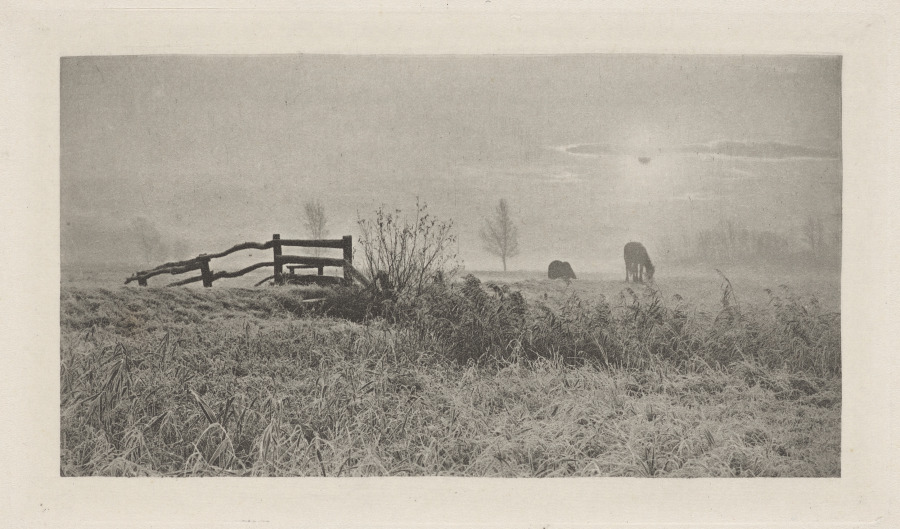
Peter Henry Emerson · The Cleveland Museum of Art · Mr. and Mrs. Roger J. Lerch in Memory of Carl J. Lerch and Winifred J. Lerch Endowment · CC0
- Born
- 1856 · Sagua La Grande.
- Died
- 1936 · Falmouth.
- Nationality
- United Kingdom
- Occupation
- photographer · writer
- Education
- Clare College · King's College London · Cranleigh School
- Languages
- English
VALÉORINE Encyclopedia
VALÉORINE documentary reading
Documentary summary
Illustration — Peter Henry Emerson • Illustration — "Ricking the reed", from Emerson's first photographic album Life and Landscape on the Norfolk Broads (1886) Peter Henry Emerson (13 May 1856 – 12 May 1936) was a British writer and photographer. His photographs are early examples of promoting straight photography as an art form. He is known for taking photographs that displayed rural settings and for his disputes with the photographic establishment about the purpose and meaning of photography.
Admitted source layer · organised and presented by VALÉORINE
Note VALÉORINE
No house-authored Note is published until its assertions and sources pass the VALÉORINE evidence contract. The documentary article remains available in full while that enrichment is being consolidated.
Documentary enrichment in progress · no unsupported statement published
Reference Check
Propose documentary evidence for Peter Henry Emerson. A contribution is never written directly as fact: identity, source, rights and evidence gates still decide.
Sign in to contribute
World of VALÉORINE
Documentary connections
Only confirmed graph relationships appear here. Images are shown only when their identity and reuse rights both pass the documentary gate.

Documentary evidence
Evidence Panel
not yet certified
- Identity
- resolved
- Independent source families
- 0
- Admitted assertions
- 0
- Open conflicts
- 0
Authority files
gnd · 6524344-4 · wikidata · Q515839 · wikipedia · Peter Henry Emerson
In this article
Early life
Early life
Peter Henry Emerson studied at Clare College, King's College London and Cranleigh School. The recorded working language is English. Work by Peter Henry Emerson is recorded in the collections of Art Institute of Chicago, The Nelson-Atkins Museum of Art, National Gallery of Victoria, National Gallery of Canada and Museum of Modern Art.
Emerson was born on La Palma Estate, a sugar plantation near Encrucijada, Cuba belonging to his American father, Henry Ezekiel Emerson and British mother, Jane, née Harris Billing. He was a distant relative of Samuel Morse and Ralph Waldo Emerson. He spent his early years in Cuba on his father's estate. During the American Civil War he spent some time at Wilmington, Delaware, but moved to England in 1869, after the death of his father. He was schooled at Cranleigh School where he was a noted scholar and athlete. He subsequently attended King's College London, before switching to Clare College, Cambridge in 1879 where he earned his medical degree in 1885. Emerson was intelligent, well-educated and wealthy with a facility for clearly articulating his many strongly held opinions. In 1881 he married Miss Edith Amy Ainsworth and wrote his first book while on his honeymoon. The couple eventually had five children.
20th century
20th century
After the publication of Marsh Leaves in 1895, generally considered to be his best work, Emerson published no further photographs, though he continued writing and publishing books, both works of fiction and on such varied subjects as genealogy and billiards. In 1924, he started writing a history of artistic photography and completed the manuscript just before his death in Falmouth, Cornwall on 12 May 1936. In 1979 he was inducted into the International Photography Hall of Fame.
Identity
Identity
Peter Henry Emerson is recorded as having studied at Clare College, King's College London and Cranleigh School.
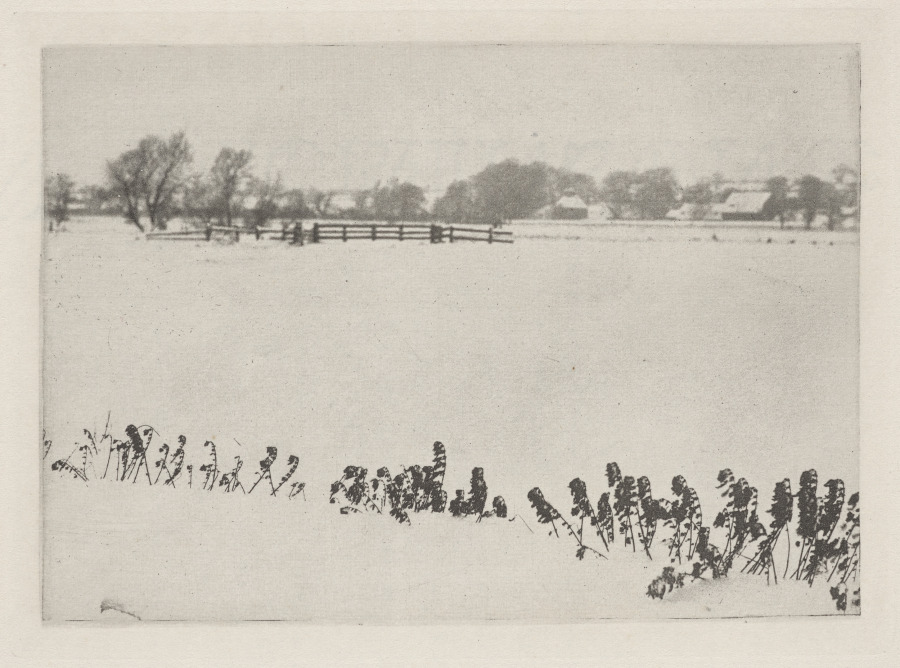
Marsh Weeds, before 1891, published 1895, by Peter Henry Emerson
Peter Henry Emerson · The Cleveland Museum of Art · Mr. and Mrs. Roger J. Lerch in Memory of Carl J. Lerch and Winifred J. Lerch Endowment
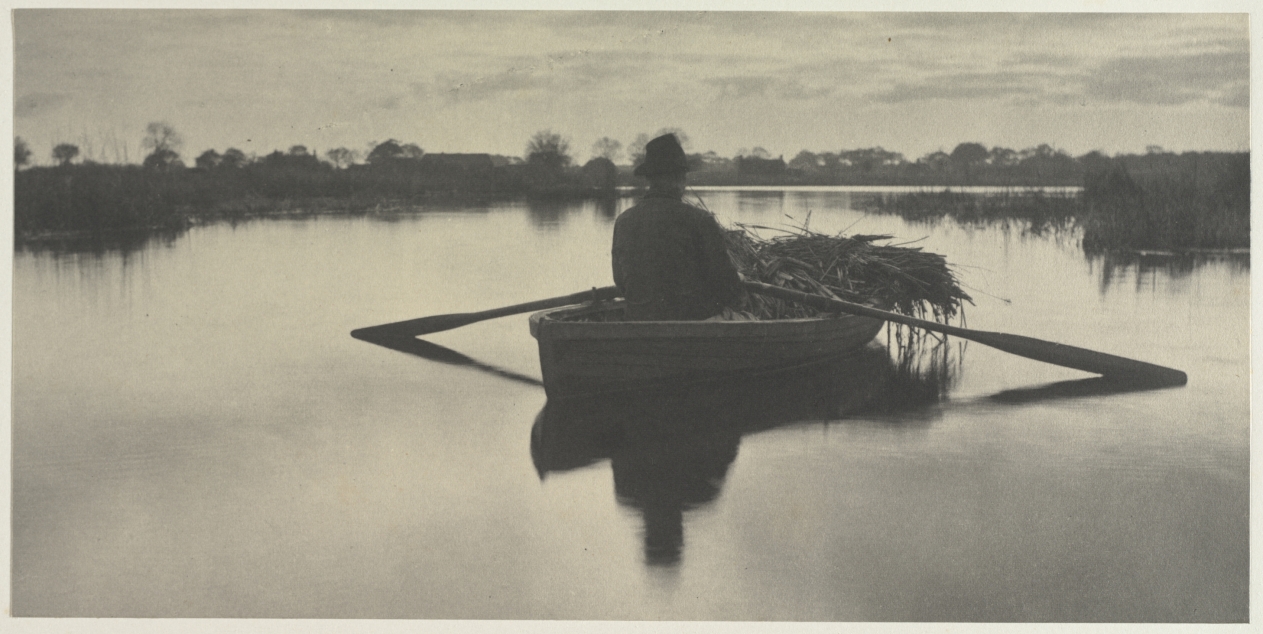
Rowing Home the Schoof-Stuff, 1886, by Peter Henry Emerson
Peter Henry Emerson · The Cleveland Museum of Art · Bequest of Edgar A. Hahn by exchange and Director's Contingent Fund
Life and career
Dated record
Life and career
The full dated record · 2 entries
1856
Peter Henry Emerson born at Sagua La Grande.
1936
Peter Henry Emerson died at Falmouth.
Places
Named by the record
Places
Only places the record itself states, plotted where the house gazetteer settles their coordinates. Nothing is inferred from a name or a nationality.
Sagua La Grande.
Birth place
Falmouth.
Death place
Publications
• Illustration — Confessions from Emerson's book Pictures From Life in Field And Fen (1887) • Paul Ray at the Hospital: a Picture of Student Life (1882, privately published) • Life and Landscape on the Norfolk Broads (1886) • Pictures from Life in Field and Fen (1887) • The Compleat Angler, or, The Contemplative Man's Recreation. Being a Discourse of Rivers, Fish-Ponds, Fish, and Fishing by Izaak Walton with photogravures by Emerson (1888) • Idylls of the Norfolk Broads (1888) • Pictures of East Anglian Life (1888) • Naturalistic Photography for Students of the Art (1889) • Wild Life on a Tidal Water (1890) • On English Lagoons (1893) • Birds, Beasts and Fishes of the Norfolk Broadland (1895) • Marsh Leaves (1895) • Caóba, the Guerilla Chief. A Real Romance of the Cuban Rebellion (1897) • The English Emersons, a genealogical historical sketch to the end of the 17th century (1898) • Suggested Amended Billiard Rules for Amateur Players (1908)
Photography
Photography
• Illustration — Blackshore, River Blythe, Suffolk from Emerson's illustrated book Pictures of East Anglian Life (1888) He bought his first camera in 1881 or 1882 to be used as a tool on bird-watching trips with his friend, the ornithologist A. T. Evans. In 1885 he was involved in the formation of the Camera Club of London, and the following year he was elected to the Council of the Photographic Society and abandoned his career as a surgeon to become a photographer and writer. As well as his particular attraction to nature he was also interested in billiards, rowing and meteorology. Initially influenced by naturalistic French painting, he argued for similarly "naturalistic" photography and took photographs in sharp focus to record country life as clearly as possible. His first album of photographs, published in 1886, was entitled Life and Landscape on the Norfolk Broads, and it consisted of 40 platinum prints that were informed by these ideas. Before long, however, he became dissatisfied with rendering everything in sharp focus, considering that the undiscriminating emphasis it gave to all objects was unlike the way the human eye saw the world. He then experimented with soft focus, but was not content with the results that this gave too, experiencing difficulty with accurately recreating the depth and atmosphere which he saw as necessary to capture nature with precision. Despite his misgivings, he took many photographs of landscapes and rural life in the East Anglian fenlands and published seven further books of his photography through the next ten years. In the last two of these volumes, On English Lagoons (1893) and Marsh Leaves (1895), Emerson printed the photographs himself using photogravure, after having bad experiences with commercial printers.
Disagreements with the photographic establishment
Disagreements with the photographic establishment
• Illustration — "At Plough, The End of the Furrow", from Emerson's photographic album Pictures From Life in Field And Fen (1887) During his life Emerson fought against the British photographic establishment on a number of issues. In 1889 he published a controversial and influential book Naturalistic Photography for Students of the Art, in which he explained his philosophy of art and straightforward photography. The book was described by one writer as "the bombshell dropped at the tea party" because of the case it made that truthful and realistic photographs would replace contrived photography. This was a direct attack on the popular tradition of combining many photographs to produce one image that had been pioneered by O. G. Reijlander and Henry Peach Robinson in the 1850s. Some of Robinson's photographs were of twenty or more separate photographs combined to produce one image. This allowed the production of images that, especially in early days, could not have been produced indoors in low light, and it also made possible the creation of highly dramatic images, often in imitation of allegorical paintings. Emerson denounced this technique as false and claimed that photography should be seen as a genre of its own, not one that seeks to imitate other art forms. All Emerson's own pictures were taken in a single shot and without retouching, which was another form of manipulation that he strongly disagreed with, calling it "the process by which a good, bad, or indifferent photograph is converted into a bad drawing or painting". • Illustration — From Emerson's album The Hunters depicting a hunter and his dog sourced from Nancy Newhall's book P.H. Emerson Emerson also believed that the photograph should be a true representation of that which the eye saw. Following contemporary optical theories, he produced photographs with one area of sharp focus while the remainder was unsharp. He vehemently pursued this argument about the nature of seeing and its representation in photography, to the discomfort of the photographic establishment. Another of Emerson's passionate beliefs was that photography was an art and not a mechanical reproduction. An argument with the establishment ensued on this point as well, but Emerson found that his defence of photography as art failed, and he had to allow that photography was probably a form of mechanical reproduction. The pictures the Robinson school produced may have been "mechanical", but Emerson's may still be considered artistic, since they were not faithful reproductions of a scene but rather having depth as a result of his one-plane-sharp theory. When he lost the argument over the artistic nature of photography, Emerson did not publicize his photographic work but still continued to take photographs.
Primary material
Documents and archives
reference work
- Wikidata, structured authority record Q515839: Peter Henry Emerson
Reputable secondary · Wikimedia Foundation
- “Peter Henry Emerson”, English Wikipedia, consulted as further reading
Reputable secondary · Wikipedia
authority file
- Gemeinsame Normdatei 6524344-4, Exhibition Peter Henry Emerson and American Naturalistic Photography (2008-2009 : Minneapolis, Minn. u.a.).
Unverified · Deutsche Nationalbibliothek
Notes from the source article
Cited by Wikipedia
Notes from the source article
These works are cited by the source article, in its own numbering. They are recorded as its citations, not as sources VALÉORINE has verified.
- 1.Stephen Hyde, great grandson of PH Emerson who visited the site of La Palma Estate in May 2011. See also documents relating to Ingenio La Palma at the Bodleian Library in Oxford http://www.bodley.ox.ac.uk/dept/scwmss/wmss/online/1500-1900/emerson/emerson.html
- 2.Whitmire, Vi. Peter Henry Emerson (1856–1936). International Photography Hall of Fame.
- 3.Emerson, Peter Henry.
- 4.Jeffrey, Ian. How to Read a Photograph. Thames & Hudson. 26–27. 2008. 978-0-500-28784-2.
- 5.Peter Turner, 'Emerson, Peter Henry (1856–1936)', Oxford Dictionary of National Biography, online edition, Oxford University Press, Sept 2004. Retrieved 31 August 2010
- 6.V&A Museum. V&A Exploring Photography – Peter Henry Emerson.
- 7.Leggatt, Robert. A History of Photography: EMERSON, Dr. Peter Henry. www.rleggat.com.
Bibliography printed in the source article · 9
- Turner, Peter, and Richard Wood. P.H. Emerson: Photographer of Norfolk. Boston: D. R. Godine; London: Gordon Fraser, 1974.
- Newhall, Nancy Wynne. P.H. Emerson: The Fight for Photography as a Fine Art. New York: Aperture, 1975.
- McWilliam, Neil, Veronica Sekules, and Michael Brandon-Jones. Life and Landscape: P.H. Emerson: Art & Photography in East Anglia, 1885–1900. Norwich: Sainsbury Centre for Visual Arts, 1986.
- Handy, Ellen, Brian Lukacher, and Shelley Rice. Pictorial Effect Naturalistic Vision: The Photographs and Theories of Henry Peach Robinson and Peter Henry Emerson. Norfolk, VA: Chrysler Museum, 1994.
- Maynard, Patrick. The Engine of Visualization: Thinking through Photography, ch. XI. Ithaca, New York: Cornell University Press, 1997.
- Taylor, John. The Old Order and the New: P.H. Emerson and Photography, 1885–1895. Munich and New York: Prestel, 2006.
- Peterson, Christian A. Peter Henry Emerson and American Naturalistic Photography. Minneapolis, MN: Minneapolis Institute of Arts; Seattle, WA: University of Washington Press, 2008.
- Ewing, Samuel. 2015. "The Courbet of England: Peter Henry Emerson’s East Anglian Photographs and the Imperial Ordering of Labour." History Of Photography 39, no. 1: 18-32.
- Fuldner, Carl. "Emerson's Evolution" Tate Papers, no. 27, Spring 2017.
References
Citations
References
Each reference names the institution holding it, so a reader may go to the document itself.
authority file
Gemeinsame Normdatei 6524344-4, Exhibition Peter Henry Emerson and American Naturalistic Photography (2008-2009 : Minneapolis, Minn. u.a.).Deutsche Nationalbibliothek
Partially resolvedreference work
Wikidata, structured authority record Q515839: Peter Henry EmersonWikimedia Foundation
Partially resolvedreference work
Partially resolved
Further particulars
Held on the record
Further particulars
Open the remaining particulars
Peter Henry Emerson is connected to 1 other published record in the VALÉORINE Encyclopedia.
Recognition and collections
Work by Peter Henry Emerson is
Art Institute of Chicago, The Nelson-Atkins Museum of Art, National Gallery of Victoria and National Gallery of Canada
Within the Encyclopedia
The Encyclopedia exists whether or not anything is for sale. Corrections are recorded rather than overwritten, and every version of this record is kept. Published 14 August 2026.
Elsewhere in Photography
11,392 published records in this field, each with its sources named.
- Peter GoinPhotographer
- Peter GowlandPhotographer
- Peter GuttmanPhotographer
- Peter HarkawikPhotographer
- Peter HovmandPhotographer
- Peter HujarPhotographer
- Peter HuttonPhotographer
- Peter Iain CampbellPhotographer
Best supported in this field
For owners
Own a work by Peter Henry Emerson?
A specialist will read what you send and tell you what the house can establish, what it cannot, and whether the object is suited to sale. There is no charge and no obligation. The object stays with you throughout; nothing is shipped to us unless it is arranged in writing beforehand.