
Paul Blobel
Paul Wilhelm Hermann Blobel (13 August 1894 – 7 June 1951) was a German Sicherheitsdienst (SD) commander and convicted war criminal who played a leading role in the Holocaust. He organised the Babi Yar massacre, the largest massacre of the Second World War at Babi Yar ravine in September 1941, pioneered the use of the gas van, and, following re-assignment, developed the gas chambers for the extermination camps. From late 1942 onwards, he led Sonderaktion 1005, wherein millions of bodies were exhumed at sites across Eastern Europe in an effort to erase all evidence of the Holocaust and specifically of Operation Reinhard.
Paul Blobel
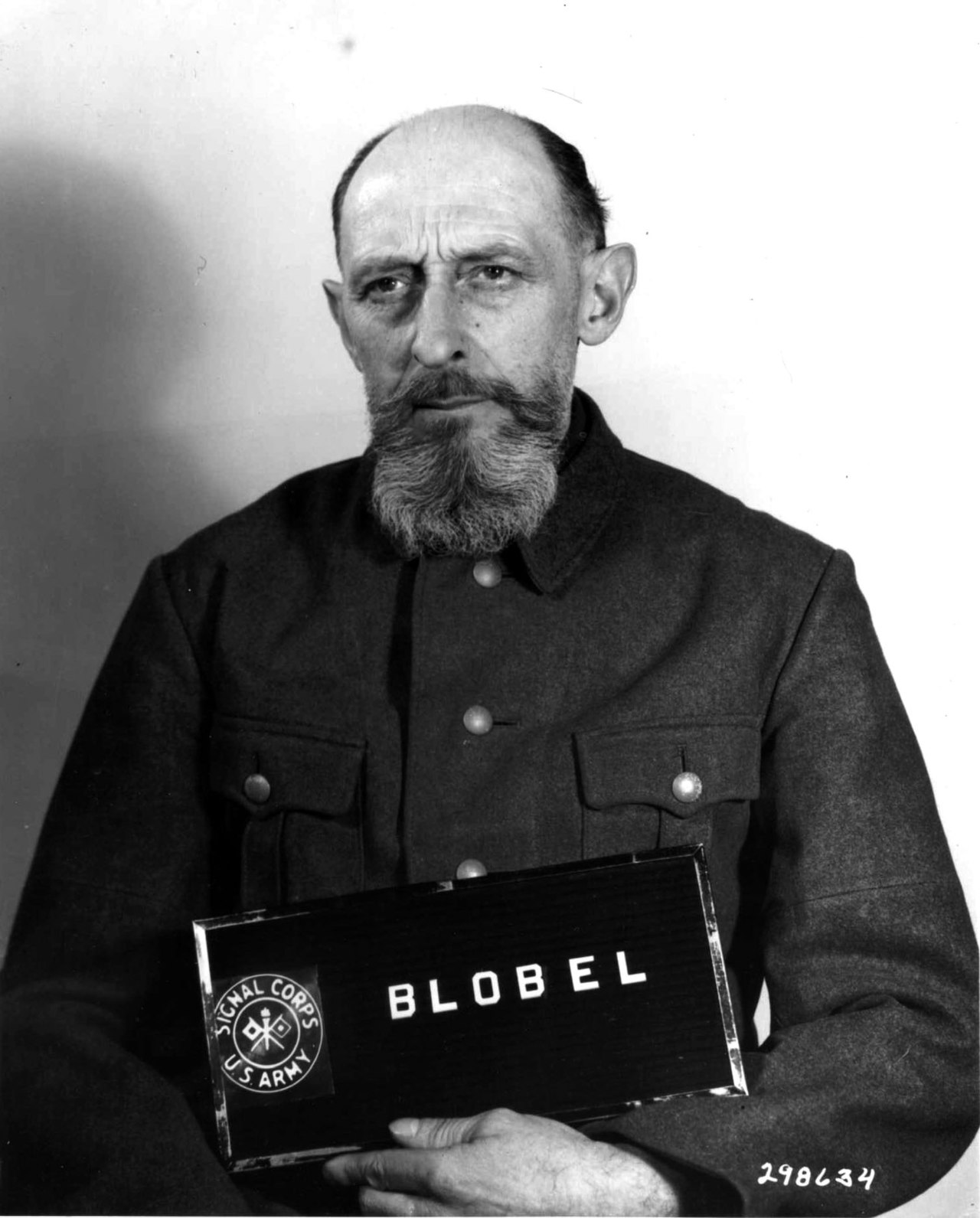
US Army Signal Corps · available from National Archives · Public domain
- Born
- 1894.
- Died
- 1951.
- Nationality
- German Empire, Weimar Republic and Nazi Germany.
- Occupation
- architect and carpenter.
VALÉORINE Encyclopedia
VALÉORINE documentary reading
Documentary summary
Paul Wilhelm Hermann Blobel (13 August 1894 – 7 June 1951) was a German Sicherheitsdienst (SD) commander and convicted war criminal who played a leading role in the Holocaust. He organised the Babi Yar massacre, the largest massacre of the Second World War at Babi Yar ravine in September 1941, pioneered the use of the gas van, and, following re-assignment, developed the gas chambers for the extermination camps. From late 1942 onwards, he led Sonderaktion 1005, wherein millions of bodies were exhumed at sites across Eastern Europe in an effort to erase all evidence of the Holocaust and specifically of Operation Reinhard.
Admitted source layer · organised and presented by VALÉORINE
Note VALÉORINE
Paul Blobel (1894–1951) was an architect and carpenter and a national of the German Empire and Nazi Germany. Born in Potsdam, the architect died in Landsberg Prison. Paul Blobel worked for Reich Main Security Office and was a member of Schutzstaffel.
Languages used include German. The architect received Iron Cross.
Composed from admitted, traceable facts · 26 September 2026
VALÉORINE
Reference Check
Propose documentary evidence for Paul Blobel. A contribution is never written directly as fact: identity, source, rights and evidence gates still decide.
Sign in to contribute
World of VALÉORINE
Documentary connections
Only confirmed graph relationships appear here. Images are shown only when their identity and reuse rights both pass the documentary gate.
Documentary evidence
Evidence Panel
original value insufficient · checked 25 September 2026
- Identity
- resolved
- Independent source families
- 0
- Admitted assertions
- 0
- Open conflicts
- 0
Authority files
wikidata · Q57984 · wikipedia · Paul Blobel
In this article
Early life
Early life
After the war, Blobel was tried at the Einsatzgruppen trial and sentenced to death. He was executed in 1951.
Blobel was born in Potsdam into a Protestant family of small trade artisans, who moved to Remscheid in 1899. He graduated schooling there without Abitur and between 1908 and 1911, Blobel completed training as a carpenter and bricklayer. In 1913, he began attending Barmen's Kunstgewerbeschule (a precursor to the University of Wuppertal), studying architecture. During World War I, Blobel enlisted in the Imperial German Army, becoming part of a pioneer battalion deployed on the Western Front, learning the use of flamethrowers, Minenwerfer, and incendiary explosives. By the time he was discharged in 1918 to the military command in Lennep, he had reached the rank of Vizefeldwebel or Unteroffizier and was highly decorated, having received an Iron Cross first class. After the war, Blobel finished his studies and around 1920, he gained a position as construction manager in the Solingen office of Franz Perlewitz, with a focus on industrial and residential buildings. Blobel married in 1921 and in late 1922, he began studying at Kunstakademie Düsseldorf. Upon his graduation in 1925, Blobel became a freelance architect, building a house for his family in Solingen's Schaberg district the following year. During the Great Depression, Blobel, by then a father of two sons, stopped receiving commission work, and received welfare while registered as unemployed between 1930 and 1933, although he had temporary employment at Solingen's administrative office.
SS career
SS career
Blobel joined the Sturmabteilung (SA), the paramilitary wing of the Nazi Party in May 1931. Despite stating during his later post-war trial that he joined the Social Democratic Party of Germany (SPD) in October 1931, claiming that the SA at the time was "not political" but rather considered a "social club, whose goals [he] did not find contrary to the SPD", records showed that he had in fact joined the Nazi Party on 1 October of the same year and become a member of the Schutzstaffel (SS) by 1 December. Additionally, he was already known to have ties with the Sicherheitsdienst (SD), the Nazi Party's intelligence service, shortly after entering the SS, while the organisation was still in its early stages, contributing to his rapid promotions within the SD. In March 1932, Blobel became deputy SD district leader in the Solingen-Remscheid-Wuppertal triangle of Gau Düsseldorf. In August 1933, he was put in charge of the 20. SS-Standarte in western Gau Düsseldorf, an area equivalent to the modern-day Regierungsbezirk Düsseldorf. Through this position, Blobel became a policeman of Düsseldorf's Gestapo office, initially only as an honorary title, but he eventually started going on patrols as an auxiliary police officer. His SD personnel file highlighted Blobel's loyalty and zeal to Nazism, making mention of an incident in which Blobel sustained heavy cranial injuries after getting into a fight with "public enemies" during an ID check. In mid-1934, Blobel received leadership of sector V in the upper Düsseldorf-West area, and a promotion from Oberscharführer to Hauptsturmführer. He was responsible for data collection in the region on Jewish organisations for the regional Judenkartei, which came into use in the mass arrest of Jews following the 1938 November pogroms.In early 1941, shortly before Operation Barbarossa, the Reich Security Main Office assigned Blobel as the leader of SS-Sonderkommando 4a of Einsatzgruppe C to take part in the invasion in Reichskommissariat Ukraine. Along with the Order Police battalions, the Einsatzgruppen were responsible for massacres of Jews behind the Wehrmacht lines in the Soviet Union. The murder campaign included all political and racial undesirables. In August 1941, Blobel was put in charge of creating a Nazi ghetto in Zhytomyr to enclose around 3,000 Jews who were murdered a month later. On 10 or 11 August 1941, Friedrich Jeckeln ordered him, on behalf of Adolf Hitler, to exterminate the entire Jewish population. On 22 August 1941, the SS-Sonderkommando murdered Jewish women and children at Bila Tserkva with the consent of Field Marshal Walther von Reichenau, commander of the 6th Army. SS-Obersturmführer August Häfner testified at his own trial in the 1960s: The Wehrmacht had already dug a grave. The children were brought along in a tractor. The Ukrainians were standing around trembling. The children were taken down from the tractor. They were lined up along the top of the grave and shot so that they fell into it. The Ukrainians did not aim at any particular part of the body.... The wailing was indescribable. Blobel, in conjunction with Reichenau's and Friedrich Jeckeln's units, organised the Babi Yar massacre in late September 1941 in Kyiv, where 33,771 Jews were murdered. In November 1941, Blobel received and activated the first gas vans at Poltava. Blobel was officially relieved of his command on 13 January 1942 for health reasons due to alcoholism, although this was an elaborate cover. Whilst in the hospital, Blobel was visited by Reinhard Heydrich and tasked with a top secret Reich matter that was presumably suspended upon the fatal shooting of Heydrich in Prague by British-trained Czech partisans. During this time, according to Dieter Wisliceny, Blobel developed the concept of the gas chambers for the extermination camps in Poland. In June 1942 Blobel was contacted by Heinrich Müller, Chief of the Gestapo and secretly placed in charge of Sonderaktion 1005 with his official cover being SD Chief of the City of Nuremberg. This secret task consisted of the destruction of the evidence of all Nazi atrocities in Eastern Europe, beginning at Chelmno and continuing on to Sobibor Extermination Camp, Auschwitz, the camps in the Independent State of Croatia, the Baltic States, Serbia and eventually back to the site of the Babi Yar Massacre in Ukraine. This entailed exhumation of mass graves, then incinerating the bodies. Blobel developed efficient disposal techniques such as alternating layers of bodies with firewood on a frame of iron rails. In October 1944 was assigned to Slovenian Styria to combat Yugoslav partisans as part of Bandenbekämpfung. Gitta Sereny related the conversation about Blobel she once had with one-time Chief of the Church Information Branch at the Reich Security Head Office, Albert Hartl. Hartl had told me of a summer evening—that same hot summer in 1942—in Kyiv when he was invited to dine with the local Higher SS Police Chief and Brigadeführer, Max Thomas. A fellow guest, SS Colonel Paul Blobel, had driven him to the general's weekend dacha. "At one moment—it was just getting dark," said Hartl, "we were driving past a long ravine. I noticed strange movements of the earth. Clumps of earth rose into the air as if by their own propulsion—and there was smoke; it was like a low-toned volcano; as if there was burning lava just beneath the earth. Blobel laughed, made a gesture with his arm pointing back along the road and ahead, all along the ravine—the ravine of Babi Yar—and said, 'Here lie my thirty-thousand Jews.'"Blobel went on sick leave in December 1944, spending three months at a hospital in Marburg an der Drau until April 1945, when he was ordered to report to Ernst Kaltenbrunner's office in Berlin for further commands. He was briefly stationed in Salzburg before being captured with his unit in Rastatt in May 1945.
Trial and conviction
Trial and conviction
Over 59,018 killings are attributable to Blobel, however he personally estimated to have killed 10,000–15,000 people. He was later sentenced to death by the U.S. Nuremberg Military Tribunal in the Einsatzgruppen trial. He was hanged at Landsberg Prison shortly after midnight on 7 June 1951.
In the media
In the media
Blobel was portrayed by actor T. P. McKenna in the 1978 miniseries Holocaust. Blobel is an historical character in Herman Wouk's book War and Remembrance. He was portrayed by actor Kenneth Colley in the television adaptation of the book. Blobel appears as a historical character in the Philip Kerr novel A Man Without Breath.

Paul Blobel, Paul-Blobel
Wikimedia Commons

Defendant Paul Blobel is sentenced to death by hanging at the Einsatzgruppen Trial.
USHMM [Photograph #08607], courtesy of National Archives and Records Administration, College Park [1] Originally from sv.wikipedia
Life and career
Dated record
Life and career
The full dated record · 2 entries
1894
Paul Blobel was born on 13 August 1894.
1951
Paul Blobel died at Landsberg Prison.
Notes from the source article
Cited by Wikipedia
Notes from the source article
These works are cited by the source article, in its own numbering. They are recorded as its citations, not as sources VALÉORINE has verified.
- 1.Bilstein, Jochen. Hier wohnte Frau Antonie Giese: die Geschichte der Juden im Bergischen Land : Essays und Dokumente. 92. 1998.
- 2.Paul Blobel Affidavit. Holocaust Historical Society.
- 3.Paul Blobel. Max-Leven-Zentrum.
- 4.Bilstein, Jochen. Hier wohnte Frau Antonie Giese: die Geschichte der Juden im Bergischen Land : Essays und Dokumente. 93. 1998.
- 5.Zentner, Christian Ed. The Encyclopedia of the Third Reich. Macmillan. 1150. 1991. 0-02-897502-2.
- 6.Ogorreck, Ralf (2010). Les Einsatzgruppen, Tallandier, p. 150,
- 7.Ogorreck, Ralf, op. cit. p. 203.
- 8.Friedländer, Saul. The Years of Extermination: Nazi Germany and the Jews, 1939–1945. HarperCollins. 2007. 978-0-06-019043-9.
- 9.Christopher Browning: The Origins of the Final Solution: The Evolution of Nazi Jewish Policy, September 1939 – March 1942 (With contributions by Jürgen Matthäus), Lincoln: University of Nebraska Press, 2004. pp. 291–292
- 10."Five death sentences were confirmed: the sentence against Oswald Pohl, as well as those passed against the leaders of the Mobile Killing Units, Paul Blobel, Werner Braune, Erich Naumann and Otto Ohrlendorf. ... In the early morning hours of 7 June, the Nazi criminals were hanged in the Landesburg prison courtyard." Norbert Frei, Adenauer's Germany and the Nazi Past: The Politics of Amnesty and Integration. Columbia University Press, 2002. p. 165 and p. 173
- 11.1941: Mass Murder The Holocaust Chronicle. p. 270
- 12.Sereny, Gitta. Albert Speer: His Battle With Truth. Picador. 272. 1996. 978-0-330-34697-9.
References
Citations
References
Each reference names the institution holding it, so a reader may go to the document itself.
reference work
Partially resolvedreference work
Partially resolved
The Encyclopedia exists whether or not anything is for sale. Corrections are recorded rather than overwritten, and every version of this record is kept. Published 14 August 2026.
Elsewhere in Design
11,558 published records in this field, each with its sources named.
- Paul B. RiisDesigner
- Paul BartholomewDesigner
- Paul BellotDesigner
- Paul BigotDesigner
- Paul BoeswillwaldDesigner
- Paul BonatzDesigner
- Paul ByardDesigner
- Paul C. ReillyDesigner
Best supported in this field
For owners
Own a work by Paul Blobel?
A specialist will read what you send and tell you what the house can establish, what it cannot, and whether the object is suited to sale. There is no charge and no obligation. The object stays with you throughout; nothing is shipped to us unless it is arranged in writing beforehand.