
Pascal Sebah
Pascal Sébah (Arabic: باسكال صباح, romanized: Baskāl Ṣabāḥ; 1823 – June 25, 1886) was an Ottoman photographer in Istanbul and Cairo. Best known for his prolific photography of Anatolia, Egypt, and Greece, Sébah established the studio that would later become Sébah & Joaillier.
Also recorded as Pascal Sébah · P. Sébah · Sébah, Pascal · J. Pascal Sébah
Pascal Sebah

Wikimedia Commons · Public domain
- Born
- 1823.
- Died
- 1886.
- Nationality
- Ottoman Empire.
- Occupation
- photographer.
VALÉORINE Encyclopedia
VALÉORINE documentary reading
Documentary summary
Pascal Sébah (Arabic: باسكال صباح, romanized: Baskāl Ṣabāḥ; 1823 – June 25, 1886) was an Ottoman photographer in Istanbul and Cairo. Best known for his prolific photography of Anatolia, Egypt, and Greece, Sébah established the studio that would later become Sébah & Joaillier.
Admitted source layer · organised and presented by VALÉORINE
Note VALÉORINE
No house-authored Note is published until its assertions and sources pass the VALÉORINE evidence contract. The documentary article remains available in full while that enrichment is being consolidated.
Documentary enrichment in progress · no unsupported statement published
Reference Check
Propose documentary evidence for Pascal Sebah. A contribution is never written directly as fact: identity, source, rights and evidence gates still decide.
Sign in to contribute
World of VALÉORINE
Documentary connections
Only confirmed graph relationships appear here. Images are shown only when their identity and reuse rights both pass the documentary gate.
Documentary evidence
Evidence Panel
not yet certified
- Identity
- resolved
- Independent source families
- 0
- Admitted assertions
- 0
- Open conflicts
- 0
Authority files
wikidata · Q704918 · wikipedia · Pascal Sébah
In this article
Life and work
Life and work
Pascal Sébah was born in Istanbul, then the capital of the Ottoman Empire, to a Syrian father and an Armenian mother. He initially worked in collaboration with the French photographer, Henri Bechard. After receiving medals at the International Exhibition in Paris, he decided to open his own studio in Constantinople in 1857. Sébah's studio was known as El Chark (meaning "The Orient"), situated at 439 Grande Rue de Pera in the center of the city and close to the embassies and hotels where tourists met. Sébah primarily produced photographs for the tourist trade. By the second half of the 19th century, tourist travel to Egypt had created a strong demand for photographs as souvenirs. Sébah was among a group of early photographers in Constantinople and Cairo to capitalise on this demand. These pioneering photographers included Félix Bonfils (1831-1885); Gustave Le Gray (1820-1884), brothers Henri and Emile Bechard; the British-Italian brothers Antonio Beato (c. 1832–1906) and Felice Beato and the Greek Zangaki brothers. By 1873 Sébah was successful enough to open a second studio in Cairo. The same year, he exhibited at the Ottoman pavilion of the Universal Exhibition in Vienna, Austria. He established a valuable working relationship with Turkish painter and archeologist Osman Hamdi Bey, taking photographs as part of the artist's preparation, and in which he experimented with light and shade. In turn, Hamdi Bey selected Sébah to illustrate his text on the popular costumes worn by Turkish and other ethnic groups, entitled Les Costumes Populaires de la Turquie en 1873: ouvrage publié sous le patronage de la Commission impériale ottomane pour l'Exposition universelle de Vienne and published in 1873. Following his death on 25 June 1886, the studio continued in business. It was managed by his brother, Cosmi, and in 1888 Polycarpe Joiallier became a partner. At this time, the company was renamed Sebah & Joaillier Pascal's son, Jean Pascal Sébah, also joined in 1888 and went on to run the studio with other photographers. The firm developed a reputation as the leading representative of Orientalist photography and in 1889 was appointed the Photographers by Appointment to the Prussian Court. Sébah's studio continued operations, in one form or another, until 1952 at the same address and then moved until its closure in 1973. Sébah, a Syrian Catholic, was buried in the Feriköy Latin Catholic Cemetery in Istanbul. His son, Jean Pascal Sébah, is also buried there.
Life and career
Dated record
Life and career
Explore 1823–1886
The full dated record · 6 entries
1823
Pascal Sebah born at Istanbul.
1868
İstanbul (Pascal Sebah) (1868) is digitised and catalogued by Internet Archive.
1870
Mohamed Ali mosque, Cairo, Egypt. Photograph by Pascal Sébah, ca. 1870. (Wellcome Collection).
1870
Cairo, Egypt: Mameluk tombs with decorative towers. Photograph by Pascal Sébah, ca. 1870. (Wellcome Collection).
1875
Egypt: a temple: the carved exterior facade. Photograph by Pascal Sébah, ca. 1875. (Wellcome Collection).
1886
Pascal Sebah died at Istanbul.
Primary material
Documents and archives
reference work
- “Pascal Sébah”, English Wikipedia, consulted as further reading
Reputable secondary · Wikipedia
authority record
- Wikidata, structured authority record Q704918: Pascal Sebah
Unverified · Wikidata
General references
General references
Fabrizio Casaretto, Sébah & Joaillier photos. www.sebahjoaillier.com Engin Özendes, From Sébah & Joaillier to Foto Sabah. Orientalism in Photography, Istanbul, YKY, 1999. Michelle L. Woodward, "Between Orientalist Clichés and Images of Modernization: Photographic Practice in the Late Ottoman Era," History of Photography, winter 2003, Vol. 27, No. 4. doi:10.1080/03087298.2003.10441271

Pascal Sebah, Sebah, Pascal (1823-1886) - n. ... - Ile de Phyle - Temple Hypèthre
Wikimedia Commons
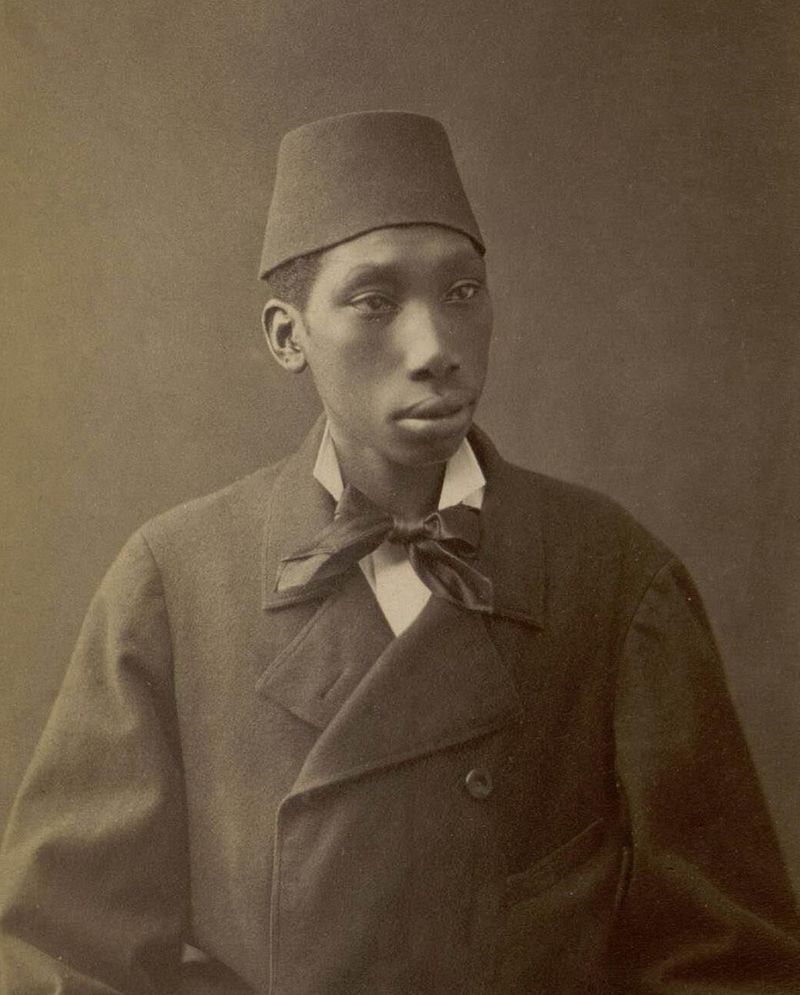
Black Eunuch of the Ottoman Sultan. Eunuque du Sultan
Pascal Sebah · [1]
Notes from the source article
Cited by Wikipedia
Notes from the source article
These works are cited by the source article, in its own numbering. They are recorded as its citations, not as sources VALÉORINE has verified.
- 1.Philip Carabott, Yannis Hamilakis and Eleni Papargyriou (eds), Camera Graeca: Photographs, Narratives, Materialities, Routledge, 2016, p. 114
- 2.Hannavy, J., Encyclopedia of Nineteenth-Century Photography, Routledge, 2013, p. 1032
- 3.J. Paul Getty Museum; Note that the source confuses father and son. Confusion between Pascal Sébah (father) and son Jean Pascal Sébah (son) is not uncommon. Users should be very careful when using images from Wiki Commons as this source also confuses the two photographers and the World Cat Identities exhibits similar problems with identities. Other sources are more careful, see for instance, Philip Carabott, Yannis Hamilakis and Eleni Papargyriou (eds), Camera Graeca: Photographs, Narratives, Materialities, Routledge, 2016, p. 114
- 4.Jacobson, K., Odalisques and Arabesques: Orientalist Photography, 1839-1925, London, Bernard Quaritch, 2007, p. 277.
- 5.Photography in Ottoman Istanbul by Margaret Kurkoski, 2013-2015 Curatorial Fellow, Smith College Museum of Art
- 6.Osman Hamdi Bey; Marie de Launay; J Pascal Sébah, Les Costumes Populaires de la Turquie en 1873: ouvrage publié sous le patronage de la Commission impériale ottomane pour l'Exposition universelle de Vienne, Turkey, Commission impériale ottomane pour l'Exposition universelle de Vienne, 1873
- 7.Hannavy, J., Encyclopedia of Nineteenth-Century Photography, Routledge, 2013, p. 1036
References
Citations
References
Each reference names the institution holding it, so a reader may go to the document itself.
reference work
Partially resolvedauthority record
Unverified
The Encyclopedia exists whether or not anything is for sale. Corrections are recorded rather than overwritten, and every version of this record is kept. Published 14 August 2026.
Elsewhere in Photography
11,392 published records in this field, each with its sources named.
- Pascal Dagnan-BouveretPhotographer
- Pascal GrandmaisonPhotographer
- Pascal MaitrePhotographer
- Pascal MeunierPhotographer
- Pascale Marthine TayouPhotographer
- Pascual + VincentPhotographer
- Pasquale VerdicchioPhotographer
- Pat BoothPhotographer
Best supported in this field
For owners
Own a work by Pascal Sebah?
A specialist will read what you send and tell you what the house can establish, what it cannot, and whether the object is suited to sale. There is no charge and no obligation. The object stays with you throughout; nothing is shipped to us unless it is arranged in writing beforehand.