
Painter Müller
Illustration — Friedrich Müller Friedrich Müller (13 January 1749 – 23 April 1825), German poet, dramatist and painter from the Electoral Palatinate, is best known for his slightly sentimental prose idylls on country life. Usually known as Maler Müller (i.e.
Also recorded as Johann Friedrich Müller · Fritz Müller · Friedrich Muller · Maler Muller
Painter Müller

Ludwig Emil Grimm · Public domain
- Born
- 1749. · Bad Kreuznach.
- Died
- 1825. · Rome.
- Nationality
- Kingdom of Prussia.
- Occupation
- poet, playwright, painter and writer.
- Languages
- German.
VALÉORINE Encyclopedia
VALÉORINE documentary reading
Documentary summary
Illustration — Friedrich Müller Friedrich Müller (13 January 1749 – 23 April 1825), German poet, dramatist and painter from the Electoral Palatinate, is best known for his slightly sentimental prose idylls on country life. Usually known as Maler Müller (i.e.
Admitted source layer · organised and presented by VALÉORINE
Note VALÉORINE
No house-authored Note is published until its assertions and sources pass the VALÉORINE evidence contract. The documentary article remains available in full while that enrichment is being consolidated.
Documentary enrichment in progress · no unsupported statement published
Reference Check
Propose documentary evidence for Painter Müller. A contribution is never written directly as fact: identity, source, rights and evidence gates still decide.
Sign in to contribute
World of VALÉORINE
Documentary connections
Only confirmed graph relationships appear here. Images are shown only when their identity and reuse rights both pass the documentary gate.
Documentary evidence
Evidence Panel
not yet certified
- Identity
- resolved
- Independent source families
- 0
- Admitted assertions
- 0
- Open conflicts
- 0
Authority files
wikidata · Q481491
In this article
Early life and education
Early life and education
Müller was born in Kreuznach. He showed a talent for art in his youth, and studied painting at Zweibrücken, where his personality and varied endowments won him the favor of court circles. At 18, he published several collections of etchings which attracted much attention with their originality. In 1774-1775, he settled in Mannheim, where he soon acquired a reputation as a poet. In 1777 he was appointed court painter.
Painting
Painting
• Illustration — Kleiner Wasserfall in schroffer Felslandschaft ("A small waterfall in a rugged landscape with cliffs") In 1778 he was enabled by a public subscription to visit Italy, which remained his home for the rest of his life. In 1780 he became a Roman Catholic. He was unfavourably influenced by the study of Italian models, and gradually became estranged from painting through failures and distress. He devoted himself instead to the study of the history of art. He became a sort of ambulant antiquary, and his services as cicerone were especially in demand among German visitors to Rome.
Later years
Later years
Through the patronage of the Crown Prince of Bavaria (afterwards King Louis I), he was enabled to pass his declining years in comparative ease. He died in Rome in 1825.
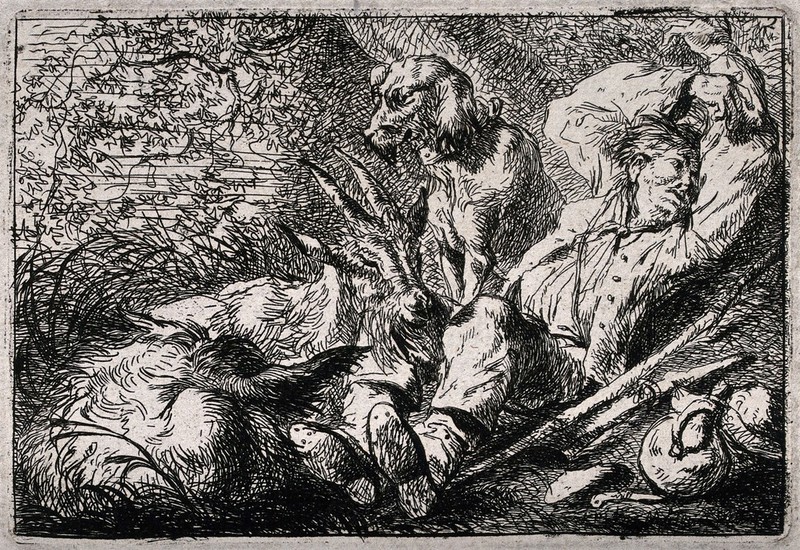
A goatherd lies down to rest with his goats and his dog. Etching by F. Müller., 1700-1799, by Painter Müller
Painter Müller · Wellcome Collection, London · Wellcome Collection
Places
Named by the record
Places
Only places the record itself states, plotted where the house gazetteer settles their coordinates. Nothing is inferred from a name or a nationality.
Bad Kreuznach.
Birth place
Rome.
Death place
Literature
Before he left Mannheim, he had tried his hand at literature, under the influence of the Sturm und Drang movement. In 1775, he published several idylls: Satyr Mopsus, Der Faun, Bacchidon und Milon, Der erschlagene Abel and Die Schafschur. In form and content, these were closely modeled on the works of Solomon Gessner. In 1778 came Adam's First Awaking and First Happy Nights (Adams erstes Erwachen; 2nd revised edition, 1779). A lyric drama of the same year, Niobe (1778), attracted little attention, but Faust's Leben dramatisiert (Faust's Life Dramatized) (1778) appealed to the turbulent spirit of the time, and Golo und Genoveva (begun in 1776, but not published until 1801) was an excellent imitation of Goethe's Götz von Berlichingen. In his idylls, notably Die Schafschur and Das Nusskernen (1811), he struck out a more independent path. In these, emancipating himself from the artificiality of Gessner, he realistically reproduced scenes from the German peasant life of his day, not without a touch of satire. His later idylls took Voss as a model. Maler Müller's Werke appeared in 3 vols. (1811–1825); in 1868 H. Hettner published two volumes of Dichtungen von Maler Müller, which contain most of his writings. Gedichte von Maler Friedrich Müller; eine Nachlese zu dessen Werken appeared in 1873, and his Fausts Leben was reprinted by B. Seuffert in 1881.
Citations
References
Each reference names the institution holding it, so a reader may go to the document itself.
reference work
Partially resolved
The Encyclopedia exists whether or not anything is for sale. Corrections are recorded rather than overwritten, and every version of this record is kept. Published 14 August 2026.
Elsewhere in Books
39,285 published records in this field, each with its sources named.
- Pai Hsien-yungAuthor
- Paidin mac Lochlainn Ó MailchonaireAuthor
- Paige Ackerson-KielyAuthor
- Paik Sun-yupAuthor
- Paisius of HilendarAuthor
- Päivi RäsänenAuthor
- PajsijeAuthor
- Pak ChiwŏnAuthor
Best supported in this field
For owners
Own a work by Painter Müller?
A specialist will read what you send and tell you what the house can establish, what it cannot, and whether the object is suited to sale. There is no charge and no obligation. The object stays with you throughout; nothing is shipped to us unless it is arranged in writing beforehand.