
Otakar Ostrčil
Otakar Ostrčil (25 February 1879 in Prague – 20 August 1935 in Prague) was a Czech composer and conductor. He is noted for symphonic works Impromptu, Suite in C Minor, and Symfonietta, and in his opera compositions Poupě and Honzovo království.
Also recorded as Otakar Ostrcil
Otakar Ostrčil

Anonymous Unknown author · Faculty of Social Sciences, Charles University in Prague Pestrý týden, 23.11.1929, s.7 · Public domain
- Born
- 1879. · Prague.
- Died
- 1935. · Prague.
- Nationality
- Czechoslovakia.
- Occupation
- conductor, composer, music educator, pianist, language teacher, dramaturge and musician.
- Fields
- opera and classical music.
- Education
- Charles University.
- Languages
- Czech.
VALÉORINE Encyclopedia
VALÉORINE documentary reading
Documentary summary
Otakar Ostrčil (25 February 1879 in Prague – 20 August 1935 in Prague) was a Czech composer and conductor. He is noted for symphonic works Impromptu, Suite in C Minor, and Symfonietta, and in his opera compositions Poupě and Honzovo království.
Admitted source layer · organised and presented by VALÉORINE
Note VALÉORINE
Otakar Ostrčil (1879–1935) was a composer, conductor and dramaturge, among other activities, of Czechoslovak nationality. The composer was born and died in Prague.
Otakar Ostrčil was educated at Charles University. The composer worked for Královské Vinohrady Municipal Theatre and Prague Conservatory.
The work spans classical music and opera. Languages used include Czech.
Composed from admitted, traceable facts · 26 September 2026
VALÉORINE
Reference Check
Propose documentary evidence for Otakar Ostrčil. A contribution is never written directly as fact: identity, source, rights and evidence gates still decide.
Sign in to contribute
World of VALÉORINE
Documentary connections
Only confirmed graph relationships appear here. Images are shown only when their identity and reuse rights both pass the documentary gate.

Documentary evidence
Documentary basis
Authority files
museum · e0d23c79-6f72-4562-bb03-fb29c84dbc66 · wikidata · Q707300 · wikipedia · Otakar Ostrčil
In this article
Compositional career
Compositional career
Ostrčil was born, and spent his entire life, in Prague, the center of the Czech musical community of his generation. He studied philosophy at Charles University, attending the classes of Otakar Hostinský, and simultaneously studied composition and music theory privately under Zdeněk Fibich. From his early student days he was a close friend of Zdeněk Nejedlý, whose outspoken voice in musicology formed Ostrčil's greatest critical support. He worked as a conductor at the Vinohrady Theater (1914–1919) and later at the National Theatre (Prague) (1920–1935), which was one of the most influential positions in Czech musical life. He also worked as a pedagogue at the Prague Conservatory, teaching conducting. Ostrčil wrote six operas: Jan Zhořelecký (written as a student under Fibich, 1898, unperformed), Vlasty skon (Vlasta's passing, premiered 1904, to a libretto previously considered by Smetana and Fibich), Kunálovy oči (Kunál's eyes, 1908), Poupě (The Bud, 1912), Legenda z Erinu (A Legend of Erin, 1921), and Honzovo království (Honzo's Kingdom, based on a short story by Leo Tolstoy, 1934). His most significant orchestral music includes Symphony in A (1906), Impromptu (1912), Suite in c minor (1914), Symfonietta (1922), Léto (Summer, tone poem, 1927), and Křížova cesta (The Way of the Cross, orchestral variations, 1929). He also composed various works for chamber and choral ensembles. As was the case with his main musical influence, Gustav Mahler, his rigorous conducting schedule rarely allowed free time for composition, with the exception of the summers when the theater was not in season.
Works
Works
Operas Rybáři (fragment) Jan Zhořelecký (1898) Cymbelín (1899 - unfinished) Vlasty skon, Op. 5 (1903) Kunálovy oči, Op. 11 (1908) on the theme from the short story of Julius Zeyer. Poupě, Op. 12 (1910) Legenda z Erinu, Op. 19 (1919) Honzovo království, Op. 25 (Honza's Kingdom after Leo Tolstoy 1933) Melodramas and Orchestral Songs Krásné dědictví (Eliška Krásnohorská - destroyed) Kamenný mnich (1893) Lilie (Karel Jaromír Erben) Balada o mrtvém ševci a mladé tanečnici, Op. 6 (K. Leger - 1904) Balada česká, Op. 8 (Jan Neruda - 1903) Osiřelo dítě, Op. 9 (The Orphan's Tale, 1907) Cizí Host, Op. 16 (The Stranger, 1913) Skřivan, Op. 26 (Mir. Valenta - 1934) Orchestral works Selská Slavnost, Op. 1 (Peasant Festival, 1897) Pohádková Suita, Op. 2 (Fairy Tale Suite, 1898) Pohádka o Šemíku, Op. 3 (Tale of Šemík, tone poem, 1899) Symphony in A, Op. 7 (1906) Sirotek, Op. 10 (The Orphan, incidental music for play after Nemcova, 1906) Impromptu, Op. 13 (1912) Suite in c minor, Op. 14 (1912) Sinfonietta, Op. 20 (1922) Léto, Op. 23 (Summer, tone poem, 1927) Křížova cesta Variations for Large Orchestra, Op. 24 (1928) (Calvary or The Way of the Cross) Choral works Ceská Legenda Vánocní, Op. 15 (Czech Christmas Legend, 1912) Legenda o sv. Zite Cantata, Op. 17 text by Jaroslava Vrchlického (1913) Prosté Motivy, Op. 21 (1922) Chamber music String Quartet in B Major, Op. 4 (1899) Sonatina for Viola, Violin and Piano, Op. 22 (1925) Songs 3 Songs, Op. 18 (1910-1913)
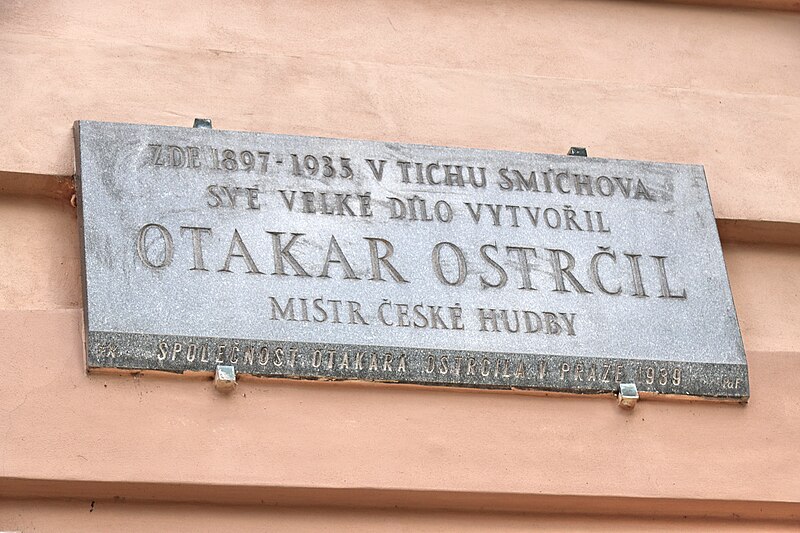
Pamětní deska Otakara Ostrčila na domě v Praze 5-Smíchově, Zborovská 601/38 (roh ul. Malátova).
ZSsen
Life and career
Dated record
Life and career
The full dated record · 1 entries
1935
Otakar Ostrčil died at Prague.
Influences
Like his contemporaries, Vítězslav Novák, Josef Suk, and Otakar Zich, Ostrčil composed in a densely orchestrated, thickly contrapuntal style that was heavily influenced by Mahler, Richard Strauss, and the early works of Arnold Schoenberg. At times, the extreme linearity of his work (as in the orchestral preludes to Legenda z Erinu and the climactic sections of Křížova cesta) goes beyond functional harmony; in these moments he can easily be aligned with the Viennese expressionists, whom he much admired. At the very end of his career, with his final opera Honzovo království, he turned to an ironic sort of neoclassicism reminiscent of Paul Hindemith or even Dmitri Shostakovich: the work is full of grotesque marches and folk dances that match the socialist politics of the libretto's mock folktale atmosphere. As a conductor, Ostrčil had a significant influence on his younger contemporaries in the interwar period. From the beginning of his time at the National Theater he conceived new ideas of musical leadership and choice of repertoire, wherein representatives of the current generation of musical modernism, both at home and abroad, were presented to Prague audiences as a matter of cultural responsibility. As a result, under Ostrčil, Prague saw the Czech premieres of works by Debussy, Strauss, Stravinsky, Darius Milhaud, Zich, and most importantly, the opera Wozzeck by Alban Berg in 1926. These programming choices met extreme controversy over Ostrčil's fifteen-year administration at the National Theater, especially from conservative critics such as Antonín Šilhan, who branded the conductor an anti-Czech pro-communist traitor, and whose articles prompted a riot at the third performance of Wozzeck. Many of these criticisms had to do with Ostrčil's close association with Nejedlý, who by this time was a strong proponent of the Czechoslovak Communist Party. It was Ostrčil's belief in the necessity of presenting modern art to the public that won him many supporters among the students of Prague, led by the young pedagogue and microtonal composer Alois Hába; in a climate increasingly unsympathetic to modernist exploration, the conductor was hailed as a hero. His untimely death in 1935, at the height of his career, was a bitter blow to the community, and for the remainder of the democratic era (to 1938) his achievements were continually rhapsodized in print.
Primary material
Documents and archives
reference work
- Wikidata, structured authority record Q707300: Otakar Ostrčil
Reputable secondary · Wikimedia Foundation
- “Otakar Ostrčil”, English Wikipedia, consulted as further reading
Reputable secondary · Wikipedia
Institutional database
- MusicBrainz artist record for Otakar Ostrčil
Scholarly · MetaBrainz Foundation
scholarly publication
- Ostrčil, Otakar (opera), Oxford Music Online, 2002
Scholarly · Crossref registry · 2002
References
Citations
References
Each reference names the institution holding it, so a reader may go to the document itself.
Institutional database
MusicBrainz artist record for Otakar OstrčilMetaBrainz Foundation
Institutional witnessscholarly publication
Ostrčil, Otakar (opera), Oxford Music Online, 2002Crossref registry
Institutional witnessreference work
Wikidata, structured authority record Q707300: Otakar OstrčilWikimedia Foundation
Secondary witnessreference work
Secondary witness
People, houses and institutions
Knowledge graph
People, houses and institutions
Teachers, collaborators, publishers and institutions recorded against this person, each on a stated basis.
Studied at
1- Charles UniversityOrganisation
Established from a fact already recorded on a verified source.
The Encyclopedia exists whether or not anything is for sale. Corrections are recorded rather than overwritten, and every version of this record is kept. Published 14 August 2026.
Elsewhere in Music memorabilia
43,117 published records in this field, each with its sources named.
- Oswald d'AndréaPerson
- Oswald KabastaPerson
- Otakar HollmannPerson
- Otakar JeremiášPerson
- Otakar ŠevčíkPerson
- Otakar ŠínPerson
- Otakar ZichPerson
- Otar GordeliPerson
Best supported in this field
For owners
Own a work by Otakar Ostrčil?
A specialist will read what you send and tell you what the house can establish, what it cannot, and whether the object is suited to sale. There is no charge and no obligation. The object stays with you throughout; nothing is shipped to us unless it is arranged in writing beforehand.