
Oscar I of Sweden
Oscar I (born Joseph François Oscar Bernadotte; 4 July 1799 – 8 July 1859) was King of Sweden and Norway from 8 March 1844 until his death. He was the second monarch of the House of Bernadotte. The only child of King Charles XIV John, Oscar inherited the thrones upon the death of his father.
Also recorded as Oscar I · Oskar · Oskar I
Oscar I of Sweden

Joseph Karl Stieler · Public domain
- Name
- Oscar I
- Birth Name
- Joseph François Oscar Bernadotte
- Born
- 4 July 1799
- Birthplace
- Paris, France
- Died
- 8 July 1859
- Place of death
- Stockholm, Sweden
- Nationality
- France · Sweden
- Occupation
- monarch · composer
- Education
- Uppsala University · Lycée Louis-le-Grand
- Honours
- Knight of the Order of the Golden Fleece · Knight of the Order of St. Alexander Nevsky · Order of Saint Anna and 1st class · Order of St. Andrew · Knight Grand Cross of the Military Order of William · Royal Order of the Seraphim
- Languages
- Norwegian · Swedish · French
VALÉORINE Encyclopedia
VALÉORINE documentary reading
Documentary summary
Oscar I (born Joseph François Oscar Bernadotte; 4 July 1799 – 8 July 1859) was King of Sweden and Norway from 8 March 1844 until his death. He was the second monarch of the House of Bernadotte. The only child of King Charles XIV John, Oscar inherited the thrones upon the death of his father.
Admitted source layer · organised and presented by VALÉORINE
Reference Check
Propose documentary evidence for Oscar I of Sweden. A contribution is never written directly as fact: identity, source, rights and evidence gates still decide.
Sign in to contribute
World of VALÉORINE
Documentary connections
Only confirmed graph relationships appear here. Images are shown only when their identity and reuse rights both pass the documentary gate.

Documentary evidence
Documentary basis
Authority files
wikidata · Q52926 · wikipedia · Oscar I of Sweden
In this article
Biography
Biography
Throughout his reign he would pursue a liberal course in politics in contrast to Charles XIV John, instituting reforms and improving ties between Sweden and Norway. In an address to him in 1857, the Riksdag declared that he had promoted the material prosperity of the kingdom more than any of his predecessors.
Oscar I of Sweden studied at Uppsala University and Lycée Louis-le-Grand. The recorded working language is Norwegian, Swedish and French. Positions recorded include Monarch of Sweden and Monarch of Norway. Work by Oscar I of Sweden is recorded in the collections of Nationalmuseum. Distinctions recorded are Knight of the Order of the Golden Fleece, Knight of the Order of St.

King Oscar I of Sweden and Norway (1799-1859)
Augusta Åkerlöf · Images in the public domain since 1938
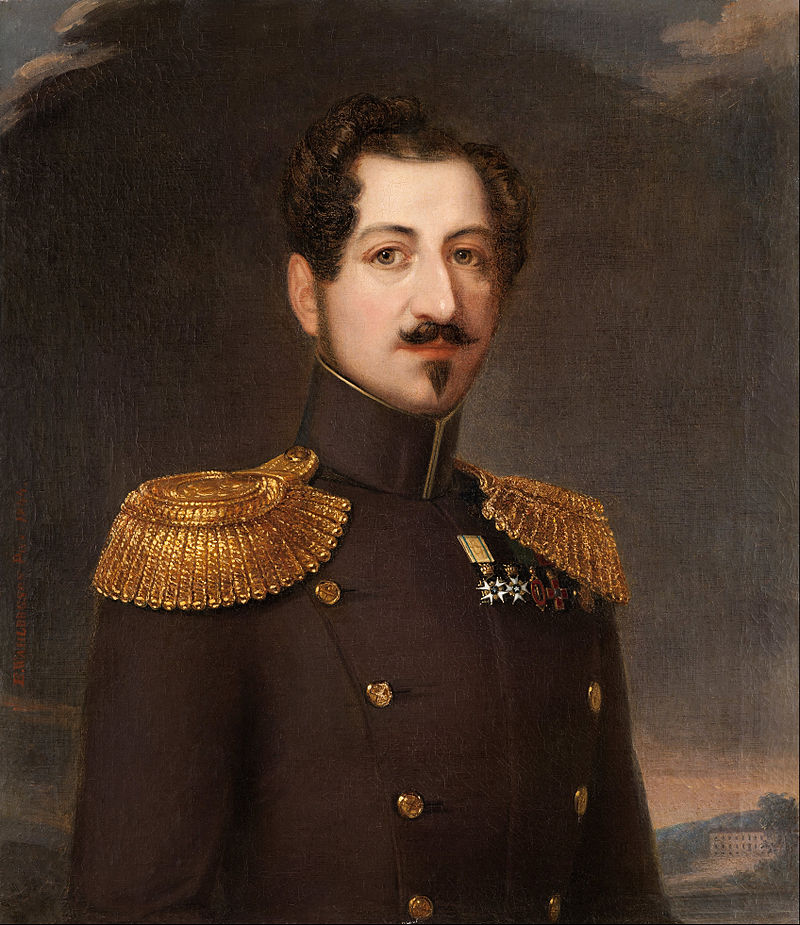
Oscar I of Sweden, Erik (Wahlberg) Wahlbergson - Oscar I, King of Sweden and Norway 1844-1859 - Google Art Project
Erik Wahlbergson · Google Arts Culture: Home page – Image
Key facts
Key facts
• Name — Oscar I • Succession — King of Sweden and Norway • Reign — 8 March 1844 – 8 July 1859 • Coronation — 28 September 1844, Stockholm • Predecessor — Charles XIV & III John • Successor — Charles XV & IV • Birth Name — Joseph François Oscar Bernadotte • Born — 4 July 1799 • Birthplace — Paris, France • Died — 8 July 1859 • Place of death — Stockholm, Sweden • Burial Date — 8 August 1859 • Burial Place — Riddarholm Church • Issue — * Charles XV • Prince Gustaf, Duke of Uppland • Oscar II • Princess Eugenie • Prince August, Duke of Dalarna • House — Bernadotte • Father — Charles XIV John • Mother — Désirée Clary
Early life and family
Early life and family
• Illustration — Oscar's parents, King Carl John and Queen Desideria • Illustration — Oscar Bernadotte a few years before being chosen with his father to be Swedish royalty. Oscar was born at 291 Rue Cisalpine in Paris (today: 32 Rue Monceau) to Jean-Baptiste Jules Bernadotte, then-French Minister of War and later Marshal of the Empire and Sovereign Prince of Pontecorvo, and Désirée Clary, Napoleon Bonaparte's former fiancée. He was named Joseph after his godfather Joseph Bonaparte, who was married to his mother's elder sister Julie, but was also given the names François Oscar. The latter name was chosen by Napoleon after one of the heroes in the Ossian cycle of poems, and was the name that came to be used in the family, mainly by the mother and the aunt. Désirée is said to have chosen Napoleon to be Oscar's godfather. He spent his first years in France, living with his mother and aunt, partly in Paris, partly at Joseph Bonaparte's country residence, the Château de Mortefontaine north of Paris. In 1807, he received his first tutor, Le Moine.
Prince of Sweden
Prince of Sweden
As the Swedish king Charles XIII was without legitimate heirs, and Sweden therefore was without an heir to the throne, Oscar's father was proposed as a possible candidate to the Swedish throne in 1810. As one of the arguments for his election, it was argued that he already had a son and the future succession to the throne was secured. A portrait of the young Oscar was handed out at the Diet of the Four Estates assembled in Örebro to elect an heir to the throne, serving as a lever for the election of Bernadotte. On 21 August 1810, the Riksdag elected Oscar's father as heir-presumptive to the Swedish throne. Two months later, on 5 November, he was formally adopted by the king under the name of "Charles John"; Oscar was then created a Prince of Sweden with the style of Royal Highness, and further accorded the title of Duke of Södermanland. Oscar and his mother moved from Paris to Stockholm in June 1811; while Oscar soon acclimated to life at the royal court, quickly acquiring the Swedish language, Désirée had difficulty adjusting and despised the cold weather. Consequently, she left Sweden in the summer of 1811, and would not return until 1823. Oscar, who was accompanied to Sweden by Le Moine, immediately got a teacher of Swedish and was soon able to serve as his father's interpreter. On 17 January 1816, Oscar was elected an honorary member of the Royal Swedish Academy of Sciences, and in 1818 was appointed chancellor of Uppsala University, where he spent one semester. Oscar became Crown Prince in 1818 upon the death of his adoptive grandfather, and the accession of Charles John to the Swedish and Norwegian thrones.
Marriage and issue
Marriage and issue
• Illustration — Medal for Oscar and Josephine 1829 Seeking to legitimise the new Bernadotte dynasty, Charles XIV John had selected four princesses as candidates for marriage, in order of his priority: • Vilhelmina of Denmark (born 18 January 1808), daughter of Frederick VI of Denmark and Marie Sophie of Hesse-Kassel (ultimately she married first Frederick VII of Denmark and second Karl, Duke of Schleswig-Holstein-Sonderburg-Glücksburg) • Josephine of Leuchtenberg (born 14 March 1807), daughter of Eugene, 1st Duke of Leuchtenberg and Augusta of Bavaria, and granddaughter of the Empress Josephine. • Marie of Hesse-Kassel (born 6 September 1804), daughter of William II, Elector of Hesse and Augusta of Prussia (ultimately she married Bernard II of Saxe-Meiningen) • Marie of Saxe-Weimar-Eisenach (born 3 February 1808), daughter of Charles Frederick I of Saxe-Weimar and Maria Pavlovna of Russia (ultimately she married Prince Charles of Prussia) Oscar would eventually marry Josephine, first by proxy at the Leuchtenberg Palace in Munich on 22 May 1823 and in person at a wedding ceremony conducted in Stockholm on 19 June 1823. The couple had five children: • King Charles XV & IV (1826–1872) • Prince Gustaf, Duke of Uppland (1827–1852) • King Oscar II (1829–1907) • Princess Eugenie (1830–1889) • Prince August, Duke of Dalarna (1831–1873) Oscar also had two extramarital sons (unofficially called the Princes of Lapland) by actress Emilie Högquist: • Hjalmar Högquist, born 18 June 1839 in Hamburg, died 1874 in London. • Max Högquist, born 12 August 1840 in Stockholm, died 1872 in China. By Countess Jaquette Löwenhielm (née Gyldenstolpe) Oscar had a premarital daughter: • Anna Maria Oscara Hilder née Meijergeer (1819–1880)
Crown Prince
Crown Prince
• Illustration — Portrait of Oscar as Crown Prince by Joseph Karl Stieler, 1823 In 1824 and 1833, Oscar briefly served as Viceroy of Norway. In 1832–1834 he completed the romantic opera Ryno, the errant knight, which had been left unfinished on the death of the young composer Eduard Brendler. In 1839 he wrote a series of articles on popular education, and in 1841 anonymously published Om Straff och straffanstalter, a work advocating prison reforms.
Reign
Reign
• Illustration — Coronation medal 1844 • Illustration — Daguerreotype of Oscar I in 1844; this is the first known photograph of a Swedish monarch. In 1838 Charles XIV John began to suspect that his son was plotting with the Liberal politicians to bring about a change of ministry, or even his own abdication. If Oscar did not actively assist the opposition on this occasion, his disapprobation of his father's despotic behaviour was notorious, though he avoided an actual rupture. Yet his liberalism was of the most cautious and moderate character, as the opposition—shortly after his accession to the thrones in 1844—discovered to their great chagrin. The new king would not hear of any radical reform of the cumbersome and obsolete 1809 Instrument of Government, which made the king a near-autocrat. However, one of his earliest measures was to establish freedom of the press. He also passed the first law supporting gender equality in Sweden when he in 1845 declared that in the absence of a will specifying otherwise, brothers and sisters should have equal inheritance. Oscar I also formally established equality between his two kingdoms by introducing new flags with the common Union badge of Sweden and Norway, as well as a new coat of arms for the union. In foreign affairs, Oscar I was a friend of the principle of nationality; in 1848 he supported Denmark against the Kingdom of Prussia in the First War of Schleswig by placing Swedish and Norwegian troops in cantonments in Funen and North Schleswig (1849–1850), and was the mediator of the Truce of Malmö (26 August 1848). He was also one of the guarantors of the integrity of Denmark (the London Protocol, 8 May 1852). As early as 1850, Oscar I had conceived the plan of a dynastic union of the three Scandinavian kingdoms, but such difficulties presented themselves that the scheme had to be abandoned. He succeeded, however, in reversing his father's favored-nation policy towards Imperial Russia. His fear lest Russia should demand a stretch of coast along the Varanger Fjord induced him to remain neutral during the Crimean War, and, subsequently, to conclude an alliance with the United Kingdom and the Second French Empire (25 November 1855) for preserving the territorial integrity of Sweden-Norway.
Death
Death
• Illustration — Oscar on his deathbed in 1859 In the 1850s, Oscar's health began to rapidly deteriorate; he became paralyzed in 1857 and died two years later at the Royal Palace in Stockholm on 8 July 1859, four days after his 60th birthday. He was buried in the traditional burial site for Swedish monarchs, the Riddarholmen Church on the islet of Riddarholmen in central Stockholm. His eldest son, who had served as regent during his absence, succeeded him as Charles XV. • Illustration — Photograph of Oscar I (right) and his son Prince Gustaf (left), c. 1852
Arms and monogram
Arms and monogram
* Crown Prince, Duke of Södermanland (1818–1826) — Crown Prince, Duke of Södermanland (1826–1844) — King Oscar I of Sweden and Norway — Royal Monogram of King Oscar I of Sweden
Identity and origins
Identity and origins
The authorities additionally record the headings Oscar I, Oskar and Oskar I. His recorded languages were Norwegian, Swedish and French. His recorded confession was Lutheranism. He was the child of Charles XIV John of Sweden and Désirée Clary. He married Josephine of Leuchtenberg. 4 children are recorded: Carl XV of Sweden, Prince Gustaf, Duke of Uppland, Oscar II of Sweden and Prince August, Duke of Dalarna.
Career and activity
Career and activity
Recorded positions include Monarch of Sweden, Monarch of Norway and Master-General of the Ordnance. He belonged to Royal Swedish Academy of Sciences, Saint Petersburg Academy of Sciences, Russian Academy of Sciences, Royal Swedish Academy of Letters, History and Antiquities and Royal Society.
Identity
Identity
Oscar I of Sweden is recorded with the occupation composer. Recorded as monarch and composer.
Life and career
Dated record
Life and career
The full dated record · 2 entries
1799
Oscar I of Sweden was born on 4 July 1799.
1859
Oscar I of Sweden died at Stockholm Palace.
Places
Named by the record
Places
Only places the record itself states, plotted where the house gazetteer settles their coordinates. Nothing is inferred from a name or a nationality.
Paris.
Birth place
Stockholm Palace.
Death place
Recognition and collections
Where the work is held
Recognition and collections
Oscar I of Sweden received Knight of the Order of the Golden Fleece, Knight of the Order of St. Alexander Nevsky, Order of Saint Anna, 1st class, Order of St. Andrew, Knight Grand Cross of the Military Order of William and Royal Order of the Seraphim.
Documents and archives
Primary material
Documents and archives
reference work
- “Oscar I of Sweden”, English Wikipedia, consulted as further reading
Reputable secondary · Wikipedia
authority record
- Wikidata, structured authority record Q52926: Oscar I of Sweden
General reference · Wikidata
Honours
Swedish and Norwegian honours • Knight and Commander of the Order of the Seraphim, 26 September 1810 • Knight of the Order of Charles XIII, 26 September 1810 • Commander Grand Cross of the Order of the Sword, 26 September 1810 • Commander Grand Cross of the Order of the Polar Star, 26 September 1810 • Commander Grand Cross of the Order of Vasa, 26 September 1810 • Founder and Master of the Royal Norwegian Order of St. Olav, 21 August 1847 Foreign honours
Notes from the source article
Cited by Wikipedia
Notes from the source article
These works are cited by the source article, in its own numbering. They are recorded as its citations, not as sources VALÉORINE has verified.
- 1.Norsk biografisk leksikon. Oscar 1, Konge.
- 2.kongehuset.no. Kong Oscar I (1799–1859).
- 3.Nordisk familjebok. Oskar, konungar af Sverige och Norge.
- 4.Cronholm, Neander N. A History of Sweden from the Earliest Times to the Present Day. 1902.
- 5.Norsk biografisk leksikon. Karl 3 Johan, Konge.
- 6.Norsk biografisk leksikon. Desideria, Dronning.
- 7.Lars Elgklou. Familjen Bernadotte. En släktkrönika. (The Bernadotte family. A family chronicle.). Skogs Boktryckeri Trelleborg. 21. 1995. 91-7054-755-6.
- 8.Store norske leksikon. Karl 2.
- 9.Hjalmar Lagerqvist, Sveriges drottningar
- 10.Norsk biografisk leksikon. Josefine, Dronning.
- 11.Norsk biografisk leksikon. Oscar 2, Konge.
- 12.Söderhjelm & Palmstierna in Oscar I, Bonniers, Stockholm 1944, p. 279
- 13.Lars O. Lagerqvist in Sverige och dess regenter under 1000 år (Sweden and Her Rulers for 1000 years) pp. 273–274
- 14.The Order of St. Olav. www.royalcourt.no.
- 15.Liste der Ritter des Königlich Preußischen Hohen Ordens vom Schwarzen Adler (1851), "Von Seiner Majestät dem Könige Friedrich Wilhelm III. ernannte Ritter" p. 16
- 16.l'Académie Imp. des Sciences. Almanach de la cour: pour l'année . 1817. 63, 78. 1817.
- 17.En la Imprenta Nacional. Guía de forasteros en Madrid para el año de 1850. 80. 1850.
- 18.Bayern. Hof- und Staatshandbuch des Königreichs Bayern: 1858. Landesamt. 7. 1858.
- 19.Beck und Fränkel. Hof- und Adreß-Handbuch des Fürstenthums Hohenzollern-Sigmaringen: 1844. 19. 1844.
- 20.Hof- und Staats-Handbuch des Großherzogtum Baden (1853), "Großherzogliche Orden" p. 31 , 46
- 21.Johann Heinrich Friedrich Berlien. Der Elephanten-Orden und seine Ritter: eine historische Abhandlung über die ersten Spuren dieses Ordens und dessen fernere Entwicklung bis zu seiner gegenwärtigen Gestalt, und nächstdem ein Material zur Personalhistorie, nach den Quellen des Königlichen Geheimen-Staatsarchivs und des Königlichen Ordenskapitelsarchivs zu Kopenhagen. Gedruckt in der Berlingschen Officin. 168–169. 1846.
- 22.Militaire Willems-Orde: Wales, Oscar I. Ministerie van Defensie. 21 June 1849.
- 23.Almanach Royal Officiel. 35. 1850.
- 24.Staat Hannover. Hof- und Staatshandbuch für das Königreich Hannover: 1858. Berenberg. 37, 66. 1858.
- 25."A Szent István Rend tagjai".
- 26.Schellenberg. Staats- und Adreß-Handbuch des Herzogthums Nassau: 1859. 7. 1859.
Bibliography printed in the source article · 2
- Cronholm, Neander N. A History of Sweden from the Earliest Times to the Present Day. 273–288. 1902.
- Ulvros, Eva Helen (2007) Oscar I: en biografi (Stockholm: Historiska media)
References
Citations
References
Each reference names the institution holding it, so a reader may go to the document itself.
reference work
Secondary witnessauthority record
General reference
People, houses and institutions
Knowledge graph
People, houses and institutions
Teachers, collaborators, publishers and institutions recorded against this person, each on a stated basis.
Born at
1- ParisPlace
Established from a fact already recorded on a verified source.
The Encyclopedia exists whether or not anything is for sale. Corrections are recorded rather than overwritten, and every version of this record is kept. Published 17 August 2026.
Elsewhere in Music memorabilia
42,375 published records in this field, each with its sources named.
- Oscar FetrásPerson
- Oscar GhigliaPerson
- Oscar Hammerstein IPerson
- Oscar Hernández FalcónPerson
- Oscar IsaacPerson
- Oscar LevantPerson
- Oscar LopezPerson
- Oscar Lorenzo FernándezPerson
Best supported in this field
For owners
Own a work by Oscar I of Sweden?
A specialist will read what you send and tell you what the house can establish, what it cannot, and whether the object is suited to sale. There is no charge and no obligation. The object stays with you throughout; nothing is shipped to us unless it is arranged in writing beforehand.