
Ortgies Semi-Automatic Pistol
The Ortgies 7.65 mm pistol was a hammerless semi-automatic pistol that was produced in Germany in the years immediately after World War I, first by its inventor Heinrich Ortgies and then by Deutsche Werke. Inexpensive, but of good quality, the pistol achieved considerable success at contemporary shooting competitions and, as an export product, was popular throughout the Americas.
Ortgies Semi-Automatic Pistol
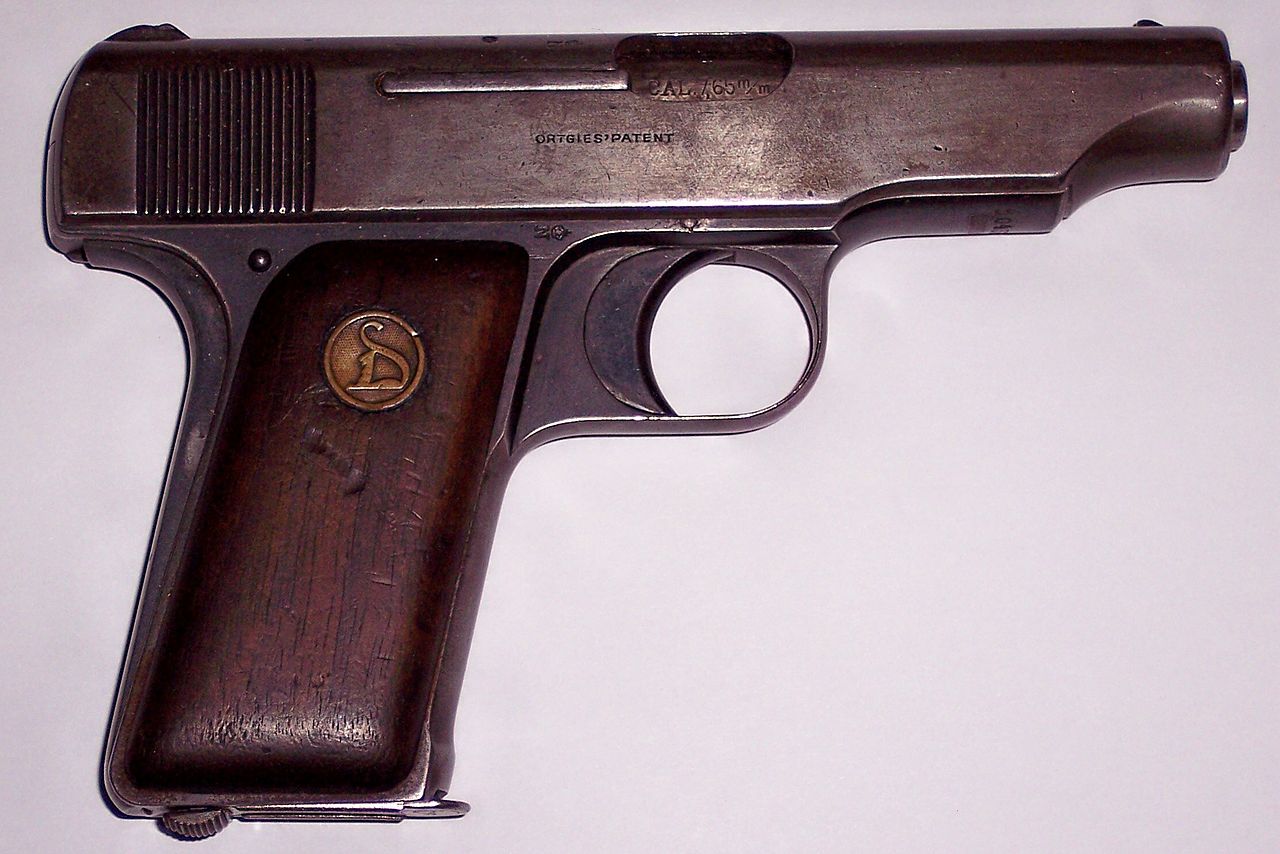
Drhoehl at English Wikipedia · Public domain
- Field
- semi-automatic pistol.
VALÉORINE Encyclopedia
VALÉORINE documentary reading
Documentary summary
The Ortgies 7.65 mm pistol was a hammerless semi-automatic pistol that was produced in Germany in the years immediately after World War I, first by its inventor Heinrich Ortgies and then by Deutsche Werke. Inexpensive, but of good quality, the pistol achieved considerable success at contemporary shooting competitions and, as an export product, was popular throughout the Americas.
Admitted source layer · organised and presented by VALÉORINE
Note VALÉORINE
No house-authored Note is published until its assertions and sources pass the VALÉORINE evidence contract. The documentary article remains available in full while that enrichment is being consolidated.
Documentary enrichment in progress · no unsupported statement published
Reference Check
Propose documentary evidence for Ortgies Semi-Automatic Pistol. A contribution is never written directly as fact: identity, source, rights and evidence gates still decide.
Sign in to contribute
World of VALÉORINE
Documentary connections
Only confirmed graph relationships appear here. Images are shown only when their identity and reuse rights both pass the documentary gate.

Documentary evidence
Evidence Panel
not yet certified
- Identity
- resolved
- Independent source families
- 0
- Admitted assertions
- 0
- Open conflicts
- 0
Authority files
wikidata · Q7104317 · wikipedia · Ortgies semi-automatic pistol
In this article
Design
Design
The pistol was produced in 6.35 mm, 7.65 mm, and 9 mm Kurz variants, all of which used blowback as their operating mechanism. Although not expensive, at the time it was of advanced design and high quality construction with relatively few parts, well sealed against dirt. Metal components were forged or machined, and assembly in general made no use of screws, even securing the wooden grips with a spring-loaded metal fastener inside the magazine well, although some examples do incorporate a single screw for that purpose. The hammerless action depended on a spring-loaded striker to fire the cartridge. As in early Colt and Browning pocket pistols, the Ortgies striker also operated as an ejector as the slide traveled backwards after discharge. Unusual design features included the safety and the magazine. The safety was a lever inset into the back of the grip and, with the gun cocked, forced backward out of the grip into the "safe" position by spring tension from the firing pin upon depression of a button under the slide. Thus, engaging the safety simultaneously reduced tension on the firing pin spring. To disengage the safety, a shooter simply would squeeze the grip, pressing the lever forward and locking it flush with the back of the frame. At least the earlier Ortgies magazines could accommodate both 7.65mm (aka.32 ACP) and 9 mm Kurz, (aka.380 ACP) ammunition and were interchangeable between pistols of either calibre. One side of the magazine was marked for 7.65 mm and featured seven holes showing the positions that cartridges of that size would occupy when loaded; the other side had similar holes and markings for 9 mm cartridges. Modern replacement magazines are purpose-built for one caliber only.
Production
Production
Heinrich Ortgies designed the pistol while living in Liège, Belgium during World War I. After the war, he moved to Erfurt, Germany, where in 1919 he commenced production of the pistol in his own factory. The weapons bore the mark "Ortgies & Co. – Erfurt" on their slides and a circular brass insert in their grips marked with a stylized "HO". The production of the pistols eventually passed to Deutsche Werke in 1921, a shipbuilding company headquartered in Berlin. For a short time thereafter, the slide marking was changed to "Deutsche Werke Aktiengesellschaft Berlin" before changing again to "Deutsche Werke Aktiengesellschaft Werke Erfurt", which was ultimately shortened to "Deutsche Werke – Werke Erfurt". Deutsche Werke pistols continued to feature the "HO" brass grip inset until relatively late in their production, when they substituted one with a new trademark depicting a stylized crouching cat with long tail forming an S-curve over its back. In keeping with prevalent economics in Germany at the time, factory finishes were limited to bluing or, rarely, nickel. The latter finish could be either matte or bright. No Ortgies pistol was produced with a chrome finish or, aside from one known salesman's sample, with factory engraving. Production ceased in 1924.
Performance
Performance
The Ortgies was a well-balanced, sturdy weapon that found considerable favor in competitive shooting. In 1921, prize winners at some 70% of principal shooting competitions had chosen Ortgies 7.65 mm pistols, and the winner of the German championship on 26 September 1921, at Halensee, Germany, took the prize firing an Ortgies. The US outlaw John Dillinger carried an Ortgies. Several hundred Ortgies pistols in both.25 and.32 ACP saw service with Finnish prison authorities throughout World War II
Historic Examples
Historic Examples
An Ortgies pistol chambered in 6.35 mm, was presented to Eva Braun by Adolf Hitler. It differs only slightly from a standard Ortgies pistol, in that it has a small gold plate inlaid into the side of the slide, stamped "Eva Braun". The pistol was removed from her house following World War II, and has made its way through a few auction houses since.
Licensing
Text attribution
Part of the biographical narrative on this page reuses licensed material. Its origin, revision and licence are recorded here.
The biographical narrative on this page is based on the Wikipedia article Ortgies semi-automatic pistol, revision 1372552088 (EN edition), by its contributors. VALÉORINE has edited that text and built its own documentary record around it. The reused material is available under CC BY-SA 4.0, and this page's reuse of it is offered under the same licence. Everything else on this page — the chronology, the holdings, the evidence, the plates and the connections — is VALÉORINE's own record. Sources and licences.
Notes from the source article
Cited by Wikipedia
Notes from the source article
These works are cited by the source article, in its own numbering. They are recorded as its citations, not as sources VALÉORINE has verified.
- 1.Koelliker, Donald W., "Ortgies: A Well-Known but Little Studied German Armsmaker of the Early Post-War Years," Gun Collector's Digest 1981, accessed April 19, 2010
- 2.REME Museum of Technology Internet site, accessed April 19, 2010.
- 3.Ortgies Automatic Pistols: Not as Boring as You Think!.
- 4."Deutsche Werke – Ortgies," Belgian Littlegun Internet site, referencing Ian Hogg and John Weeks, Pistols of the World, accessed April 19, 2010
- 5.Guns and the Gunfighters, by the editors of Guns and Ammo, New York: Bonanza Books, 1975 ( ), dustjacket quoted at Arms2armor Internet site, accessed April 22, 2010
- 6.Jaeger Platoon: Finnish Army 1918–1945 Internet site, accessed April 19, 2010.
- 7.https://www.rockislandauction.com/detail/57/1502/deutsche-werke-ortgies-pistol-635-mm-auto
References
Citations
References
Each reference names the institution holding it, so a reader may go to the document itself.
reference work
Partially resolvedreference work
Partially resolved
Connections
Knowledge graph
Connections
Each connection was recorded deliberately, with the basis for it kept on the internal record.
Broader subject
1- semi-automatic pistolTerminology
Established from a fact already recorded on a verified source.
The Encyclopedia exists whether or not anything is for sale. Corrections are recorded rather than overwritten, and every version of this record is kept. Published 14 August 2026.
Elsewhere in Militaria
6,095 published records in this field, each with its sources named.
- OreshnikTerminology
- Origin-12Terminology
- Orita M1941Terminology
- Orsini bombTerminology
- OstwindTerminology
- OSU-35KTerminology
- OSV-96Terminology
- OTO Melara 76 mm gunTerminology
Best supported in this field
For owners
Own an object connected with Ortgies Semi-Automatic Pistol?
A specialist will read what you send and tell you what the house can establish, what it cannot, and whether the object is suited to sale. There is no charge and no obligation. The object stays with you throughout; nothing is shipped to us unless it is arranged in writing beforehand.