
Olympe Aguado
Count Olympe-Clemente-Alexandre-Auguste Aguado (3 February 1827 – 25 October 1894) was a Franco-Spanish photographer and socialite, active primarily in the 1850s and 1860s. One of several early photographers who learned the practice from Gustave Le Gray, Aguado pioneered a number of photographic processes, including carte de visite photographs and photographic enlargement processes. He was also a founding member of the influential French Photographic Society in 1854.
Also recorded as Olympe Clemente Aguado · Olympe Aguado de las Marismas · Olympe-Clemente-Alexandre-Auguste Aguado de las Marismas, comte · Olympe, Comte Aguado
Olympe Aguado
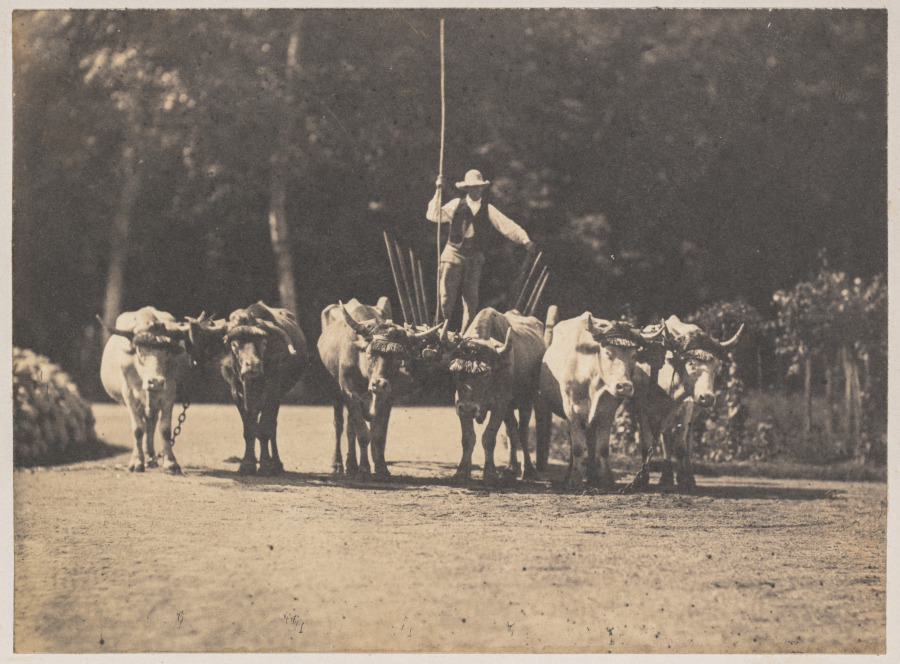
Olympe Aguado · The Cleveland Museum of Art · John L. Severance Fund · CC0
- Name
- Olympe Aguado
- Born
- 3 February 1827
- Birthplace
- Paris, France
- Died
- 25 October 1894
- Place of death
- Compeigne, France
- Full name
- Olimpio Clemente Alexandro Augusto Aguado y Remirez Angulo de Estenoz.
- Nationality
- France.
- Occupation
- photographer.
- Education
- Lycée Henri-IV.
- Teachers
- Gustave Le Gray.
- Honours
- Knight of the Legion of Honour.
- Languages
- French.
VALÉORINE Encyclopedia
VALÉORINE documentary reading
Documentary summary
Count Olympe-Clemente-Alexandre-Auguste Aguado (3 February 1827 – 25 October 1894) was a Franco-Spanish photographer and socialite, active primarily in the 1850s and 1860s. One of several early photographers who learned the practice from Gustave Le Gray, Aguado pioneered a number of photographic processes, including carte de visite photographs and photographic enlargement processes. He was also a founding member of the influential French Photographic Society in 1854.
Admitted source layer · organised and presented by VALÉORINE
Note VALÉORINE
Olympe Aguado (1827–1894) was a French photographer. Born in former 2nd arrondissement of Paris, the photographer died in Compiègne.
Olympe Aguado studied at Lycée Henri-IV. The photographer was a member of Société française de photographie and Société héliographique.
Languages used include French. Works by Olympe Aguado are held at Museum of Modern Art, National Gallery of Canada and The Nelson-Atkins Museum of Art. The photographer received Knight of the Legion of Honour.
Composed from admitted, traceable facts · 01 October 2026
VALÉORINE
Reference Check
Propose documentary evidence for Olympe Aguado. A contribution is never written directly as fact: identity, source, rights and evidence gates still decide.
Sign in to contribute
World of VALÉORINE
Documentary connections
Only confirmed graph relationships appear here. Images are shown only when their identity and reuse rights both pass the documentary gate.
Documentary evidence
Documentary basis
Authority files
wikidata · Q2734214 · wikipedia · Olympe Aguado
In this article
Biography
Biography
Olympe Aguado studied at Lycée Henri-IV. Training under Gustave Le Gray is recorded. The recorded working language is French. Work by Olympe Aguado is recorded in the collections of The Nelson-Atkins Museum of Art, National Gallery of Canada, Museum of Modern Art and J. Paul Getty Museum. Distinctions recorded are Knight of the Legion of Honour.
Key facts
Key facts
• Name — Olympe Aguado • Born — 3 February 1827 • Birthplace — Paris, France • Died — 25 October 1894 • Place of death — Compeigne, France • Parents — Alejandro Aguado, 1st Marquess of Marismas del Guadalquivir Maria de Carmen Vidoire Moreno • Relatives — Onésipe Aguado (brother)
Life
Life
Aguado was born in Paris in 1827, the second son of the 1st Marquess of Marismas del Guadalquivir (1784–1842) and Maria de Carmen Vidoire Moreno. His father had been a supporter of Joseph Bonaparte during the Peninsular War (1808-1814). Following the war, he went into exile in Paris, and rose to become one of the wealthiest bankers in France. In the 1820s and 1830s, he negotiated a series of loans that saved Spain from bankruptcy, and King Ferdinand VII of Spain conferred on him the title of Marquess of Marismas del Guadalquivir. Upon his death, his sons, including Olympe, inherited a considerable fortune. • Illustration — Hunting Dogs In the late 1840s, Aguado learned photography from pioneering French photographer Gustave Le Gray. From his studio on the Place Vendôme, he initially worked with daguerreotypes, but by the early 1850s, was already experimenting with other photographic processes, namely with negative paper and collodion on glass. In 1854, he and Edouard Delessert developed the carte-de-visite printing method as a way to add portraits to visiting cards (the process was patented by Eugène Disderi later that year). Later in the decade, he experimented with enlargement processes. Like Le Gray, Aguado taught photography to a number of his friends, among them Camille Silvy. Aguado was a member of the early French photographic organization, the Société héliographique, in the early 1850s. In 1854, he was a founding member the Société héliographique's more inclusive successor, the French Photographic Society (Société française de photographie). This organization would prove influential in subsequent decades in the development and promotion of photography in France. Aguado frequently served as a judge for the Society's exhibitions during the 1850s and 1860s. Aguado was a frequent figure at the court of Emperor Napoleon III, and photographed both the emperor and his wife, Eugénie. Aguado's photographs during this period included a number of staged portraits that poked fun at the mores and habits of Second Empire nobility. By the end of the 1860s, Aguado had largely lost interest in photography, and produced few photographs in subsequent decades. He died in Compeigne in 1894. Olympe's younger brother, Onésipe (1830–1893), was also a photographer, and the two collaborated on a number of projects. A nephew of Olympe Aguado, Henry Tenre, was a noted early-20th-century painter.
Works
Works
• Illustration — La Lecture Most of Aguado's photographs consist of landscapes (especially trees, rivers, and pastoral scenes) and portraits. He had a penchant for experimenting with new photographic processes, and thus produced photographs using numerous different mediums. Surviving Aguado daguerreotypes include Intérieur d'un hôtel particulier, which depicts the interior of a large house. Salt paper prints by Aguado include Still Life with Garden Equipment (1855) and Study of Trees, Bois de Boulogne (1855). He initially preferred collodion on glass for portraits, but later switched to albumen prints. No known examples of Aguado's enlargement experiments have survived. Some of Aguado's most interesting images consist of a series of staged family portraits, or "living pictures," taken in the 1860s as an apparent critique of Second Empire nobility. The most well-known of these include Admiration, which depicts several people with their backs turned to the camera admiring a painting, and La Lecture, which depicts a man reading to a bored audience (some of whom are falling asleep). Aguado's photographs are included in the collections of the Getty Museum, the Musée d'Orsay, the French Photographic Society, and the Strasbourg Museum of Modern and Contemporary Art.
Gallery
Gallery
• Illustration — The Artist, His Mother, and Friends in Fishing Garb • Illustration — Chateau de Sivry interior • Illustration — Admiration • Illustration — An early pastoral scene
Places
Named by the record
Places
Only places the record itself states, plotted where the house gazetteer settles their coordinates. Nothing is inferred from a name or a nationality.
former 2nd arrondissement of Paris.
Birth place
Compiègne.
Death place
Primary material
Documents and archives
reference work
- “Olympe Aguado”, English Wikipedia, consulted as further reading
Reputable secondary · Wikipedia
authority record
- Wikidata, structured authority record Q2734214: Olympe Aguado
General reference · Wikidata
Notes from the source article
Cited by Wikipedia
Notes from the source article
These works are cited by the source article, in its own numbering. They are recorded as its citations, not as sources VALÉORINE has verified.
- 1.Denis Canguilhem, John Hannavy (ed.), Encyclopedia of Nineteenth-Century Photography, Vol. 1 (Routledge, 2007), pp. 21-22.
- 2.Hugh Chisholm (ed.), "Alexandre Marie Aguado," Encyclopædia Britannica, Vol. 1, 11th ed. (1910-11), p. 427.
- 3.Masterpieces of the J. Paul Getty Museum, 1999, p. 40.
- 4.Mark Haworth-Booth, Photographer of Modern Life: Camille Silvy (London: National Portrait Gallery, 2010), p. 22.
- 5.Helmut Gernsheim, The History of Photography from the Camera Obscura to the Beginning of the Modern Era (New York: McGraw-Hill, 1969), pp. 191, 293.
- 6.Imbert de Saint-Amand, The Court of the Second Empire (New York: Charles Scribner's Sons, 1898), p. 132.
- 7.Comte Fleury, Memoirs of the Empress Eugénie (London: D. Appleton and Company, 1920), p. 358.
- 8.Emperor Napoleon III photograph, Metropolitan Museum of Art. Retrieved: 21 February 2012.
- 9.Empress Eugénie photograph, Metropolitan Museum of Art. Retrieved: 21 February 2012.
- 10."Filiation du peintre Henry Tenre," L'Interimédiaire des chercheurs et curieux, 2002, p. 745. Snippet view in Google Books search: "This genre painter (1864-1926) is quoted in an announcement of death, as grandnephew of Count Olympe Aguado, who died in 1894."
- 11.Getty Search Gateway search for Aguado, Olympe. Accessed: 21 February 2012.
References
Citations
References
Each reference names the institution holding it, so a reader may go to the document itself.
reference work
Secondary witnessauthority record
General reference
The Encyclopedia exists whether or not anything is for sale. Corrections are recorded rather than overwritten, and every version of this record is kept. Published 18 August 2026.
Elsewhere in Photography
11,392 published records in this field, each with its sources named.
- Olivier RollerPhotographer
- Olivier ZabatPhotographer
- Olivo BarbieriPhotographer
- Olu OguibePhotographer
- Omar BadshaPhotographer
- Omar Borkan Al GalaPhotographer
- Omar Victor DiopPhotographer
- Ömer AsanPhotographer
Best supported in this field
For owners
Own a work by Olympe Aguado?
A specialist will read what you send and tell you what the house can establish, what it cannot, and whether the object is suited to sale. There is no charge and no obligation. The object stays with you throughout; nothing is shipped to us unless it is arranged in writing beforehand.