
Okumura Masanobu
Illustration — "Shōki zu" (Shōki striding), by Okumura Masanobu in pillar print format, c. 1741–1751 Okumura Okumura Masanobu (1686 – 13 March 1764) was a Japanese print designer, book publisher, and painter. He also illustrated novelettes and in his early years wrote some fiction.
Also recorded as Tanchōsai · Masanobu · Genpachi Okumura · Genpachirō
Okumura Masanobu
Okumura Masanobu · The Cleveland Museum of Art · Gift of Mr. and Mrs. J. H. Wade · CC0
- Nationality
- Japan.
- Occupation
- painter, xylographer, publisher, writer, artist and bookseller.
- Fields
- shunga and erotic art.
- Movements
- hashira-e and uki-e.
VALÉORINE Encyclopedia
VALÉORINE documentary reading
Documentary summary
Illustration — "Shōki zu" (Shōki striding), by Okumura Masanobu in pillar print format, c. 1741–1751 Okumura Okumura Masanobu (1686 – 13 March 1764) was a Japanese print designer, book publisher, and painter. He also illustrated novelettes and in his early years wrote some fiction.
Admitted source layer · organised and presented by VALÉORINE
Reference Check
Propose documentary evidence for Okumura Masanobu. A contribution is never written directly as fact: identity, source, rights and evidence gates still decide.
Sign in to contribute
Documentary evidence
Documentary basis
Authority files
getty · 500121074 · gnd · 133885623 · wikidata · Q3350120 · wikipedia · Okumura Masanobu
In this article
Life and career
Life and career
At first his work adhered to the Torii school, but later drifted beyond that. He is a figure in the formative era of ukiyo-e doing early works on actors and bijin-ga ("pictures of beautiful women").
Okumura Toshinobu, Masafusa Okumura and Okumura Masatoshi are recorded as having studied under Okumura Masanobu. The field of work recorded is shunga and erotic art. Places of work recorded in the authority are Japan. Work by Okumura Masanobu is recorded in the collections of Minneapolis Institute of Art, Art Institute of Chicago, The Nelson-Atkins Museum of Art, Auckland Art Gallery and Finnish National Gallery.
While Masanobu's early life is largely undocumented, he is believed to have been born about 1686, possibly in Edo (modern Tokyo). Edo was a small fishing village when Tokugawa Ieyasu chose it as his administrative capital of the Tokugawa shogunate, and by the early 17th century the city had prospered and its population had grown to half a million. Masanobu appears to have been self-taught painter (though he did study poetry under Tachiba Fukaku); he is not known to have belonged to any artistic school. Over his career he used several gō art names, including Bunkaku, Genroku, Hōgetsudō, Shidōken and Tanchōsai. His early work shows the influence of the Torii school of ukiyo-e painting, particularly Torii Kiyonobu I, and he likely learned from the examples of Torii Kiyomasa and the early ukiyo-e artist Hishikawa Moronobu. A print album published by Kurihara Chōemon in 1701 depicting courtesans in the Yoshiwara pleasure district is Masanobu's earliest surviving signed work, followed by a similar work ten months later. Moronobu provided the illustrations, and sometimes text, for at least twenty-two ukiyo-zōshi novels and librettos for puppet theatre between 1703 and 1711. These included a modernized illustrated version of the 11th-century Tale of Genji in eighteen volumes, whose translation was by Masanobu. After 1711 Masanobu's output of book illustrations shriveled as he turned his attention to albums of prints, usually about a dozen per set, on a variety of themes—most outstanding of which were the comic albums. These prints, influenced perhaps by 12th-century Toba-e and the caricature paintings of Hanabusa Itchō (1652–1724), depicted humorous scenes from, or parodies of, Noh, kabuki, and Japanese mythology. This period also saw Masanobu produce large kakemono-sized portraits of courtesans, whose designs had a warmth and humanity largely absent from the earlier Torii and Kaigetsudō beauties. The financial restraints of the Kyōhō Reforms begun in 1717 brought an end to the luxury of these large prints, replaced by smaller hosoban-sized prints, which were often sold as triptychs—which when placed together were little smaller than the kakemono-sized prints. At least as early as 1718, Masanobu's were some of the earliest urushi-e prints, printed with brass powder sprinkled on the ink, which created a lacquer effect. About 1721 Masanobu abandoned the publishers of his earlier works and opened his own wholesaler, Okumura-ya, in Tōri Shio-chō in Edo. His trade mark was a gourd-shaped sign, a mark he thereafter stamped on the works he printed. It is likely that Masanobu died at 78 in 1764; 1769 has also been given as his death date.
Art styles
Art styles
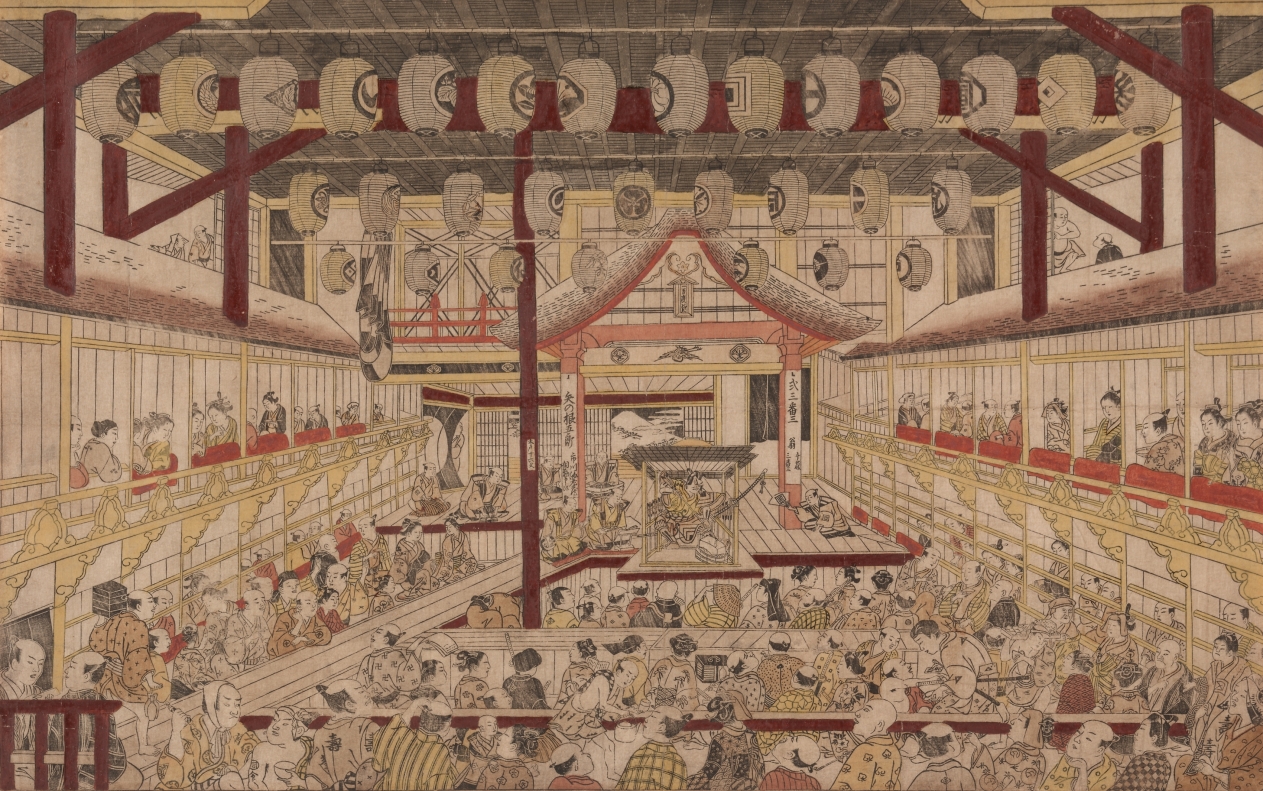
Okumura Masanobu is said to be master of the urushi-e style. Urushi-e is usually done on woodblocks and has thick black lines. Styles of urushi-e can be found in many works from Masanobu. The most famous examples are Large Perspective View of the Interior of Echigo-ya in Suruga-chô, Actor holding folders, Actor as Wakanoura Osana Komachi, Actors Ôtani Hiroji and Sodesaki Iseno, and Lion, Peonies, and Rock. All of these works have dark, thick lines and are made on woodblocks. His works are famous for his gentile and flowing lines throughout his drawings. He has a recurring pattern consisting of tan backgrounds and neutral coloring. His pieces capture things and or people in motion. His objects in drawings are always in mid-motion of walking somewhere or doing something. Masanobu was famous for capturing the beauty of nature. He painted and drew birds, women, men, actors, and warriors. The Japanese women he draws have the same style and 'boneless' structure. The faces show; however, the bodies are covered by long, flowing dresses. This style is referred to as tan-e: drawing women as full-bodied and round. The tan-e style brings a sense of gentleness and gracefulness to the beauties. Okumura Masanobu's art consists of the insights of stores and theatres. These pieces are large-scale and referred to as uki-e. Uki-e is a style used by Japanese artists that means "looming picture". He was very good at capturing the luxury and leisure of his paintings on theatre. He played around and experimented with all kinds of styles on woodprints and was always willing to learn more. By experimenting, he created and is said to be the first artist to make pillar prints. Okumura is also said to be the creator of the large, wide, vertical prints referred to as habahiro hashira-e. Many of his scripts are examples of this style of print. Although early commentators credited Masanobu as the first to introduce uki-e into ukiyo-e prints and paintings, the earliest known printed example is now attributed to Torii Kiyotada I, from around 1739–40; Masanobu's own uki-e works followed shortly afterward, and he was particularly skilled at depicting interiors. Masanobu was known for staying true to his time and what he was good at. He created many new styles that are used today; without him art wouldn't be the same. Masanobu's ukiyo-e were mostly produced in the Kyōhō era. They display the printmaker's sense of line, colour, and composition. The subjects are most often humorous and are executed in a lively manner with figures in brightly coloured, fashionable clothing.
Gallery
Gallery
• Illustration — A Roofer's Precariousness • Illustration — Daytime in the Gay Quarters • Illustration — Tiger and Bamboo, c. 1725 • Illustration — Morita-za • Illustration — Taking the Evening Cool by Ryōgoku Bridge, 1745 • Illustration — Shibai Uki-e, c. 1741–44
Life and career
Dated record
Life and career
Explore 1686–1764
The full dated record · 3 entries
1686
Okumura Masanobu born at Edo.
1749
Ichikawa Ebizo II as Sukeroku is dated 1749.
1764
Okumura Masanobu died.
Legacy
The era Masanobu was born into was a prosperous and creatively fertile one, in which flourished the haiku poets Matsuo Bashō and Ihara Saikaku, the bunraku dramatist Chikamatsu Monzaemon, and the painter Ogata Kōrin. Masanobu was one of the most influential innovators of the ukiyo-e form, introducing the comic album, the pillar, two-colour, and lacquer prints, and popularizing Western-style perspective drawing. His career saw ukiyo-e evolve from its monochromatic origins to the verge of the full-colour nishiki-e revolution of Suzuki Harunobu's time. Though less known to the public than masters such as Sharaku and Hokusai, Masanobu has gained the regard of connoisseurs as one of the greatest ukiyo-e artists, held in esteem by Japanese collectors such as Kiyoshi Shibui and Seiichirō Takahashi, and Westerners such as Ernest Fenollosa, Arthur Davison Ficke, and James A. Michener.
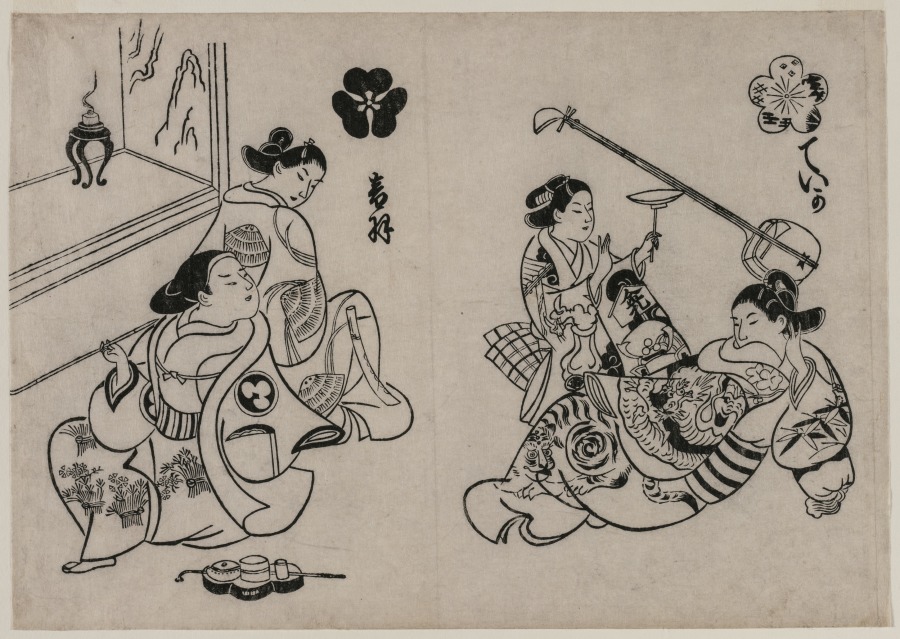
Three Courtesans with a Client, by Okumura Masanobu
Okumura Masanobu · The Cleveland Museum of Art · The Kelvin Smith Collection, given by Mrs. Kelvin Smith
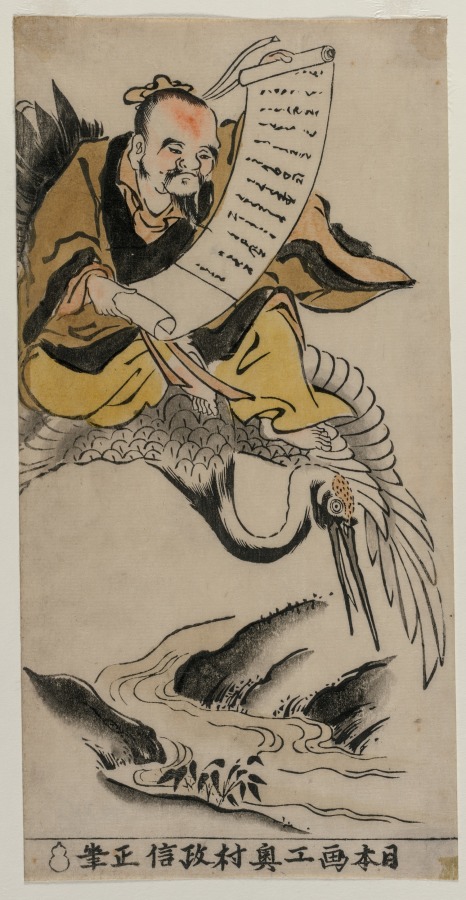
The Taoist Immortal Kung Ho (?) Riding a Crane, c. mid 1720s, by Okumura Masanobu
Okumura Masanobu · The Cleveland Museum of Art · Gift of Mr. and Mrs. J. H. Wade
Primary material
Documents and archives
authority file
- Gemeinsame Normdatei 133885623, Okumura, Masanobu.
General reference · Deutsche Nationalbibliothek
- Getty Union List of Artist Names 500121074, Okumura Masanobu.
General reference · The Getty Research Institute
reference work
- Wikidata, structured authority record Q3350120: Okumura Masanobu
Reputable secondary · Wikimedia Foundation
- “Okumura Masanobu”, English Wikipedia, consulted as further reading
Reputable secondary · Wikipedia
Notes from the source article
Cited by Wikipedia
Notes from the source article
These works are cited by the source article, in its own numbering. They are recorded as its citations, not as sources VALÉORINE has verified.
- 1.Marks, Andreas. Japanese woodblock prints Artists, Publishers and Masterworks 1680-1900. Tuttle Publishing. 2010. 978-4-8053-1055-7.
- 2.Milone, Marco. Ukiyo-e. L'Erudita. 59. 2022. 9788867707270.
Bibliography printed in the source article · 7
- cite book
- Okumura Masanobu. Museum of Fine Arts, Boston.
- Okumura Masanobu. Biography.com.
- Artwork images, Exhibitions, and Reviews: Okumura Masanobu.
- Rosenberg, K. (March 14, 2006). "Diversions and Delights from the Floating World". The New York Times.
- Meech, J. & Oliver, J. 2008. Designed for pleasure: the world of Edo Japan in prints and paintings. New York: Asia Society and Japanese Art Society of America.
- Okumura Masanobu. The British Museum.
References
Citations
References
Each reference names the institution holding it, so a reader may go to the document itself.
authority file
Gemeinsame Normdatei 133885623, Okumura, Masanobu.Deutsche Nationalbibliothek
Secondary witnessauthority file
Getty Union List of Artist Names 500121074, Okumura Masanobu.The Getty Research Institute
Secondary witnessreference work
Wikidata, structured authority record Q3350120: Okumura MasanobuWikimedia Foundation
Secondary witnessreference work
Secondary witness
The Encyclopedia exists whether or not anything is for sale. Corrections are recorded rather than overwritten, and every version of this record is kept. Published 14 August 2026.
Elsewhere in Paintings
19,183 published records in this field, each with its sources named.
- Okada SaburosukeArtist
- Oksana MasArtist
- Oksana ShachkoArtist
- Okuda San MiguelArtist
- Olaf IsaachsenArtist
- Olaf KühnemannArtist
- Olaf PooleyArtist
- Olav Christopher JenssenArtist
Best supported in this field
For owners
Own a work by Okumura Masanobu?
A specialist will read what you send and tell you what the house can establish, what it cannot, and whether the object is suited to sale. There is no charge and no obligation. The object stays with you throughout; nothing is shipped to us unless it is arranged in writing beforehand.