
Obice da 149/12
The Obice da 149/12 was an Italian howitzer produced under license in Italy by Ansaldo and Vickers-Terni which was used during World War I and World War II.
Obice da 149/12
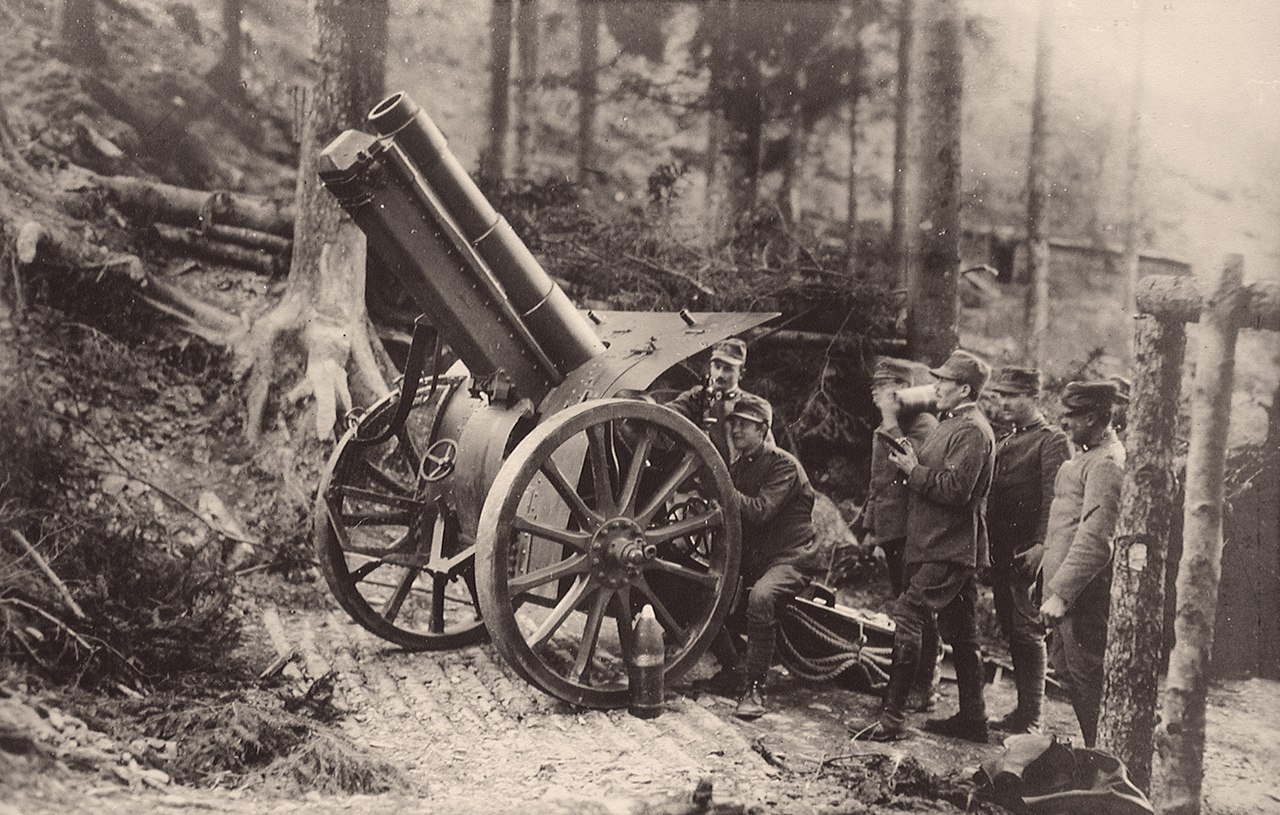
Italian Army · CC BY 2.5
- Name
- Obice da 149/12
- Field
- howitzer.
- Region
- Italy.
Reference Check
Propose documentary evidence for Obice da 149/12. A contribution is never written directly as fact: identity, source, rights and evidence gates still decide.
Sign in to contribute
World of VALÉORINE
Documentary connections
Only confirmed graph relationships appear here. Images are shown only when their identity and reuse rights both pass the documentary gate.

Documentary evidence
Documentary basis
Authority files
wikidata · Q55641300 · wikipedia · Obice da 149/12
In this article
Key facts
Key facts
• Name — Obice da 149/12 • Origin — German Empire • Type — Howitzer • Is Artillery — yes • Service — 1914–1945 • Used By — Kingdom of Italy Albania Bulgaria • Wars — World War I Second Italo-Ethiopian War Spanish Civil War World War II • Designer — Krupp • Design Date — 1913 • Manufacturer — Ansaldo Vickers-Terni • Production Date — 1914–1918 • Number — 1,500 • Variants — 149/12 Modello 1916 149/12 Modello 1918 • Weight — 2344 kg • Length — 5.6 m • Part Length — 2.090 m L/12 • Width — Modello 1914: 1.48 m Modello 1916: 1.23 m Modello 1918: 1.5 m • Cartridge — 149.1 x 112. 5 mmR Separate-loading, cased charge (7 charges) • Cartridge Weight — 38.9-42.34 kg • Caliber — 149.1 mm (5.89 in) • Rate — 3 rpm • Velocity — 300 m/s • Range — 6.9 km • Max Range — 8.8 km • Breech — Horizontal sliding-block • Recoil — Hydro-spring variable recoil • Carriage — Box trail • Elevation — Modello 1914-1916: −5° to +45° Modello 1918: −5° to +65° • Traverse — 5°
History
History
After the independence and unification of Italy, the Italians were not self-sufficient in arms design and production. Foreign firms such as Armstrong, Krupp, Schneider, and Vickers all provided arms and helped establish local production of their designs under license. One of the models that the Italian Army bought was the Krupp 15 cm sFH 13. With Italy's entry into the First World War in 1915 on the side of the Entente Powers Krupp only produced 112 pieces for the Italians. However, before the start of the war, Ansaldo and Vickers-Terni had acquired a production license for the 15 cm sFH 13 which was given Italian classification Obice da 149/12. Although the overall length of the barrel is 14 calibers in length the Italians classified it as 12 calibers because the Italian system does not count the gun's breech.
Design
Design
The 149/12 was a conventional artillery piece of the era with spoked wooden wheels with steel rims, a steel box trail carriage, a horizontal sliding-block breech, hydro-spring recoil system, a gun shield and used cased separate-loading charges and projectiles. The carriage had an open space behind the breech to accommodate high angles of elevation while the separate-loading system could accept up to 7 bags of propellant to vary velocity and range. The main difference between the models is their carriages and shields. Otherwise, their barrels remained the same. 1,500 guns of all three variants were produced.
Variants
Variants
• Obice da 149/12 Modello 1914 - This was the main production variant by Vickers-Terni and is nearly identical to the 15 cm sFH 13. • Obice da 149/12 Modello 1916 - This version was produced by Ansaldo and used a narrower carriage 1.23 m and 1 m diameter wheels. • Obice da 149/12 Modello 1918 - This version's carriage was modified to allow the wheels to extend to allow extra clearance for the breech to recoil. This combined with a modified recoil mechanism and elevation mechanism allowed up to 65° of elevation. This model can be identified by the two seats for the gun crew on the tail of the carriage and the new curved gun shield.
Organization
Organization
A 149/12 battery consists of 4 howitzers, 4 Pavesi P4 tractors, 2 machine guns for close defense and 7 trucks. A 149/12 could be towed at 12-20 km/h and setup only took a few minutes.
World War I
World War I
All three models of the 149/12 were widely used by the Italians during the First World War and a number survived to be used in the Spanish Civil War and Second World War.
World War II
World War II
In addition to being used by Italy, the 149/12 was also exported to Albania and Bulgaria. It may have also been exported to Austria, Poland, and Spain. When Italy joined the Second World War in 1940, they had 580 Modello 1914 and 116 Modello 1918's in service, not having completed the replacement of this piece with the 149/13.
Ammunition
Ammunition
• High-Explosive - Loaded with TNT or pentrite or picricum-tritol acid mixture (MAT) or binitrophenol-tritol mixture (MBT), 41.45 kg • Shrapnel - This is the same shell from the earlier 149/35, 42.34 kg • Common - This is the same shell from the earlier 149/35, cast iron and black powder.
Photo Gallery
Photo Gallery
• Illustration — A surviving Modello 1914 without its gun shield. • Illustration — A battery of Modello 1916's. • Illustration — A Modello 1918.
Places
Named by the record
Places
Only places the record itself states, plotted where the house gazetteer settles their coordinates. Nothing is inferred from a name or a nationality.
Italy.
Country
Obice da 149/12 is associated with Italy.
Country
Primary material
Documents and archives
reference work
- “Obice da 149/12”, English Wikipedia, consulted as further reading
Reputable secondary · Wikipedia
authority record
- Wikidata, structured authority record Q55641300: Obice da 149/12
General reference · Wikidata
Text attribution
Licensing
Text attribution
Part of the biographical narrative on this page reuses licensed material. Its origin, revision and licence are recorded here.
The biographical narrative on this page is based on the Wikipedia article Obice da 149/12, revision 1361870878 (EN edition), by its contributors. VALÉORINE has edited that text and built its own documentary record around it. The reused material is available under CC BY-SA 4.0, and this page's reuse of it is offered under the same licence. Everything else on this page — the chronology, the holdings, the evidence, the plates and the connections — is VALÉORINE's own record. Sources and licences.
Notes from the source article
Cited by Wikipedia
Notes from the source article
These works are cited by the source article, in its own numbering. They are recorded as its citations, not as sources VALÉORINE has verified.
- 1.149/13 Italiano / MUNICION.ORG. old.municion.org.
- 2.Obice pesante da 149/12 mod.14. www.passioncompassion1418.com.
- 3.Regio Esercito - Materiale bellico - Obice da 149/12 Mod. 1914. www.regioesercito.it.
- 4.Regio Esercito - Materiale bellico - Obice da 149/12 Mod. 1916. www.regioesercito.it.
- 5.Cappellano, Filippo. Le artiglierie del Regio Esercito nella Seconda Guerra Mondiale. Albertelli. 1998. 8887372039.
References
Citations
References
Each reference names the institution holding it, so a reader may go to the document itself.
reference work
Secondary witnessauthority record
Secondary witness
The Encyclopedia exists whether or not anything is for sale. Corrections are recorded rather than overwritten, and every version of this record is kept. Published 17 August 2026.
Elsewhere in Militaria
6,095 published records in this field, each with its sources named.
- Nudelman-Suranov NS-37Terminology
- Nudelman-Suranov NS-45Terminology
- nunchakuTerminology
- OB-25Terminology
- Obice da 149/19 modello 37Terminology
- Obice da 280Terminology
- Obiekt 416Terminology
- Objective Individual Combat WeaponTerminology
Best supported in this field
For owners
Own an object connected with Obice da 149/12?
A specialist will read what you send and tell you what the house can establish, what it cannot, and whether the object is suited to sale. There is no charge and no obligation. The object stays with you throughout; nothing is shipped to us unless it is arranged in writing beforehand.