
Nikolai Virta
Nikolai Yevgenyevich Virta (real name Karelsky) (December 19 1906 – January 3, 1976) was a Soviet writer who developed the theory of "conflictless" drama.
Also recorded as Nikolaj Evgenʹevič Virta · Nikolai Yevgenyevich Virta
Nikolai Virta
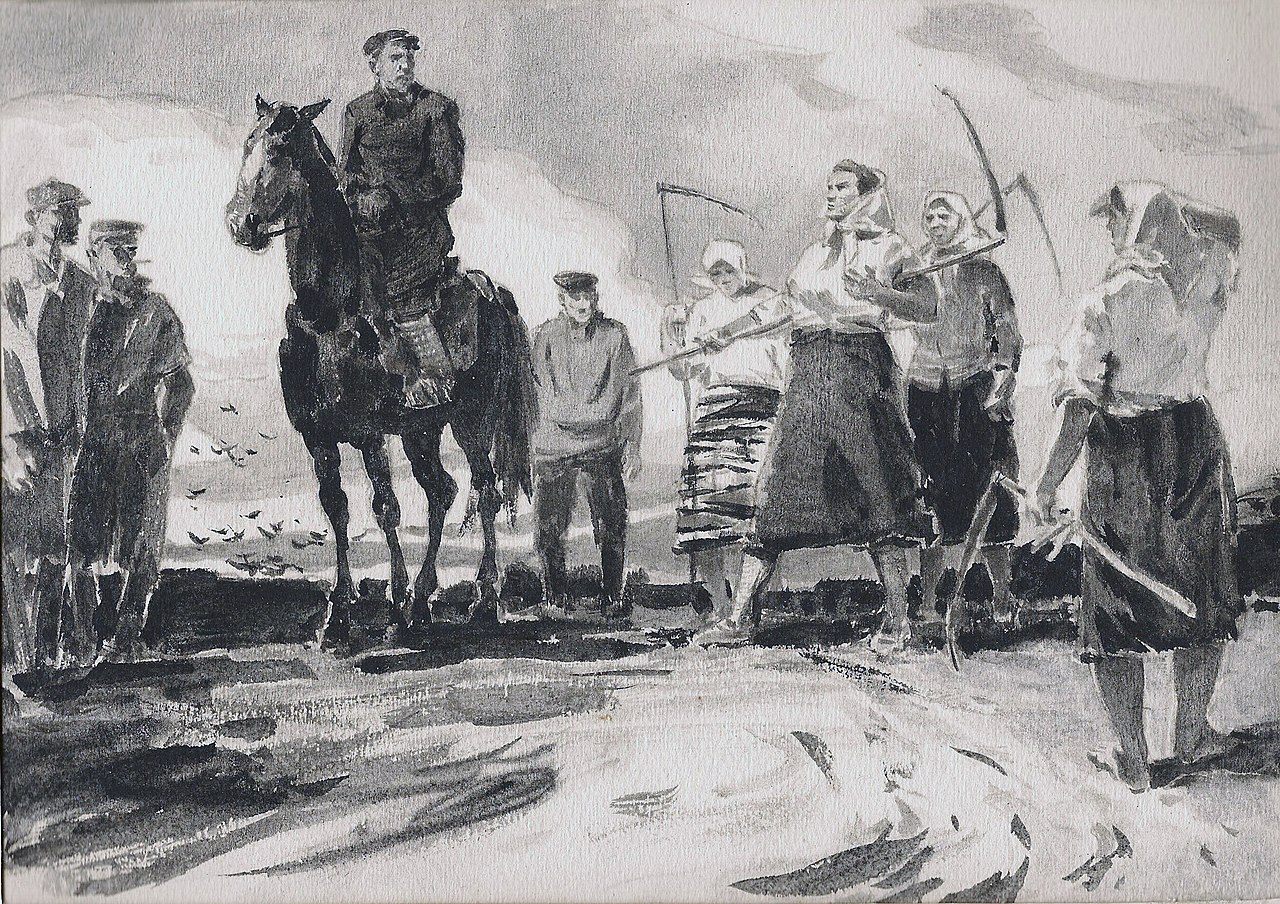
Художник Анатолий Викторович Борисов (1933—1969). Фотографии и сканы Михаила Тренихина. Из собрания Михаила Тренихина · CC BY-SA 4.0
- Born
- 19 December 1906
- Birthplace
- Bolshaya Lazovka, Tambov Governorate, Russian Empire
- Died
- 3 January 1976
- Place of death
- Moscow, Soviet Union
- Awards
- Stalin Prize first degree (1949, 1950), Stalin Prize first degree (1941, 1948).
- Nationality
- Soviet Union.
- Occupation
- journalist, screenwriter, writer, playwright, dramaturge and war correspondent.
- Fields
- creative and professional writing, prose, drama and war journalism.
- Education
- Lomonosov Moscow State University.
- Honours
- Stalin Prize, Medal For the Victory over Germany in the Great Patriotic War 1941–1945, Order of Lenin, Medal For the Defence of Leningrad and Medal For the Defence of Stalingrad.
- Languages
- Russian.
VALÉORINE Encyclopedia
VALÉORINE documentary reading
Documentary summary
Nikolai Yevgenyevich Virta (real name Karelsky) (December 19 1906 – January 3, 1976) was a Soviet writer who developed the theory of "conflictless" drama.
Admitted source layer · organised and presented by VALÉORINE
Reference Check
Propose documentary evidence for Nikolai Virta. A contribution is never written directly as fact: identity, source, rights and evidence gates still decide.
Sign in to contribute
World of VALÉORINE
Documentary connections
Only confirmed graph relationships appear here. Images are shown only when their identity and reuse rights both pass the documentary gate.
Documentary evidence
Documentary basis
Authority files
wikidata · Q862412 · wikipedia · Nikolai Virta
In this article
Biography
Biography
Nikolai Virta studied at Lomonosov Moscow State University. The recorded working language is Russian. The field of work recorded is creative and professional writing, prose and drama. Subjects and genres recorded for the work are short novel. Distinctions recorded are Stalin Prize, Medal "For the Victory over Germany in the Great Patriotic War 1941–1945", Order of Lenin and Medal "For the Defence of Leningrad".

Художник Анатолий Викторович Борисов (1933–1969). Дипломная работа. Иллюстрации и оформление книги «Крутые горы» Н.Е. Вирты. 1960. Собрание Михаила Тренихина
Художник Анатолий Викторович Борисов (1933—1969). Фотографии и сканы Михаила Тренихина. Из собрания Михаила Тренихина

Художник Анатолий Викторович Борисов (1933–1969). Дипломная работа. Иллюстрации и оформление книги «Крутые горы» Н.Е. Вирты. 1960. Собрание Михаила Тренихина
Художник Анатолий Викторович Борисов (1933—1969). Фотографии и сканы Михаила Тренихина. Из собрания Михаила Тренихина
Key facts
Key facts
• Born — 19 December 1906 • Birthplace — Bolshaya Lazovka, Tambov Governorate, Russian Empire • Died — 3 January 1976 • Place of death — Moscow, Soviet Union • Awards — Stalin Prize first degree (1949, 1950), Stalin Prize first degree (1941, 1948).
Biography
Biography
Nikolai Virta was born in the village of Bolshaya Lazovka in Tambov Governorate, into the family of a village priest who was shot in 1921 as a supporter of Aleksandr Antonov. From 1923 he worked as a reporter for newspapers and radio, and after 1930, he lived in Moscow. He took his writer name Virta (Finnish for "stream") as a reference to his Karelian forefathers. He won fame with his 1935 novel Odinochestvo (Alone), which he used as the basis for his play Zemlya (Earth, 1937). He was awarded the Stalin Prize for the novel in 1941, as well as for his plays Khleb nash nashushchny (Our Daily Bread) in 1948 and Zagovor obrechennykh (Conspiracy of the Condemned, a "virulently anti-American drama") in 1949, and for his script for the film Stalingradskaya bitva (The battle of Stalingrad) in 1950. He later turned his 1956 novel Krutye gory (Steep Hills) into the play Dali dal'nye, ne oglyadnye (1957). In 1943, Joseph Stalin decided to allow publication of the Bible in Russia, and Virta was chosen as the censor for the project; he decided there were no deviations from Communist ideology and passed it without alteration. In 1954, as the result of a scandal, he was excluded from the Writers' Union, but he was reinstated in 1956. In describing the "nadir of the Soviet theatre" between World War II and the death of Stalin, Michael Glenny writes: Matters reached the depth of absurdity when one of the most compliant Stalinist playwrights, Nikolay Virta, propounded the theory of 'lack of conflict'. According to this, the only possible basis of drama for a Soviet play was the struggle between the 'good' and the 'better'. The resulting plays were so abysmal that even the party was forced to disown them. Kornei Chukovsky described Virta as follows in his diary entry for October 19, 1941: But morally suspect as he is, there is something endearing about him: he hasn't read a thing and doesn't care for poetry, music, or nature, yet he is hardworking, tireless in his machinations (and not only when they're for his own good), not without literary ability (some of his newspaper reports are very well written). It's just that he's a predatory type by nature. He adores things—fancy clothes, fine furniture, rich food—and power.
English translations
English translations
• Alone, Foreign Languages Publishing House, 1950.
Identity
Identity
Nikolai Virta is recorded as having received Stalin Prize, Medal "For the Victory over Germany in the Great Patriotic War 1941–1945" and Order of Lenin.
Life and career
Dated record
Life and career
The full dated record · 2 entries
1906
Nikolai Virta born.
1976
Nikolai Virta died at Moscow.
Where the work is held
Recognition and collections
Nikolai Virta received Stalin Prize, Medal "For the Victory over Germany in the Great Patriotic War 1941–1945", Order of Lenin, Medal "For the Defence of Leningrad", Medal "For the Defence of Stalingrad" and Medal "In Commemoration of the 800th Anniversary of Moscow".
References
Citations
References
Each reference names the institution holding it, so a reader may go to the document itself.
reference work
Secondary witnessreference work
Secondary witness
People, houses and institutions
Knowledge graph
People, houses and institutions
Teachers, collaborators, publishers and institutions recorded against this person, each on a stated basis.
Died at
1- MoscowPlace
Established from a fact already recorded on a verified source.
Distinctions
1- Order of LeninTerminology
Established from a fact already recorded on a verified source.
Further particulars
Held on the record
Further particulars
Open the remaining particulars
He also worked under the name Николай Вирта. The authorities additionally record the headings Nikolaj Evgenʹevič Virta and Nikolai Yevgenyevich Virta. His recorded language was Russian. One child is recorded: Tatyana Virta. Virta worked in creative and professional writing, prose, drama and war journalism. He belonged to USSR Union of Writers.
Identity and origins
Career and activity
The Encyclopedia exists whether or not anything is for sale. Corrections are recorded rather than overwritten, and every version of this record is kept. Published 16 August 2026.
Elsewhere in Books
39,529 published records in this field, each with its sources named.
- Nikolai TeleshovAuthor
- Nikolai TikhonovAuthor
- Nikolai TrubetzkoyAuthor
- Nikolai UspenskyAuthor
- Nikolai YutAuthor
- Nikolai ZlatovratskyAuthor
- Nikolaj Aleksandrovič Serno-Solov'evičAuthor
- Nikolaj Frederik Severin GrundtvigAuthor
Best supported in this field
For owners
Own a work by Nikolai Virta?
A specialist will read what you send and tell you what the house can establish, what it cannot, and whether the object is suited to sale. There is no charge and no obligation. The object stays with you throughout; nothing is shipped to us unless it is arranged in writing beforehand.